
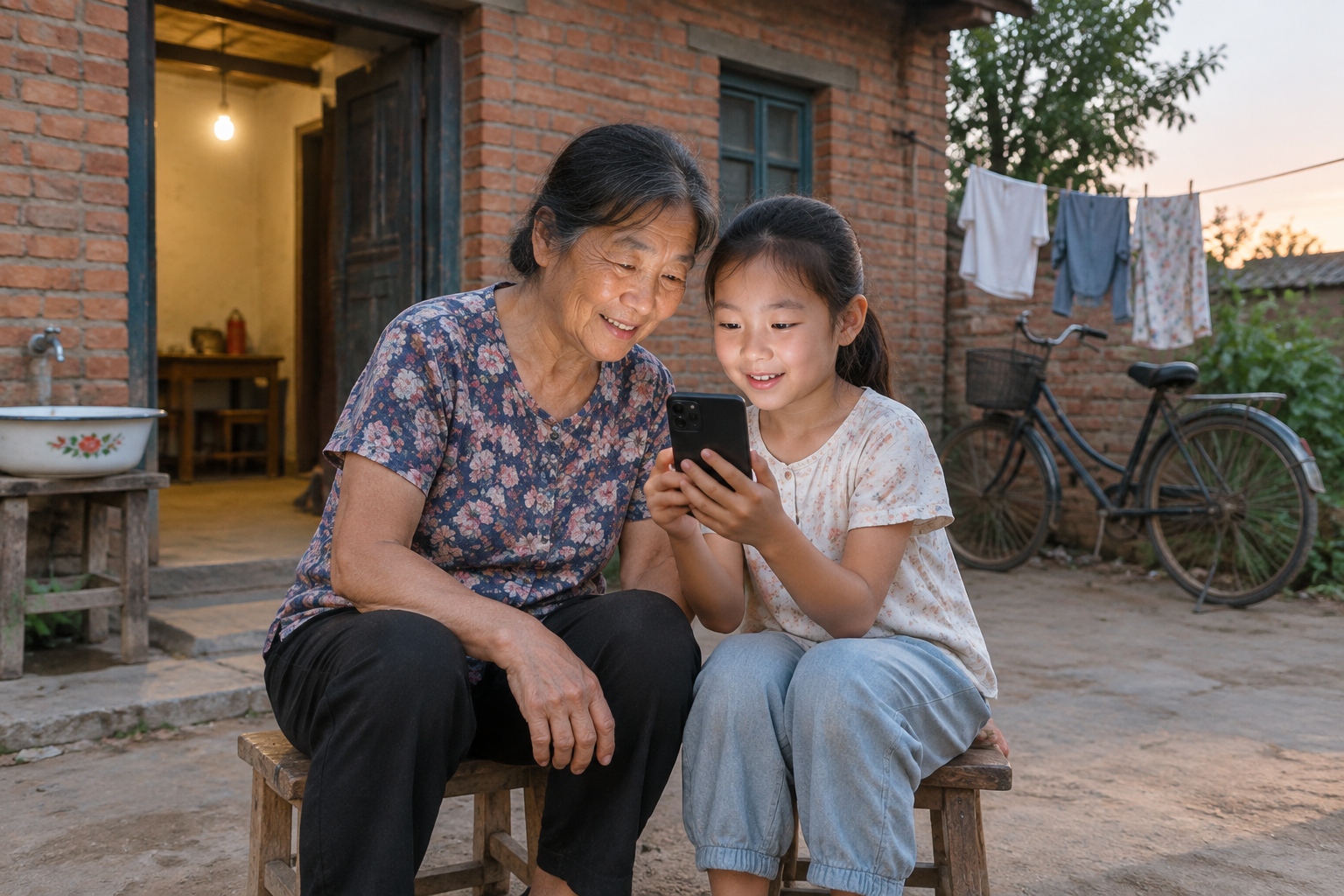

Two kitchen tables, 1,400 kilometres apart
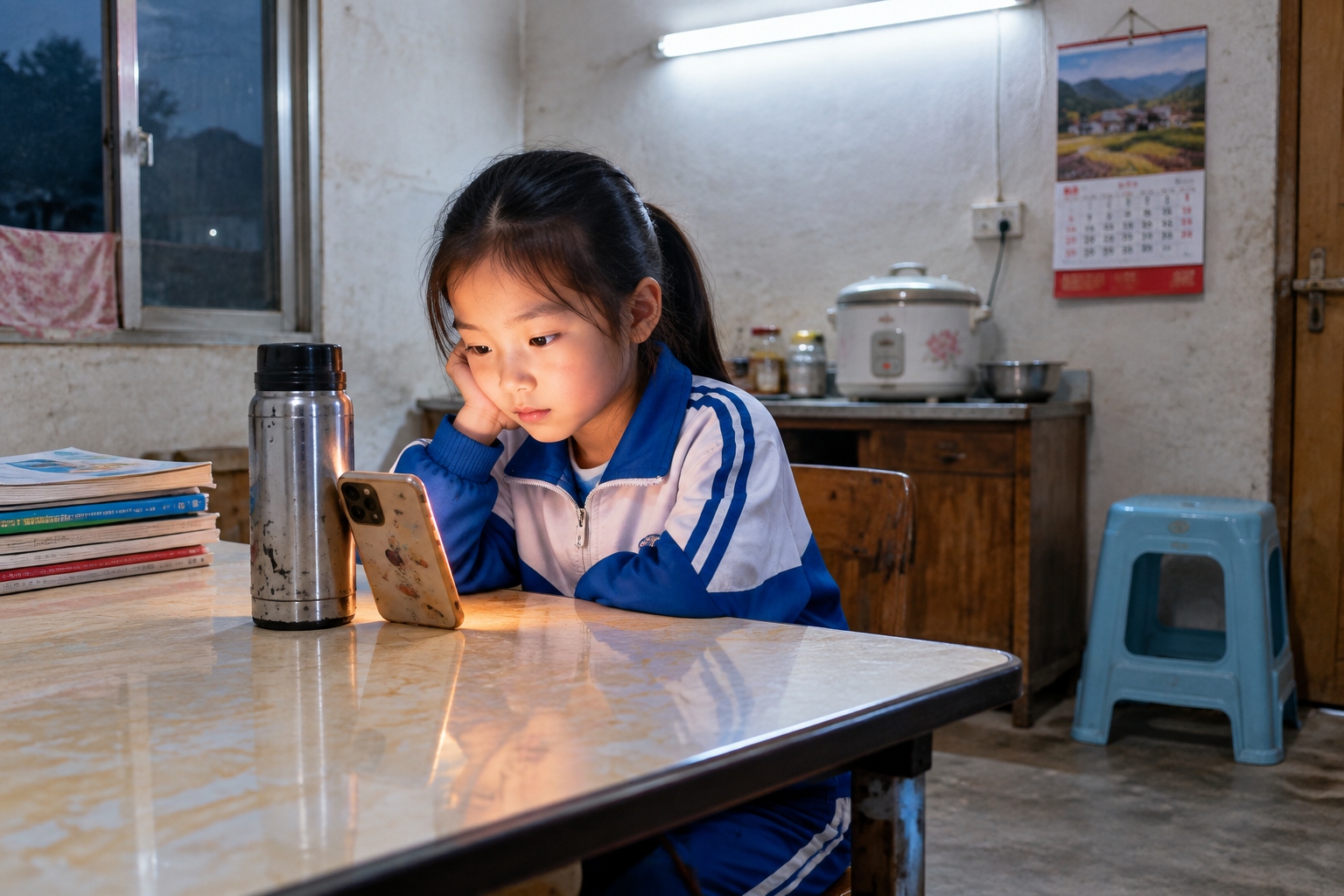
At 8:40 on a Tuesday evening in a village outside Zhoukou, in eastern Henan province, nine-year-old Yuxin props her grandmother’s phone against a chipped steel thermos on the kitchen table and waits for the screen to light. A single fluorescent tube hums overhead. Her mother is 1,400 kilometres south in Dongguan, Guangdong, sewing sleeve seams in a garment factory, and she has been there for six years.
“Have you eaten?” her mother asks. “Yes.” “Homework finished?” “Yes.” Then neither of them says much. Yuxin tilts the phone so her mother can see the room behind her: a wall calendar, a rice cooker, her grandmother’s back at the sink. The call lasts eleven minutes. Her mother is on the early shift and has to be asleep by ten.
At roughly the same hour on the eastern edge of Beijing, twelve-year-old Haoran is sitting at a very similar table with his mother three feet away — not on a screen. She is slicing cucumber for tomorrow’s lunch. He has lived in the capital since he was four, speaks with a Beijing accent, and has never spent more than two weeks in the Anhui village where his household is registered. Under current rules, he cannot sit the high school entrance exam here. When he finishes ninth grade, he will probably board a train south, alone.
The children in this article have been given pseudonyms, and some identifying details have been changed at their families’ request.
The two labels, and the system behind them
Chinese policy and academic research sort these families into two groups. Liushou ertong (留守儿童), usually translated as “left-behind children,” are children who stay in their home village while one or both parents work in a city, most often cared for by grandparents. Liudong ertong (流动儿童), “migrant children” or “floating children,” are children who move to the city with their parents but keep their household registration somewhere else.
Both categories exist because of hukou, the household registration system. A family’s hukou is tied to a place, and that place determines access to local public schools, some health services and social benefits. When a factory opens a thousand kilometres away, parents have to choose: bring the child and fight for a school seat in a city that does not consider them local, or leave the child with family and send money home. Millions do the second.
How many? It depends on the definition, which is why the numbers vary so wildly. China’s 2010 census counted about 61 million rural children with at least one parent working away. A much narrower official definition used in 2016 — children under 16 with both parents away, or one parent away and the other unable to care for them — produced a count of about 9 million, falling to just under 7 million by 2018. Researchers reading the 2020 census with a broader definition put the figure closer to 40 million. On the other side of the ledger, the same census found roughly 70 million children under 18 living outside the district where their household was registered.
The two labels are not opposites. They are two stages of one family strategy, and children move from one to the other — and back — as circumstances change.
Two rooms, two kinds of missing
Yuxin’s school day starts at 7:50 and ends at 4:30. Her grandmother cooks, keeps the house, and cannot help with English. Yuxin’s mother calls most Sundays, and on weekday evenings when the shift allows. What Yuxin says she misses is not the idea of a mother but specific things: being woken up, her mother’s handwriting in the margin of her homework, someone to sit with her when there is thunder.
The absence is also measured in money: about 3,000 yuan sent home each month, which covers school fees, clothing, and the medical bills her grandmother does not always mention.
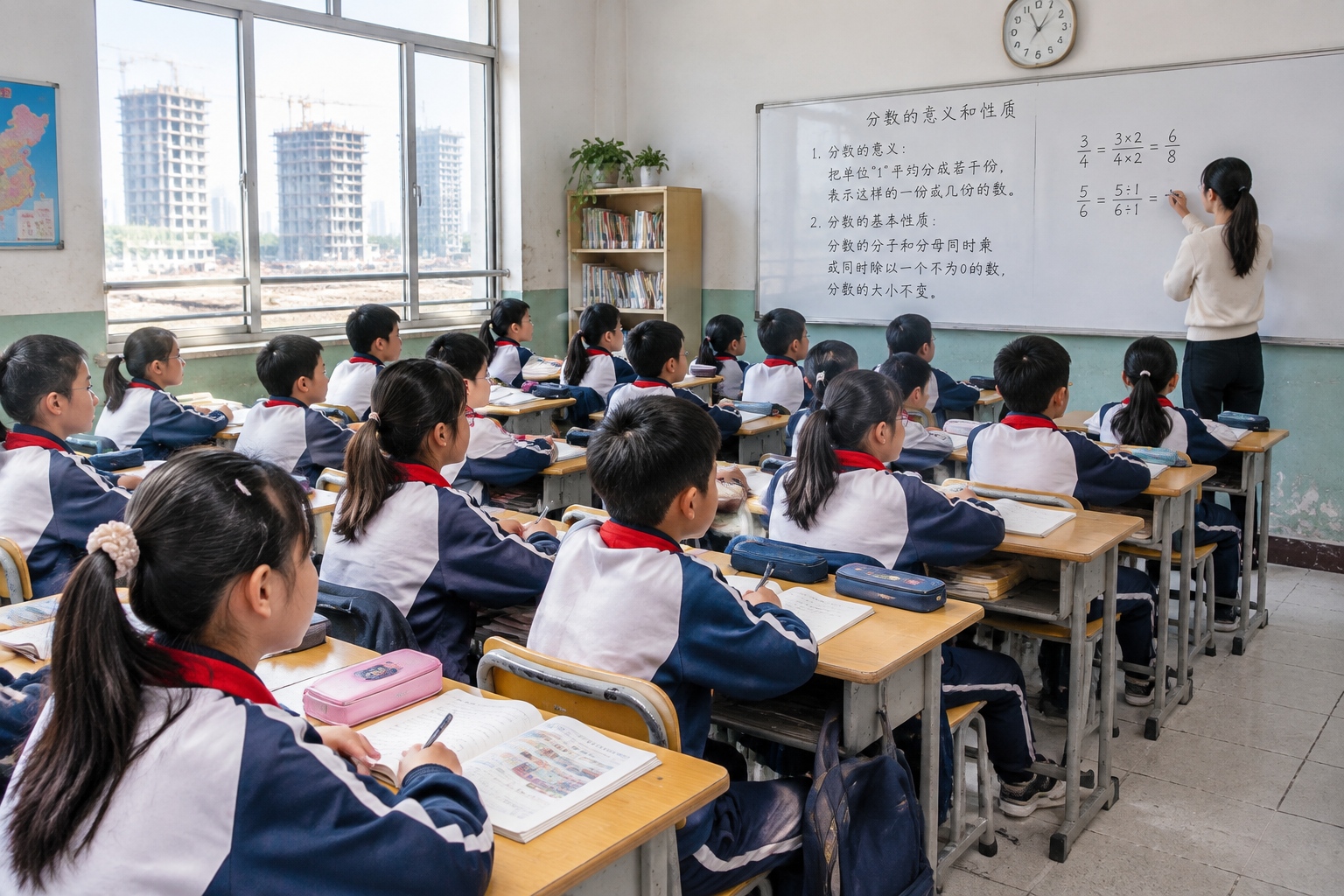
Haoran’s problem is different. His parents are with him, and that matters — his mother notices when he goes quiet, his father takes him to the evening market on Sundays. But the family rents a one-bedroom flat outside the fifth ring road for 2,300 yuan a month, roughly a third of what his parents bring in, and they still send 1,000 yuan a month to his grandmother in Anhui. His school occupies a converted three-storey building; there are 44 children in a classroom built for 30, and teachers leave every year for public schools that pay more. He is one of the luckier ones. Many children in his position attend schools with no library, no laboratory, and no clear path to a local high school.
What separation does — and what the evidence can’t settle
Two decades of research have tried to measure the cost of this arrangement, and the honest answer is that it is complicated. Some large studies find higher rates of depression and anxiety, and lower academic scores, among left-behind children. Others find the gap shrinks or disappears once family income and the quality of the caregiver are taken into account. In other words, a child whose parents earn more by leaving may be better off materially and worse off emotionally at the same time.
Three things show up consistently, both in the research and in what children describe:
- Age matters. Separation before a child turns three appears to have the longest-lasting effect on attachment. That is often exactly when parents migrate, because that is when a grandmother can still carry a baby.
- Who stays matters more than whether someone stays. A warm, stable grandparent softens a great deal. A relative who took the child in out of obligation does not.
- A video call is not a presence. A parent on a screen can check homework and ask whether a child is being bullied. A parent in the room can comfort. Children of every age describe the difference.
Migrant children carry a different weight. Children who grew up in the city often have to leave it at 15 to sit the high school entrance exam where their hukou is registered. Researchers call it “return migration”: a teenager who has spent a decade in Shanghai or Beijing is sent back to a village school, sometimes to grandparents he barely knows, and becomes, statistically, a left-behind child. The category can be entered in either direction.
What policy has actually done
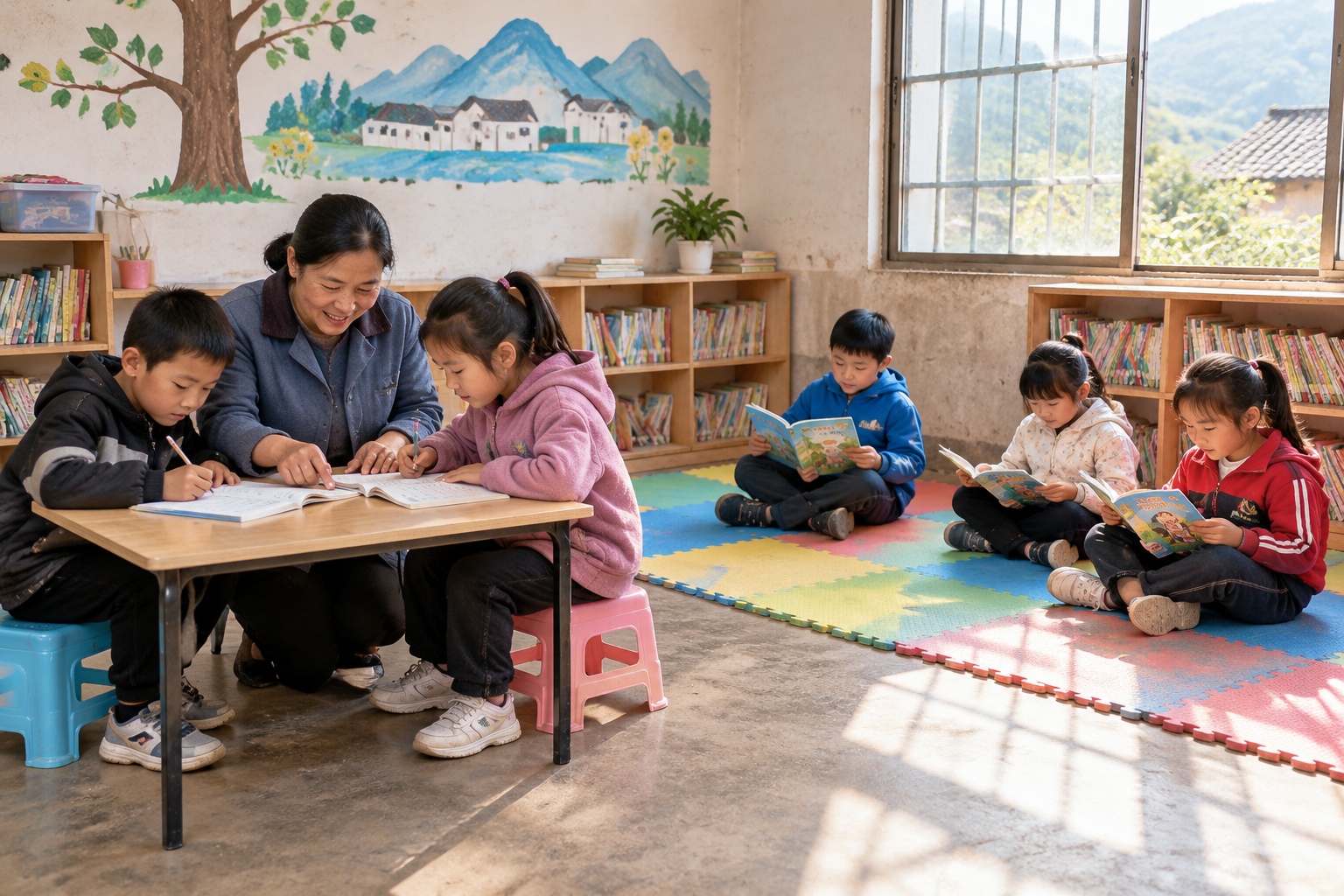
The turning point was 2016, when the State Council issued its first national guidance on protecting rural left-behind children. It required a nationwide registration, which produced the 9 million figure; it made village-level monitoring a formal duty; and it pushed the creation of ertong zhi jia — children’s rooms — in villages. Tens of thousands now exist, though quality ranges from a well-stocked after-school room with a paid staff member to a locked door with a sign on it.
Non-profits filled some gaps. The Tongban Mama (“Companion Mom”) programme, run by the China Foundation for Rural Development since 2015, hires and trains a local woman — usually a mother herself — to visit every child in her village at least once a month. It now operates in hundreds of villages across provinces including Guizhou, Jiangxi and Yunnan. It is not a substitute for a parent. Volunteers say it is often the difference between a child being noticed and not.
On schooling, the guiding principle since 2001 has been “two mainly”: city governments are mainly responsible, and public schools should be the main providers. The extra “borrowed-study” fees that city schools once charged migrant families were formally scrapped in the late 2000s, and by the education ministry’s own accounting, more than 80 percent of migrant children in compulsory education now attend public schools. The caveat is that the largest and most attractive cities remain the hardest to enter, and a public school seat is not the same thing as the right to sit a local exam.
Hukou reform has moved, unevenly. Since 2022, cities with fewer than three million urban residents have been required to remove all restrictions on transferring registration, and cities between three and five million have relaxed theirs. That has helped places like Zhengzhou, Changsha and Guiyang. It has not changed Beijing, Shanghai or Guangzhou, where the jobs and the best schools are.
Shorter distances, the same arithmetic
Some of the change is happening without policy. Manufacturing has moved inland over the past fifteen years, and a parent who once had to travel 1,400 kilometres can now sometimes find work 90 kilometres away and come home on Sunday. Henan, Sichuan and Guizhou have built industrial parks in counties that used to export all of their labour.
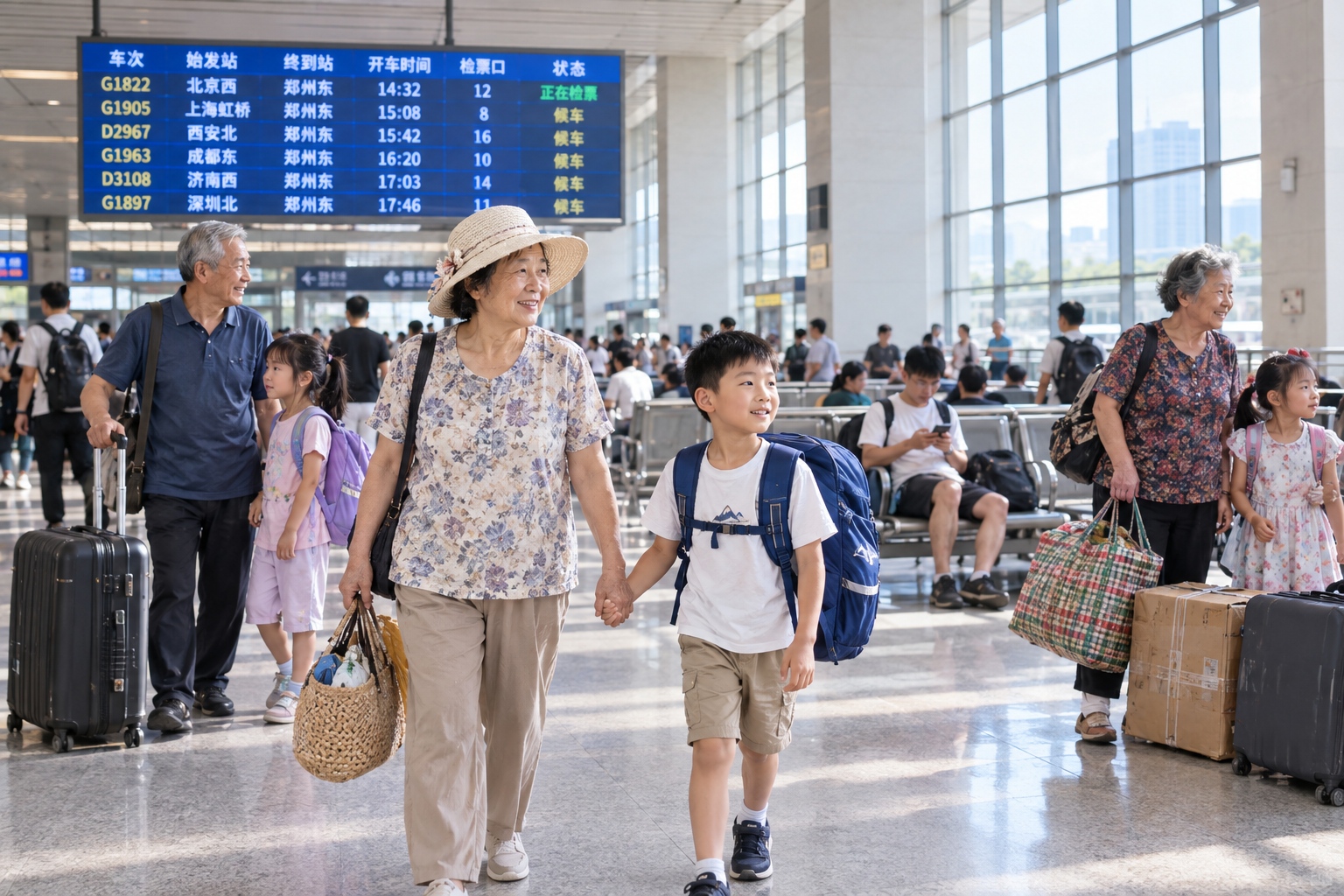
Every July, railway stations in cities like Zhengzhou and Chengdu fill with what the Chinese press calls “little migratory birds” — children travelling alone or with grandparents to spend the summer break with their parents. Station staff escort them between platforms. In August, they go back.
There is a newer pattern too: families who buy an apartment in the county seat so the child can attend a better school there. The mother moves into the county flat; the father stays in the city where wages are higher. The child no longer counts as left-behind under any official definition, but the household still has three addresses.
Back in the village outside Zhoukou, Yuxin’s mother is doing arithmetic that millions of parents are doing at the same moment. A new electronics assembly plant 40 minutes away is hiring, at around 4,200 yuan a month. In Dongguan she earns 6,000 and sees her daughter twice a year. She has not decided. Yuxin does not know the question is on the table.
On the doorframe of the front room, next to the calendar, there is a row of pencil marks recording her height on each birthday. Her mother has seen the last three of them only in photographs.
Start the discussion at forum.chinacomes.com