


On a Park Bench in Shanghai
On a mild Monday evening in Shanghai, a 30-year-old expat from the UK sat on a bench in the French Concession, staring at his phone. He had been in China for nine months. His job was going well, and he had a circle of friends, but a grey weight in his chest never seemed to lift. He asked himself the same questions many foreigners at that moment would ask: Is there a therapist who speaks English? Can I just go to a hospital? How much will this cost? And if I am in real trouble, who do I call?
A Rapidly Growing Field
For a long time, mental health in China was rarely discussed in public. Economic growth and urban stress have changed the conversation. In Beijing, Shanghai, Guangzhou and Shenzhen, counseling is becoming a normal part of self-care. Bilingual therapists, expat-aimed clinics, and psychological hotlines now exist in every major city. There are also new national standards for counseling training, a deliberate response to a growing demand.
For a foreigner, the legal side is simple: you can see any licensed professional you wish. The harder part is knowing who to see and where to book. This guide breaks down the steps so you can get the right help without endless guesswork.

Counselor, Psychologist or Psychiatrist: What Is the Difference?
The titles in China can be confusing, even for locals.
A counselor (心理咨询师, xinli zixun shi) is usually trained to give supportive therapy. The old national counselor certificate was discontinued in 2017, and now many counselors come from psychology, social work or clinical training programs. In practice, independent counselors focus on life stress, relationships and mild anxiety or depression.
A psychotherapist (心理治疗师, xinli zhiliao shi) is more medical-oriented. They often work in hospitals or clinics and use structured methods like cognitive behavioral therapy to treat mood disorders.
A psychiatrist (精神科医生, jingshenke yisheng) is a medical doctor with full authority to diagnose mental illness and prescribe medication. If you have symptoms such as persistent low mood, panic attacks, insomnia or intrusive thoughts, it is safer to start with a psychiatrist. For short-term stress or adjustment problems, a counselor may be enough.
There is also a growing number of TCM-based approaches and psychological support in the community. You can always switch if the first professional is not the right fit.
How and Where to Find a Professional
Public Hospital Psychiatric Outpatient Departments
Every large city has psychiatric hospitals or general hospitals with psychology departments. Two of the most well-known are Beijing Anding Hospital and Shanghai Mental Health Center. These are also teaching hospitals, meaning you might see a junior doctor under supervision. Booking is usually through a hospital’s WeChat official account or a phone booking hotline. The consultation fee is low (often between 20 and 100 RMB), but the waiting room can be crowded and the appointment short. If you do not speak Chinese fluently, hospitals with an international clinic are your best option, such as the International Medical Center at Beijing United Family Hospital or Shanghai East International Medical Center.
Private Counseling Clinics
For expats, private clinics are often the least stressful choice. They offer in-depth assessments, flexible appointment times and consistent treatment. Clinics in the Shanghai and Beijing expat districts may specialise in cross-cultural issues, expat partners, and trauma. You can find them by asking your HR department, searching on That’s Shanghai or SmartShanghai, or using referral networks. A second session with a bilingual private counselor includes treatment planning and sometimes psychological testing.
Online Therapy Platforms
If you live outside a big city or prefer home messaging, online therapy platforms are a good first step. Domestic services include 简单心理 (Jiandan Xinli), 壹心理 (Yi Xinli), and 好心情 (Hao Xin Qing). Some of these sites have multilingual interfaces. Most have a database of licensed therapists and allow you to filter by language. During the pandemic, many private practitioners moved online, and some still offer a hybrid format. It is vital to check whether online sessions are sufficient for you or if you need in-person care.
Quality of Care, Credentials and the Language Barrier
China does not yet have a single national licensing law for talk therapists, so quality varies. Here are a few questions to ask before you book:
What qualifications do you hold? Are you a licensed medical doctor? How many years have you worked with international clients? Do you have supervision? Keep in mind that a title alone is not a guarantee. You have to trust your own feeling as well. A good first session should include a clear rationale for how you will work together and some immediate coping strategies. If you are not impressed, move on.
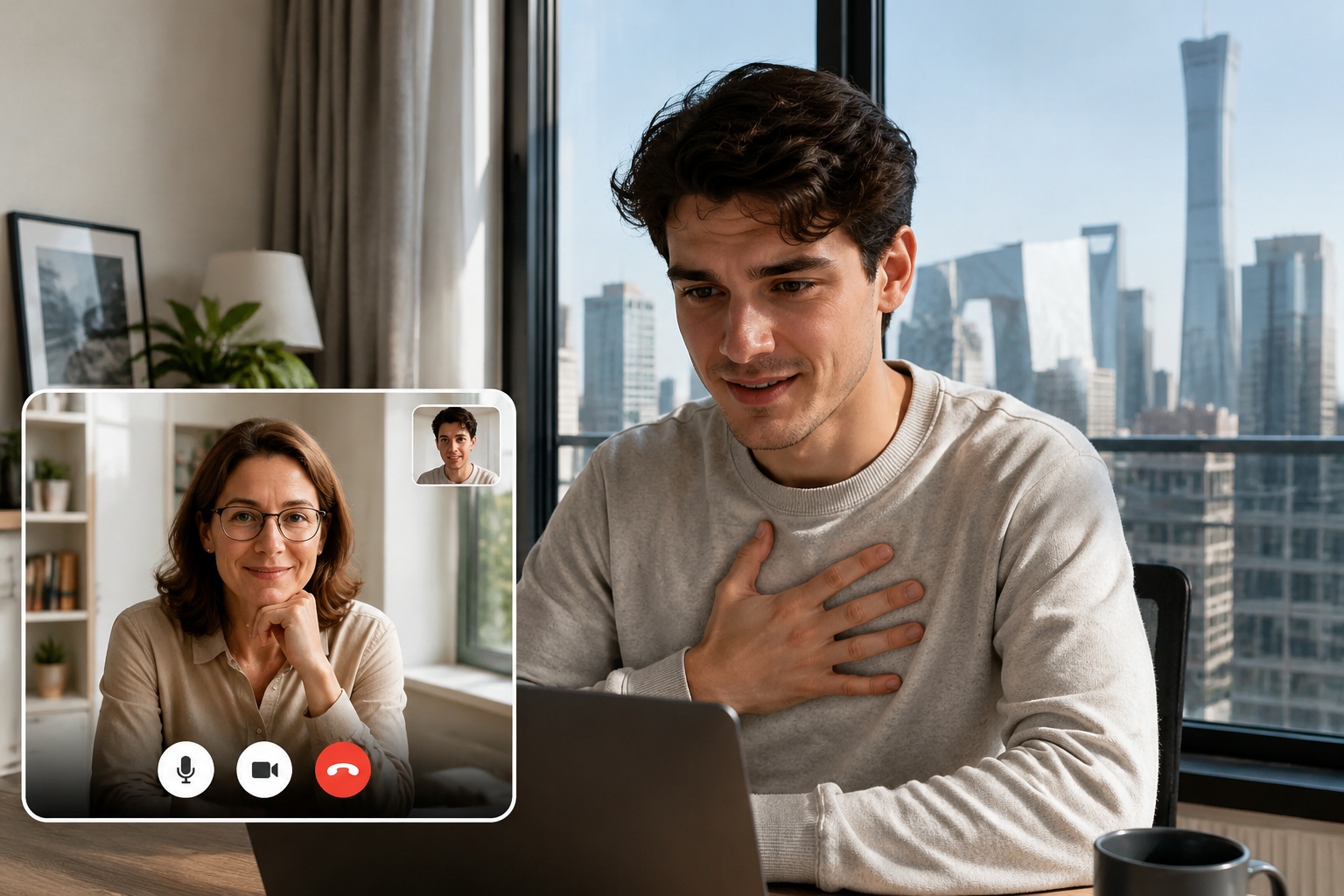
Many expats solve the language problem by seeing a bilingual therapist in China. Another common route is to see an online therapist based in your home country. This works if time zones and fees allow. For English-speaking psychiatrists, the choice is much smaller, but expat-focused hospital international departments usually have access to psychiatrists who speak English.
Online Therapy and Rules Across Provinces
Telehealth became popular in China long before the pandemic. Psychiatrists and counselors are allowed to offer online consultations, but there are important boundaries. In general, a doctor may only prescribe medication after an in-person consultation. For talk therapy alone, remote sessions across cities are widely accepted. As a patient, you have to judge whether online care is safe for you. If you are experiencing suicidal thoughts, self-harm or severe substance problems, it is never a reason to avoid going to a hospital emergency room.
What It Costs and How to Pay
Costs vary considerably, and this data is only a snapshot. In public hospitals, a psychiatrist consultation is in the range of 20 to 100 RMB, but this does not include possible psychotherapy sessions, which can be 150–500 RMB per session. Private bilingual counselors charge anywhere from 500 to 1,500 RMB per 50-minute session. Online platforms are often cheaper, with some introductory sessions starting from 200 RMB. High-end expat clinics may charge 2,000 RMB for the first assessment.
Chinese public health insurance is built for people who contribute to the local scheme. If you are employed by a Chinese company, you might be eligible. For expats, most international insurance plans include mental health treatment. Before you travel, look for a policy that explicitly covers outpatient psychiatry and psychotherapy in China. Some insurers reimburse you when you pay out of pocket, so always request detailed receipts. It is also smart to ask the clinic directly if they accept your insurance or if they can issue invoices for reimbursement.
Since prices change, this guide cannot be used as a fixed price list. Always contact the clinic or hospital before you schedule to confirm their current rates and whether they accept insurance.
If You Are in Crisis Right Now
If you are in immediate danger, call 120 and say “psychiatric emergency” if you can. You can also go directly to the emergency department of any large hospital.
For a mental health crisis but not immediate danger, call the national psychological support hotline: 12356. This line was introduced as a free, 24-hour service across many provinces in China starting 2025. If it is not yet active where you live, use the Beijing Crisis Intervention and Research Center hotline at 010-82951332. In Shanghai, Lifeline Shanghai can be reached at 021-6120-1200 and is run by English-speaking volunteers. Store these numbers in your phone now. You never know when you or a friend may need them.
Small Steps Matter
Seeking help in a foreign country takes courage. The Chinese mental health system is far from perfect, but it is expanding rapidly, and more expats are finding quality support every year. Start with a simple online inquiry, ask questions, and give yourself credit for pressing send. That first step is the most important one.
Start the discussion at forum.chinacomes.com