

6:40 a.m. at Pudong, and Nobody Is Asking About the Bund
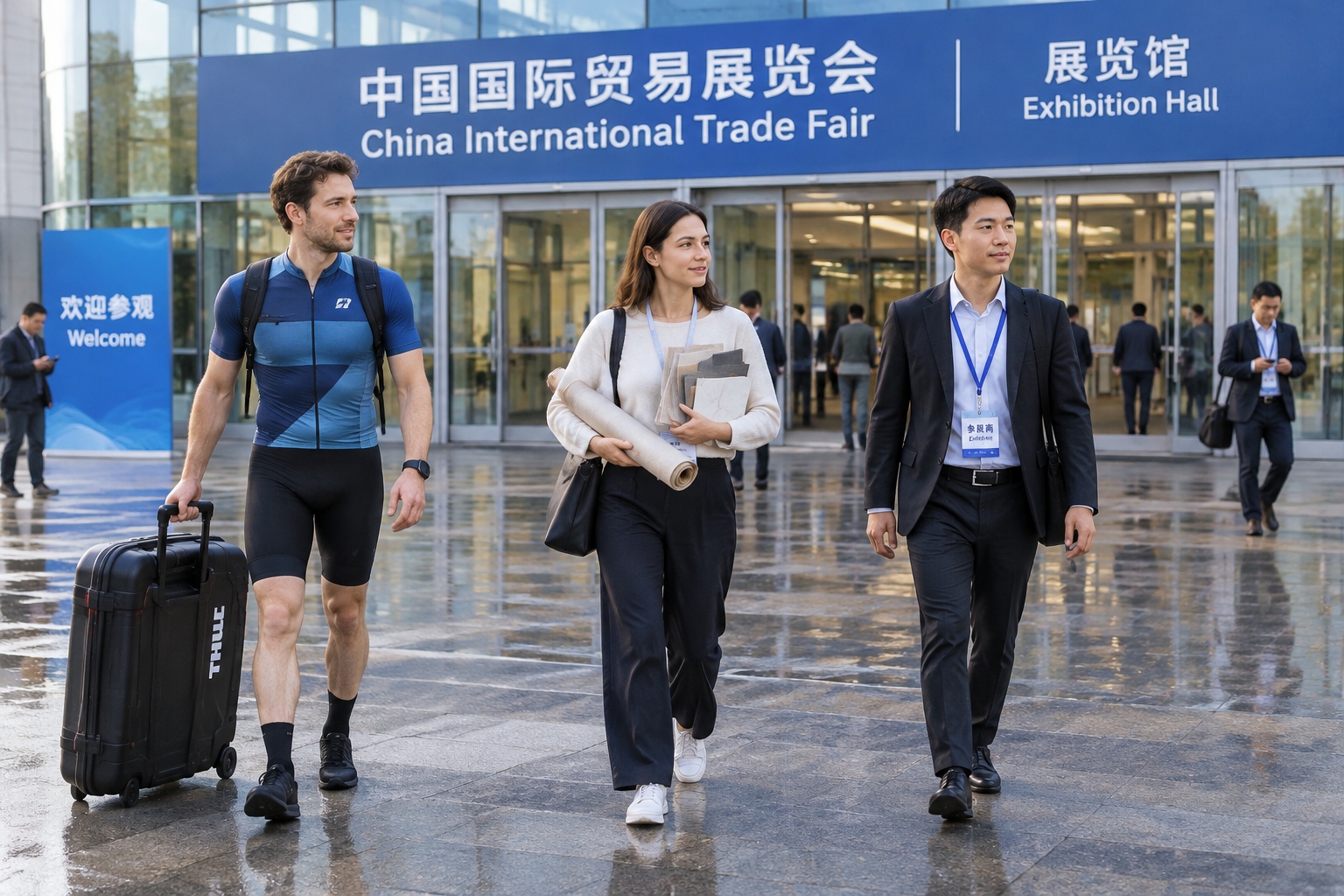
The bike box comes off the carousel sideways, which tells you the flight was full. A man in a Lycra jersey and compression socks drags it upright, crouches to check the derailleur hanger through the cardboard, and lets out a breath. Three belts over, a woman is re-taping bubble wrap around what looks like a stack of ceramic tiles. She already has a lanyard on — not from this flight, from the last one.
Nobody in this corner of the arrivals hall is looking up tourist attractions on their phone. One of them is heading to a cycling event at a reservoir four hours away by high-speed train. The other has a booth to build in 36 hours and a container to fill before Friday.
Over the past two years, this kind of arrival has become ordinary. China’s inbound leisure tourism has come back unevenly, but a different lane has filled up faster: people who fly in for a specific, dated, non-negotiable reason — a race bib, a booth number, an appointment at a factory gate.
Who Actually Gets on the Plane
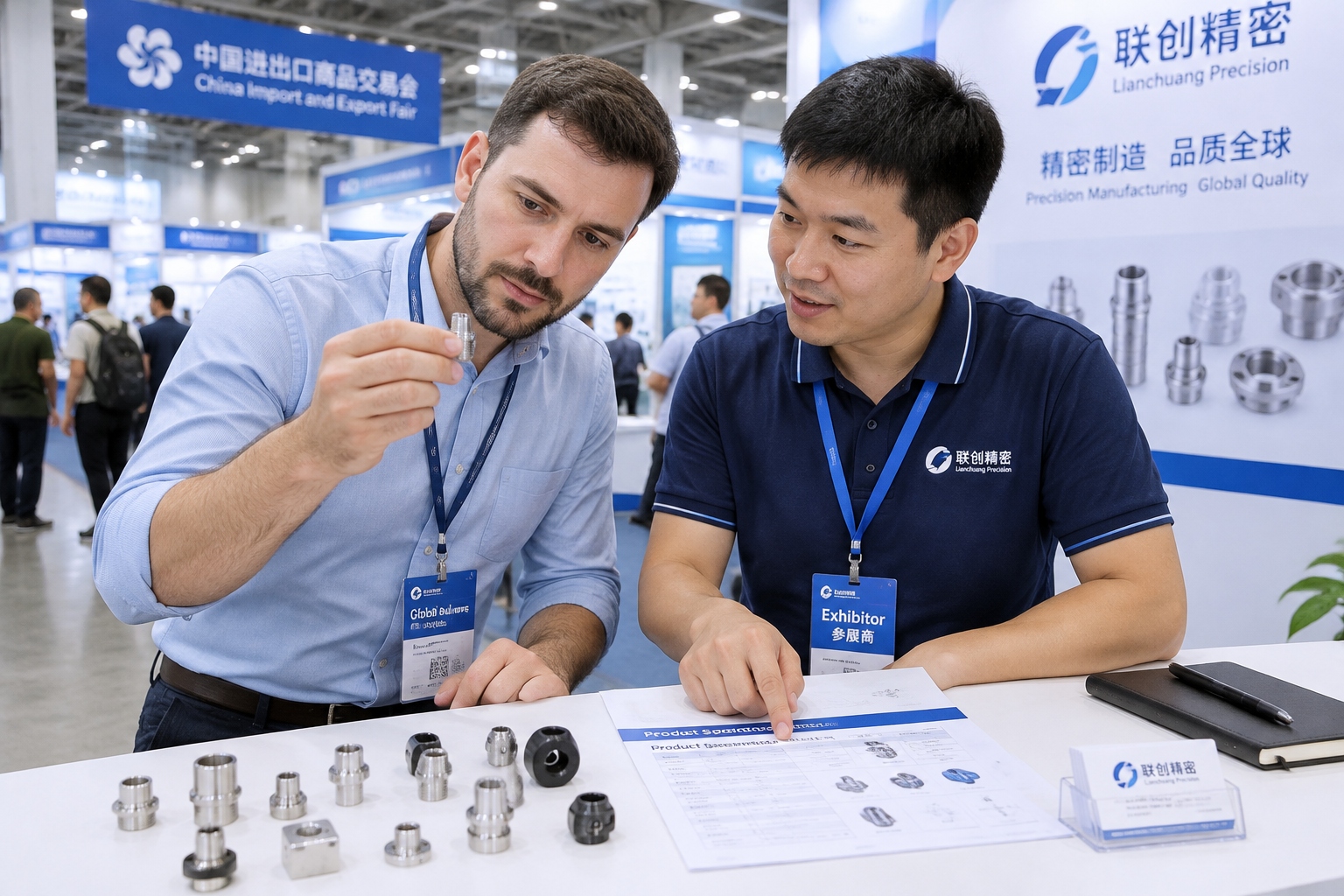
They fall into a handful of recognizable groups. Amateur endurance athletes — marathoners, trail runners, cyclists, triathletes — chasing races that sell out in hours, from city marathons to mountain ultras in Yunnan and Chongli. E-sports players and fans, following a tournament calendar that now regularly routes through Shanghai, Chengdu and Shenzhen. Makers and hardware people, the kind who land in Shenzhen with a laptop, a problem, and a three-day window to solve it. Craft and design exhibitors — ceramicists, textile designers, small furniture studios — who pay for a table at a fair because the buyers walk past it. And buyers: sourcing agents, category managers, people from small import businesses in Europe or Latin America who need to touch the product before they commit to 5,000 units.
What they share is that the trip has a deadline baked into it. A sightseeing tour is a ten-day loop you could stretch or shorten. A trade show is three days and then the lights go off. A marathon starts at 7 a.m. whether you slept or not. That structure changes the whole texture of a visit — you’re not consuming a country, you’re operating inside it.
Why China: Density Is the Product
The simplest explanation is volume. In 2019, China staged more than 1,800 road races with over seven million participants; even after the pandemic pause, the calendar refilled within about eighteen months. The Canton Fair in Guangzhou runs twice a year and draws roughly 200,000 buyers from more than 200 countries per session. Yiwu’s wholesale market spreads some 70,000 stalls across five connected buildings — you can walk from Christmas ornaments to dental floss in twenty minutes and negotiate both in the same afternoon.
For anyone in hardware, the attraction is even more concrete. A small brand in the Netherlands that wants to change a housing, a battery contact and a packaging insert might spend six weeks emailing three suppliers in two countries. Around Shenzhen and Dongguan, the printed-circuit board shop, the mold maker and the assembly line can be three buildings apart on the same street. A design change that takes a quarter elsewhere can be a Tuesday afternoon here.
That density isn’t automatically better — it comes with its own pressures, like minimum order quantities, intellectual-property worries, and a market where a competitor can copy you fast. But for a buyer or a maker, it collapses the distance between a question and an answer. You ask something at 9 a.m. and hold the answer at 4 p.m.
The First 48 Hours: What Speeds You Up, What Snags You
Entry has gotten easier in ways that are genuinely hard to overstate. China expanded its visa-free transit window to 240 hours across dozens of ports, and a long, shifting list of countries — much of Europe, Australia, New Zealand, Japan, South Korea, Malaysia and others — now has unilateral 30-day visa-free entry. High-speed rail covers more than 45,000 km; the 12306 booking app has an English interface that accepts a passport number.
Payments were the classic complaint and are now mostly solved. Alipay and WeChat Pay both link to foreign cards, with per-transaction limits raised to around $5,000 and an annual cap near $50,000 — enough for a hotel, a train ticket and a week of meals. A foreign card taps on the metro in most big cities. Ride-hailing works in English.
Then come the snags. Plenty of local services live inside mini-programs that assume a Chinese phone number for verification. Food delivery apps are Chinese-only at the interface level. Booking a museum slot or registering for a domestic race often means uploading a passport photo into a form that was designed for an 18-digit ID card. Translation apps handle maybe 85 percent of a conversation; the remaining 15 percent is where misunderstandings actually live.
After the Hall Closes
The part that tends to surprise first-timers isn’t the infrastructure — the trains and the payment QR codes are what everyone warns you about — it’s how quickly the trip turns social.
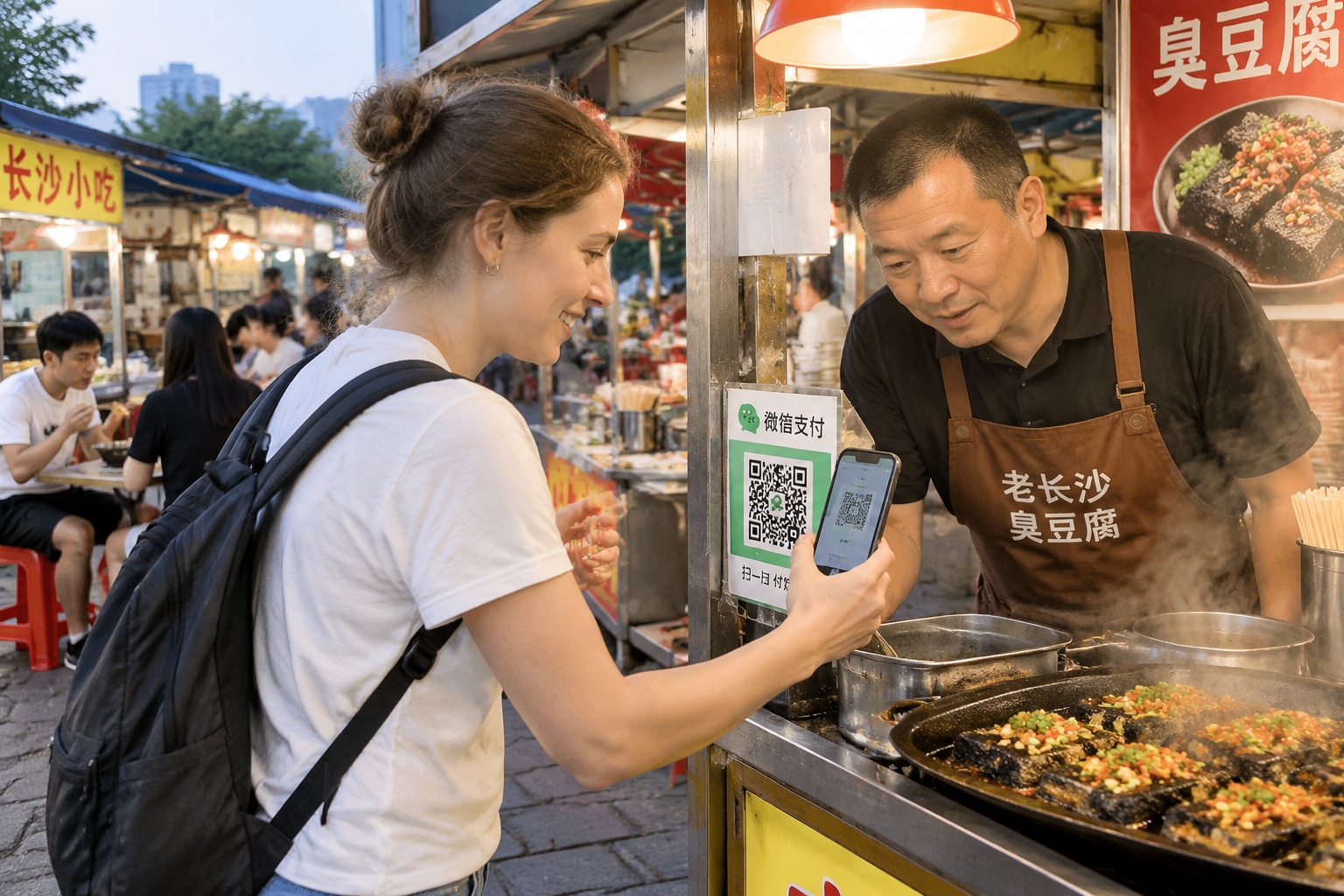
A buyer from Berlin finishes at a wholesale market in Guangzhou, walks two blocks to a night market, and pays a stall owner by scanning a code. She scans back. By the second night they’re exchanging WeChat messages, and three weeks later he sends a photo of next month’s stock. A foreign runner at a mid-size Chinese marathon gets lost looking for the shuttle bus and is walked there by a volunteer who is a nineteen-year-old nursing student practicing her English. In a park at 7:30 p.m., somebody’s grandmother waves a foreign visitor into the line dance, badly, and everyone laughs.
Coffee is a decent proxy for how much has changed. Shanghai alone is reported to have more than 9,000 coffee shops, more than any city in the world by some counts — and they’re working spaces, not postcards. It is entirely normal to see a Spanish designer and two Chinese suppliers around a small table at 10 p.m., arguing over a color swatch.

It’s Not One-Way Traffic
The easy framing is that foreigners come to look and Chinese people present. That’s not what it looks like on the ground. Running clubs in Chengdu actively seek out visiting coaches and experienced pacers, because amateur running exploded faster than the coaching base could. A factory engineer in Ningbo takes feedback from a Dutch designer and redraws a part three times until the hinge stops squeaking — and the fix ends up in that factory’s standard catalog. A café owner in Shanghai hosts a foreign exhibitor for an afternoon, and six months later is emailing about importing her beans.
The traffic goes out, too. Chinese marathoners fly to Berlin and Tokyo. Chinese craft brands book booths in Frankfurt and Milan. What’s actually happening is a two-way market where China is one node, not the destination at the end of the line.
The Parts That Are Still Annoying
It would be dishonest to file this under “everything works.” It doesn’t. Google, Instagram and WhatsApp need a workaround, and that is a real, everyday friction for visitors. Not every hotel is licensed to register foreign guests, so a cheap, well-located place may turn you away at check-in — a genuine annoyance with no equivalent in most of Europe. Cash is legally accepted but awkward in practice; small vendors may not have change. Some ticketing systems still break when the ID field expects a Chinese number. Outside the biggest cities, English thins out fast, and a hospital visit without a translator is a hard afternoon.
These are not dealbreakers for someone with a race number, but they shape the trip. Experienced visitors build in buffers: an extra hour at the station, a screenshot of the address in Chinese, a hotel booked through a chain that handles registration.
China as a Schedule, Not a Checklist
Here’s the useful thing about the race-and-trade-show crowd: they generate a kind of knowledge that guidebooks can’t. They know which station exit is closest to which hall. They know that a prototype takes three days, not three weeks. They know the difference between a city that has been polished for visitors and a city that is simply working.
For a reader planning a first trip, that suggests a different way in. Rather than building an itinerary around landmarks, find an event — a marathon in November, a design fair in spring, a sourcing week in Guangzhou — and build the trip around that. You’ll see less, and understand more. China is not primarily a list of places to look at. It is a schedule of things happening, most of them open to outsiders who show up with a reason.
Start the discussion at forum.chinacomes.com