
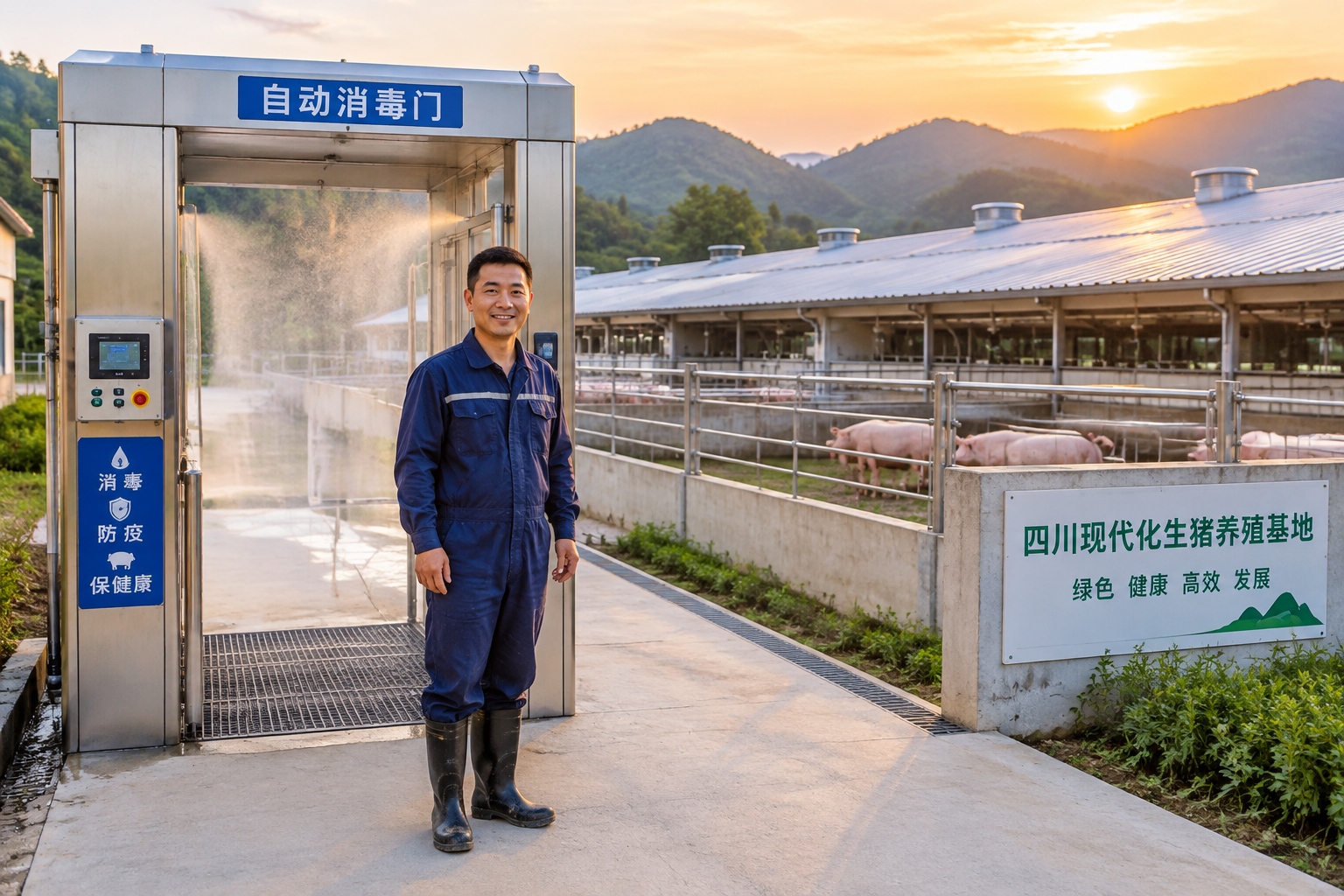

On a crisp morning in Guanghan, Sichuan, Wang Jie stands at the gate of her newly rebuilt pig barn, dipping her boots into a foam-filled disinfectant trough. “Last year, we used a hand sprayer,” she says, pointing to the automatic sensor sprayer above the entrance. This small upgrade is part of a larger overhaul that began after African swine fever (ASF) tore through her herd in 2019, killing most of her 200 pigs.
Wang is one of thousands of pig farmers in Sichuan, China’s top pig-breeding province, trying to recover from consecutive shocks. ASF first hit China in 2018, wiping out large numbers of pigs nationwide. Sichuan lost roughly a quarter of its herd at the peak, according to local agricultural authorities. Then came the market swings: hog prices surged as supplies fell, then fell sharply as herds recovered, and hit a trough in 2021-2022 that pushed many farmers into debt. For Wang and her neighbors, recovery is not just about restocking—it is about building resilience against both disease and price cycles.
The Long Road Back: Numbers That Tell the Story
According to China’s National Bureau of Statistics, the national hog inventory dropped to 310 million in 2019, a year-over-year decrease of 27.5%. Sichuan, which normally produces over 50 million pigs a year, saw its herd fall by around a quarter in the worst weeks. By late 2020, national inventory had recovered to 407 million; by 2021, it reached 449 million. But as supply returned, prices collapsed. The national average hog price peaked at over 40 yuan per kilogram in early 2021, then fell to around 18 yuan by late 2021, below the production cost for many farmers. This classic boom-bust cycle, accelerated by the disease shock, forced a rethink.
From interviews with farmers, veterinarians, and rural cooperative leaders across Sichuan, a clear set of strategies emerged. These are not textbook theories; they are tactics proven on the ground, working at different scales—whether a farmer has 30 sows or 1,000.
What Works: A Recovery Playbook
1. Treat Biosecurity as a Permanent Investment
Wang’s first step was to redesign her farm. The new single-entry system requires anyone entering to change boots and clothes, and to walk through a 30-second disinfectant bath. Vehicles are sprayed with a disinfectant gun. Fences separate each barn, reducing the risk of a single infection spreading. For smallholders, biosecurity does not have to be expensive. In nearby villages, farmers use lime powder and disinfectant mats at gateways. They also changed feed delivery—no more village-wide trucks driving from farm to farm. Instead, feed is delivered in sealed bags to a drop-off point.
Veterinarian Liu Yang, who serves several townships, says farmers who survived the ASF outbreak had two traits: strict hygiene and early culling. “When one pig showed symptoms, they did not wait for a test. They removed it immediately, along with adjacent animals. That’s harsh, but it protected the rest.”
2. Use Insurance and Subsidies as Safety Nets
China runs a national insurance program for breeding sows and fattening pigs. The government covers about 80% of the premium, so a farmer pays only a small share—roughly 20 yuan per sow annually. If a pig dies from disease, the insurer pays out, often 800 to 1,200 yuan for a sow. In Sichuan, these payouts helped many farmers cover feed costs during downtime. There are also subsidies for new barn construction and for buying high-genetic boars. Wang used a low-interest loan from a local bank, under a government-supported microloan program, to finance her new barn materials.
Zhang Fuquan, a farmer in Nanchong who lost 40 pigs to a follow-up ASF wave in 2020, says: “Without the insurance payout, I would have been finished. It did not cover all my losses, but it gave me a cushion.” In many counties, farmers can file claims with a quick phone photo, and the vet verifies it online.
3. Scale Up Gradually and Watch Market Signals
There is an understandable urge to refill barns as fast as possible, but it is dangerous. Farmers who rushed to buy piglets at high prices in 2020 were hit hardest when the price crashed in 2021. Successful rebuilders took a different path. They started with a smaller sow base, expanded as prices stabilized, and kept a larger share of weaned pigs for internal replenishment rather than buying outside. This reduces both disease risk and market exposure.
Market signals matter, too. The government publishes a weekly “hog-to-corn ratio”—a rough indicator of profit margin. When the ratio is above 6:1, it signals good margins; below 5:1, losses loom. Savvy farmers track this and adjust their buying or selling timing. One farmer explained, “If the ratio is below 5:1, I stop expanding. I wait for the next turn.”

4. Diversify Income to Smooth the Cycles
Many Sichuan farmers now combine pigs with crops. Wang has planted ten acres of citrus trees around her farm. The pig manure is fermented into organic fertilizer, saving her more than 2,000 yuan a month on chemicals. When hog prices are low, she can sell oranges and keep money flowing. In some cooperatives, members operate small biogas plants that convert manure to cooking fuel, cutting household energy bills and adding another revenue stream.
Contract farming is another option. Some large meat processors, like New Hope, provide piglets, feed, and technical guidance to farmers, who raise pigs for a fixed fee per head. This shifts much of the price risk to the company. It is not available in every village, but it is spreading.
Realities and Variances
The recovery is not uniform. Large corporate farms with deep pockets adopted high-tech surveillance and genetic improvements faster. Smallholders often lack capital and labor. In remote mountain areas, biosecurity is harder to enforce, and veterinary services are thin. Government support has been stronger in the major grain-producing plains than in the hillier regions.
There is also a psychological toll. Farmers I spoke with describe hesitancy—fear of investing again, only to lose everything. In the mountains of Bazhong, 64-year-old Li Mingfu rebuilt his herd to just 10 sows. He says, “I cannot afford steel pens or automatic feeders, but I can pour lime on the floor and keep strangers out.” He also relies on a village-level insurance committee that helps him file claims. His story is a reminder that recovery does not happen overnight, and adaptation takes many forms.
Lessons for Producers Elsewhere
Whether you are raising pigs in Illinois, Ukraine, or the Philippines, the Sichuan playbook offers practical ideas. Start by making biosecurity continuous, not a one-time response to an outbreak. Second, use insurance and government support as complements—not substitutes—for good management. Third, resist the urge to over-expand after a crisis; scale up slowly and keep an eye on market signals. Fourth, diversification can keep your farm afloat during down cycles. Fifth, accurate, accessible market data is priceless; seek out local and national sources. Finally, lean on community networks—Sichuan farmers formed more than 30 cooperatives to share equipment and information, lowering both costs and anxiety.
For Wang Jie, the new normal is not about returning to pre-outbreak numbers. “My barn is smaller but safer. I know the price will go up and down. I just want to be here when it goes up again.”
The road back is not straight, and no magic bullet exists. But in Sichuan, an agricultural region accustomed to weathering disasters, farmers are rebuilding with a new playbook—one that combines old caution with new tools. Their experience is a grounded example for anyone navigating the risky business of livestock raising.
Start the discussion at forum.chinacomes.com