
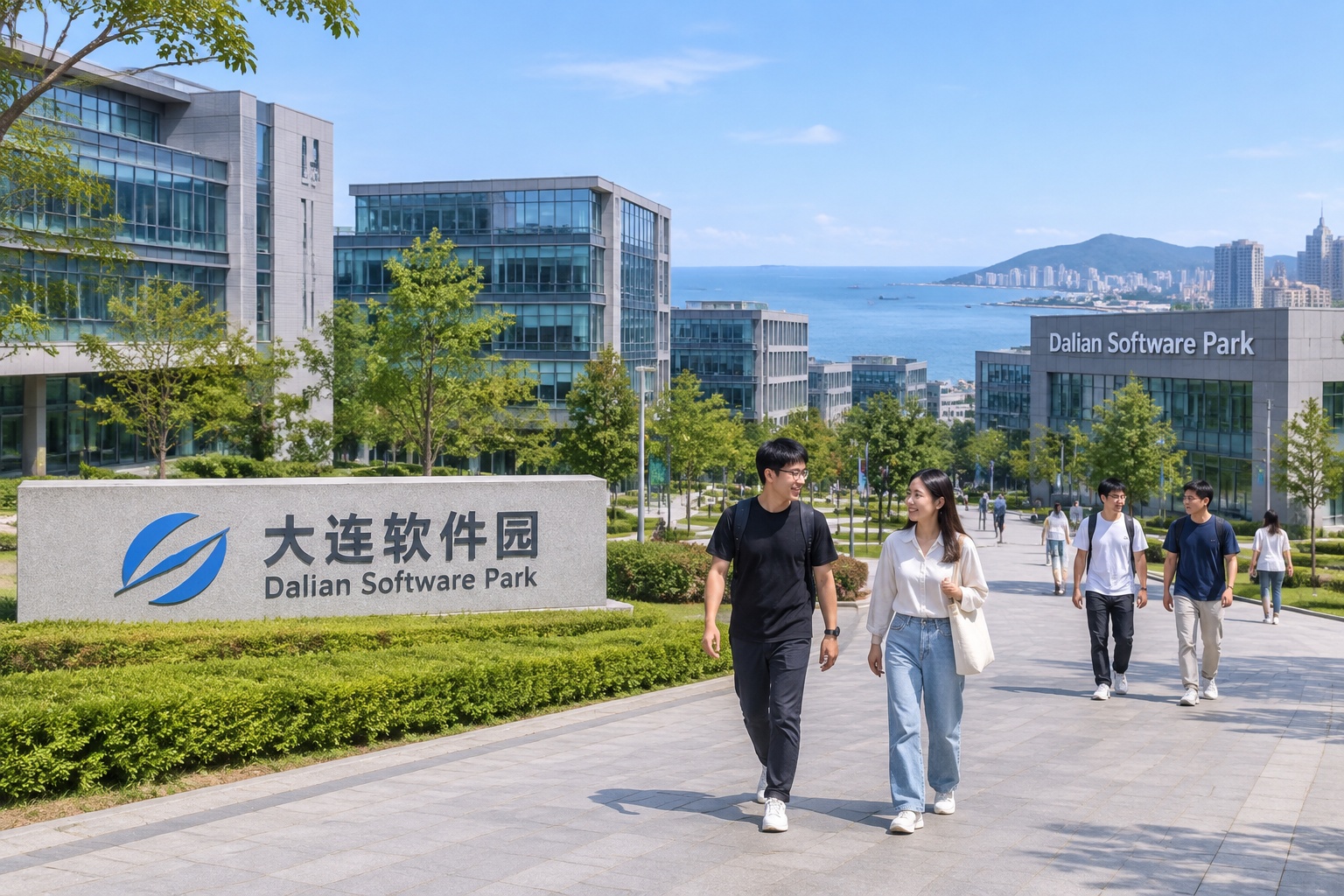

Morning in the Software Park
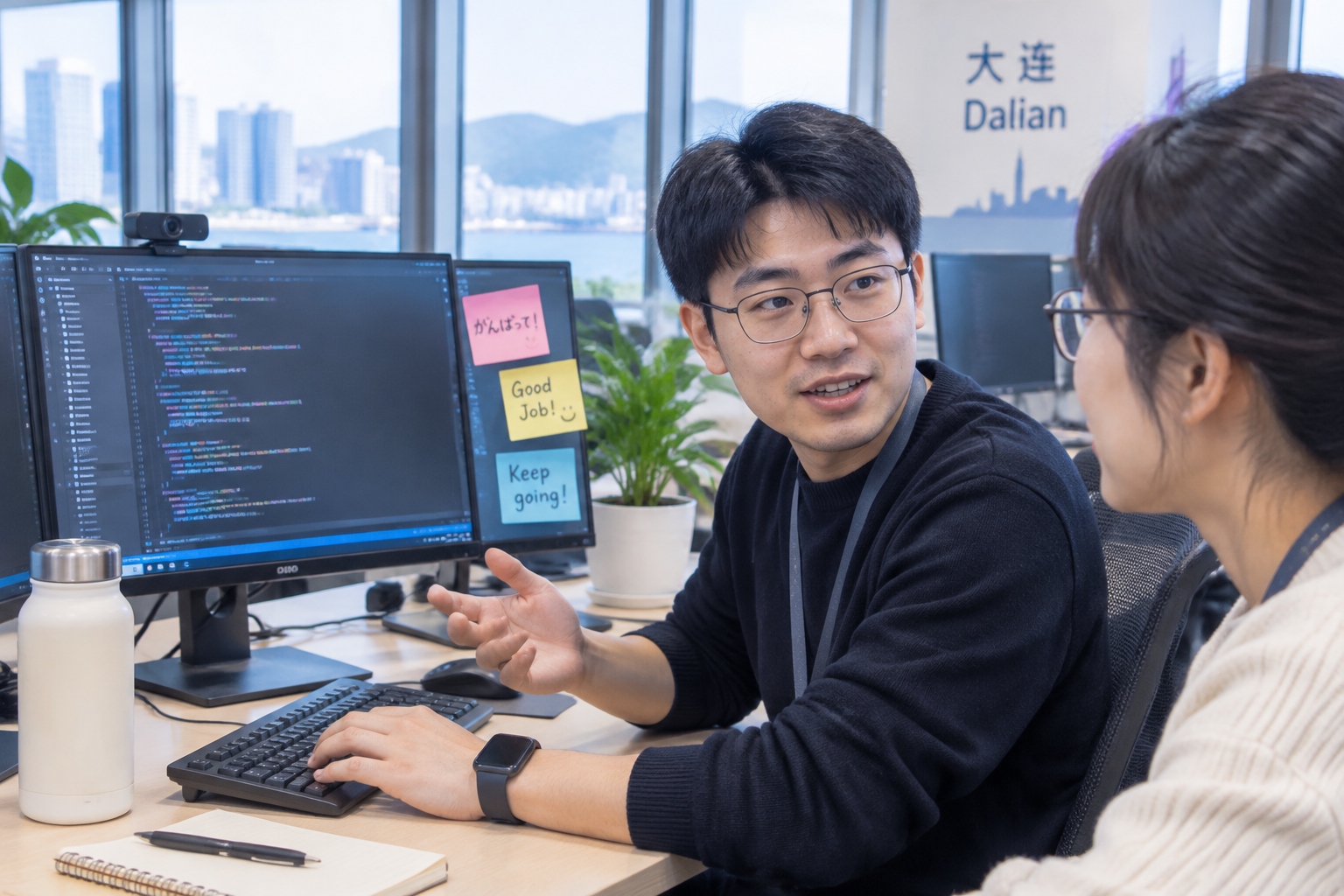
At 8:30 on a Tuesday, Li Wei swipes his access card at the gates of Dalian Software Park. He’s 27, a backend developer for a company that builds logistics software for Japanese clients. He grabs a soy milk and a steamed bun at the cafeteria, then settles in front of two monitors. Half of his team is already on a video call with Osaka.
Dalian, a city of 7 million on China’s northeast coast, might not be the first place that comes to mind when you think of Chinese tech. But for over two decades, this port city has quietly become one of China’s software outsourcing hubs, with a particular specialty in serving Japanese and Korean markets. Walk into any office in the park and you’ll hear a mix of Mandarin, Japanese, and English, under the constant clatter of keyboards.
Why Dalian? Geography and a Head Start
Dalian’s software story began in the late 1990s. China was pushing to expand its tech sector, and Dalian’s location—close to Japan and South Korea, with a deep-water port—made it a natural choice for companies looking to outsource coding and IT services. The city government set up the Software Park in 1998, offering tax breaks and infrastructure. Local universities like Dalian University of Technology and Dalian Maritime University started churning out computer science graduates.
By the mid-2000s, Dalian was known as the ‘Japan Office of China.’ Global giants like IBM, Accenture, and Hewlett-Packard set up centers here. Local firms like Chinasoft International and Neusoft also built large campuses. The city’s bilingual advantage was key: many graduates studied Japanese, and a steady stream of engineers learned Korean. For a Japanese company needing software at half the cost without leaving the same time zone, Dalian was perfect.
What It’s Like to Work Here
Li Wei, the backend developer, isn’t paid as much as his counterparts in Shanghai or Shenzhen. His monthly salary is around 15,000 RMB (about $2,100), which sounds modest. But his rent for a one-bedroom apartment near the park is just 2,500 RMB. He can walk to work in 15 minutes. On weekends, he goes to the beach, or hikes in the mountains outside the city. ‘I used to want to go to Beijing,’ he says. ‘But here I have a life.’
The work itself has changed. In the early days, most projects were simple code translation and QA testing, following detailed specs from Tokyo. Now, teams like Li’s take on full product development, cloud migration, and AI integration. The pay gap with Japan has narrowed, so the industry can’t rely on low-cost labor anymore. Instead, Dalian firms are pushing into higher-value niches: automotive software, healthcare systems, and logistics tech.
Not everything is smooth. The outsourcing model means clients control the roadmap, and profits are thin. After a project ends, there’s often a lull. ‘We’re selling time and expertise, not products,’ says Zhang Min, a project manager with 15 years in the industry. ‘When the yen weakens, our bonuses shrink.’
The People Behind the Code
Walk into any training room at a Dalian software company and you’ll see a familiar scene: rows of young people, many from small towns in northeast China, staring at screens. They’re often from families where state-factory jobs were the norm, and software was seen as a ticket to a middle-class life.
Wang Fang, 24, works as a QA engineer. She grew up in a village in Liaoning province. Her parents didn’t finish high school. ‘They don’t really know what I do,’ she laughs. ‘But they know I sit in a clean office and don’t get my hands dirty.’ For her, the job offers stability. The company pays for her Japanese classes, and she’s already passed the N2 level. A few colleagues have been transferred to Tokyo. ‘I’m saving up first,’ she says.
The industry also helps keep the city young. While most northeastern cities are shrinking, Dalian’s population has stayed stable. The software sector employs directly around 300,000 people, and many more in related services. For young parents, a job in tech means they can afford decent schools and housing. The city is not as expensive as Beijing, but costs are rising. ‘Our salaries haven’t kept up with housing prices,’ Li Wei admits. ‘But it’s still way better than in the industrial towns.’

Challenges: The Yen, AI, and Competition
Dalian’s software industry has a vulnerability: it depends heavily on Japan. When the Japanese economy stagnates or the yen falls, orders shrink. The COVID-19 pandemic hit international travel hard, but remote work actually deepened the collaboration. Japanese clients got used to online meetings, and Dalian teams proved they could handle more responsibility.
AI is the new wildcard. Coding is one of the fields most exposed to generative AI. Simple tasks like writing boilerplate code or translating legacy systems can now be done by machines. ‘We’re telling our developers to learn AI skills,’ says Zhang Min. ‘Knowing how to prompt the model is now more important than knowing how to type fast.’
Competition from other Chinese cities is also fierce. Chengdu, Xi’an, and Wuhan have all built tech parks with lower costs and equally good universities. Why would a company pick Dalian? The answer, for now, is the language and cultural ties. But those can erode.
There’s also a persistent brain drain. Many experienced engineers eventually move to Beijing, Shanghai, or Shenzhen for higher pay. They leave because the top tech companies—like the big internet firms—are not headquartered in Dalian. To keep talent, local companies are trying to create their own products and startups are emerging.
What the Future Looks Like
Dalian’s software industry is at a crossroads. It can’t stay as a low-cost outsourcer forever. So the city is pushing for more innovation. A new ‘Digital Dalian’ plan aims to integrate software with local strengths: maritime equipment, clean energy, and logistics. Companies are also exploring the Japanese market for digital transformation services, helping old-fashioned factories become smart factories.
For the coders themselves, the future feels less certain but more open. ‘In the past, our career path was: get a job, work hard, maybe get promoted to team lead,’ says Li Wei. ‘Now my friends are starting their own startups. Some are doing game development for the Japanese market. Others are doing remote work for U.S. companies. The internet lets us sell to the world.’
During lunch, Li Wei and his colleagues walk to a nearby square where food stalls sell Korean tofu stew, Japanese ramen, and local seafood noodles. They talk about the latest anime, the new iPhone, and where they’ll go for the next public holiday. It feels like any tech hub in the world, except that a 10-minute drive takes you to a beach where you can watch the sun set over the Bohai Sea.
That’s the thing about Dalian’s software industry. It’s not a flashy unicorn story. It’s a workmanlike community of people who write code, raise families, and enjoy a quality of life that’s increasingly rare in global tech. It’s an ordinary city doing an extraordinary thing: reinventing itself, one line of code at a time.

Start the discussion at forum.chinacomes.com