
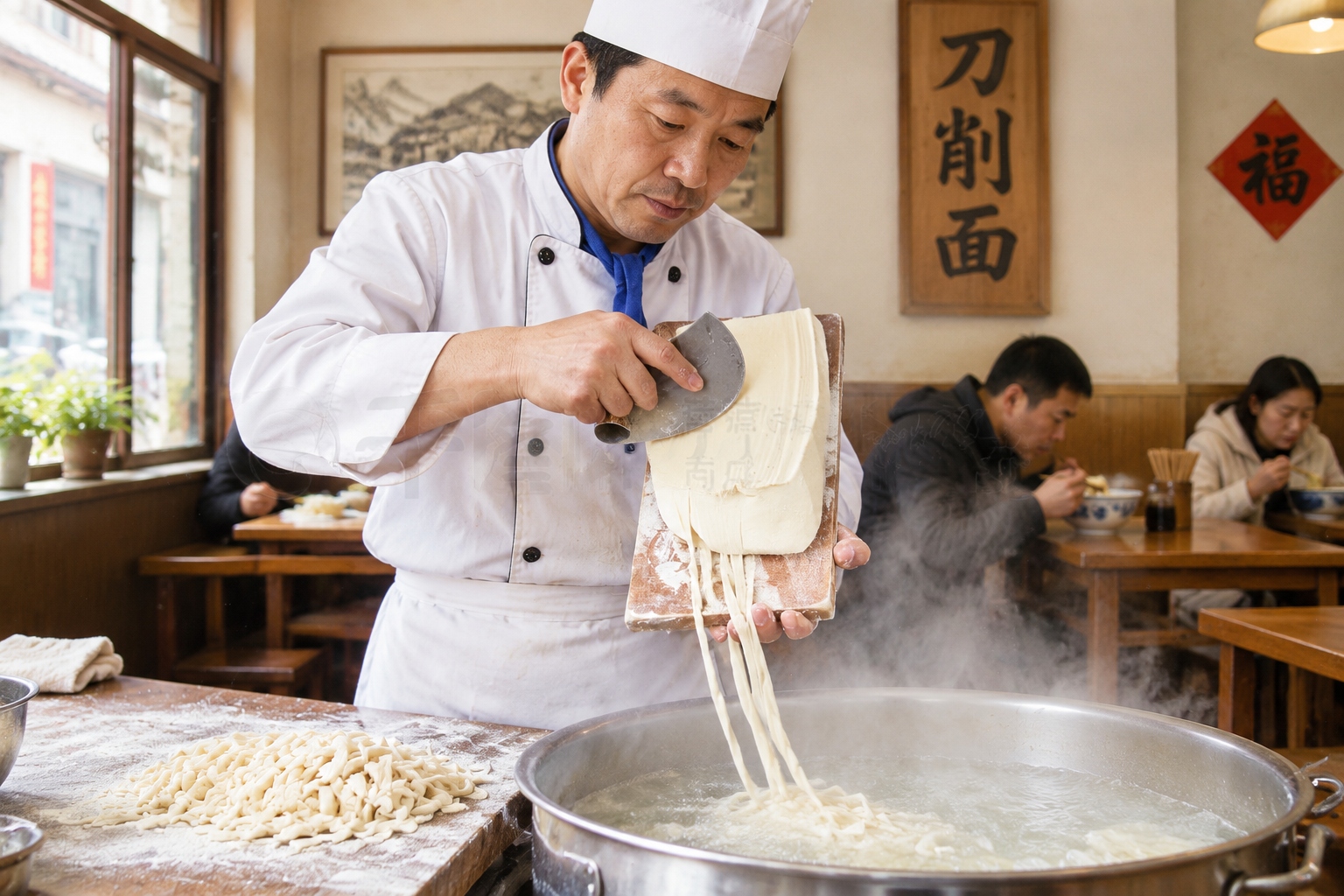

A Bowl of Noodles, Sliced by Hand
In a small noodle shop in Taiyuan, the air is thick with steam and the sharp rhythm of a knife. The cook holds a block of dough in one hand and a curved blade in the other. He does not look down. Each slice falls into the boiling water with a flick of the wrist, quick and certain. The noodles are thick in the middle and thin at the edges, chewy in a way that machine-cut noodles never quite match.
This is knife-cut noodles, or daoxiaomian. In Shanxi, it is not a novelty dish. It is lunch. It is what people eat on a Tuesday, sitting at formica tables with a bowl of black vinegar on the side.
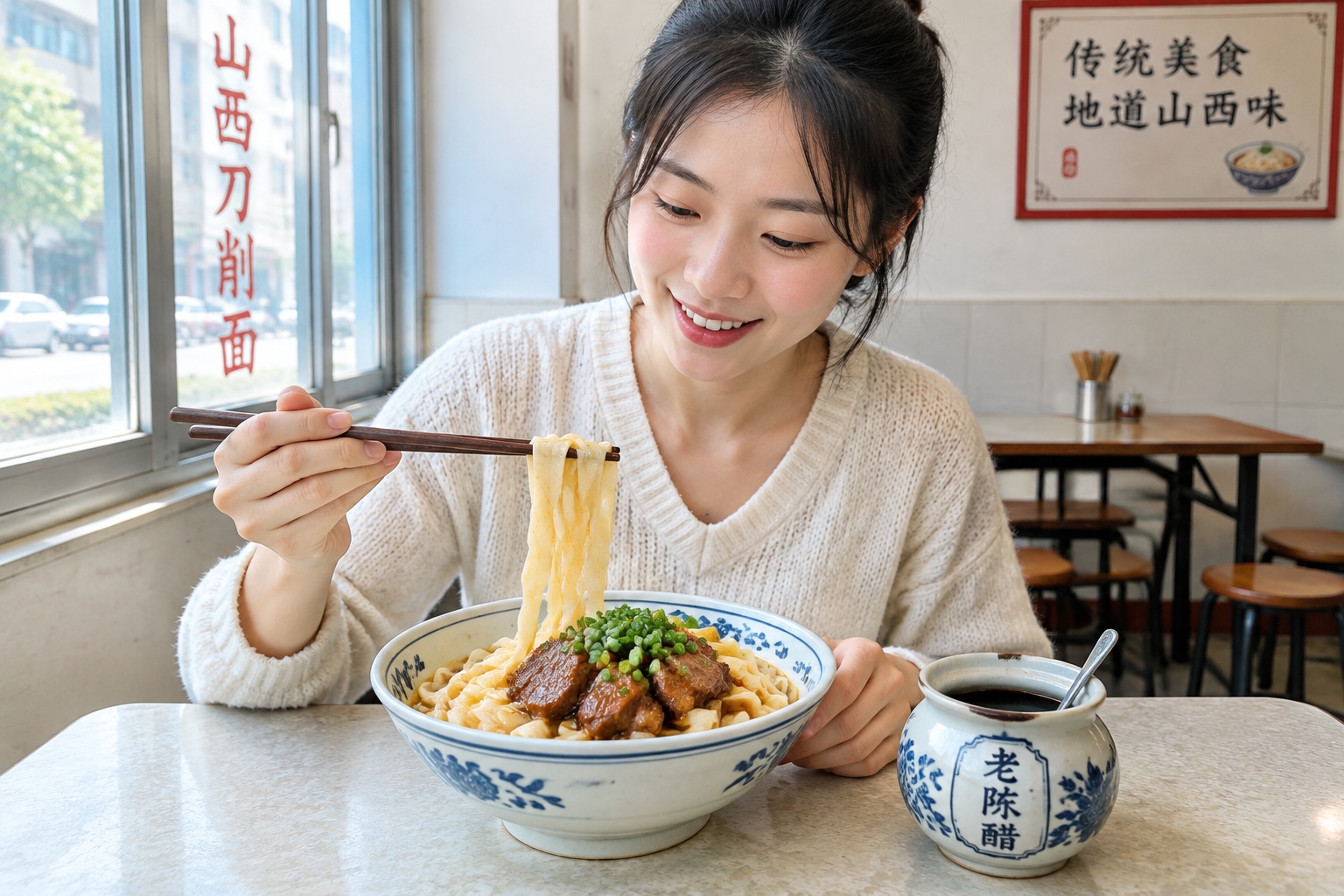
For a visitor from Europe or the United States, the first surprise is the vinegar. It arrives in a small ceramic pot, dark and almost syrupy. You pour a little into your noodle bowl, maybe a spoonful. The taste is not sharp like balsamic. It is mellow, slightly sweet, with a deep fermented finish. It cuts through the richness of the noodles and the braised pork. You will see people pour it over almost everything: dumplings, stir-fried vegetables, even rice.
Vinegar as a Way of Life
An hour’s drive from Taiyuan, in a village near the old merchant town of Pingyao, an elderly woman named Zhang Guiying tends to rows of clay jars in her courtyard. She is 74. She has been making vinegar since she was a teenager. Her jars are filled with sorghum, bran, and water. They sit in the sun and ferment for months. The smell is strong, earthy, and slightly sour.
“You cannot rush vinegar,” she says. “The weather changes it. The jar changes it. Even the person who stirs it changes it.”
She stirs each jar by hand every few days. She says the vinegar is ready when the color turns deep amber and the taste settles into something smooth. Her family sells it to neighbors and to a few small shops in the city. She does not use a website. She does not ship overseas. But her vinegar is famous in the village.
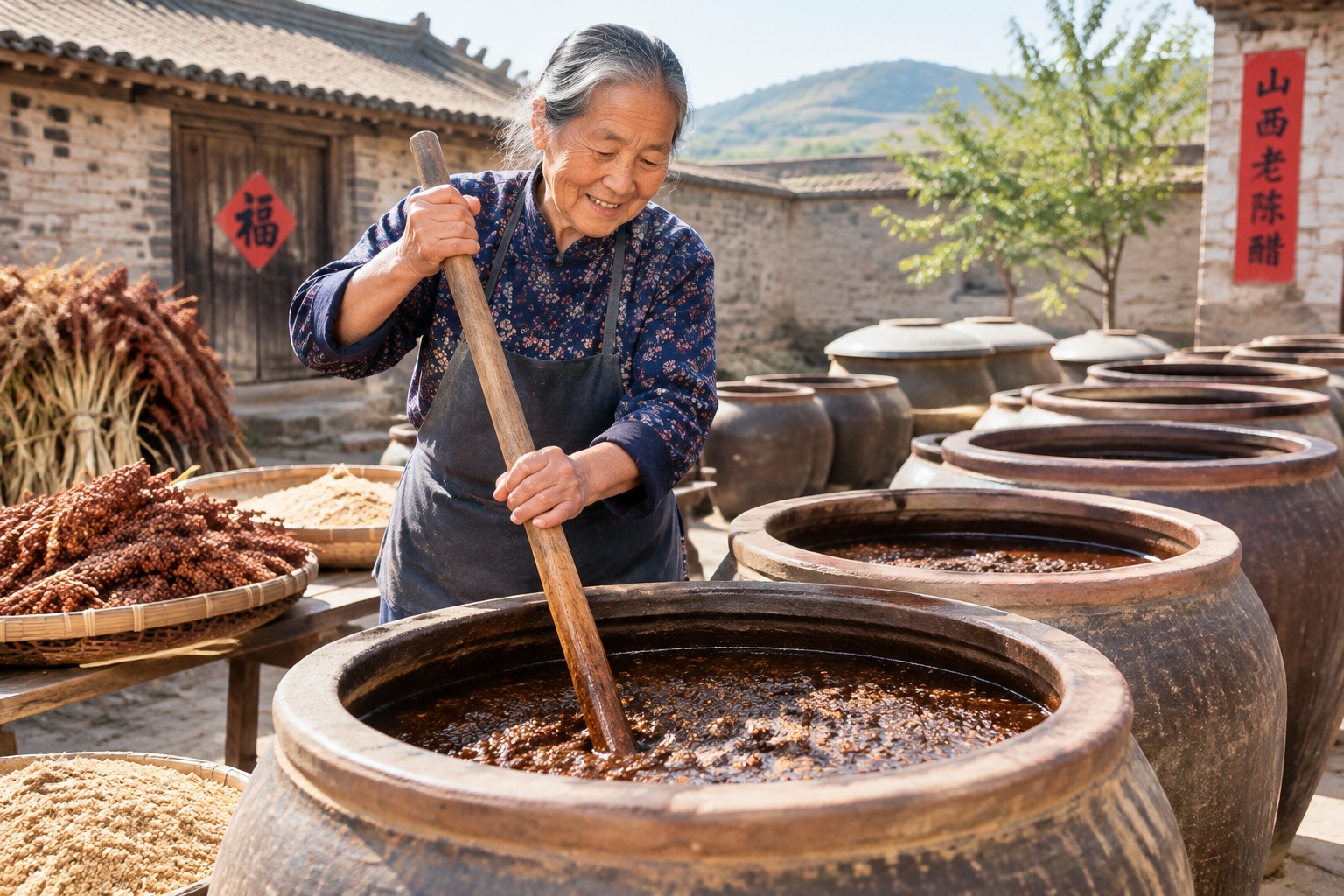
This is aged vinegar, or laochencu. It is one of Shanxi’s most famous products. In Chinese supermarkets, you can find bottles of it with labels boasting “aged for five years” or “aged for ten.” But in villages like this one, vinegar is not a brand. It is a household skill, passed down through generations.
The Courtyards and the People Outside Them
Pingyao is one of China’s best-preserved ancient cities. Its walls are intact. Its streets are lined with old merchant courtyards, once home to the wealthy Shanxi merchants who dominated Chinese finance in the 19th century. They ran banks, traded tea and silk, and built grand family compounds with carved wooden beams and stone lions.
Tourists come from all over China to walk these streets. They buy tickets to enter the courtyards. They take photos in front of the old bank counters. They buy boxes of vinegar and bags of dried noodles.
But step outside the main tourist streets, and you find something else. You find people living their lives. You find a woman hanging laundry on a line strung between two old walls. You find a man repairing a bicycle on the sidewalk. You find children playing badminton in a narrow alley. You find a small shop selling cigarettes, soda, and phone chargers.
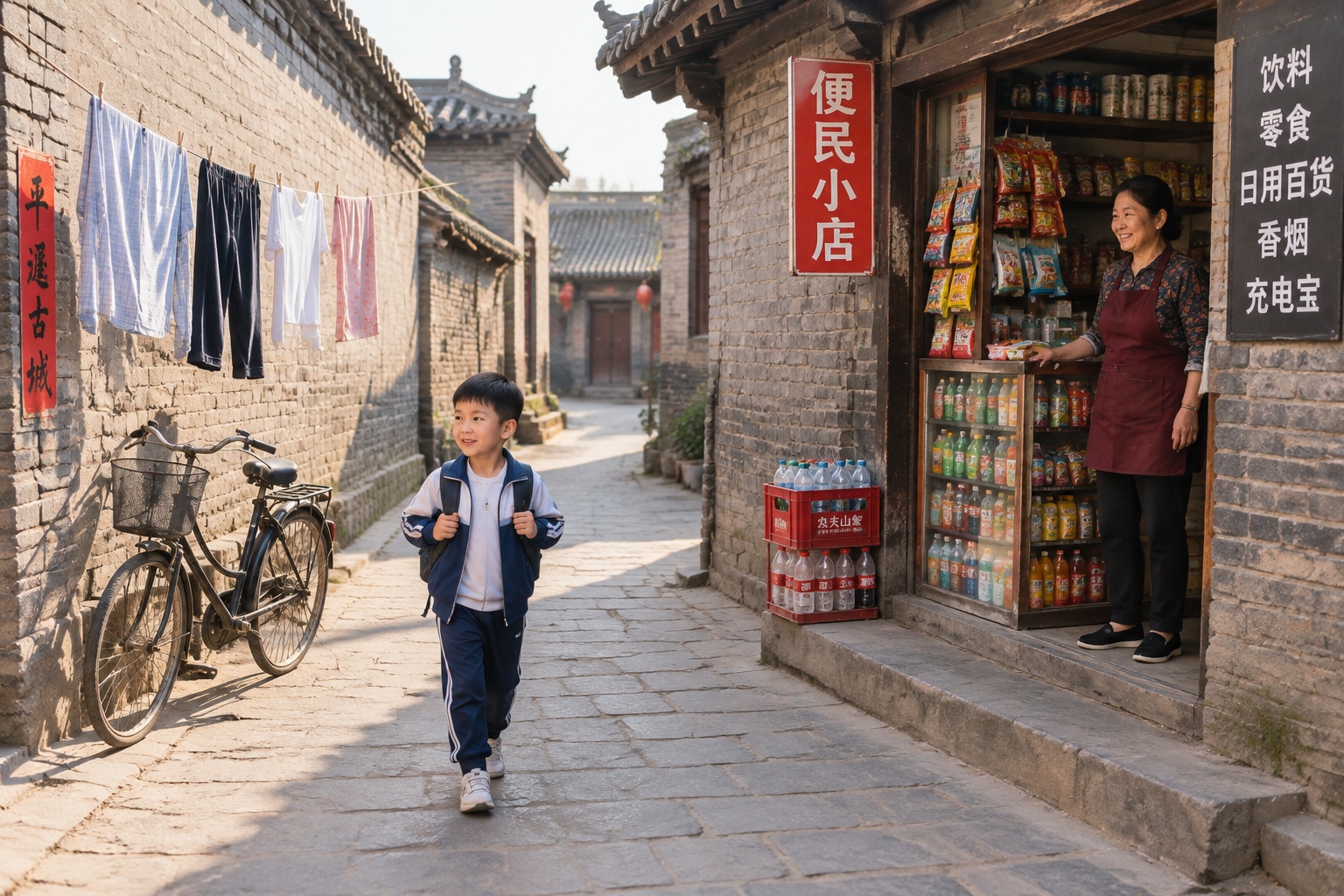
This is the everyday Shanxi that tourists rarely see. The courtyards are beautiful, but they are also museums. The real life happens in the streets around them, in the small restaurants and the corner stores and the homes where people still cook with vinegar their grandmothers made.
Why Shanxi Merchants Matter
To understand Shanxi, you need to understand the merchants. In the 1800s, Shanxi merchants were the bankers of China. They invented a system of draft banks that allowed people to deposit money in one city and withdraw it in another. This was long before modern banking. They operated across the country, from Beijing to Guangzhou, and even into Russia and Japan.
Their success built the grand courtyards that tourists visit today. But it also shaped the local culture. Shanxi people became known for being thrifty, practical, and good with money. They invested in education and in their home villages. They brought back new foods and new ideas.
Noodles and vinegar were part of this world. They were practical foods for people who traveled and worked hard. They were also a source of local pride. Even today, Shanxi people will tell you that their vinegar is the best in China, and their noodles are the most authentic. They are not entirely joking.
The Young People Coming Back
For decades, young people left Shanxi villages for cities. They went to Beijing, Shanghai, and Shenzhen for factory jobs, office jobs, and better pay. The villages grew quiet. The old houses emptied.
But in the past few years, something has shifted. A small number of young people are coming back. They are opening guesthouses in old courtyards. They are selling vinegar online. They are livestreaming from their kitchens, showing viewers how to make knife-cut noodles.
One of them is Liu Yang, 28. He grew up in a village near Pingyao. He studied computer science in Xi’an and worked for an internet company for four years. Then he quit and came home. He and his wife rented a small courtyard and turned it into a guesthouse with six rooms. They serve breakfast: steamed buns, pickled vegetables, and, of course, vinegar.
“I missed the pace here,” he says. “In the city, everything is fast. Here, you can breathe.”
He also sells his grandmother’s vinegar online. He packages it in small glass bottles and ships it across the country. He says sales are growing. He has customers in Shanghai and Guangzhou who order every month.
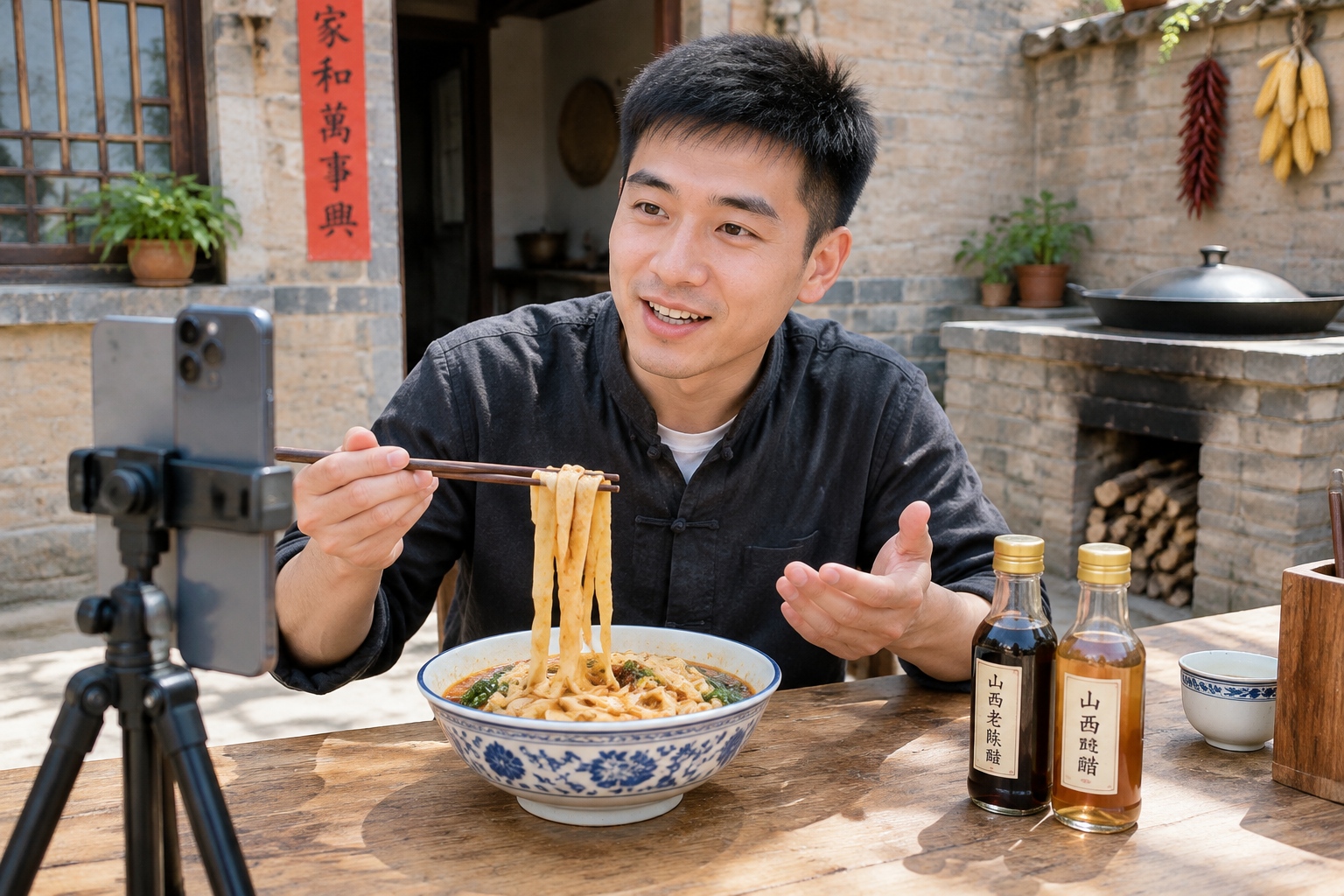
Liu Yang is not alone. Across Shanxi, you can find young people experimenting with new ways to keep old traditions alive. They are not trying to freeze the past. They are trying to make it useful again.
What This Means for a Visitor
If you come to Shanxi from Europe or the United States, you will notice things that feel familiar and things that feel different. The old courtyards might remind you of medieval European towns. The vinegar culture might remind you of wine regions in France or Italy. The noodles might remind you of fresh pasta.
But the combination is uniquely Chinese. The merchants who built the courtyards were not aristocrats. They were businessmen. The vinegar is not a luxury product. It is a daily condiment. The noodles are not a gourmet dish. They are a working lunch.
This is what makes Shanxi interesting. It is not a theme park. It is a place where history and ordinary life are tangled together. You can visit a 200-year-old bank and then eat a bowl of noodles made by a man who has been slicing dough for thirty years. You can buy vinegar that was fermented in a clay jar in someone’s backyard.
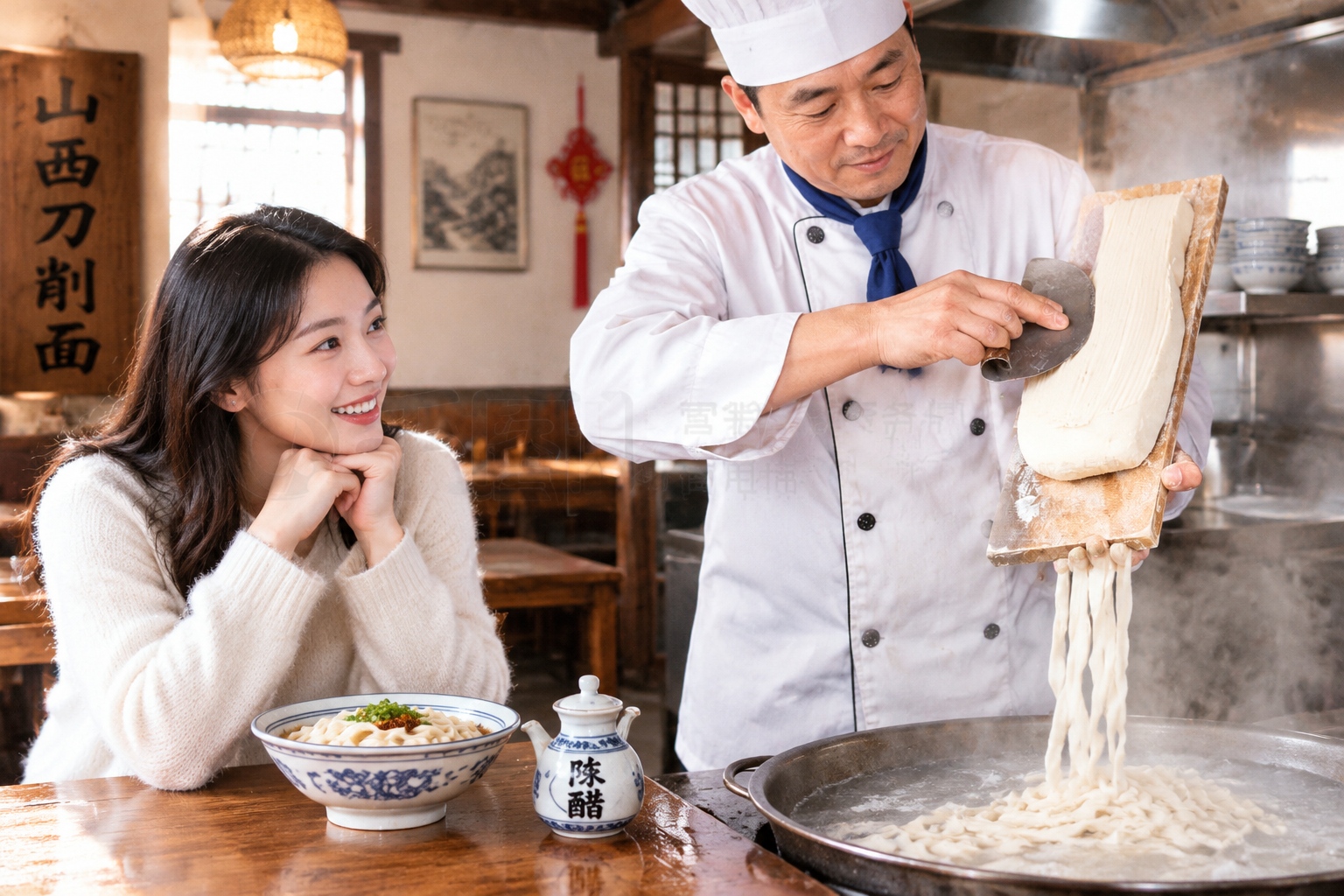
For a visitor, the best way to understand Shanxi is to slow down. Sit in a noodle shop. Watch the knife. Taste the vinegar. Walk outside the tourist streets and look at the laundry hanging on the line. Talk to the people. They will tell you about their lives, their families, and their food. And they will probably offer you a bowl of noodles.
Final Thoughts
Shanxi is not the China of skyscrapers and high-speed trains, though those exist here too. It is the China of small towns and old traditions, of vinegar jars and noodle knives, of merchants and farmers and young people trying to build something new without losing what came before.
If you want to understand how China holds its past and its present together, Shanxi is a good place to start. Bring an appetite. The noodles are waiting.
Start the discussion at forum.chinacomes.com