


I woke up at 5 a.m. to the sound of wooden sticks hitting the ground. Outside the window of my guesthouse near Shaolin Temple, rows of teenage monks were doing handstands on stone slabs. One of them, no older than 12, balanced on two fingers while his master counted under his breath. By noon, I was standing in a different world: the old city of Luoyang, 80 kilometers away, where neon signs flickered over a night market that didn’t open until sunset. This is the time-travel route that more and more travelers are discovering — not a visit to a museum, but a day that stretches from ancient martial arts to a scene that feels straight out of a cyberpunk film.
Shaolin Temple, nestled in the Songshan Mountains, has been a mecca for martial arts pilgrims since the 5th century. But it’s not frozen in time. The monks still train at dawn, but they also use QR-code payment at the visitor center. The real magic happens early, before the tour buses arrive. For an hour, the courtyard belongs to the monks — their shouts echoing off the red walls, their movements sharp as swords. It’s a performance of discipline that hasn’t changed in centuries, yet the audience has changed: today, it’s as likely to be a Brazilian jiu-jitsu instructor snapping videos for Instagram as a Chinese family.
From Monastery to Neon
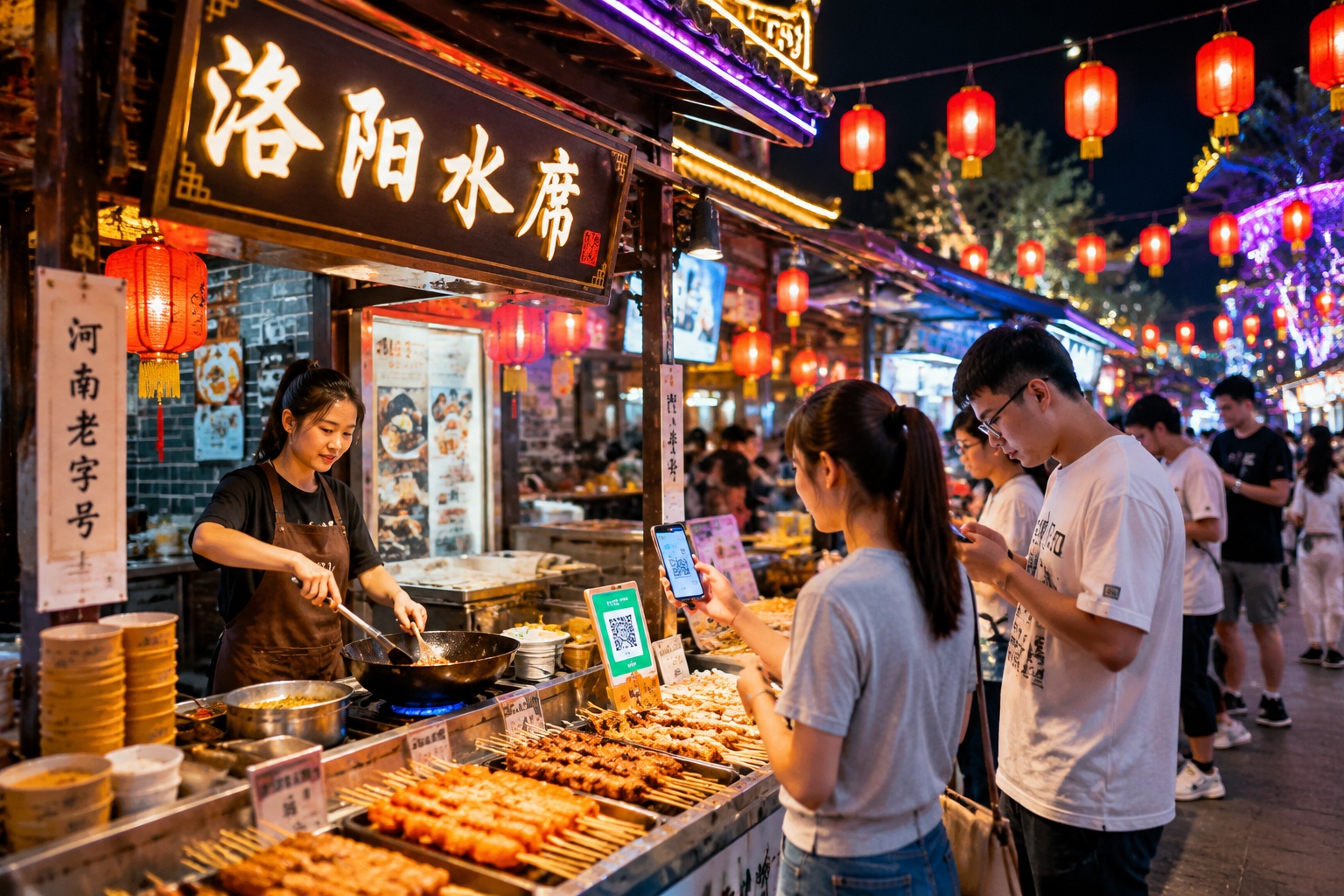
By late afternoon, the same day-trippers who watched the monks are back in Luoyang, heading to the Lao Cheng (old town) district. As dusk settles, the narrow streets transform. Strings of red lanterns and LED strips in electric blue and purple crisscross overhead. Stalls sell grilled squid skewers next to traditional shui xi — the famed “water banquet” of Luoyang, where dishes arrive in a constant flow of broths and sauces. You can eat a meal that the Tang emperors enjoyed, served on plastic tables under the glow of a 3D hologram advertisement for a local phone company.
This juxtaposition creates a disorienting but exciting atmosphere. Street vendors take payment via a scan of your phone — no cash, no cards. A woman selling handmade silk fans uses a tablet to livestream her craft to 10,000 followers. She tells me the monks at Shaolin have their own account too, though “they post less often than me.” I ask her if she feels the tension between old and new. She laughs: “Why tension? I sell a Song-dynasty pattern in the morning and a Star Wars mask in the evening. People want both.”
Interview: A Young Vendor’s Perspective
At one stall, I meet 26-year-old Li Wei, who runs a bu da bu xiang shi — “don’t hit, don’t know” — snack shop that serves a spicy cold noodle dish dating back to the Sui dynasty. He adds a modern twist: edible glitter and lime foam. “The old recipes are the base,” he says, “but I have to make it look good for TikTok.” His customers are mostly Chinese students from nearby universities, but he’s noticed more foreigners lately. “They always ask if this night market is “authentic.” I tell them: this is what authentic means today. We live in the same city where my grandparents had never seen a lightbulb, and now I’m making a video of my noodles with a drone camera.”
Li Wei’s story reflects Luoyang’s broader rebirth. Once the capital of 13 dynasties, the city was known as a quiet backwater, famous for peonies and ancient chariot pits. But in the last five years, it has leaned into its contrasts. A new metro line connects the old town to the high-tech zone, where self-driving buses shuttle workers past glass towers that have subtle pagoda-inspired curves.
The Longmen Grottoes Bridge
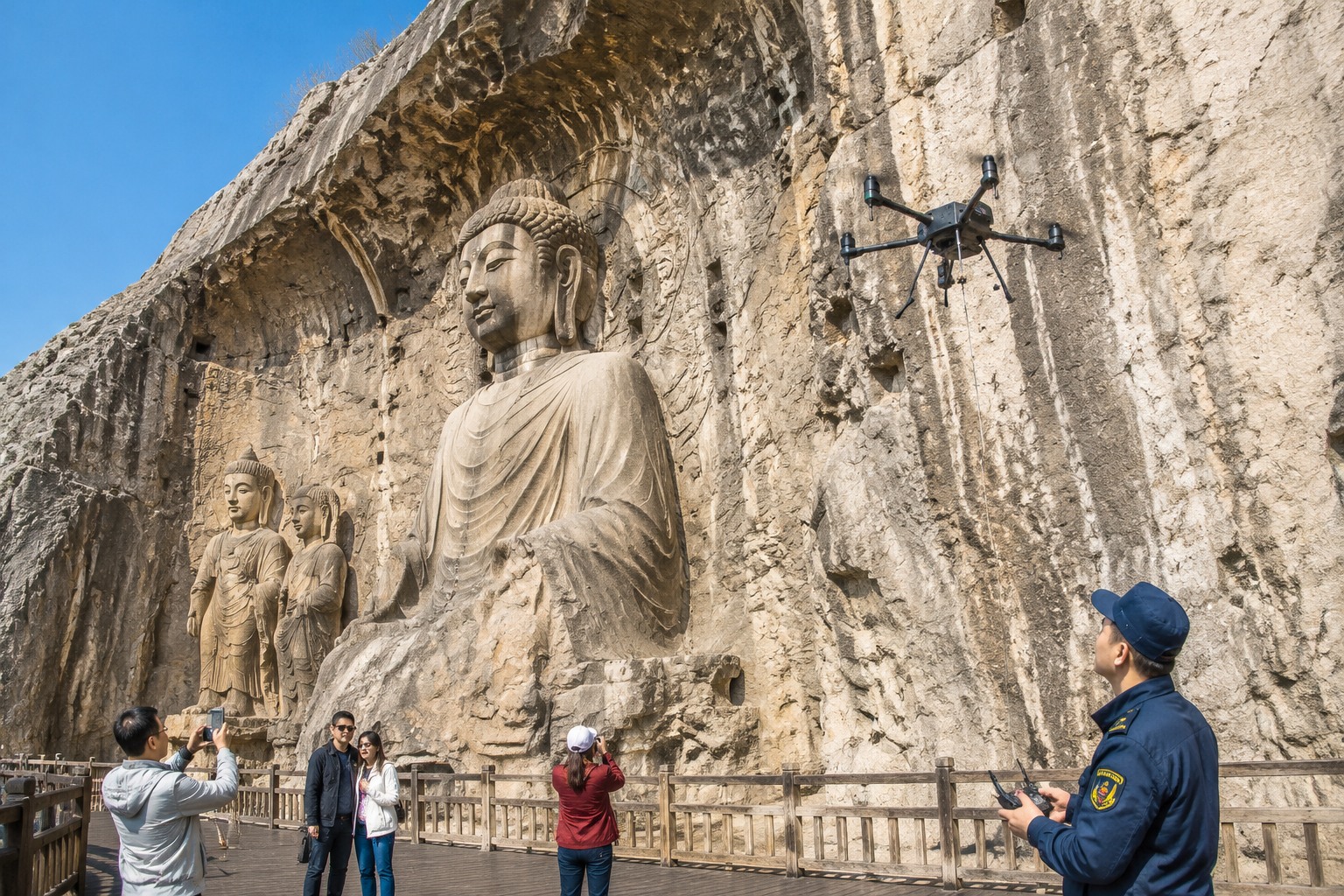
No trip to Luoyang is complete without the Longmen Grottoes, a UNESCO World Heritage site with over 100,000 Buddhist statues carved into limestone cliffs. The oldest date back to 493 AD. On a weekend, the walkway is crowded with selfie sticks, but a recent digital management system limits visitor numbers by timed tickets, and a new app tells you exactly where to stand for the best lighting. The site is a bridge: ancient hands chiseled the giant Vairocana Buddha over 1,300 years ago; today, maintenance drones scan the same cliffs for erosion cracks. “We’re not just preserving rocks,” says a guide, “we’re preserving the idea that people across centuries still bow the same way.”
Rebranding for the World
Luoyang’s municipal tourism office has launched a campaign called “Meet Luoyang in the Future.” It includes a night-time digital art show on the old city walls and a “kung fu meets rap” performance that rotates weekly. The goal is to attract younger international visitors who are tired of the usual Beijing–Shanghai circuit. So far, it’s working: hostel bookings in the old town are up 40% year-over-year, and a direct flight from Singapore now lands three times a week.
But there’s a balancing act. Locals worry about over-commercialization. A tea house owner told me he refuses to install the neon signs that his neighbors use. “I want my shop to look like a Ming dynasty courtyard,” he says. “Tourists can get cyberpunk anywhere. They come here for the depth.” The city has listened: a new ordinance caps the brightness of signs in the historic core, preserving the ancient skyline while keeping the night market’s energy.

One City, Two Rhythms
Standing at a night-market table, I watch a monk (off-duty, in plain clothes) order a plate of spicy tofu. He pays with his phone and chats with the vendor about the weather. No one stares. In this city, the ancient and the futuristic are not rivals; they’re roommates. The monks train at dawn, the neon buzzes at dusk, and the Longmen Buddhas watch over both, carved in stone yet somehow flexible enough to tolerate a selfie-stick world.
For travelers, this route isn’t about choosing between past and future. It’s about seeing how a civilization that has reinvented itself many times handles the latest reboot. Luoyang’s answer seems to be: keep the old hands moving, add a little glitter, and let the time-line blur. The water banquet flows, the LED glow brightens, and somewhere a 12-year-old monk is mastering his two-finger handstand — maybe while humming a tune from his favorite anime. That’s not a contradiction. It’s just China, in one city.
Start the discussion at forum.chinacomes.com