
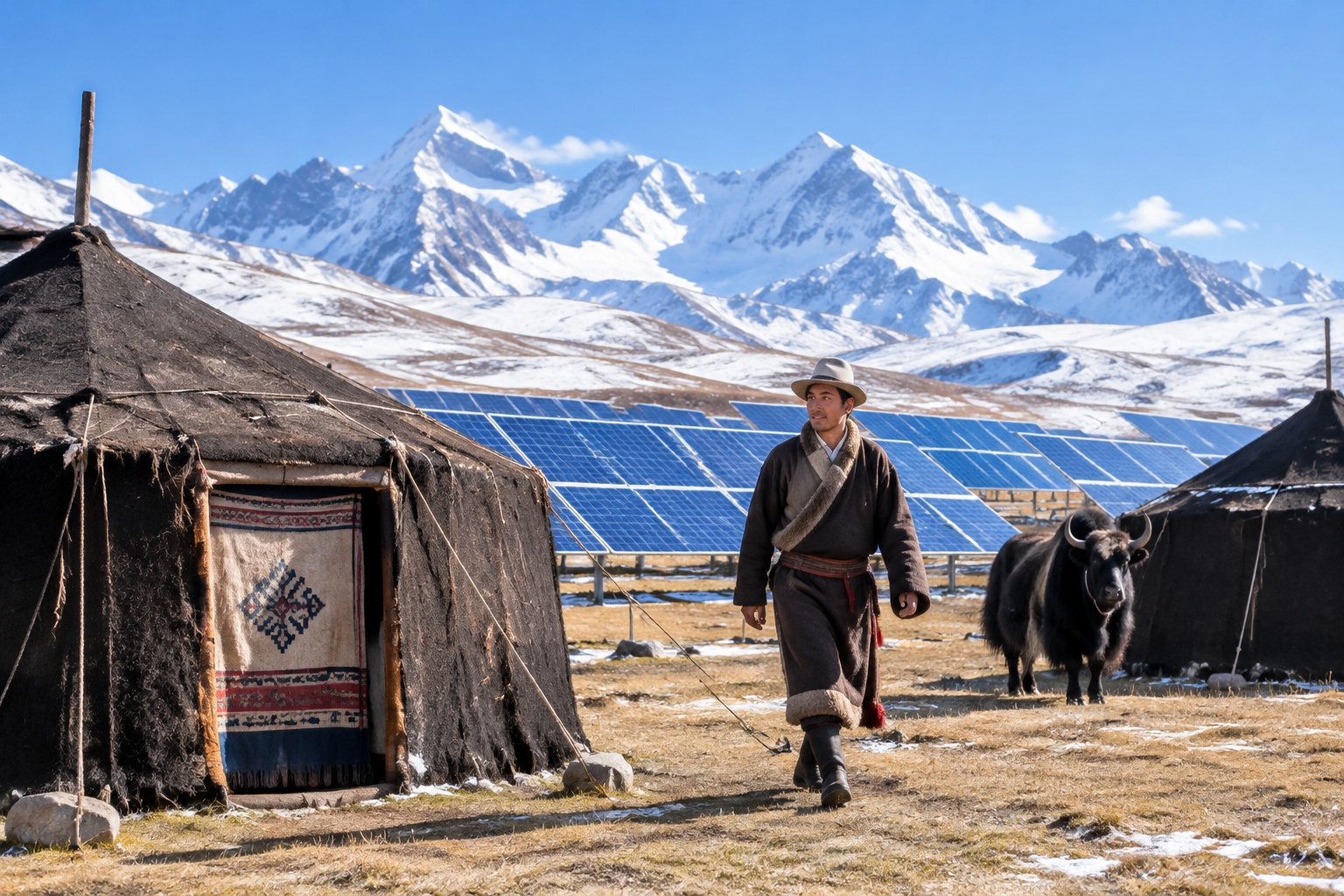

Introduction: A Light in the Black Night
The winter night on the Qinghai-Tibet Plateau falls fast and hard. Temperatures drop below minus 20 degrees Celsius. In the past, once the last ray of sunlight faded, the vast grassland turned pitch-black, and herding families like 45-year-old Dawa’s crawled into their tents to wait out the long dark hours.
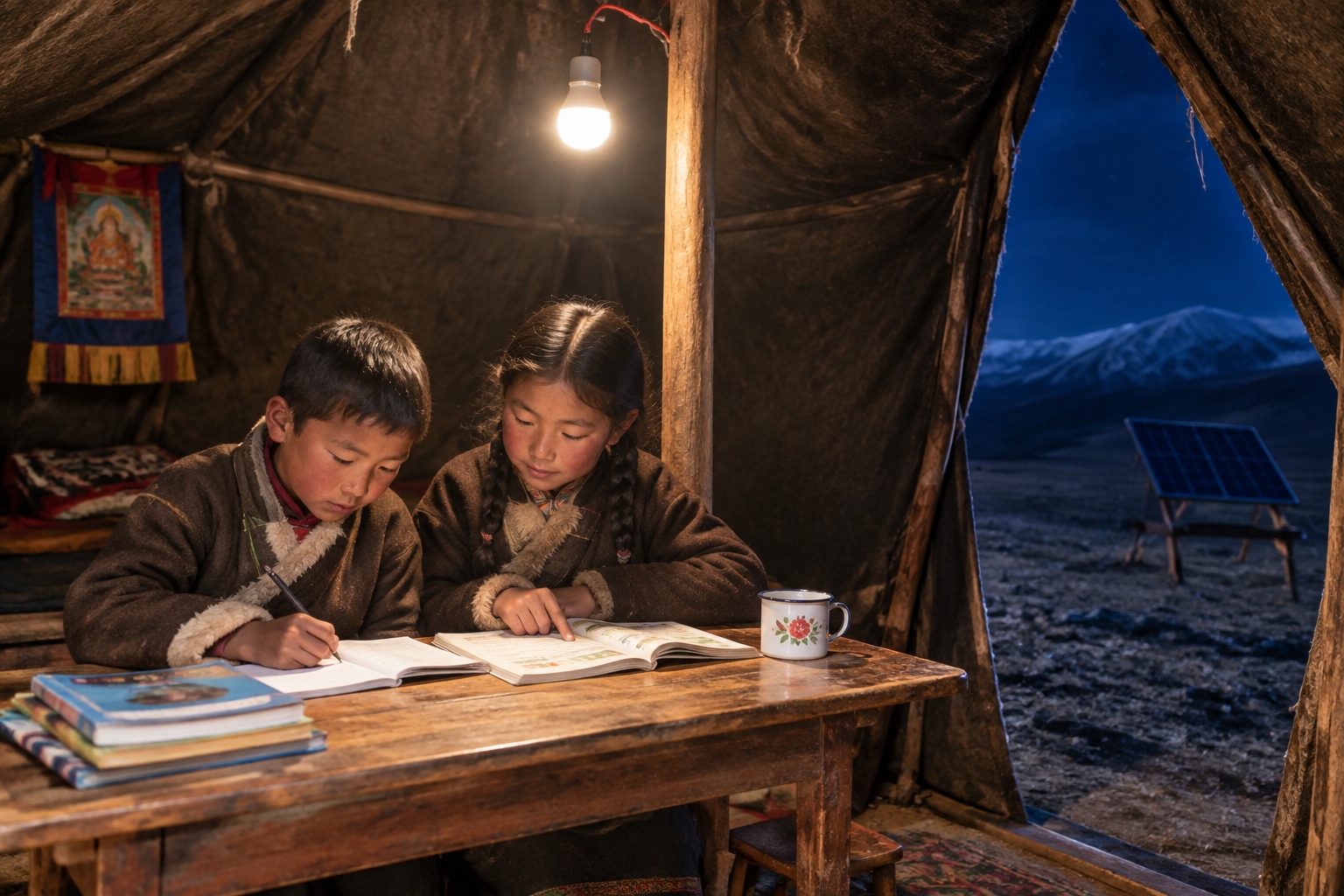
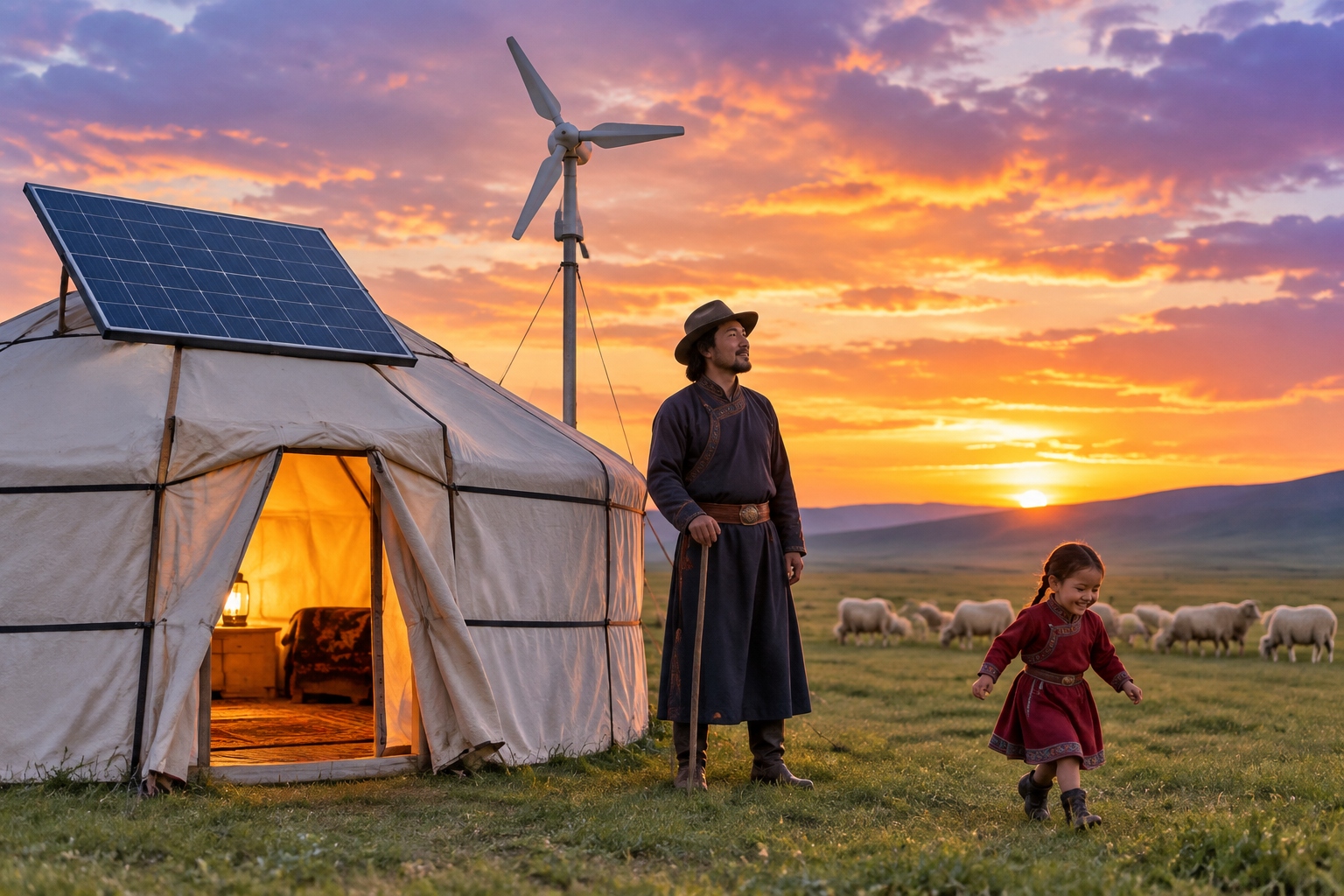
But tonight, as I sit inside Dawa’s yak-hair tent on the northern Tibetan plateau, the space is bright and warm. A single LED bulb hangs from the tent pole, casting clear light on a small table where his two children are doing homework. Outside, a solar panel the size of a double bed tilts toward the sun. Inside, a compact battery box stores the electricity for the night ahead. “We used to burn butter lamps,” Dawa says, smiling. “They flickered and smoked. Now we have light that never goes out.”
Before the Panels: Life Without Electricity
For most of the world, electricity comes from a socket in the wall. But for Tibet’s nomadic herders, who move with their yaks and sheep across some of the most remote terrain on Earth, the power grid was long out of reach. The population density is about one person per square mile in many areas. Extending transmission lines across frozen rivers and 5,000-meter passes is not just costly—it’s often technically impossible.
So herders lived off-grid, using dried yak dung for cooking and heating, butter lamps or candles for light. Mobile phones, if any, had to be charged during rare visits to a county town. Radios were battery-hungry. Children studied by the dim glow of a kerosene lamp. Health emergencies after dark were dangerous—not just for the patient, but for anyone trying to find help in the dark.
“At night, we could only see the stars,” recalls Tashi, a 30-year-old herder who lives about a day’s drive from the nearest town. “If a family member got sick, we’d have to wait for dawn.”
How Solar Power Reached the Plateau
That began to change in the early 2000s, when China launched a national campaign to bring electricity to every corner of the country. For remote areas beyond the grid, the solution was not cables but solar panels. Government subsidies, combined with equipment from Chinese manufacturers, made off-grid solar affordable for herding families.
In 2015, Dawa received his first solar system from a local government program. “It was three panels and a battery,” he says. “The first night, we all just sat there looking at the light.”
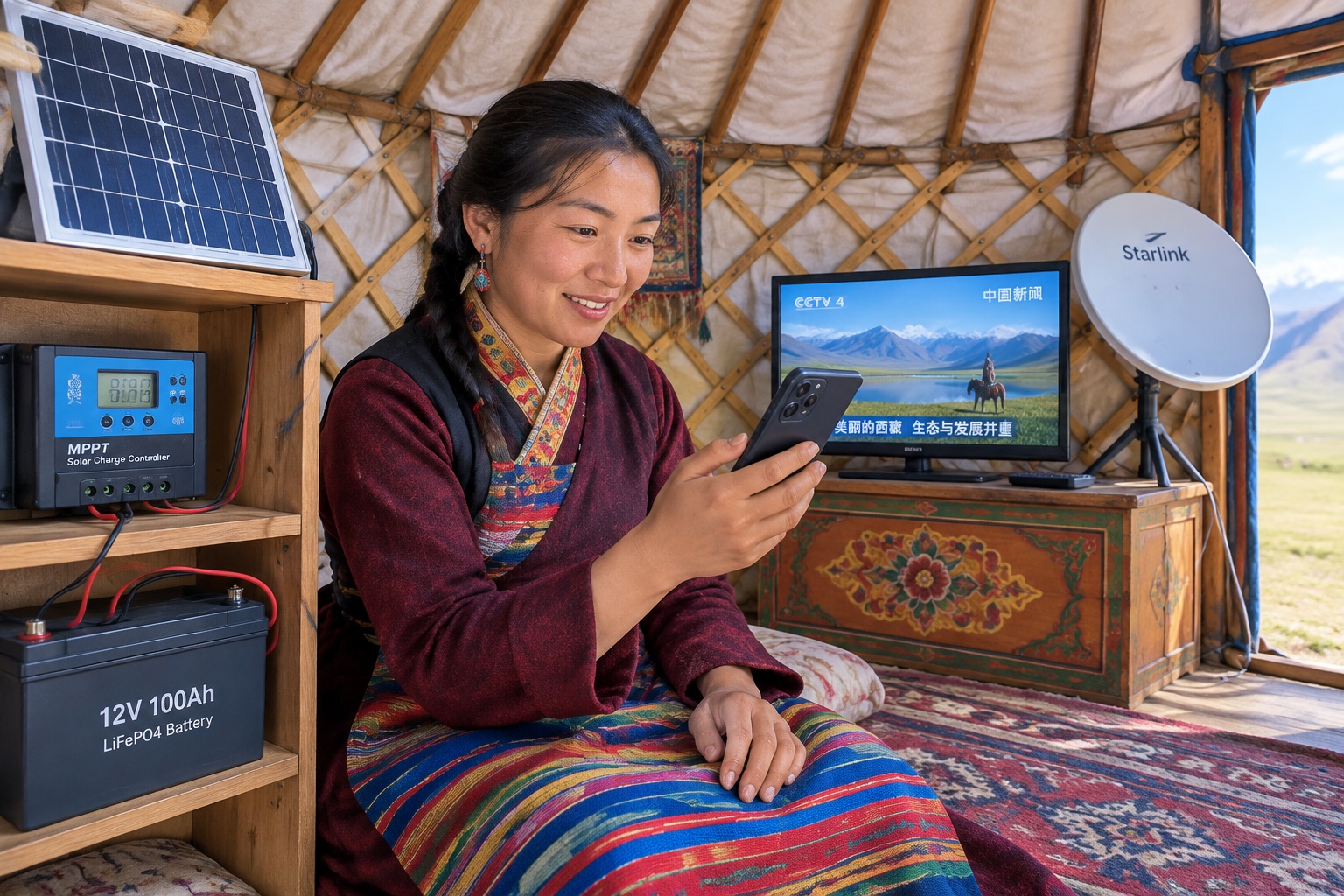
Since then, the technology has evolved rapidly. Early basic systems gave way to solar home systems with deep-cycle batteries, inverters, and multiple outlets. Today, many herding tents have televisions, satellite dishes, and even small refrigerators powered by the sun. The cost has fallen sharply, too—a basic setup that cost 3,000 yuan in 2015 is now half that, and often subsidized further.
A Day in a Solar-Powered Tent
Morning in Dawa’s camp starts with porridge cooked over a traditional dung stove, but the water to mix it comes from a solar-powered electric kettle. After breakfast, Dawa checks his phone—a habit he developed only after getting solar panels. “Now I can check weather forecasts and market prices for my wool,” he says. He also uses a solar-powered electric fence to keep wolves away from his sheep at night.
The children attend a school with dormitory, but during school holidays they’re back home. At night, LED lamps allow them to study for hours. “My daughter wants to be a doctor,” Dawa says. “She can read more books now.”
Solar power has also brought entertainment. A small television, connected to a satellite dish, gives the family access to news, sports, and Tibetan-language programs. On weekends, nearby herders sometimes gather in Dawa’s tent to watch a movie together—a new form of community bonding.
More Than Light: Solar’s Impact on Livelihoods
Beyond homework and TV, solar power is changing the economics of herding. With electricity, herders can run small milking machines, electric cream separators, and portable freezers to store meat for sale in town. Some families have set up small solar-powered water pumps for their livestock.
Internet connectivity, also solar-powered through mobile base stations, has opened new opportunities. Dawa sells yak wool online through a cooperative. “Before, we had to take the goods to a market, which meant a two-day trip,” he says. “Now we can compare prices on WeChat and arrange sales before we leave.”
In some areas, solar energy cooperatives allow herders to feed excess electricity back into a mini-grid, generating a small income. While still rare, this is a sign of a growing energy democracy.
Challenges That Remain
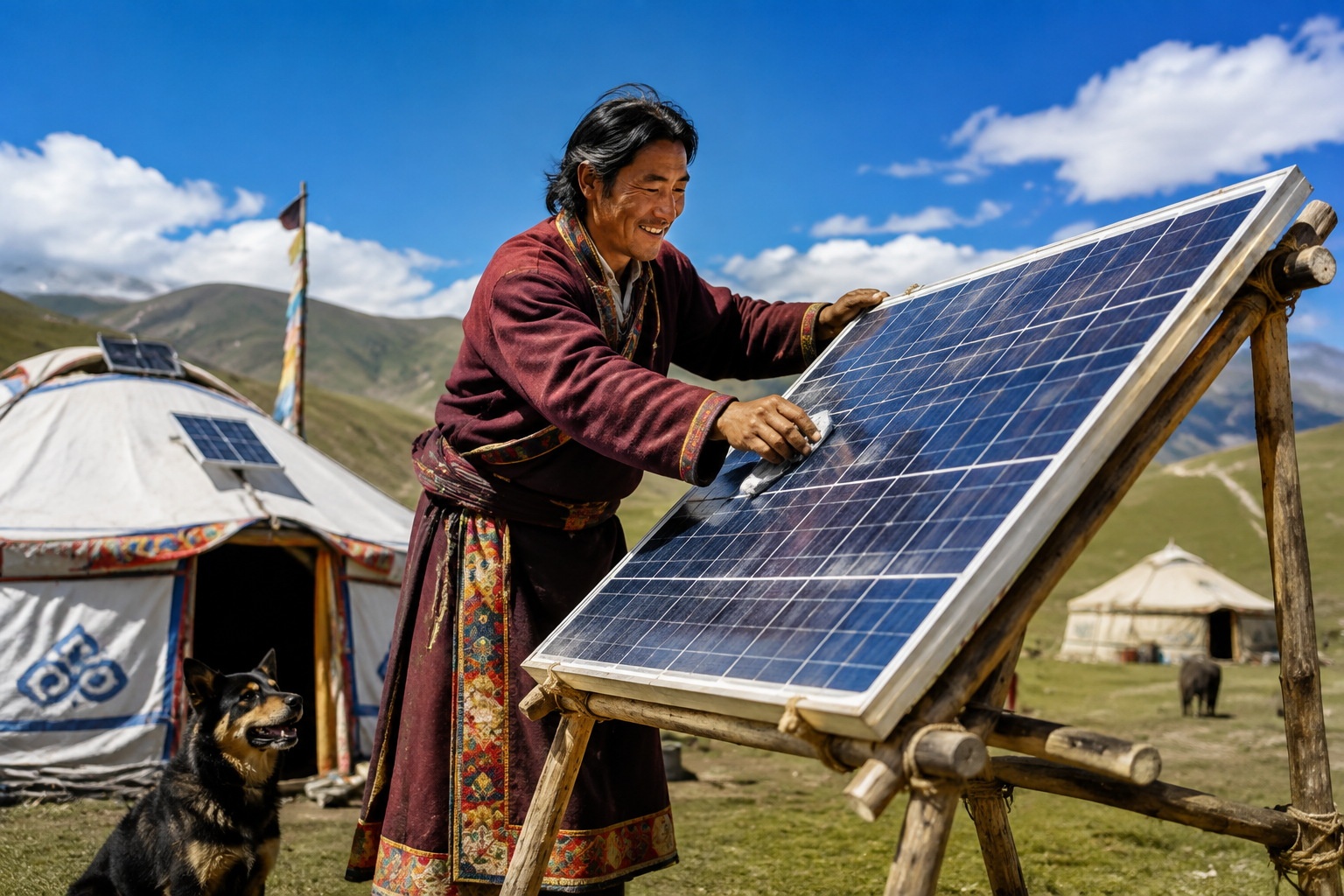
It would be misleading to suggest everything is perfect. Winter months can see reduced sunlight and heavy snow, requiring careful battery management. Solar panels need occasional cleaning to remove dust and ice. Batteries wear out after five to eight years and must be recycled. And while basic systems are affordable, more sophisticated setups still cost more than many herders can comfortably spend.
Maintenance is also a concern. The nearest service center is often hours or days away. Many families learn to fix simple problems themselves, but experts say more training and localized repair networks are needed.
Yet the demand is clear. A local solar engineer in Nagqu told me that herders are eager to upgrade their systems. “They know the value of electricity better than anyone. They’ve lived without it.”
The Future: A Solar-Powered Tibetan Plateau
Looking ahead, the vision extends beyond individual tents. Large-scale solar farms are being built in Tibet, contributing to China’s renewable energy goals. The Baihetan-Jiangsu and other UHV transmission lines are designed to carry clean power to eastern cities, while remaining sensitive to the plateau’s fragile ecosystem.
For off-grid herders, the next step is smart micro-grids connecting several tents or villages, sharing energy storage and improving reliability. Pilot projects are already underway in places like the Qiangtang Nature Reserve, where environmental protection and clean energy go hand in hand.
“We don’t just want light,” says Dawa, looking at the solar panel on his tent. “We want the same opportunities as people in the cities. Solar gives us that chance.”
Conclusion
In the grand story of China’s development, solar panels in Tibet may seem like a small detail. But for a family living in a rolled-up tent on the roof of the world, that square of glass and silicon is a bridge to the modern world. It doesn’t just light a bulb—it lights a child’s homework, a mother’s phone call, a herder’s connection to a larger economy.
On my last evening with Dawa, we sat outside as the sky turned amber. The solar panel was already doing its silent work, filling the battery for the night. Somewhere in the distance, a wolf howled. A few minutes later, Dawa’s phone pinged with a message. He laughed, “Look, even the wolf wants to know if I’ve paid my internet bill.”
That small joke captures something real: in one of the most remote corners of the world, a family is living with the rhythm of the sun—and loving it.
Start the discussion at forum.chinacomes.com