

A Cart, a Curb, and the Start of the Night
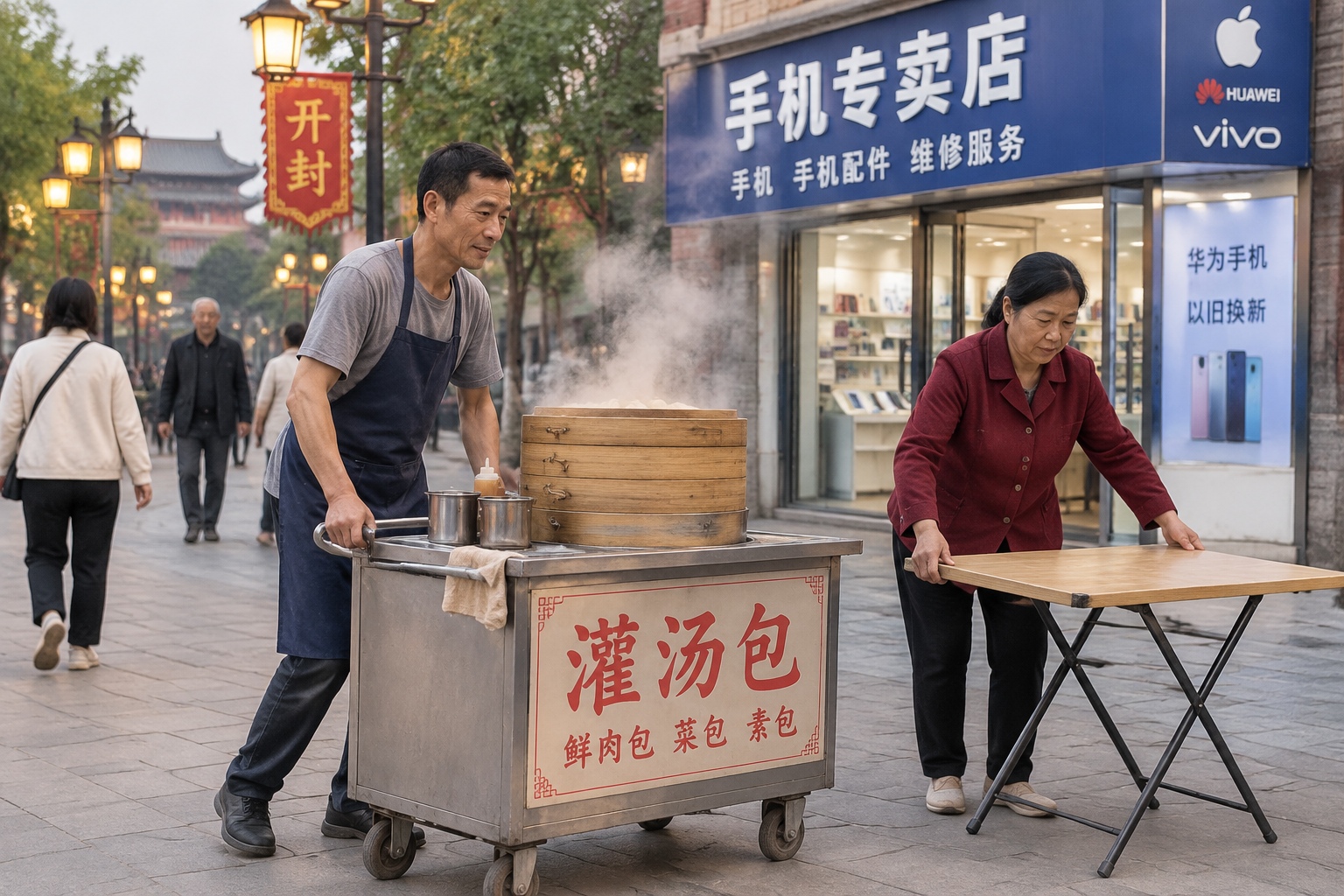
At 6:20 on a Saturday evening in Kaifeng, a man in a navy blue apron is reverse-parking a steel cart into two and a half metres of pavement outside a mobile phone shop. Left. Right. Left again. A woman with a folding table watches without comment, in the way people watch someone do a difficult thing badly. Then the gas burner clicks, steam lifts off a bamboo steamer, and the negotiation is over. The night has started.
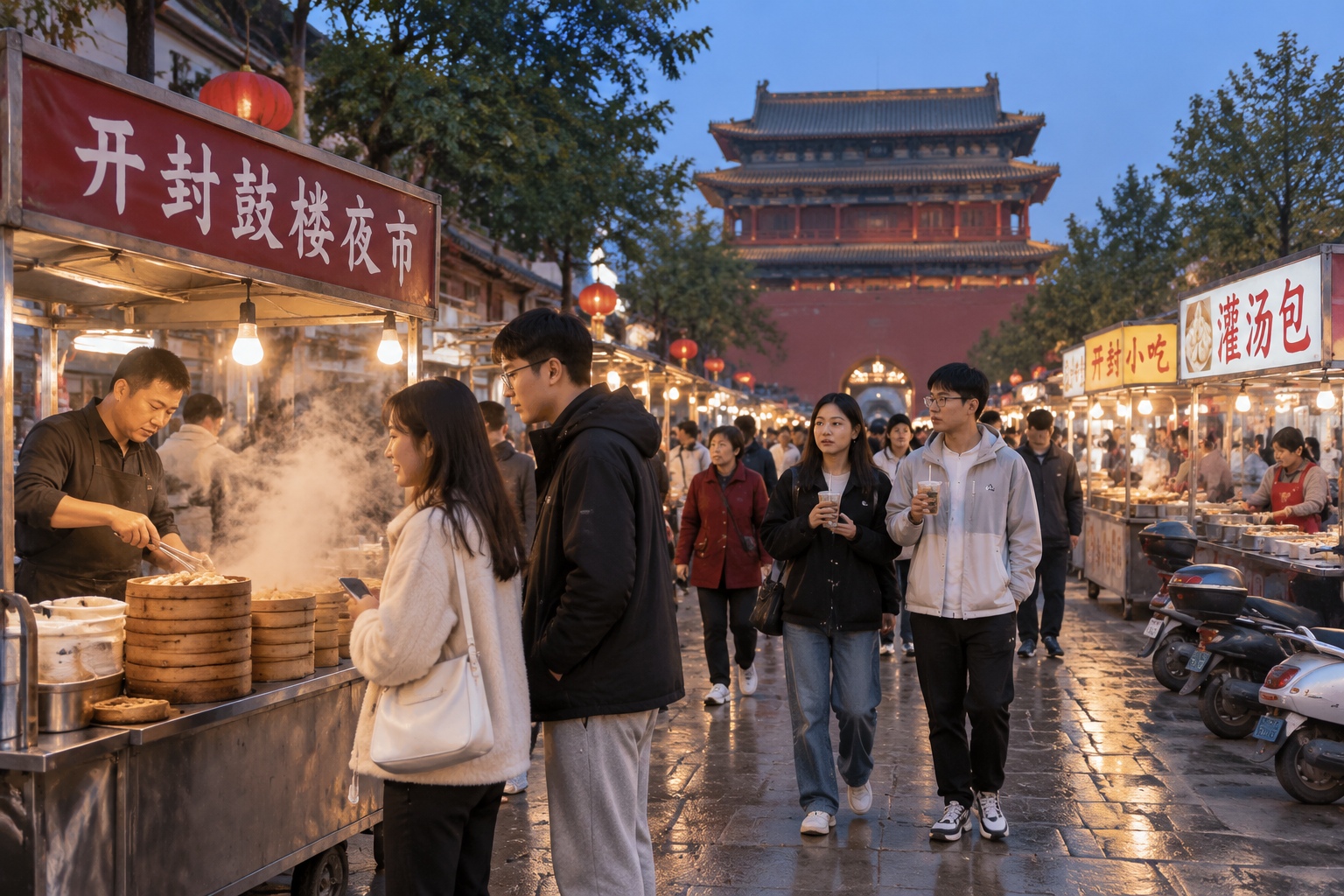
This is Gulou, the drum tower night market in the middle of Kaifeng, a city of about 4.8 million people in Henan province, roughly half an hour from Zhengzhou by high-speed train. By seven the smell has separated into layers: pork and soup dumplings down at knee height, cumin and squid at chest height, and somewhere above all of it the sweet, slightly burnt sugar of peanut candy being hammered flat on a stone slab.
The Song Dynasty Is the Story, Not the Business Model
Kaifeng’s night market credentials are not a marketing invention. Under the Northern Song (960–1127), the city — then called Dongjing — was probably the largest on earth, and it did something Chinese cities had not done before: it stayed open after dark. The old curfew that locked residents inside walled market squares at dusk fell apart. Shops traded late, food stalls ran past midnight, and officials complained about it in writing. Meng Yuanlao’s Dongjing Menghua Lu, a memoir of the lost capital written after the dynasty collapsed, is essentially a very long list of what people ate and where. Zhang Zeduan’s scroll Along the River During the Qingming Festival is the picture-book version: teahouses, wine shops, peddlers, a city that looks like it has better things to do than go to bed.
That history is genuinely fun, and Kaifeng knows it. There are Song-style costumes for rent, a rebuilt canal with pleasure boats, and a theme park that restages the Qingming scroll every day for ticket holders. But the past explains almost nothing about why the lights are on tonight. If a thousand years of heritage could run a night market, every ancient town in China would have a good one, and most of them don’t. What actually keeps Gulou working is duller and more interesting: stall permits, rubbish trucks, a road closed to cars at six, and a few thousand people deciding each afternoon that cooking outdoors is a better deal than the alternative.
What a City Eats Standing Up
Kaifeng’s signature is the soup dumpling — here usually called guan tang bao — thin-skinned, filled with pork and hot broth, sold by the basket for roughly 15 to 25 yuan (US$2–3.50). The correct technique is to bite a small hole, drink the broth, and then deal with the rest; the incorrect technique is to put the whole thing in your mouth and discover religion. Around it, the usual supporting cast: grilled squid skewers at 10 to 15 yuan, chao liangfen (cold jelly noodles fried with chilli and garlic) at about 10, lamb flatbread at 12, and peanut candy sold by weight, hammered flat while you watch because the hammering is the point.
A family of four can eat badly — in the good sense — for around 150 yuan. A student can eat for 20.
The crowd changes by the hour. Office workers arrive first, still in lanyards. Families with strollers take 7 to 8:30, when the noise is at its most forgiving. University students come after nine, moving in packs of six and buying one thing each. After ten the mix thins into people who are simply not going home yet: taxi drivers on a break, couples, a tour group trailing a guide holding a small flag above the steam.
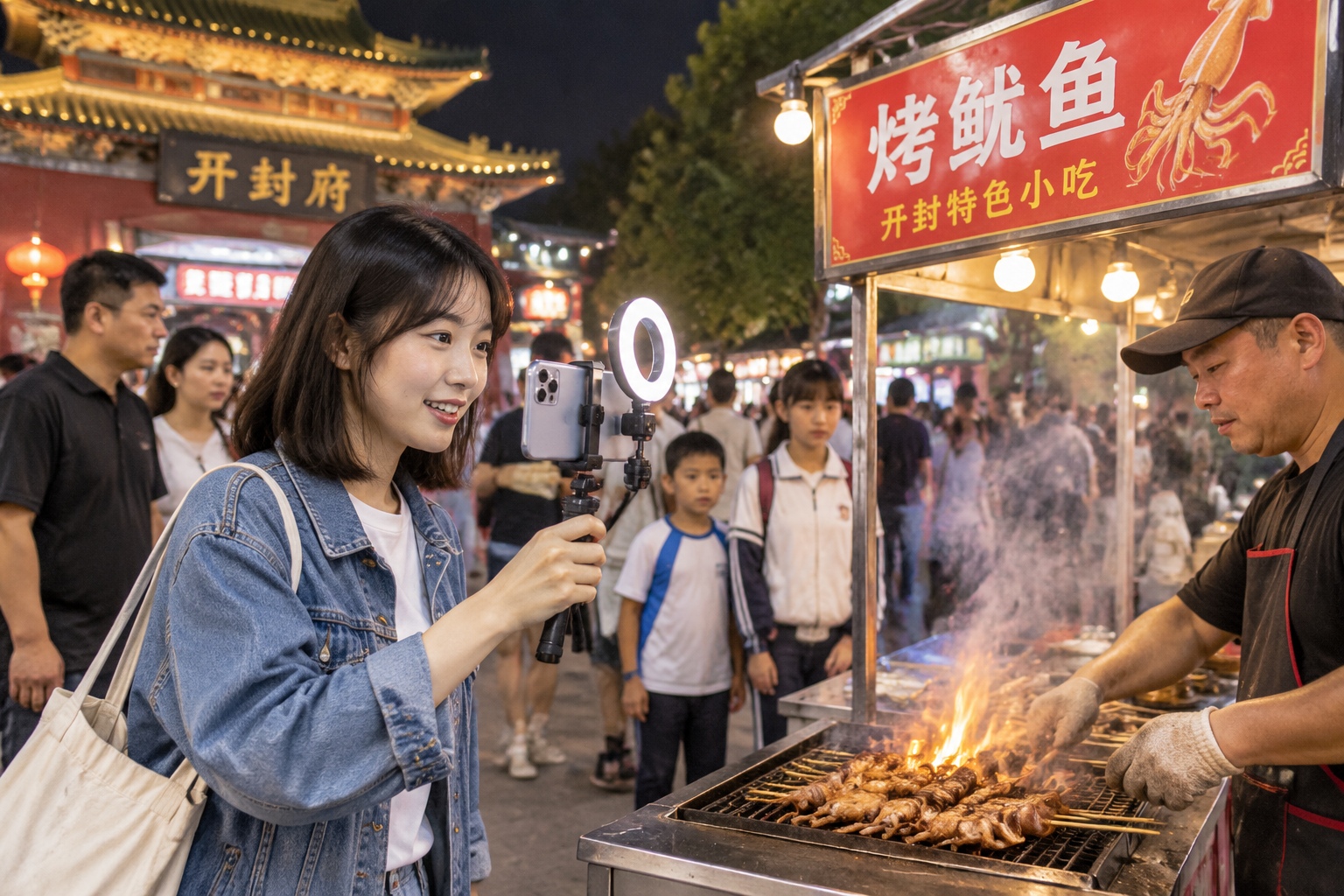
And everywhere, phones held up. A woman in her early twenties balances her phone on a pocket tripod, a small ring light clipped on, filming a squid skewer being turned over the flame for what appears to be the fourth time. She is not being vain; she is doing distribution. Somewhere on the other side of the country, someone is deciding whether to come to Kaifeng.
The Unromantic Machinery Behind the Steam
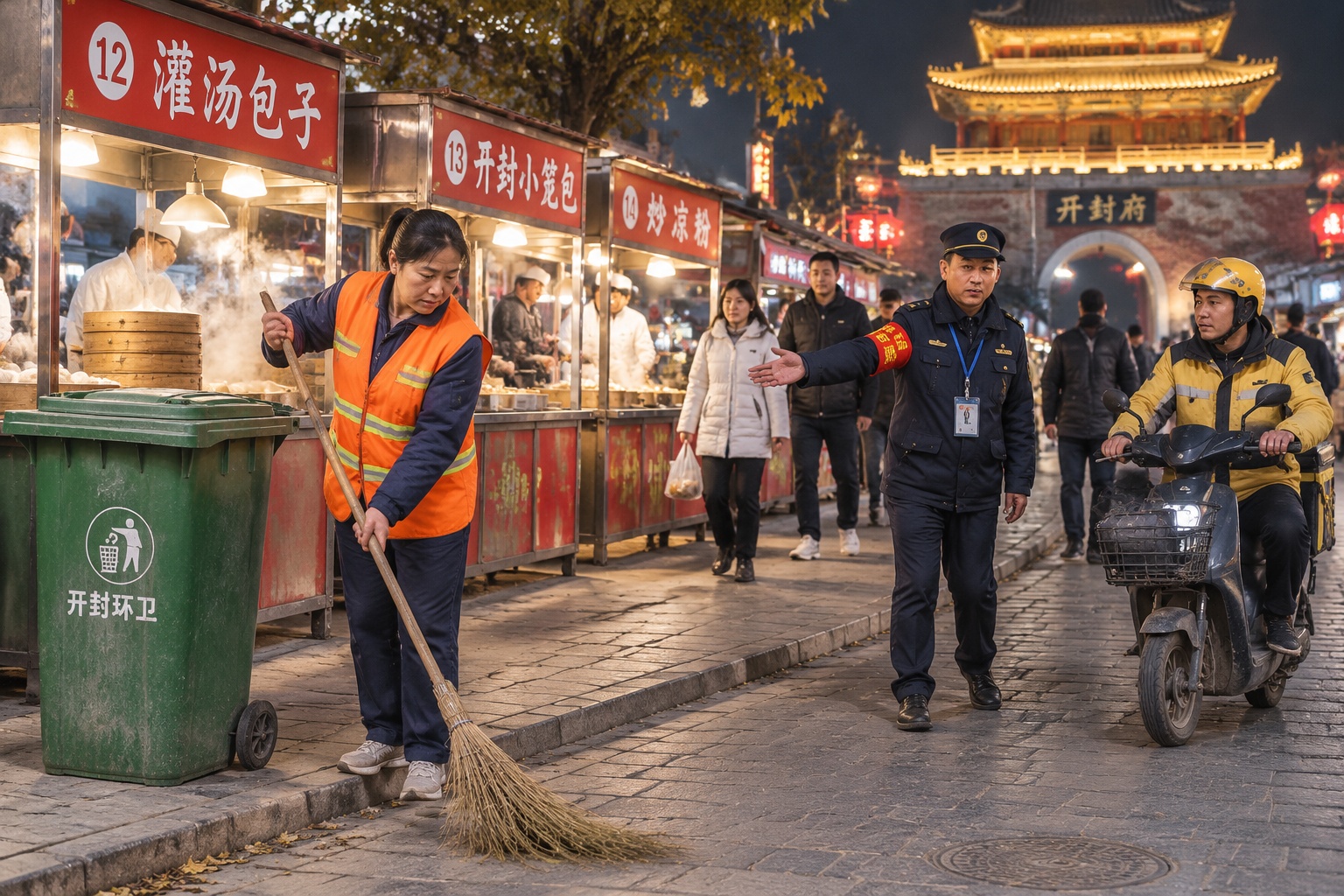
The reason the market feels loose and easy is that it is tightly organised. Stalls sit on a numbered grid with fixed footprints, assigned through district-level application, so that the same cart occupies the same patch of pavement every night and nobody has to fight for it at six o’clock. Vendors hold food-safety paperwork and are subject to spot checks; the ones selling raw seafood and the ones selling cooked food are not encouraged to share a stretch of kerb. Each cart carries its own bin, and a cleaning crew works the edges of the crowd all evening rather than waiting for the end.
Roads around the market close to vehicles in the early evening, and the surrounding blocks turn into a slow sea of scooters. Noise has a working curfew: amplified speakers are the first thing to be switched off, because the people living on the third and fourth floors above the dumpling stalls also have to get up in the morning. That last point is the least glamorous and most important. A night market is not a festival that happens to a neighbourhood; it is a negotiation with a neighbourhood, renewed nightly.
Who Actually Makes Money After Ten
The arithmetic is simple and unforgiving. A good pitch in a well-trafficked stretch costs several thousand yuan a month; a less good one costs less and earns less. Add gas, ingredients, a helper, and the ice needed to keep things cold in July. A dumpling stall doing steady business through the evening can clear a decent monthly income by Chinese city standards — not extravagant, but enough to be worth standing up for eight hours. A slow Tuesday in February can wipe out the week.
Around the full-time vendors sits a second layer of people making smaller, more flexible money. Students take weekend shifts for an hourly rate plus a meal. A woman who owns a small shop on the same street keeps the shop open until eleven because the foot traffic is outside anyway, and sells cold drinks from a fridge on the pavement. Delivery riders pass through the market constantly, not buying anything, picking up orders from the restaurants behind it. The night economy is not one job; it is a dozen kinds of part-time work arranged around a crowd.
The Phone Does More Than Pay
Every cart in Kaifeng takes QR payment, and most vendors now look faintly puzzled if you offer cash — the note goes into a plastic tub and stays there for a week. This is unremarkable in China and still worth explaining elsewhere: mobile payment didn’t modernise the night market so much as remove friction from it. No float of small change, no argument about a counterfeit note, no waiting while someone finds a wallet with wet hands.
Short video has done something bigger. A stall that gets filmed well can expect a queue of strangers within days, and vendors know it — hence the careful plating, the theatrical flame, the willingness to pause mid-pour so someone can get the shot. Group-buying vouchers bring in price-sensitive customers who arrive already committed to spending 29.9 yuan. None of this is exotic technology. It is just distribution and payment, arriving in a place that used to depend entirely on who happened to walk past.
The Parts That Don’t Photograph Well
Honesty requires a list of complaints. The biggest is sameness. Walk through enough Chinese night markets and you will see the same grilled squid, the same stinky tofu, the same ‘Changsha’ branding on stalls that have never been to Changsha, and the same spinning potato spiral. Kaifeng is better than most because it has real local dishes to fall back on, but even here the middle of the market converges on what is cheap, fast and photogenic.
Then there is seasonality. Summer is a crush, the Golden Week holidays in May and October are close to unmanageable, and January is a cold, quiet business in which vendors stand behind their steam for warmth and sell half as much. Residents above and beside the market complain, reasonably, about noise, rubbish and scooters parked across doorways. Traffic on the surrounding streets becomes a nightly problem with no elegant solution. And there is the ongoing argument about authenticity: how much of the ‘ancient city’ should be rebuilt as a stage set, and how much should be left as a place where people actually live and buy vegetables. Kaifeng has made both bets at once, and the two do not always get along.
Why a Night Market Is Public Infrastructure
Strip away the smoke and the Song dynasty branding, and what Kaifeng has built is a cheap, safe, well-lit place to be at eleven at night. That is rarer than it sounds. In many cities, an evening out means a restaurant with a minimum spend or a bar with a queue; the alternative is staying home. A night market offers the third option — public space with low prices, no dress code and no need to book. For a student, a retired couple or a family with a toddler, that changes what a city feels like after dark.
It also functions as an on-ramp to the economy. A cart and a gas burner cost a fraction of a shop lease, and the barrier to trying is low. Some of those carts become restaurants; most don’t. But the existence of the option matters, especially in a city that is not a first-tier metropolis and does not pretend to be. Kaifeng’s night market is not a tech story or a heritage story. It is a small-business story with very good lighting.
1:40 A.M.
By half past one, the market has thinned to a few dozen people and a lot of empty skewers. The man in the navy apron is stacking steamers, counting the evening on his phone, and doing the quiet arithmetic of a person who has to buy pork again tomorrow. A cleaner works along the kerb behind him with a wide broom, pushing a night’s worth of paper and skewers into a pile, unhurried, because the street will only be clean for about sixteen hours.
The stalls fold down. The scooters start up. Somewhere a lid comes off a bin. By two, the pavement outside the phone shop looks like nothing happened there at all — which is roughly what a thousand years of Kaifeng nightlife has taught the city: the important thing is not that it looks splendid in a painting, but that it can be set up again tomorrow.