


The Bookstore Shelf Test
Walk into a major bookstore in London, New York, or Toronto. You will likely find Jin Yong’s novels shelved under “Fantasy” or “Science Fiction,” right next to J.R.R. Tolkien and George R.R. Martin. The spine of the book might proudly display a blurb from The New Yorker or a similar publication: “The Tolkien of China.” For a Western reader browsing for something new, this is an efficient signpost. It says: This author built a world with deep lore, distinct cultures, and epic stakes.
I have lived in China long enough to see how my friends react when I mention that Jin Yong is often called the “Tolkien of China.” They usually laugh, not out of disrespect, but out of recognition. It’s like calling a spicy Sichuan hotpot “the Chinese soup.” Technically true? Maybe. But it misses the point entirely.
This analogy is a marketing triumph. It helped sell millions of copies of The Legend of the Condor Heroes and Demi-Gods and Semi-Devils to Western audiences who had never heard of wuxia. But as a lens for understanding Chinese culture, it is dangerously reductive. To truly understand what Jin Yong meant to China—and what he means today—we need to look past the swords and magic spells.

Why Publishers Love the Shortcut
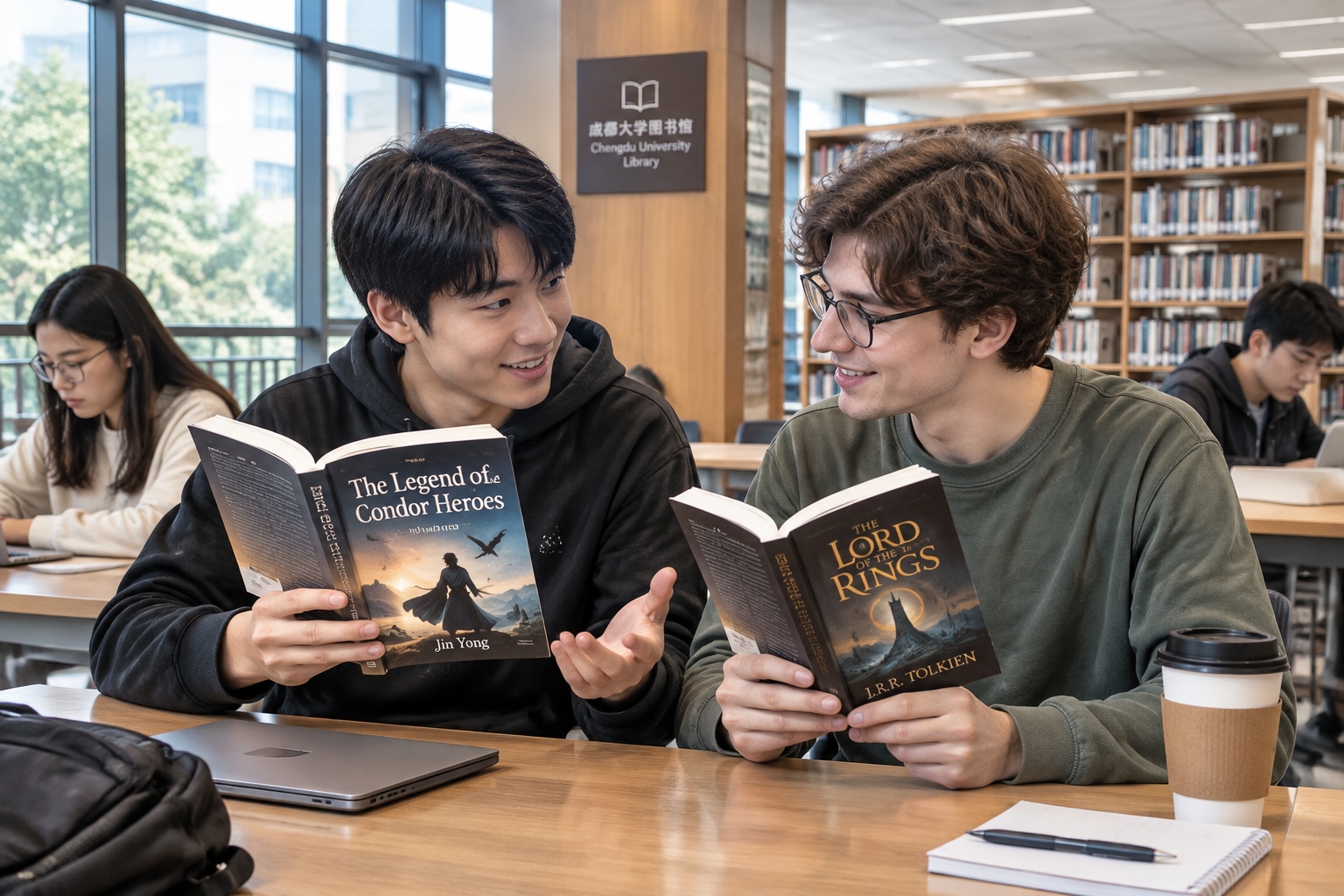
Let’s be honest about why this label exists. Publishing is a business of categorization. If you tell an American reader, “This is a story about a wandering swordsman navigating political intrigue in the Song Dynasty,” they might hesitate. It sounds like history homework. But if you say, “It’s like Lord of the Rings, but with kung fu,” their eyes light up.
For decades, wuxia (martial arts fiction) was seen in the West as pulp entertainment—low-brow, repetitive, and hard to translate due to its dense historical references. Calling Jin Yong “the Tolkien of China” elevated his status instantly. It signaled literary merit, complex world-building, and emotional depth. It gave Western critics permission to take wuxia seriously.
I remember buying a translated edition of The Return of the Condor Heroes in Beijing last year. The cover art was stylized to look like high-fantasy graphic novels. Inside, the introduction explicitly compared Jin Yong’s creation of the “Jianghu” (the martial world) to Tolkien’s Middle-earth. Both are secondary worlds that operate by their own rules. Both feature a clash between ancient powers and individual heroes. On this surface level, the comparison holds water.
The Missing King: Understanding ‘Jianghu’
Here is where the analogy starts to crack. Tolkien’s Middle-earth is ultimately a story about legitimacy and restoration. Aragorn reclaims his throne. The kings return. Order is restored through hierarchy, even if that hierarchy is magical.
Jin Yong’s China is different. There is no “return of the king.” In fact, in most wuxia novels, the emperor is often corrupt, absent, or irrelevant. The setting is Jianghu—literally “rivers and lakes,” but functionally a society outside the state.
If you are from Europe or North America, think of Jianghu not as a fantasy realm, but as a parallel society that exists in the cracks of official power. It is a place where laws are written by blood oaths and personal reputation, not by statutes. The central question isn’t “Who should sit on the throne?” It is “How do I live with honor when the system fails me?”
In China, this resonates deeply because of our historical experience with dynastic cycles. We have lived through many collapses of central authority. Jin Yong’s heroes are often people who feel alienated from the mainstream bureaucratic world. They choose a life of wandering, relying on their skills and moral code rather than government protection. This is not just fantasy; it is a cultural coping mechanism.
Chivalry Is Not Just About Fighting
When Western readers hear “martial arts,” they think of action scenes. They expect fast-paced combat, like in Crouching Tiger, Hidden Dragon. While Jin Yong does write great fight scenes, the core of wuxia is ethical philosophy.
The term for chivalry in Chinese is Xia. It doesn’t mean “knight.” A knight serves a lord. A Xia serves justice, often defined personally. This distinction matters. In Tolkien’s work, Frodo’s journey is about duty and sacrifice for the greater good of civilization. In Jin Yong’s work, characters like Guo Jing or Ling Huchong struggle with conflicting loyalties: to their sects, to their families, to the nation, and to their own conscience.
Consider a common trope in wuxia: the hero discovers that his mentor is actually a traitor. In a Western fantasy novel, this might be a plot twist about power. In wuxia, it is a crisis of identity. The hero must decide whether to kill his master (violating filial piety) or spare him (betraying justice). This tension reflects Confucian values colliding with individual moral agency.
My colleague in Shanghai, who grew up reading Jin Yong on serialized newspaper pages, told me: “Tolkien taught us about good and evil. Jin Yong taught us about gray areas.” That is the cost of the analogy. By focusing on the “fantasy” aspect, we lose the moral complexity that makes wuxia a mirror for Chinese social life.
History as a Character, Not a Backdrop
Tolkien drew from mythology and linguistics to create Middle-earth. It is timeless. Jin Yong draws from real history. His stories are set in specific dynasties—Song, Ming, Qing. The characters interact with historical figures like Genghis Khan or Emperor Kangxi.
For Chinese readers, this adds a layer of melancholy. We know how these dynasties fell. We know the tragedies that awaited China in the centuries following these stories. Jin Yong often writes about the frustration of trying to save a doomed nation. His heroes are frequently defeated not by villains, but by the tide of history.
This is far removed from the triumphant restoration in The Lord of the Rings. In wuxia, victory is often personal, small, and bittersweet. The hero saves one person, or upholds one promise, even if the empire collapses around them. This reflects a more pragmatic, resilient worldview common in East Asian literature.
Beyond the Label: How to Read Jin Yong Today
So, should we stop calling Jin Yong “the Tolkien of China”? Not entirely. The label has opened doors. But readers should walk through those doors with their eyes open.
If you are picking up a wuxia novel for the first time, don’t look for elves and dwarves. Look for the social dynamics. Watch how characters navigate hierarchy. Notice how silence speaks louder than swords in many scenes. Pay attention to the food, the medicine, the tea houses—these are not just set dressing; they are markers of class and culture.
In modern China, Jin Yong’s influence has shifted. Younger generations consume his stories through video games and TV adaptations. The “Jianghu” is now often metaphorical—it refers to the competitive business world or the chaotic internet landscape. But the core question remains: How do you maintain your integrity in a system that doesn’t value it?
Jin Yong is not just a fantasy writer. He is a philosopher of social survival. Calling him “the Tolkien of China” helps you find him on the shelf. Understanding why he isn’t quite Tolkien helps you understand China.