

A Summer Night Set Ablaze
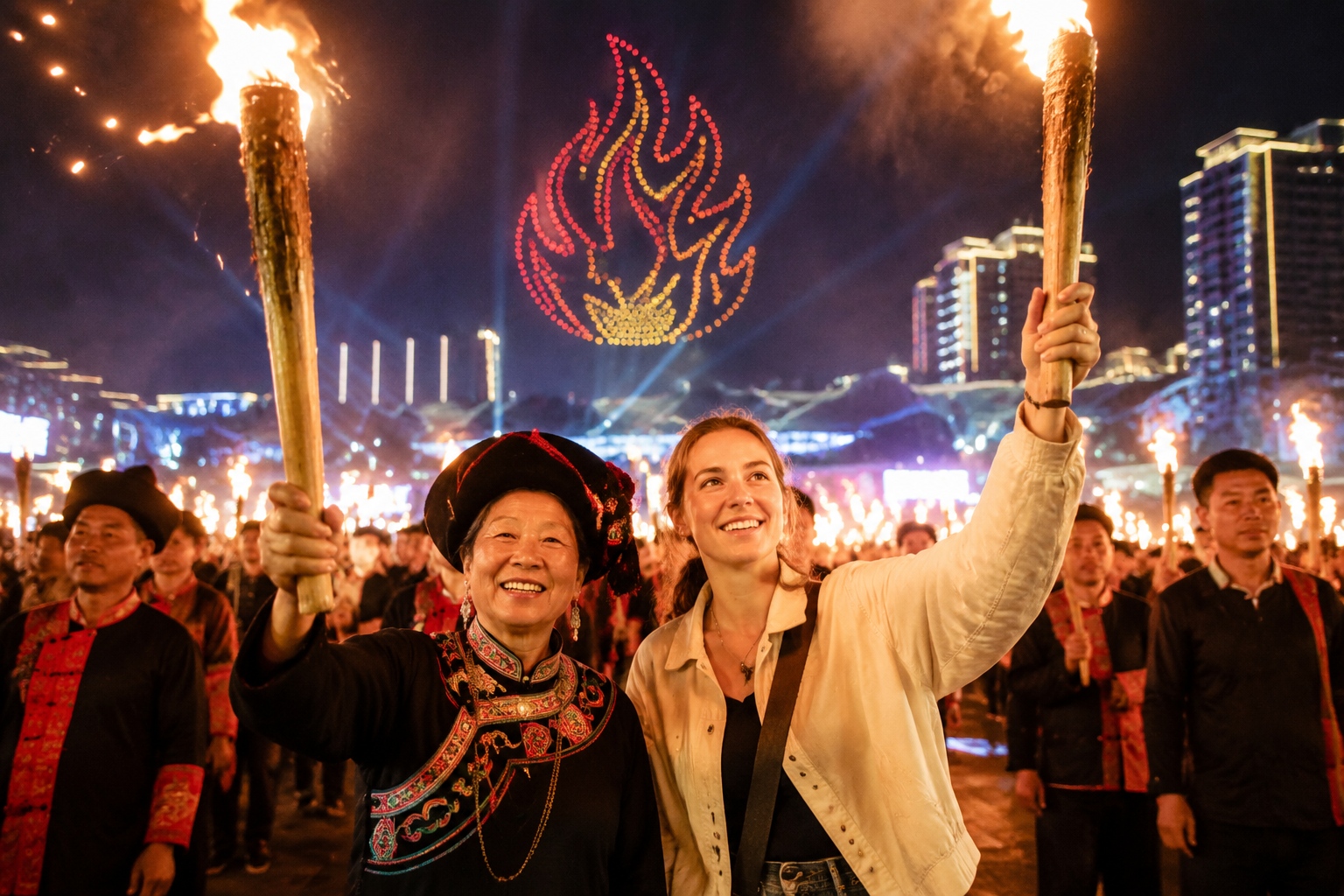
It’s nearly midnight in Xichang, the capital of Liangshan Yi Autonomous Prefecture, and the air smells of burning pine and wood smoke. In the city’s central square, thousands of people — Yi grandparents in embroidered headdresses, toddlers on shoulders, tourists from Europe and Southeast Asia — are all holding torches. When the fire chief gives a signal, a wall of flames leaps upward, and the crowd begins to move in a slow, hypnotic circle. A woman in her 70s, her face lined with years of mountain sun, hands me her torch and says in Mandarin, “You take it. It brings luck.”
This is the Torch Festival, the most important holiday for the Yi people, one of China’s 56 ethnic minorities. It takes place every year on the 24th day of the sixth lunar month, usually falling in July or August. For three days and nights, Liangshan — a mountainous region home to the largest Yi population — becomes a stage for fire, dance, music, and celebration.
What Is the Torch Festival?
The festival dates back centuries, rooted in the Yi people’s reverence for fire. In ancient times, fire was both a tool and a protector. It kept wild animals away, cleared fields, and warmed the long winters. The Yi believed that fire could drive away evil spirits and bring a good harvest. Villagers would light torches and walk around their fields, praying for crops to grow tall, livestock to stay healthy, and families to be safe.
There are also legends linked to the festival. One popular story tells of a hero named Atilabia who was killed by a god who controlled hail and drought. To avenge him, people lit torches on the day he died, and the flames confused the evil god. Since then, the ritual has been a way to honor the past and ask for protection.
Rituals Passed Down Through Generations
Watching the festival unfold, you see layers of tradition. On the first day, a group of elders performs the “fire ceremony” — a sacred act of igniting a new flame using a concave mirror or a wooden fire drill. This holy fire is then used to light all other torches.
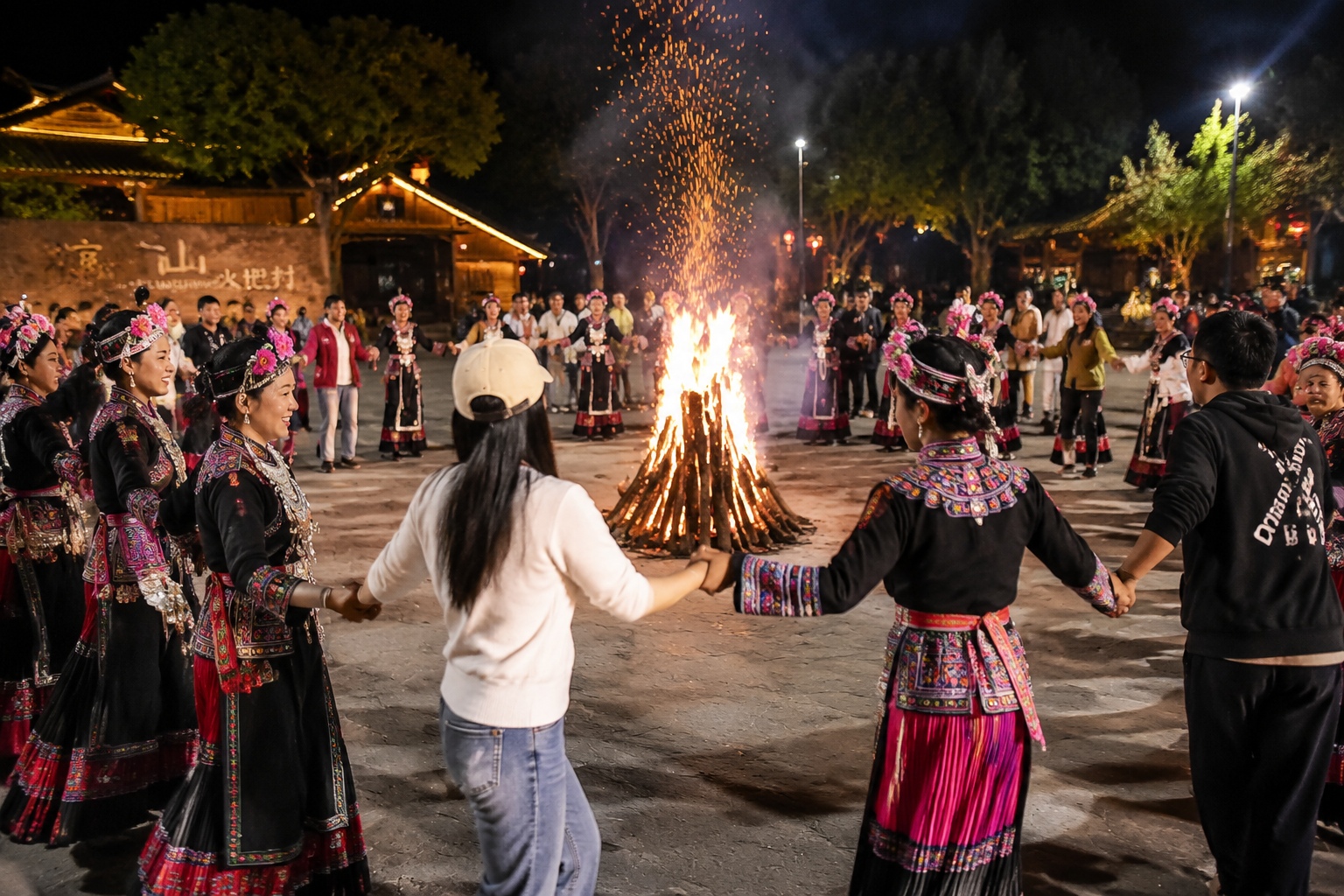
Then comes the procession. Villagers and townspeople walk through the streets, carrying torches into the fields, around their homes, and even into the local temples. The night sky fills with sparks and smoke, and the drumbeats of the “duo ti” dance — a group dance where people hold hands and move together in circles — echo across the valleys.
But not everything is about fire. The festival is also a time for bullfights, wrestling matches, horse racing, and archery contests. Young Yi men show off their strength and skill, while young women dress in their finest silver jewelry, elaborate headdresses, and handwoven skirts. One of the most anticipated events is the “Beauty Contest” (often called “the Beauty of the Torch Festival”), where women and men are chosen for their charm, poise, and knowledge of Yi culture.
“People think we only play with fire,” laughs Aji, a 19-year-old student from a nearby village, who is selling hand-painted wooden masks at the festival. “But really, it’s a huge family reunion. We eat together, sing together, and remember who we are.”
A Festival That Embraces Modernity
Walk to the edge of the main square, and you’ll see another festival happening in parallel. A massive electronic stage blasts music from DJs, and lasers cut through the smoke. A drone light show draws shapes in the sky — first a flame, then a horned sheep, then the Chinese characters for “Liangshan.” Young people film everything on their phones, live-streaming to platforms like Douyin and Kuaishou, where the hashtag #TorchFestival has already gathered billions of views.
This is the “new” Torch Festival — a carefully produced cultural tourism event that local government and businesses have embraced. There are fireworks, celebrity performances, and a “torch race” that turns the ancient ritual into a kind of urban marathon, with runners carrying torches through the city streets.
The mix is jarring at first. Traditional Yi music plays alongside electronic beats. Grandmothers in ethnic dress dance next to teenagers with glowing LED bracelets. But over the past decade, the blend has become a signature of Liangshan’s approach to preserving culture: let it breathe, but make it relevant. A local tourism official explained to me, “We don’t want to be a museum. We want the festival to be a living thing that each generation can add to.”
Voices From the Ground
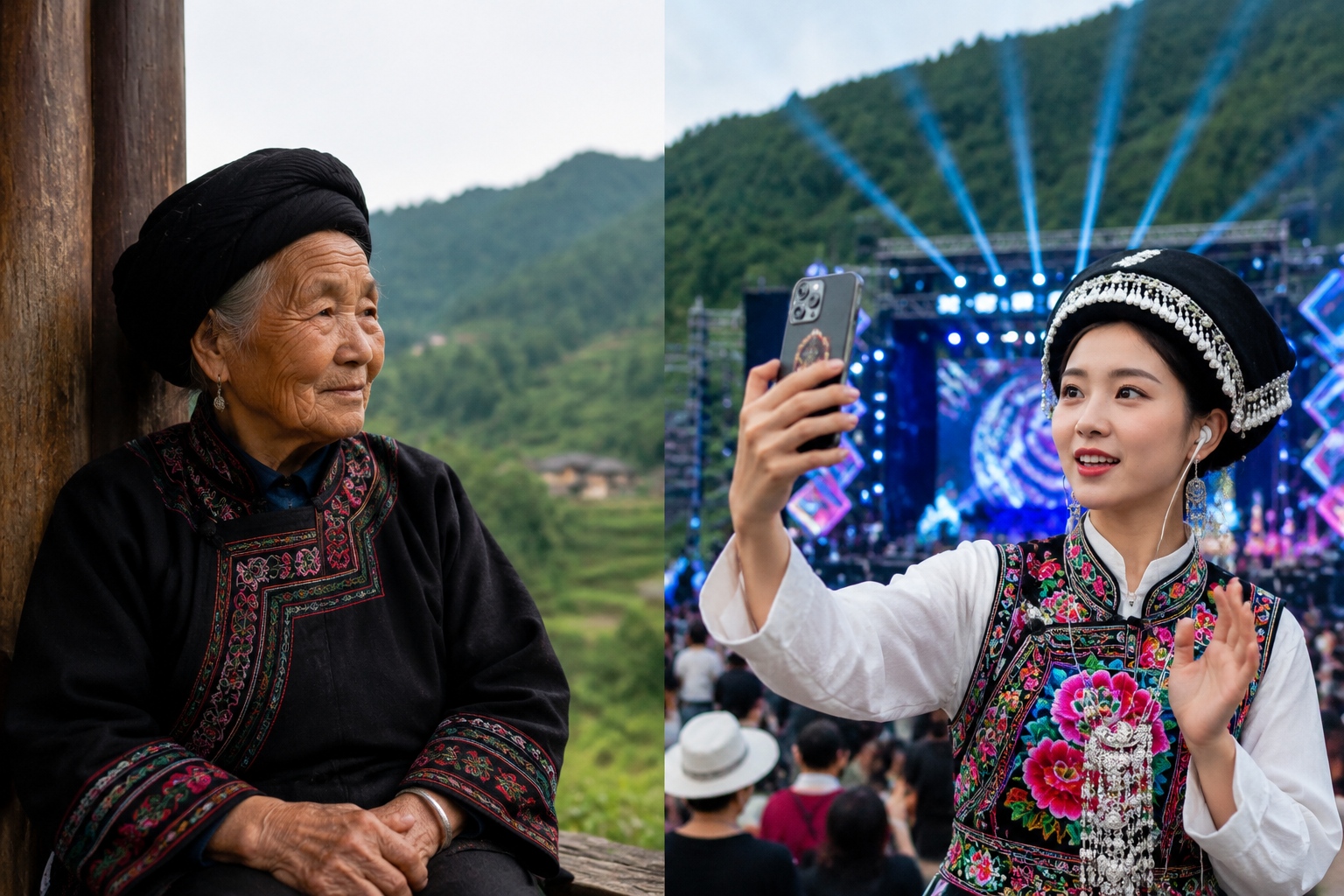
That living spirit is visible in the people who make their living from the festival. Take Li Qiong, a 32-year-old who returned to her hometown five years ago to open a guesthouse. “Before the festival, we used to have almost no visitors,” she says, pouring tea for a group of tourists from Shanghai. “Now, bookings start six months in advance. My whole family helps out — my father drives guests from the station, my mother cooks, my brother leads hiking tours.”
For Li, the festival is not just nostalgia but a livelihood. She’s built a small library with books about Yi history, and she invites local elders to tell stories to her guests. “I want visitors to understand the meaning behind the flames, not just take selfies.”
Then there’s Sha Sha, a 24-year-old Yi woman who learned to embroider from her grandmother. During the festival, she sets up a live stream on her phone, showing hands working on traditional patterns. “Last year, I sold 3,000 embroidered pouches online,” she says with a bright smile. “Customers are from all over China — and some from the US and Europe too.” She laughs. “The internet is our new torch.”
A Dutch backpacker named Tom, who traveled to China for the first time, is amazed. “I saw the drone show and thought, okay, this is a cool music festival. But then an old woman grabbed my hand and taught me the duo ti dance. I felt a real connection, thousands of years old. I’ll never forget it.”
Beyond the Festivities: Economic Ripples
The Torch Festival has become a major economic engine for Liangshan, which is one of China’s less developed regions. During the three-day event, Xichang’s hotels reach nearly 100% occupancy, restaurants double their meals, and local airlines add extra flights. The prefecture government estimates that the festival attracts over one million visitors each year, generating hundreds of millions of yuan in revenue.
But the growth hasn’t come without questions. Some locals worry that the commercial push is losing the festival’s spiritual core. “In the past, we lit torches in the fields, quietly. Now, it feels like a stage,” says an older Yi man who prefers to stay anonymous. “But,” he adds, “if we didn’t adapt, would my grandchildren still want to come back to the village?”
The challenge of balancing tradition and tourism is real. Yet many young Yi people see this as an opportunity. More and more, local schools teach the handmade crafts and songs that were once passed down orally. The festival has also become a platform for preserving the Yi script — one of the few original syllabary systems still used today.
Carrying the Flame Forward
On the last night, I find a spot among the crowd. The sky is thick with smoke, and the fire has broken loose from a central bonfire into dozens of smaller circles. People are singing, some in Yi, some in Mandarin, some in English. A little girl blows out a spark on her grandfather’s sleeve; he smiles and lifts her higher so she can see better.
For me, the Torch Festival is a perfect example of what makes modern China complex and fascinating: it doesn’t have to choose between heritage and innovation. It can hold a smartphone in one hand and a torch in the other.
As the flames begin to die down, an old man taps me on the shoulder. “You know,” he says, “our ancestors also told stories around these fires. Now we tell them on WeChat. But the fire — the fire is the same.”
The embers glow, and the crowd slowly starts to move away. But on the ground, a new torch is already being prepared for the next year.
If you’ve never seen a thousand-year-old ritual meet a drone show, come to Liangshan in July. Just be ready to dance.
Start the discussion at forum.chinacomes.com