

A City of Two Impressions
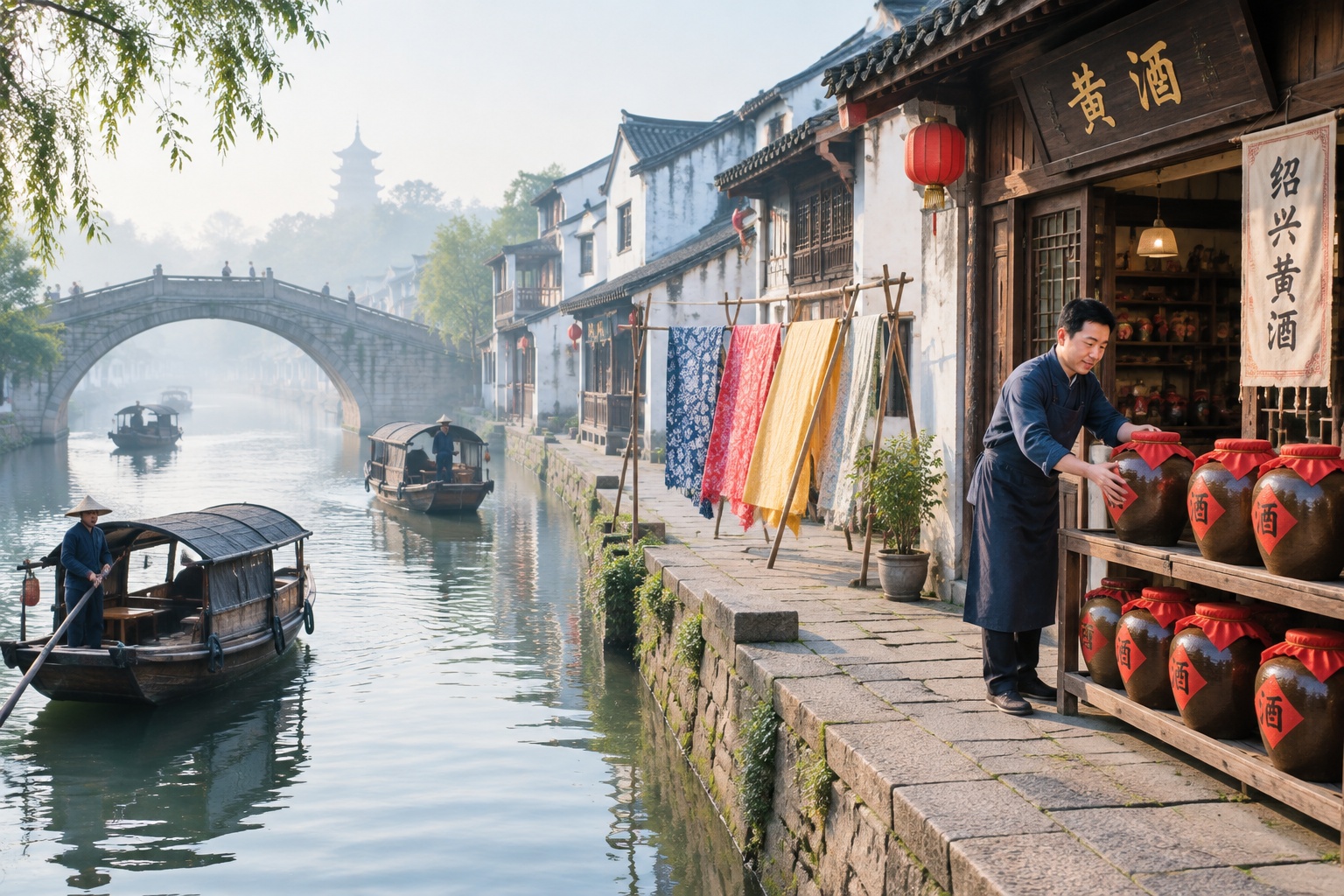
Early morning in Shaoxing, and the air is thick with the aroma of fermenting rice. On a stone path along the canal, a shop owner opens her wooden shutters and begins stacking clay jars of yellow rice wine into neat rows. Not far away, under the white walls of a modern factory, nylon threads are running at high speed on looms. The canal itself is busy: a dark-awning wupeng boat glides by, carrying a handful of tourists, while a small cargo boat loaded with bales of cloth putters in the opposite direction. This is Shaoxing, a city of about 5 million people in China’s Zhejiang province. On the surface, it appears to be two different places living side by side. But spend a day here and you’ll realize that the old and the new are not just neighbors; they are partners.
Ancient Water, Ancient Drink
Shaoxing’s identity starts with its water. The city occupies a low-lying plain, crisscrossed by rivers and lakes. That water has a particular taste, with a high mineral content and only subtle sweetness. It is perfect for making rice wine. Shaoxing wine, often called huangjiu (yellow wine), has been produced here for about 2,400 years. Even the famous writer Lu Xun, a native son, often wrote about the wine in his stories, using it as a symbol of home and memory.
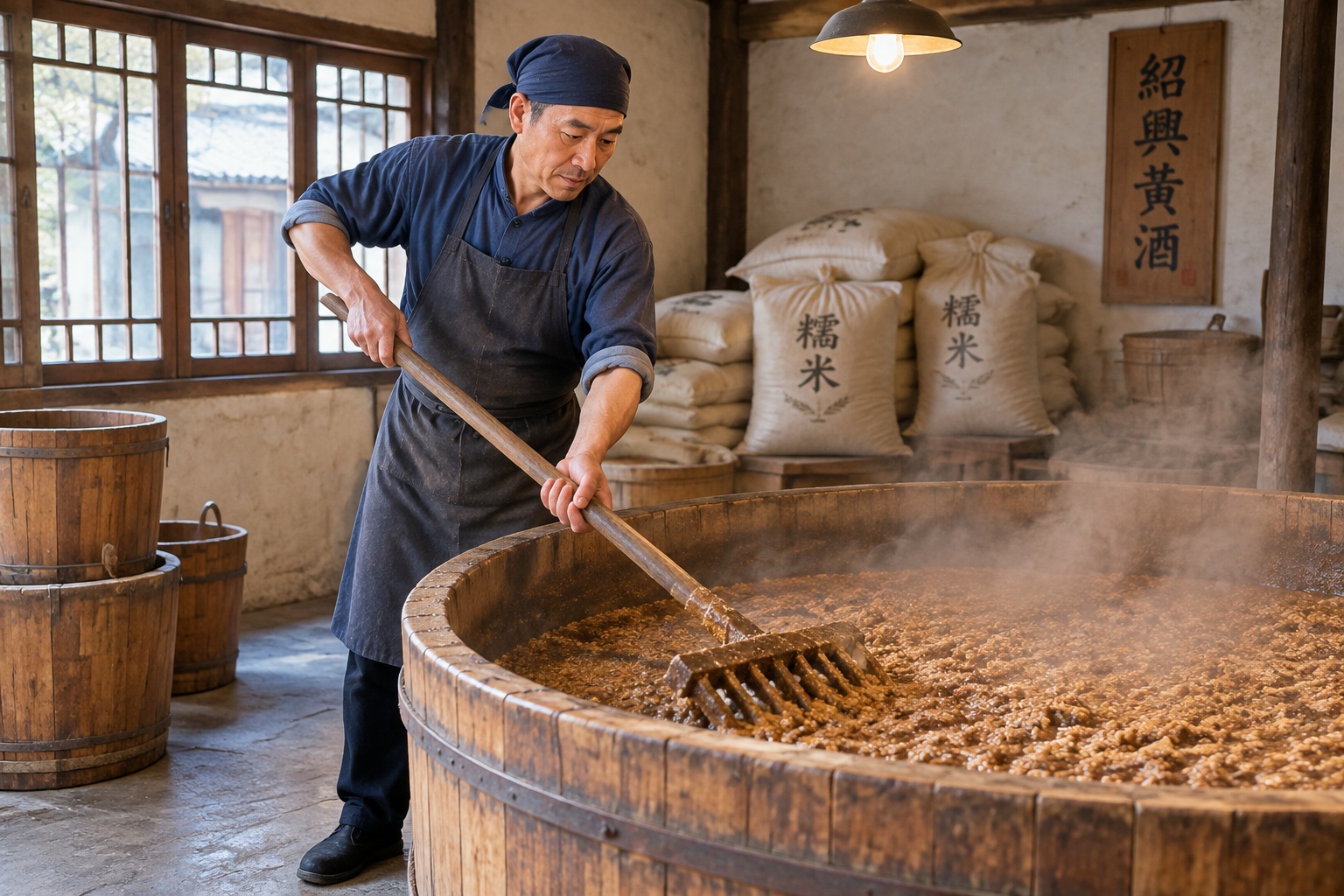
Making huangjiu is slow work. First, high-quality glutinous rice is washed and steamed. Next, a fermentation culture called wheat qu is mixed with the rice. After that, water from the local lake is added, and the mash is left to ferment. The most critical step is “kāipá,” literally “opening the rake.” A master worker turns the mash with a wooden rake to control temperature and oxygen. It has to be done at the exact time, sometimes in the middle of the night. This skill takes years to learn and is still done by hand.
For locals, rice wine is not a museum piece. It is a daily drink, a cooking ingredient, and a social lubricant. In the morning, you see elderly men carry plastic jugs with handles, refilled at the local wine shop for a few yuan. A bowl of hot wine with noodles or a piece of youtiao is a classic breakfast. Lunch and dinner tables often have a small bottle, usually warm. The wine is also used in dishes like marinated chicken and braised pork belly. If you are invited to a Shaoxing home, the first thing the host does is bring you a cup, not strong, just gentle and warming.
That said, drinking habits are evolving. Younger generations prefer lower alcohol drinks or even cocktails that use rice wine as a base. You now see specialty bars and tea houses offering “yellow wine old-fashioned” or “ricetini.” But the old tradition isn’t gone. It’s being remixed.
The Fabric Empire You Haven’t Heard Of
Now, drive twenty minutes west to Keqiao. The scenery changes from ancient bridges and black-awning boats to wide boulevards and glass shopping buildings. This is the core of China’s textile manufacturing cluster. Here sits the China Textile City, an enormous wholesale marketplace that looks like a never-ending series of warehouses and showrooms. More than 20,000 business owners operate from this district, according to local government data. They sell fabric for almost every purpose: cotton for bedsheets, polyester for jackets, silk for high-end dresses, and technical textiles for automotive and construction use.
The scale is difficult to grasp. The textile market’s transaction value in 2023 passed 200 billion yuan (about $28 billion). If you look at a piece of clothing sold in Europe or the United States, there is a decent chance that the fabric came from this city. In fact, an estimated third of China’s textile exports pass through Keqiao. Let that sink in for a minute.
In the back streets of the market, small workshops and huge factories mix. In one of them, I met Zhang Li, a 38-year-old mother of two from Jiangxi province. She has worked at a weaving factory for six years. “The job is simple but the machines are smart,” she told me. She manages six looms, watching screens and fixing thread breaks. Her son and daughter go to a nearby public school. “We have our own room in the workers’ dormitory, and the factory gives us a hot meal. It’s not bad,” she said. Thousands of workers like Zhang make the global supply chain run quietly.
The last decade has also brought drastic changes. Many local textile companies have moved to automated equipment and now hire engineers and designers. Some work with Italian and Japanese design studios to develop new fabric technologies. They pride themselves on being able to produce a small batch with a very fine pattern in days, something that would have taken weeks before.

Wine and Warp: Unexpected Mirrors
If you line up a vat of rice wine and a roll of synthetic fabric, they don’t seem to have anything in common. But ask the people who make them, and you’ll hear a shared language: water, time, and precision.
Water matters because both rice wine and dyed fabric require clean water. In the 1990s and 2000s, the booming textile industry in Keqiao seriously polluted local rivers. The government later forced factories to move into industrial parks with centralized wastewater treatment. Around the same time, ancient wine makers and environmentalists pushed for better protection of the drinking water sources. Today, the canals are much cleaner. Local environmental agencies publish weekly water quality data, and many residents have started fishing and swimming in the waterways again.
Time is another link. A good batch of rice wine is not rushed. It needs several months to a decade of aging. A good piece of textile is also about patience – from designing the pattern to dyeing and finishing, each step requires careful control. If you try to speed up, quality drops. In both industries, the old-timers use the same metaphor: “You can’t rush a good thing.”
Precision is the third commonality. The master stirs the mash at precisely the right moment, adjusting for temperature and humidity. The weaver adjusts the tension of each thread. The pair may seem distant, but they are both craftspeople in the truest sense of the word.
The View from the Street
For visitors, Shaoxing is often packaged as a taste of old China: a ride on a wupeng boat, a stroll through the former residence of Lu Xun, and, of course, a sip of warm rice wine. But locals see a more complicated picture. There is pride in the city’s history, but also an eye toward the future. A textile trader told me, “If we only look back, we won’t survive. But if we forget our roots, we’d be the same as every other industrial city.”
That balance is visible in small things. The green vines on a factory wall might be planted around a recycled wine barrel. The aroma of a brewery might drift over a sewing workshop. The new metro line connects the old town with Keqiao, making it easy for tourists to end their day at a fabric market, buying not only a piece of clothing but also the story of the city.
Young people are particularly active in blending the old and new. At a café in the old town, I saw a special “yellow wine latte” on the menu. The drink is made with a small amount of rice wine, espresso, steamed milk, and a caramelized rice cracker on top. It sounds strange, but it tastes warm and balanced. The owner, a woman in her twenties, said she wanted to introduce young customers to her hometown’s beverage in a way that felt less formal. “It’s not a ceremony anymore,” she said. “It’s part of my daily life.”

A Mirror of China Itself
Shaoxing is often called a “museum city” because of its well-preserved water town scenery. But it’s also a factory city, a port, and a home to many migrant workers. That combination might seem contradictory, but it is exactly what makes Shaoxing a useful lens for understanding China’s broader story. The country has spent decades building a modern economy without erasing its history. There are real costs: environmental pressure, urban sprawl, and the struggle to keep traditional crafts alive. But there are also real benefits: global trade links, income growth, and a youthful curiosity about their own roots.
If you stand at one of the old bridges at dusk, you’ll see another mirror. The reflection of the traditional houses shimmers in the water; behind them, the bright windows of a textile factory are also reflected. After sunset, the two images are separated only by the river. But in the morning, they are washed up together again, filling the city with the smell of rice wine and the hum of looms. That, in a nutshell, is Shaoxing.
Start the discussion at forum.chinacomes.com