
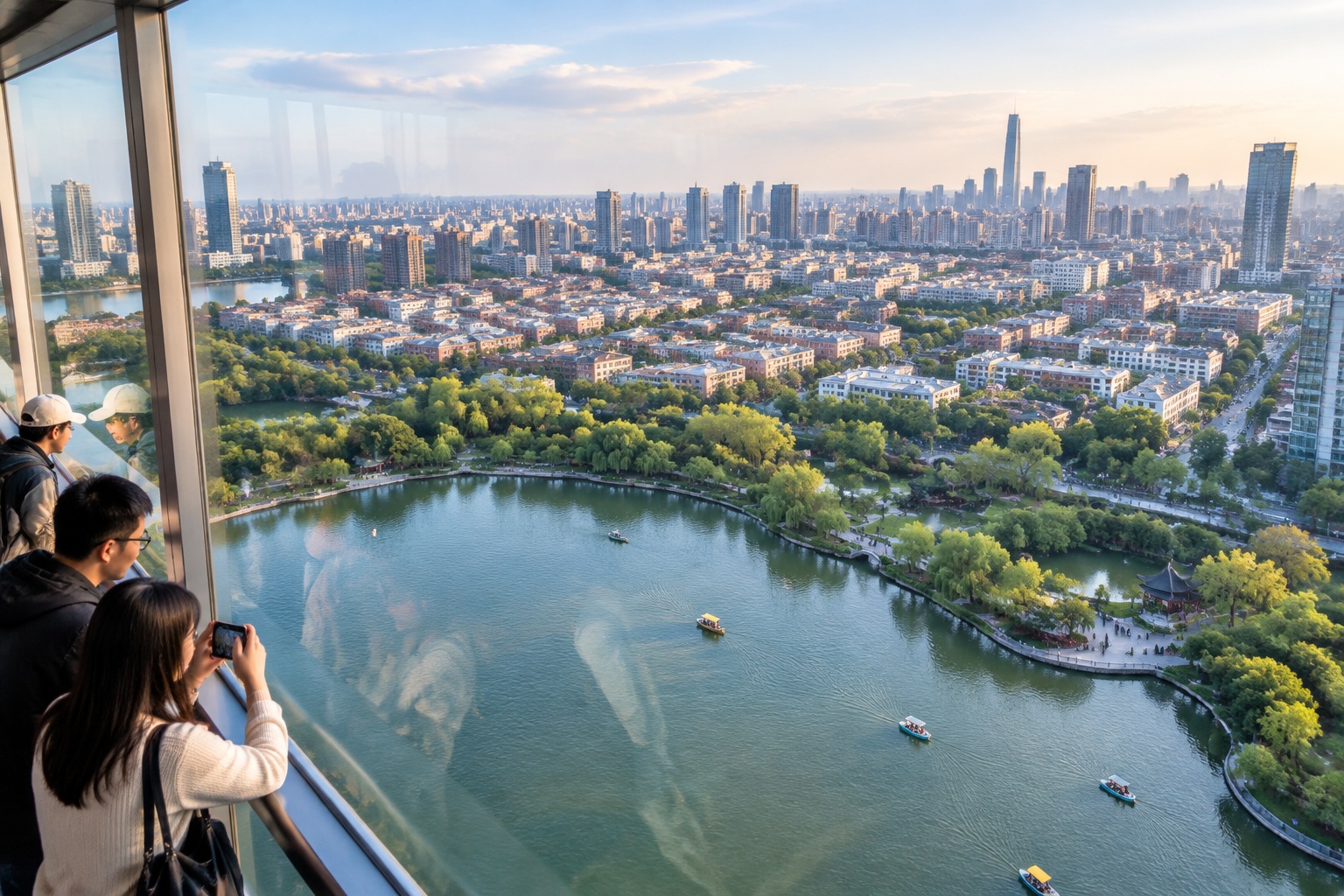

A Landmark Almost Nobody Queues For
On a Tuesday afternoon in early spring, the lift up Tianjin Tower carried four people: a technician who works in the building, two teenagers filming themselves, and me. Forty minutes later, I still had an entire wall of windows to myself.
That is a strange thing to be able to say about a 415.2-metre tower. When it opened in 1991, Tianjin Tower was one of the tallest structures of its kind in Asia. It still ranks around sixth in Asia and third in China. That number looks good on a poster, and it tells you almost nothing about what it feels like to stand up there.
The quiet has an explanation. Tianjin sits about 30 minutes from Beijing by high-speed train, which means many visitors treat the city as a half-day stop squeezed between the Forbidden City and a flight home. And the tower is a working broadcast mast first, a tourist attraction second. Its real job is pushing television and radio signals across the region. The observation deck is the side business.
What the Ride Up Feels Like
The lift takes under a minute. Your ears pop somewhere around the twentieth floor.
You step out into the observation hall at roughly 253 metres — about the height of a 60-storey office block. The hall is a ring of tall windows. The first thing that hits you is not the height. It is how flat Tianjin is.
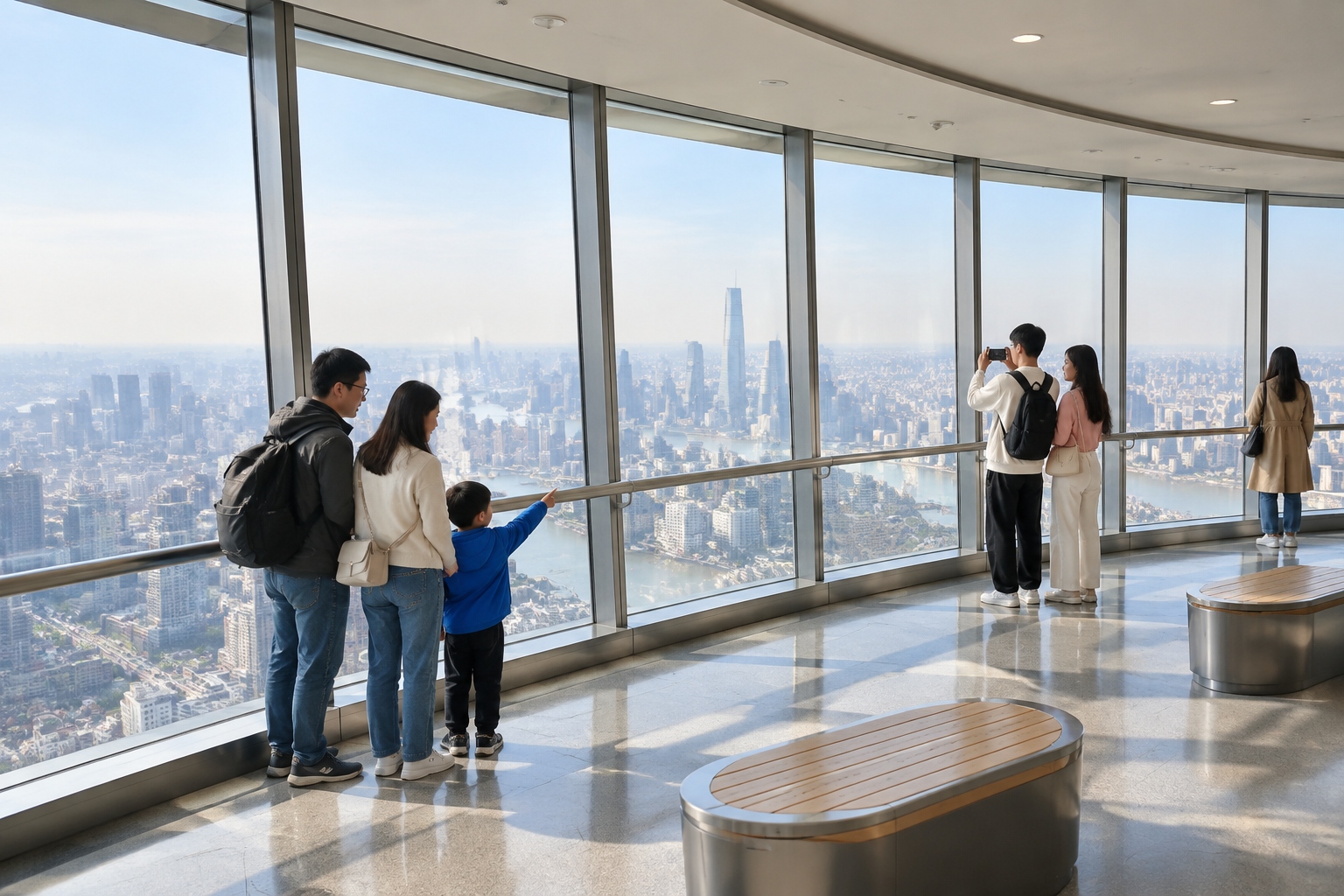
Reading the City From 253 Metres
From up here, Tianjin stops looking like a postcard and starts looking like a place where thirteen million people go to work.
The big green shapes directly below belong to Water Park and the lake the tower stands beside. You can pick out rowing boats in summer, joggers on the paths, and the small bright dots of children’s rides. In winter the same lake turns grey and hard, and a few people walk out onto it anyway.
Beyond the park, the street grid runs almost straight to every horizon. Tianjin is not a city of dramatic hills or a famous waterfront skyline. It is a northern port city that grew outward in rings, and from above you can see the logic of it: dense low-rise blocks, wide roads, and then clusters of glass towers where the newer districts were built.
Find the river. The Hai River curls through the city in a slow S, and almost everything old in Tianjin happens along it — the former trading quarters, the bridges, the evening promenades. From the tower it looks like a silver thread stitching two different cities together.
One floor above the observation hall is a revolving level. At different points in the tower’s life it has operated as a restaurant. It turns slowly enough that you only notice when the same landmark drifts back into view.
Check the air before you buy a ticket
Northern China still has smog days, mostly in winter. On a bad one, 253 metres buys you a grey-white haze and maybe two kilometres of visibility. On the day after rain or a strong north wind, you can see far into the suburbs, and if the light is right, the Tianjin Eye — a ferris wheel built into a bridge over the river — shows up as a thin circle to the northwest.
Air quality forecasts are public and easy to check on any weather app. It is worth thirty seconds of your time.
Down Below: The Park Is the Real Attraction
If you only go up the tower, you miss the better half of the visit.
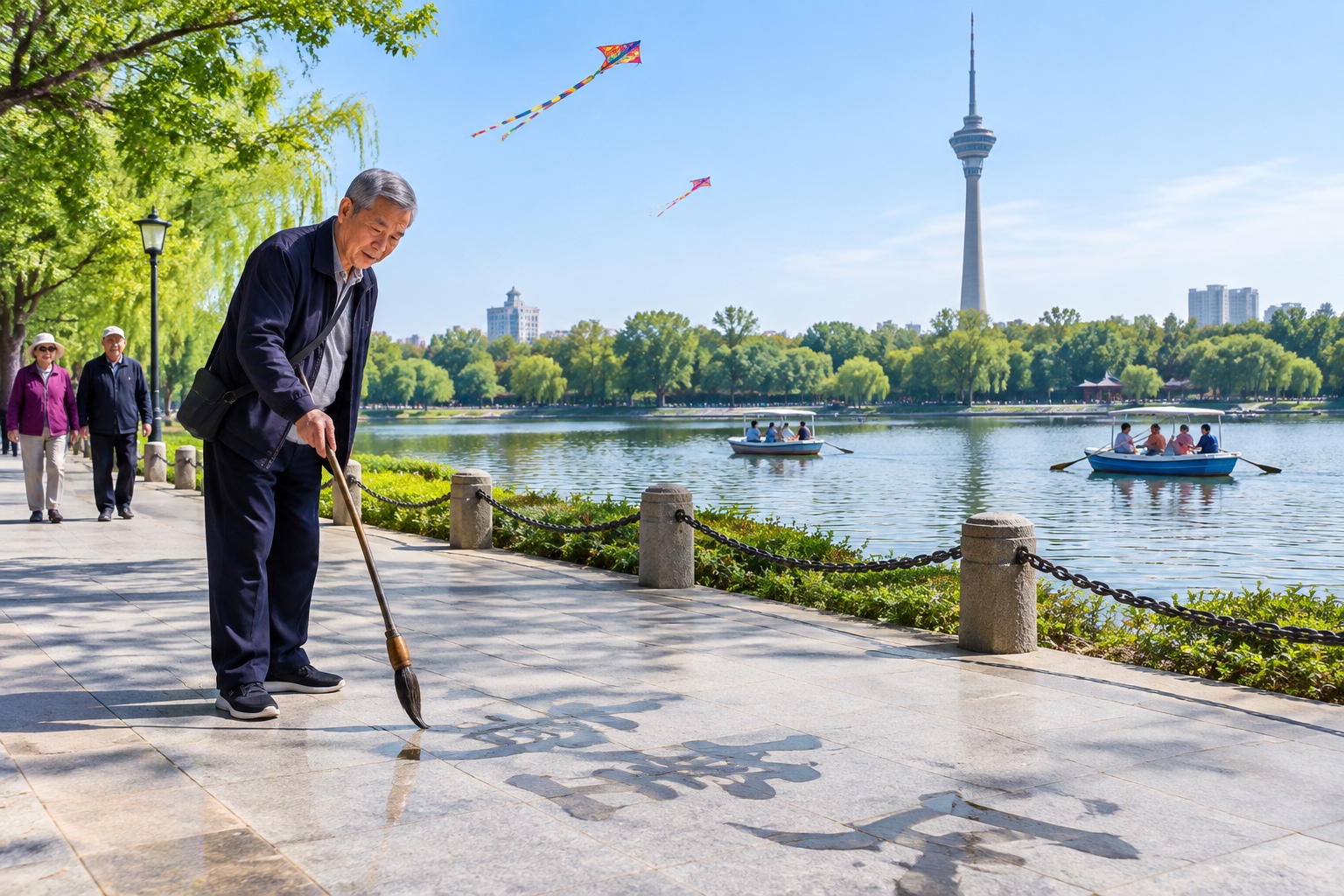
Water Park is one of the largest green spaces in Tianjin, a cluster of lakes and tree-lined paths that dropped its admission fee well over a decade ago and has been free to enter since. On a weekday morning it belongs to retirees. On a weekend afternoon it belongs to everyone.
What you will see, roughly in order of how often you will see it:
Men and women in their sixties and seventies writing Chinese characters on the paving stones with long brushes dipped in water. The strokes are confident and quick. Within a minute the sun erases them, and the writer starts again a few metres along. It is calligraphy as a daily workout, not a performance.
Kite flyers, who need wind and get it. Tianjin is close enough to the coast that the breeze is reliable, and on a good day the sky above the lake fills with shapes — swallows, dragons, and the occasional unidentifiable rectangle that still flies beautifully.
Diabolo spinners, twirling a hollow bamboo spool on a string between two sticks. It hums. It is a sound you will hear in parks across northern China and almost nowhere else.
Dance groups with portable speakers, grandparents minding toddlers, students on benches with milk tea, and vendors selling roasted sweet potatoes in the cold months. Ordinary park life, with one difference: a 415-metre tower standing over all of it like a very patient neighbour.
Old City, New City, One View
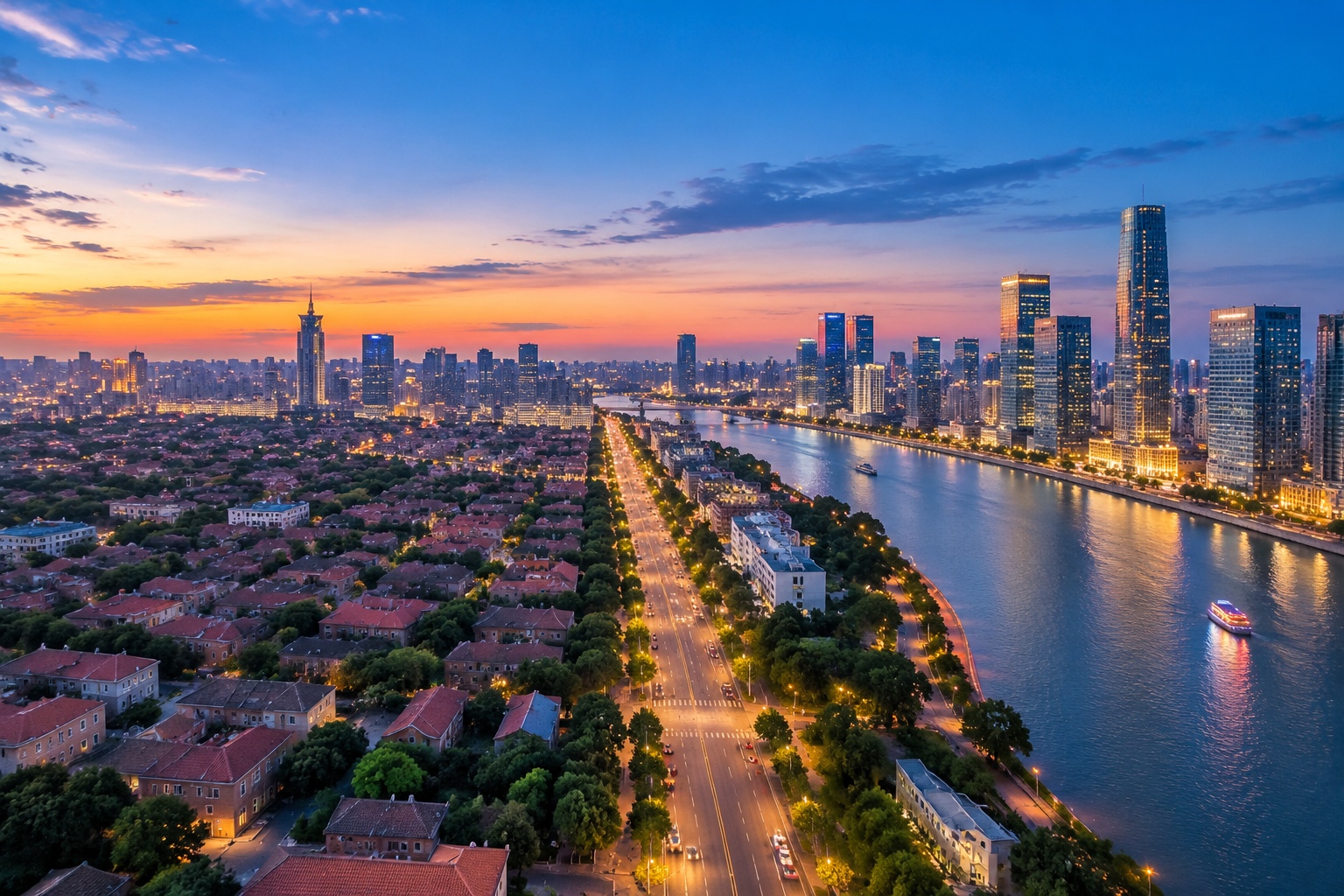
Go up in the late afternoon and stay for the lights. That is when the contrast gets interesting.
Look toward the older parts of town and you see low buildings and red roofs, a texture that comes from the concession era, when foreign powers held districts here and left behind European-style villas. The Five Great Avenues area is the best-known example, and from above it reads as a patch of trees with roofs poking through.
Turn a little and the picture changes completely: glass towers along the river, construction cranes, new residential blocks stretching toward the outer ring roads. Then the streetlights come on in waves, and the two cities — old and new — end up lit the same colour.
On a clear day, look west and you may spot something odd on the horizon: a very tall, dark, unlit slab. That is Goldin Finance 117, a 597-metre skyscraper that topped out years ago and never opened. It is a reminder that China’s building boom has had false starts, not just finished landmarks.
If You Go: A Half-Day Plan That Works
Getting there is easy. Tianjin Metro Line 3 has a station named after the tower — Tiantä station, written 天塔 — and it is a short walk from the exit. A taxi from the central railway station takes around twenty minutes depending on traffic.
Go in the late afternoon. Arrive roughly an hour before sunset and one ticket buys you three views: daylight, dusk, and the city switching its lights on. Weekday afternoons are the quietest; weekends and public holidays bring families and school groups.
Tickets and opening hours change from time to time, so check the current details before you set out. Bring a light jacket — it is noticeably windier and cooler at the top than at street level — and a phone with a compass app if you want to match what you see with a map.
Afterwards, walk into Water Park and let the tower shrink behind you. For dinner, the Olympic Sports Centre area a couple of metro stops away has a wide range of restaurants, and street-level snacks near the park gates are cheap and good. If you have energy left, Line 3 continues north toward the Italian Style Town and the Hai River promenade, which is where many locals end their evening.
What the View Actually Tells You
Tianjin does not perform for visitors the way Beijing or Shanghai does. It is a working port city of more than thirteen million people, and most of what is interesting about it is not staged.
The tower fits that personality. It broadcasts, it hosts the occasional school trip, it gives you a clean window and a quiet floor. What you get for your ticket is not a thrill. It is perspective — the chance to watch a very large Chinese city go about an ordinary day, with nobody down there looking back up at you.
Start the discussion at forum.chinacomes.com