


Let me start with a question a friend asked me after her first trip to Tibet: “Why are there so many cafés in Lhasa?” It made me smile. Ten years ago, you would have been hard pressed to find a proper flat white within a whole day’s walk of the Potala Palace. Today, on a single block near the Jokhang Temple, you can smell roasting coffee beans, Tibetan incense, and fresh bread at almost the same time. And the people pouring those cups are no longer only outsiders. A growing number of Tibetan entrepreneurs in their twenties and thirties have decided that the oldest city on the plateau is also a place to build something new.
Why Coffee, Why Lhasa?
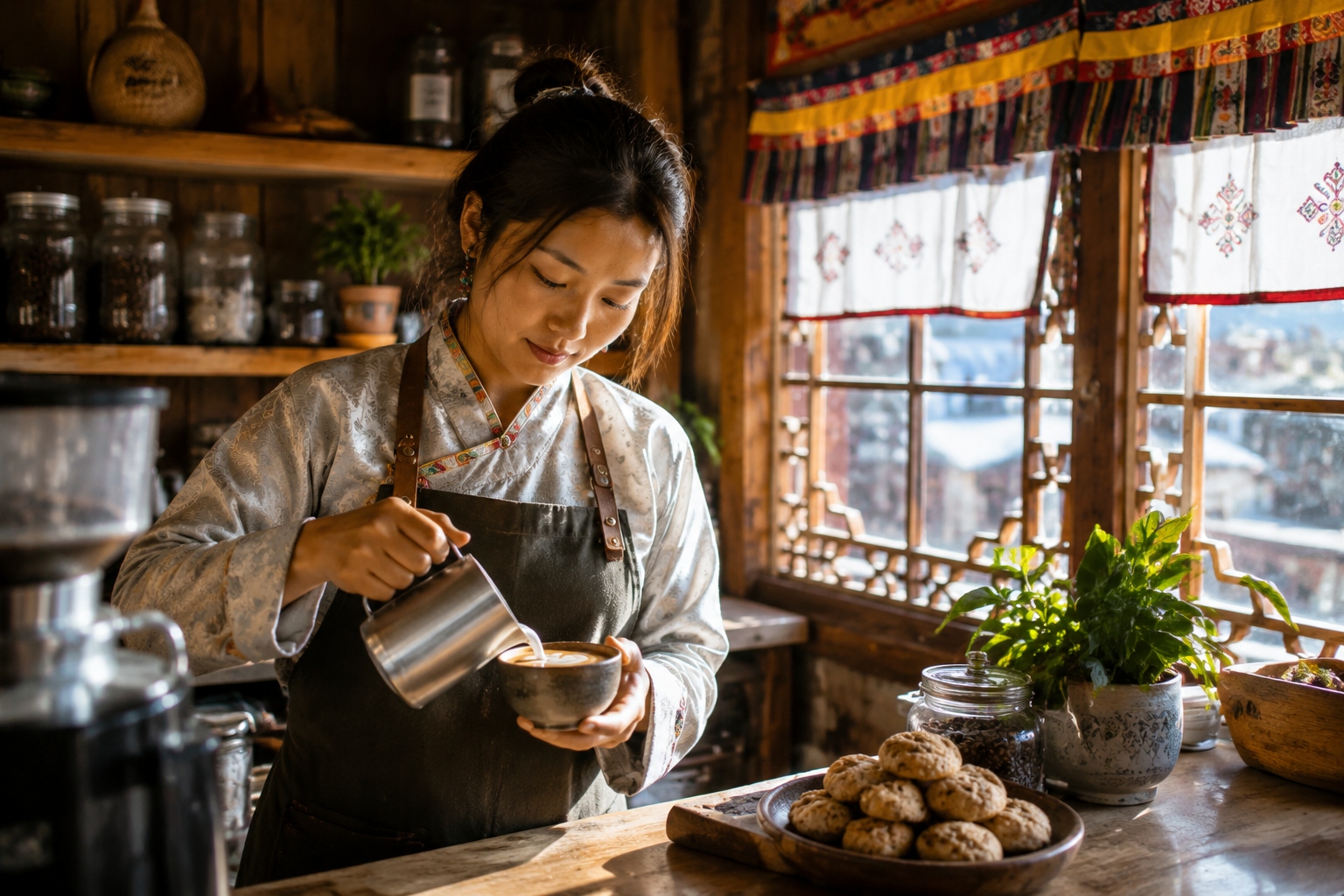
Lhasa sits about 3,650 meters above sea level, roughly the altitude of Cusco in Peru. At that height, water boils before it feels hot, and a decent espresso requires patience. Tsering, 29, runs a 15-seat café two streets from Barkhor market. She grew up on butter tea, and she still serves it. But she noticed something missing: a comfortable third place where young Tibetans could sit with a laptop, meet a friend, or show a visiting classmate how far their city has changed.
“My landlord thought I was crazy when I said I wanted to install a proper coffee machine,” Tsering laughs. “He said, ‘People in Lhasa don’t pay 28 yuan for coffee.’ He was wrong.” Her menu mixes the familiar with the new: a Tibetan sweet-tea latte made with yak milk, highland barley bread, and a locally sourced coffee bean from Yunnan. “Tourists think it’s exotic. My Tibetan regulars say it tastes like home. Both are fine.”
Café owners also pay attention to details outsiders might miss. In Lhasa, the afternoon sunlight is strong, so many café windows use traditional fabric curtains to soften it without killing the light. The furniture is wooden and low, echoing tea house styles, but the sockets are modern and plentiful. That mix is exactly what makes these spaces feel of this generation.
Tsering is part of a broader wave. Lhasa now has dozens of independent cafés in the old town, and the number is growing. Some are opened by returnees from Chengdu, Shanghai, or Beijing who came home after university. Others are built by locals who learned the trade in lower-altitude cities. Coffee, in their hands, is not a style statement. It is a service industry for a city where the old rhythm of tea houses meets the new rhythm of laptops and side projects.
From Tibetan Kitchens to Live-Stream Shopping
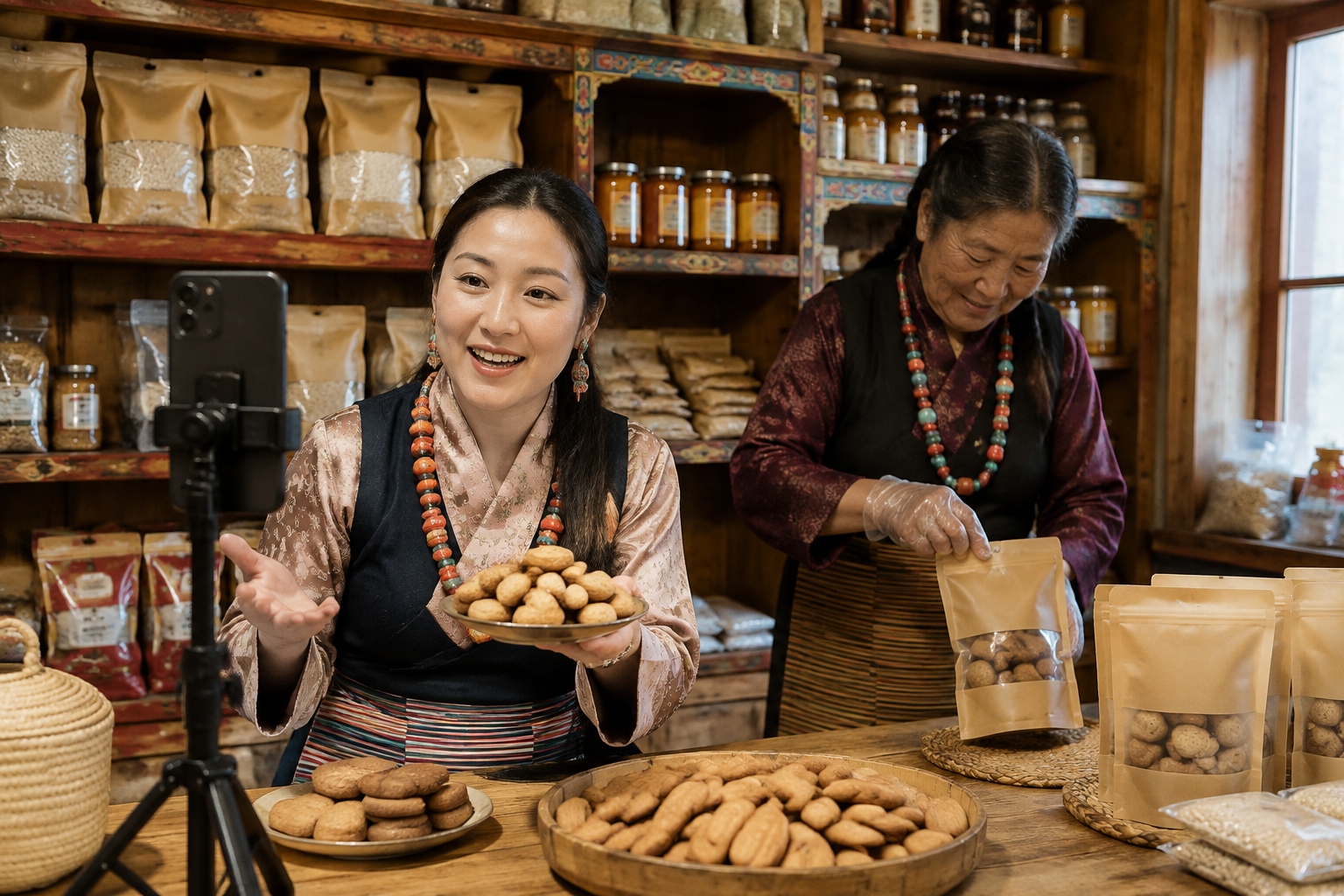
Three blocks away, 31-year-old Drolma runs a food studio that smells like melted butter and toasted barley. During the day she bakes Tibetan-style cookies with highland barley, wild honey, and a pinch of local spice. In the evening she turns her phone into a small broadcast station. “I started with 45 followers and a tripod,” she says. “I did not plan to become an internet celebrity. I just wanted someone in Shanghai to know what a real highland barley cookie tastes like.”
Her live-streaming shows, mostly on Douyin and Taobao, feel less like a sales pitch and more like a kitchen visit. She talks about the harvest season in Nyingchi, shows how her niece colors the dough with beetroot, and answers questions while the oven timer runs. “Lhasa is far from coastal cities, but logistics have changed. A small box of cookies can reach Beijing in two days. That wasn’t true when I started.”
Her team has grown to eight women, many of whom had never held a formal job. She teaches them product photography, packaging, and customer service. Her mother, who once told her that butter was the only business a girl needed, now packs boxes every Thursday. “The hardest part was not baking. It was believing people would pay for something we always had at home.”
What Are Cultural NFTs, Really?
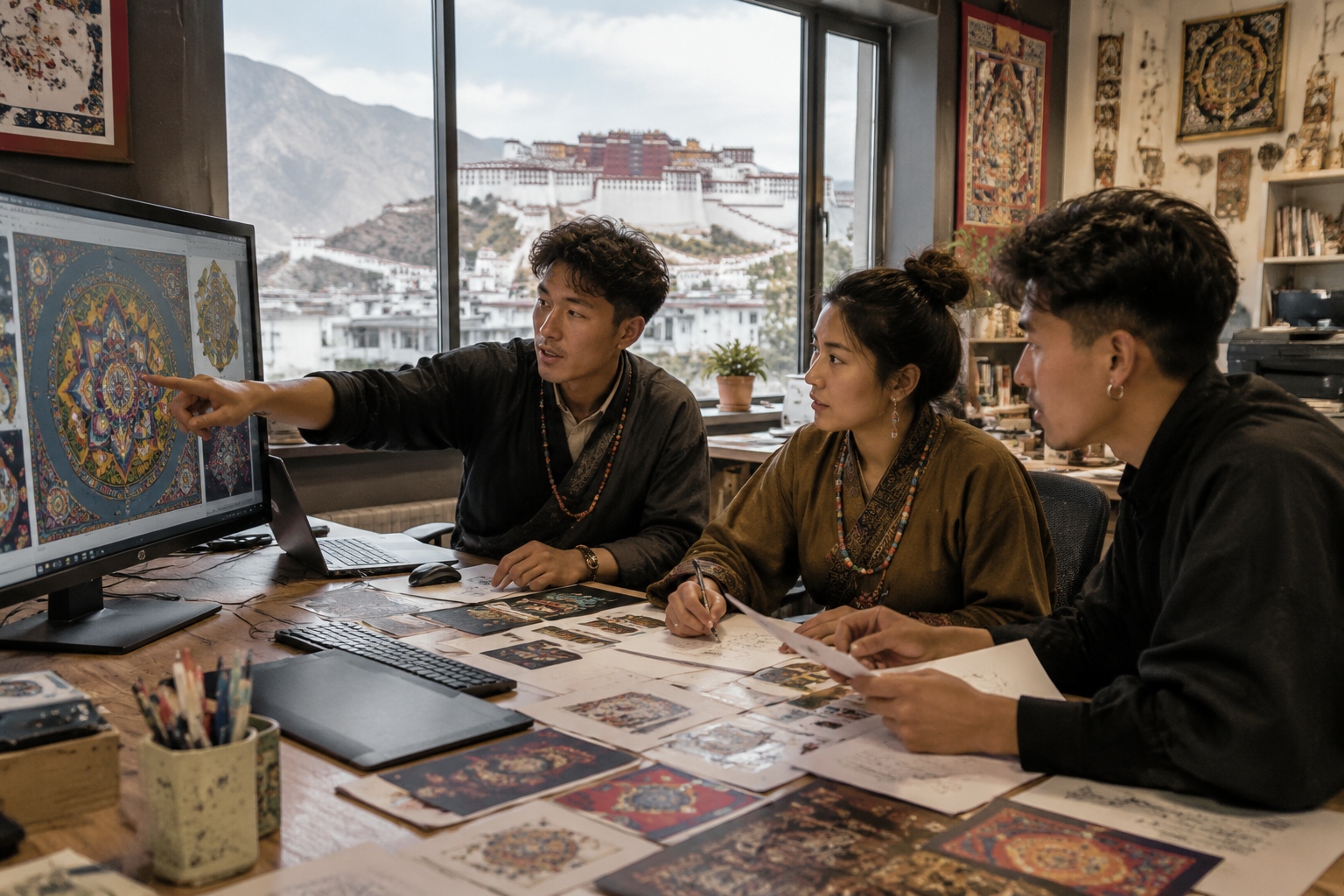
If Drolma’s story feels familiar, Losang’s might not. On a wall in a co-working space in Lhasa’s Liwu New District, there are hundreds of small digital artworks: turquoise-blue mandala patterns, stylized snow lions, the red-and-white walls of ancient monasteries. Losang, 26, calls his project “Tibetan Spatial Grammar.” In China, these items are usually called shuzi cangpin (digital collectibles), not NFT, and the comparison to crypto art helps and hurts at the same time.
“Let me clear one thing up,” Losang says. “When we put our first collection online in 2023, we did not sell them as a get-rich-quick investment. A piece cost 29 yuan, about $4. There were 1,024 unique patterns, each recolored by an algorithm based on a traditional palette. We called it a digital souvenir, not a token.”
The collection sold out in about 40 minutes. Some buyers were tourists who had visited Lhasa and wanted a memory. Others were young Tibetans living abroad. “One buyer wrote to us and said she grew up in Switzerland and used to see these patterns in her grandmother’s rugs,” Losang says. “That message meant more than the money.”
The NFT Studio with a Cultural Advisor
To avoid cultural missteps, Losang works with an older painter from Shannan and a local writer who reviews every design. “We don’t copy thangka art. We don’t put sacred images into a blockchain. We take the visual grammar—the way a flower border repeats, the way a prayer flag peels in the wind—and translate it into a more contemporary shape.”
He is careful with words. “I am not an artist who sells Tibetan culture. I am an entrepreneur who works with Tibetan culture. The difference is responsibility.”
The studio’s next step is a physical product line: printed cards, tote bags, and wall art that buyers can hold. “Digital only is too cold. We want people to feel the paper, smell the ink, and remember that behind every design there is a person in Lhasa.”
Support, Speed Bumps, and Daily Struggle
All three entrepreneurs benefit from a wider ecosystem that barely existed a decade ago. Lhasa has startup incubators in the new district, free e-commerce classes offered by local employment offices, and small subsidies for college graduates who register their own businesses. But the everyday picture is far from perfect.
Local universities also organize pitch competitions. In 2023, a team from Tibet University won awards for a platform connecting tourists with family-run homestays. But the path from award to revenue is not always smooth. Losang says domestic platforms require age verification for digital collectibles and restrict resale to discourage speculation, so he partnered with an existing app instead of building a marketplace from scratch.
Rent for a small shop on a popular street in Lhasa has doubled in five years. A 28-yuan coffee may be reasonable for a tourist but expensive for a local student. Paying customers still follow the tourist season, and winter can be painfully slow. “I spend more time on supplier management than latte art,” Tsering says. “When I was 23, I thought being a café owner was romantic. Now I know it’s a logistics job with better lighting.”
Drolma has her own complaints. “If you put the word ‘Tibet’ in your brand name, approval takes longer. People meet you with extra caution, and sometimes extra paperwork.” She shrugs. “You fix it slowly.” Losang points to technical limitations: internet coverage in some rural areas still needs work, and domestic platforms change their digital collectible rules often. “We have to adapt every few months. That’s okay. It teaches us flexibility.”
The older generation’s instinct is often to favor stable jobs. Many Tibetan parents would still prefer their children to work in a government office or a state firm. That creates real pressure. “My mother didn’t cry when I left a teaching job to bake cookies,” Drolma says. “But she told all her neighbors I was taking a gap year. After a year, she ran out of excuses.”
What’s Next?
None of these businesses is a unicorn. Tsering’s café employs three people. Drolma’s team makes a modest living. Losang’s studio has produced exactly one successful digital collection. But together they represent a shift in how a generation tells its own story. They are not asking permission to be Tibetan. They already are. They are asking what a modern Tibetan economy might look like when young people stop waiting and start building.
“People outside Tibet often want us to be a frozen postcard,” Tsering says. “Snow mountains, robes, and old monasteries. I love all those things. But I also love a properly made cappuccino and reliable Wi-Fi. Why can’t both be part of Lhasa?”
As I leave, she hands me a small highland barley cookie. “In Lhasa, hospitality has always been the first business,” she says. “We’re just adding a Wi-Fi password.”
Start the discussion at forum.chinacomes.com