


Morning Scroll: The First Thing Millions Check
It’s 7:30 AM in Beijing. Li Wei, a 28-year-old graphic designer, reaches for her phone before her feet hit the floor. She opens Weibo, China’s Twitter-like microblogging platform, and immediately scans the Hot Search list — a ranked column of trending topics updated every few minutes. Today’s top entries: a new policy on housing subsidies, a viral video of a street musician in Chengdu, a celebrity’s apology, and a heated debate about overtime work in tech companies. She sighs, taps on the housing topic, and starts reading.
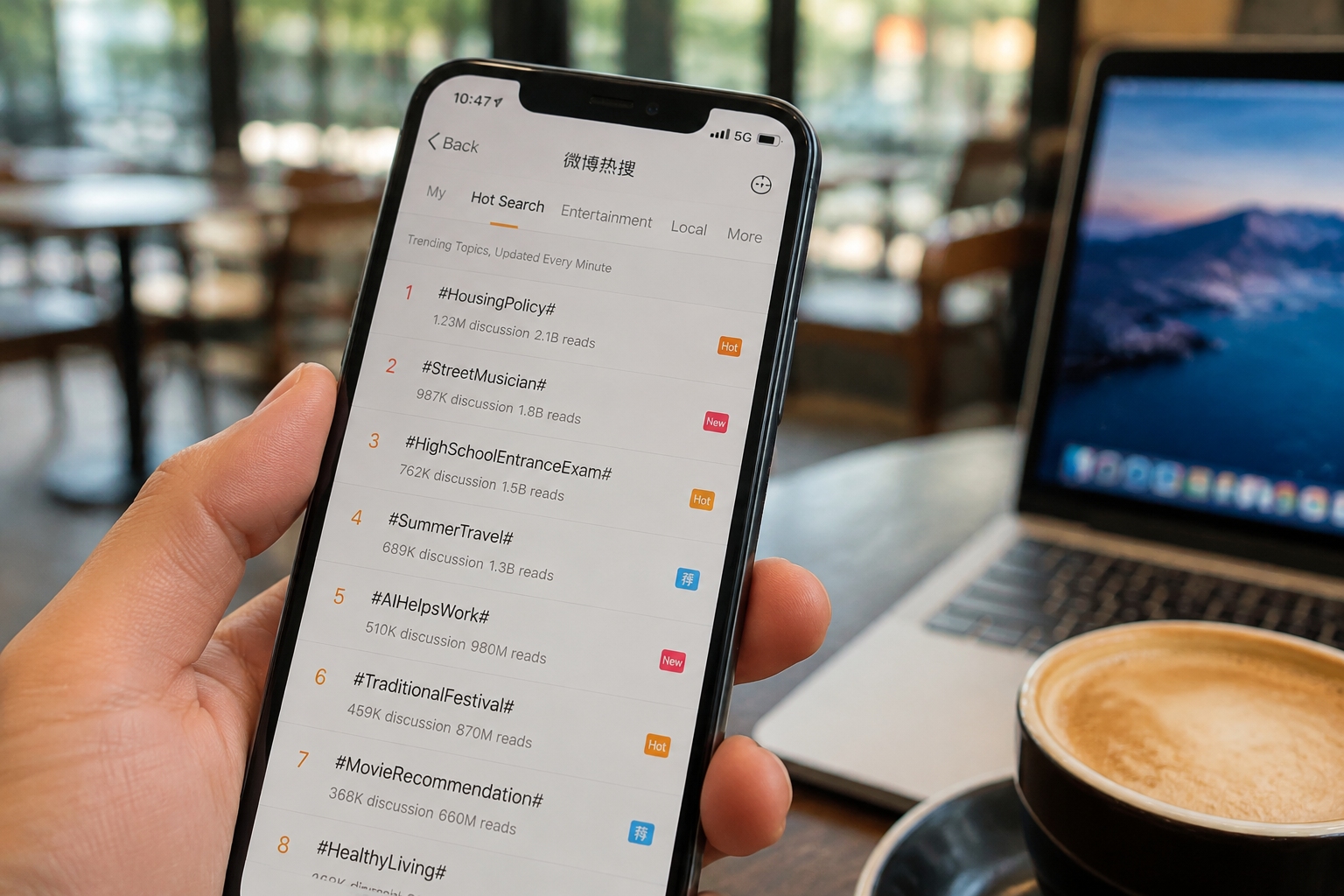
Li Wei’s morning ritual is not unique. For over 500 million monthly active users on Weibo, the Hot Search is the country’s most accessible real-time public square. It’s where news breaks, where opinions are tested, and where ordinary people — not just journalists or officials — set the agenda. Unlike a traditional newspaper or TV broadcast, the Hot Search is driven entirely by what users search for and discuss. It’s a raw, unfiltered mirror of China’s collective attention.
What Exactly Is Weibo Hot Search?
Weibo Hot Search (微博热搜, wēi bó rè sōu) is a dynamic list of the most popular topics on the platform, ranked by a combination of search volume, discussion frequency, and engagement speed. The list refreshes every few minutes, 24 hours a day. Topics range from national policy announcements and celebrity gossip to local incidents and niche memes. It’s not curated by editors — it’s algorithmically generated from real user behavior, making it one of the most democratic (and chaotic) windows into Chinese public opinion.
For a foreign reader, think of it as a mix of Twitter’s trending topics and Reddit’s front page, but with a distinctly Chinese flavor: topics are often tagged with #hashtags, and the ranking is so influential that brands, celebrities, and even government agencies watch it closely. A topic that reaches #1 can trigger a cascade of media coverage, official responses, and public demonstrations of support or outrage.
Voices from the Square: A Simulated Conversation
To understand the texture of this public square, let’s listen in on a few voices discussing a recent Hot Search topic: a video of a delivery driver being fined for a minor traffic violation, which sparked a debate on enforcement fairness.
@Chen_Shanghai (a logistics manager): “I’ve been a driver myself. The rules are necessary, but when a fine equals a week’s salary, something is off. The system shouldn’t punish the poor disproportionately.”
@Lily_Beijing (a law student): “The law is the law. If we make exceptions based on income, we lose consistency. The real issue is that the fine itself is too high — it should be a percentage of income, not a fixed amount.”
@Wang_Chengdu (a freelance writer): “I saw the video. The driver was clearly stressed. But what about the pedestrians? The whole debate is missing the bigger picture — our cities are designed for cars, not people. We need better infrastructure, not just more fines.”
@Zhao_Guangzhou (a retired teacher): “I remember when there was no such discussion. Now we can talk about it openly. It’s progress, even if we don’t agree.”
These four voices — each with a different background and viewpoint — are not a curated panel. They are real snippets from the comments section under a Hot Search topic. This is what the public square sounds like: messy, passionate, sometimes angry, but undeniably alive. The platform amplifies voices that might otherwise be ignored, and the Hot Search ensures that the most resonant topics rise to the top.

How Hot Search Shapes Public Discourse and Action
Weibo Hot Search is not just a passive reflection of what people are talking about — it actively shapes what becomes news and how issues are framed. In recent years, several high-profile cases of social injustice, workplace abuse, and environmental problems first gained traction on Weibo’s Hot Search before being picked up by mainstream media and prompting official investigations.
For example, in 2023, a story about a female employee being harassed by her manager at a major tech company went viral on Weibo. Within hours, the company’s stock dropped, the manager was suspended, and regulators announced a review of workplace harassment policies. The entire sequence was driven by netizens sharing, commenting, and pushing the topic to the top of the Hot Search.
This power also comes with risks. The same mechanism that elevates legitimate concerns can also be manipulated by state-backed disinformation campaigns, astroturfing by brands, or sensationalist clickbait. Chinese netizens are acutely aware of this — they often joke about “water armies” (paid trolls) and “fake hot searches.” The platform’s algorithms are also subject to government censorship: sensitive political topics, especially those involving the Communist Party or the leadership, are routinely removed from the list. Yet within these boundaries, an astonishing amount of genuinely public debate still occurs.
Tips for Navigating Weibo Hot Search Like a Local
If you’re a foreigner or a new Weibo user, here are some practical tips to understand the Hot Search and use it effectively:
1. Understand the Ranking Rules
The algorithm weights three factors: search volume, number of posts, and the speed of engagement. A topic that gets a sudden spike in all three can jump to #1 within minutes. Don’t assume the top spot is always the most important — sometimes it’s just the most viral.
2. Read Beyond the Headline
The Hot Search only shows a short title (e.g., “#WomanRefusesToGiveUpSeat#”). To get the full story, tap on the topic and scroll through the top-ranked posts, which are often from verified news accounts or influential users. The comments section below is where the real discussion happens.
3. Watch for Patterns
If you see the same topic appearing multiple times with slight variations, it’s likely a coordinated campaign. Also, be wary of topics that appear too uniformly positive or negative — they might be curated. Genuine public debate usually has a mix of support and criticism.
4. Use the Search Function to Dig Deeper
The Hot Search is a gateway. Once you find a topic that interests you, use Weibo’s search to find related posts, user opinions, and even historical discussions. This is especially useful for tracking how a story evolves over time.
5. Accept the Limits
China’s internet censorship means that some topics will never appear on the Hot Search. If you’re looking for discussions about political dissent, human rights, or historical events, Weibo is not the place. But for everyday life — consumer rights, education, environmental issues, workplace culture, entertainment — the Hot Search offers a remarkably vibrant and honest cross-section of Chinese society.
Conclusion: The Real China Behind the Headlines
Weibo Hot Search is far from perfect. It’s noisy, often frivolous, and subject to manipulation. Yet it remains one of the most authentic windows into the concerns and conversations of ordinary Chinese people. For anyone trying to understand modern China — not as a geopolitical abstraction, but as a living, breathing society of 1.4 billion individuals — scrolling through the Hot Search for an hour is more revealing than reading a dozen policy papers. It’s where the country argues, laughs, mourns, and celebrates together. It’s a real-time public square, and everyone is invited.
Start the discussion at forum.chinacomes.com