

An infrastructure “joke” that became a global case study
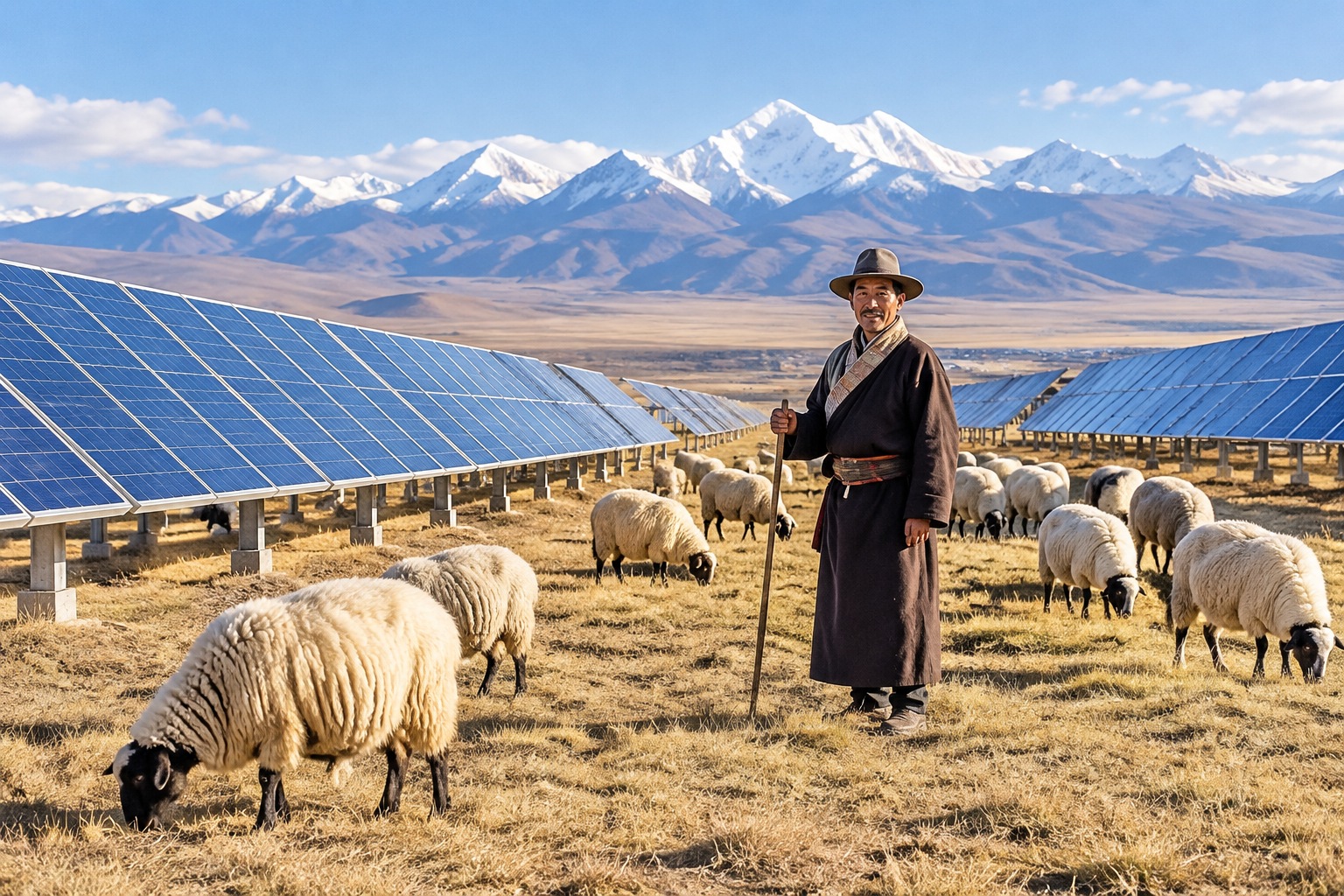
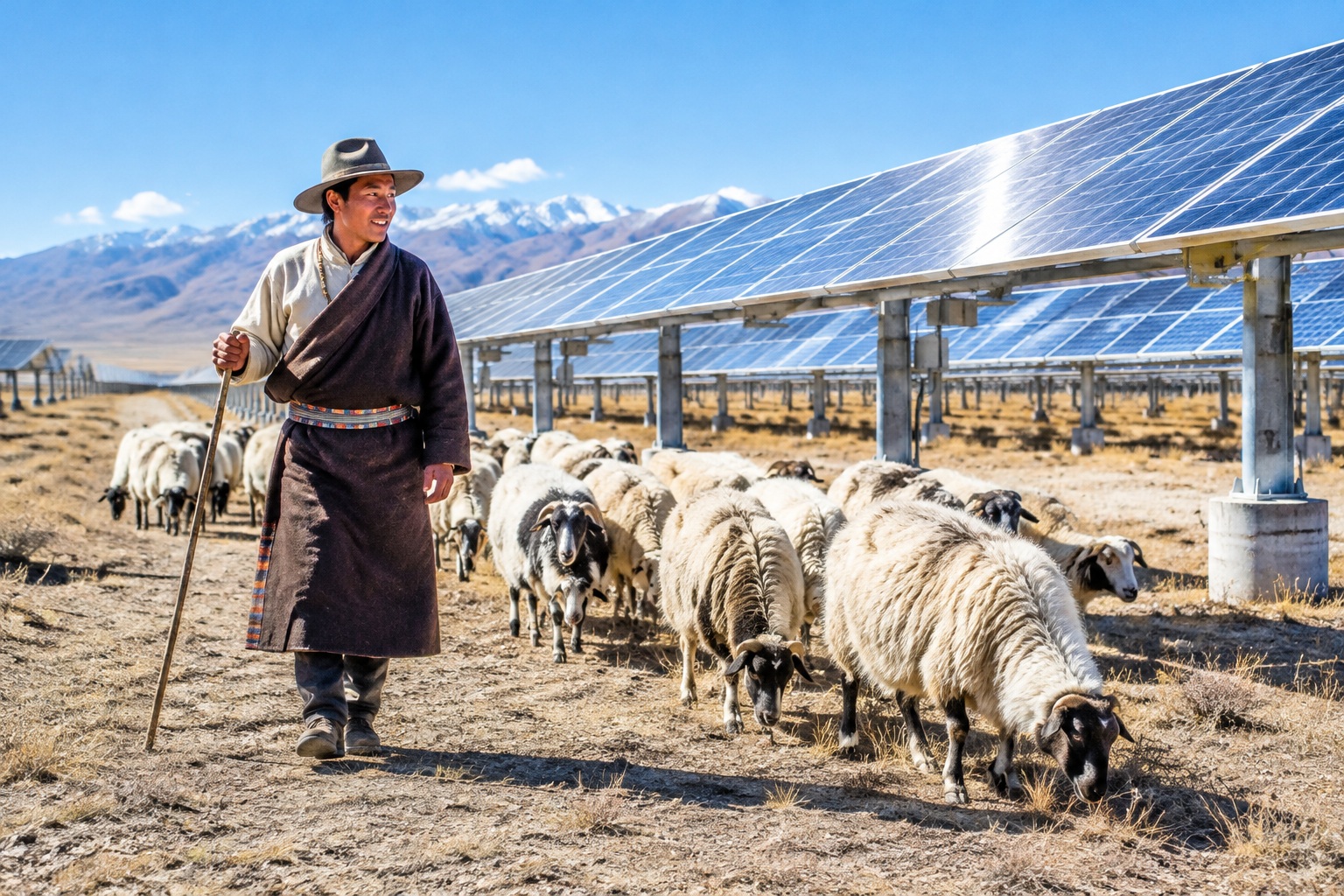
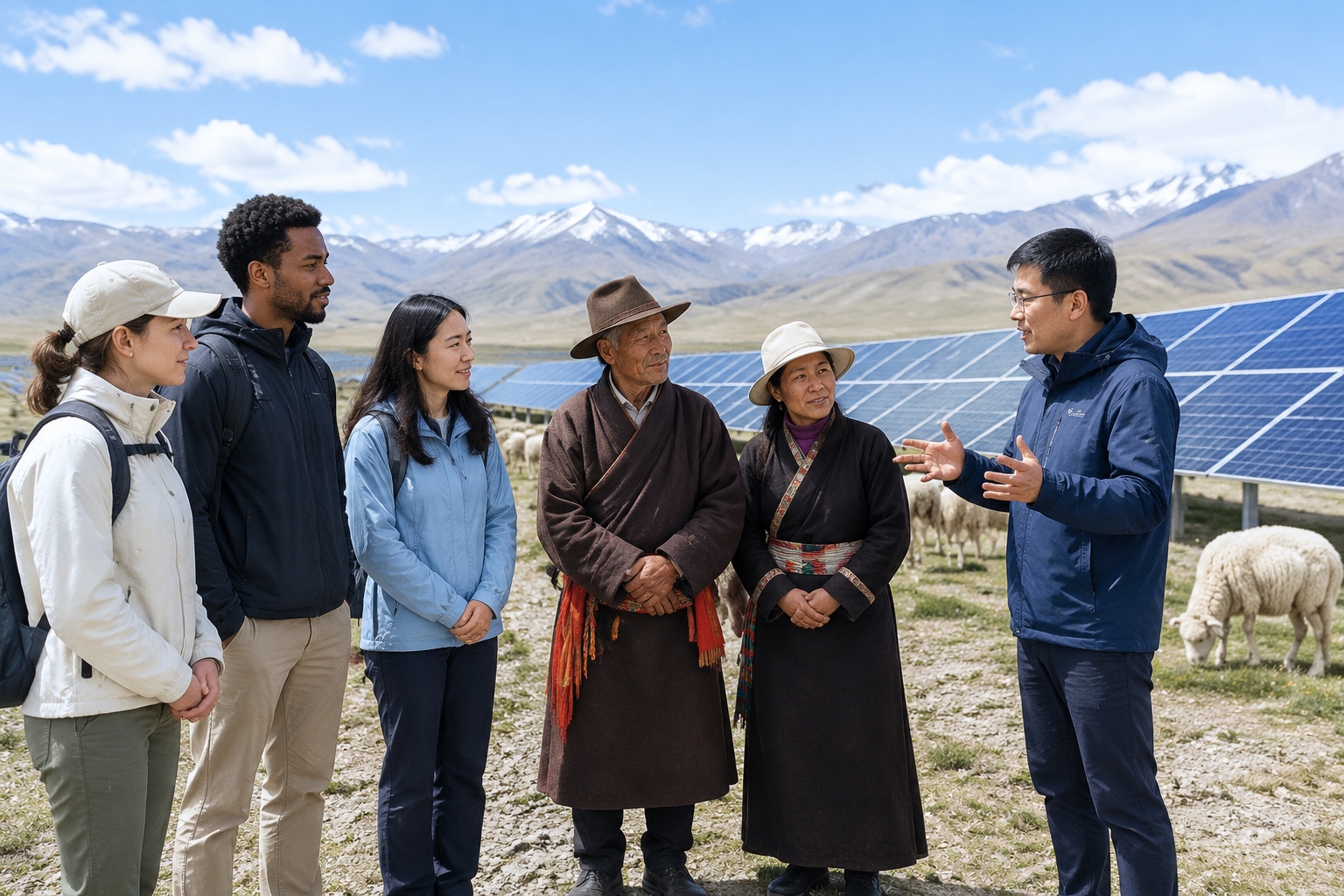
If you drive through Talatan, in Qinghai Province, northwest China, the first thing you notice may not be the endless rows of solar panels. It is the sheep grazing underneath them. They are called “photovoltaic sheep.” In 2024, one could sell for about 1,800 yuan—roughly $250—double the price of ordinary mutton. City buyers snap them up. They have become a local brand.
But the real story of Talatan is not expensive lamb. It is how a giant solar farm, once dismissed by some as a joke, accidentally took on one of the world’s oldest environmental problems: desertification.
A forgotten corner of the desert
Talatan sits on the Qinghai-Tibet Plateau, more than 3,000 meters above sea level. Before the solar plant, it was a harsh place. Wind pushed stones across the ground. Almost no grass grew. Vegetation coverage was around 2 percent. The air was thin. Ultraviolet radiation was strong enough to burn skin. Locals sometimes described it as a place God forgot.
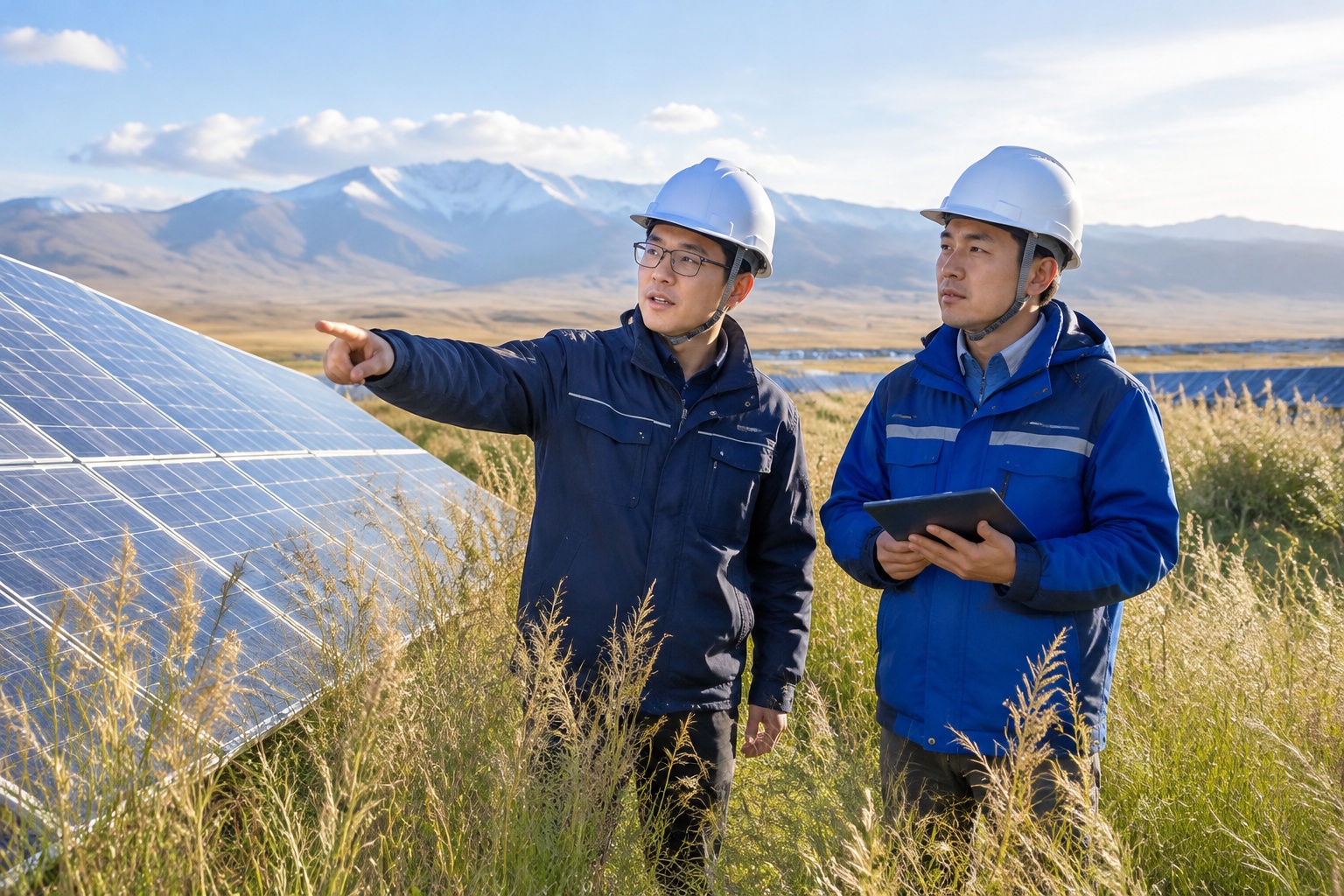
Then planners looked at the land differently. High altitude means strong sunlight. The area was cheap, empty, and exposed. In 2011, the State Grid decided to build one of China’s largest solar power facilities there. Initial investment was about 300 million yuan, or roughly $42 million. It looked like a straightforward renewable-energy project: panels in, electricity out.
What no one planned for was what would happen on the ground beneath the panels.
Why desertification is so hard to fix
Desertification is driven by climate change and land-use pressure. Overgrazing, drought, and fragile soils all play a role. The United Nations estimates that up to 40 percent of land is degraded, affecting nearly half of humanity. Traditional fixes are often expensive and slow: planting trees, building fences, limiting grazing, and constantly hauling water. Talatan did none of that. It laid down solar panels.
The panels changed the ground beneath them
Grass began to grow. At first there were only a few patches. Then green spread across the desert. Engineers were stunned. The panels were not just generating electricity. They were blocking wind, shading the soil, and reducing evaporation. In a dry landscape, those small changes were enough to let seeds sprout and survive.
Water used to clean the panels also dripped down and added a little moisture to the ground. As vegetation coverage rose from about 2 percent to 80 percent, the land itself began to hold more water and soil than before.
The problem was that the grass grew too well. It climbed around the panels and blocked sunlight, cutting power output. The station covers more than 600 square kilometers. Hiring people to cut the grass would cost nearly 2 million yuan—about $280,000—every year. And the grass kept coming back, like weeds in a garden.
Enter the sheep
In 2018, a herder walked by with his flock. He wanted to see what the solar panels looked like. The sheep followed. When the engineers came back from a meeting, they stared at the ground. Their first thought was that someone had cut the grass for them. Then they realized the sheep had eaten it—and had done a cleaner job than any lawnmower.
Suddenly the answer was obvious: the station had a ready-made biological weed-control system. As a Chinese internet joke puts it, one bug is a bug; two bugs make a workaround.
For the herders, the deal was simple. The solar station had grass. Their sheep needed grass. The station needed the grass gone. The herders were already moving their flocks. Nobody needed new tools or complicated contracts. They could just walk the sheep between the panels.
Rebuilding the infrastructure for woolly employees
The original panels were not designed for sheep. They were spaced three meters apart and stood about 1.5 meters high. A sheep could barely turn around underneath. So engineers raised the panels. They widened the spacing to five meters and lifted the clearance to 150–180 centimeters. They also opened the land to nearby herders for free grazing.
That decision turned a technical fix into an economic and ecological loop. The sheep eat the grass. The panels reduce wind and sand. Sand becomes soil. Soil grows more grass. Sheep manure fertilizes the ground. The sheep cost nothing to feed. The station keeps generating power. Vegetation coverage climbed from about 2 percent to 80 percent.
From 600 sheep to more than 20,000
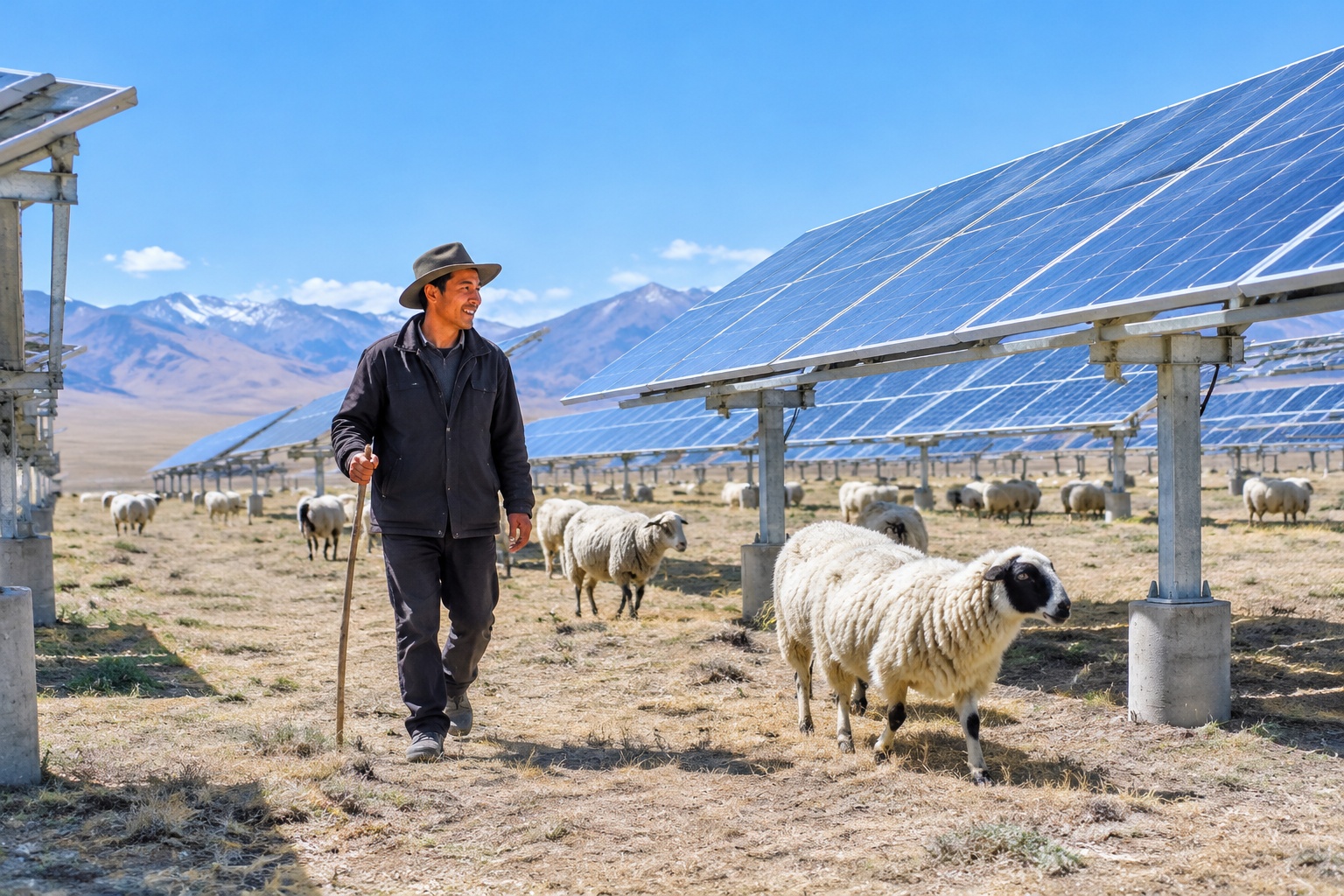
The flock grew from around 600 to over 20,000. The sheep save the solar station about 7.2 million yuan—roughly $1 million—in feed costs each year. More than 6,330 herder households benefit, with average annual income rising by tens of thousands of yuan. Because the sheep roam widely and eat wild sand-binding plants instead of processed feed, their meat is firmer, with less gamey smell and a fresh, grassy note. Prices doubled from 800 yuan to 1,800 yuan.
The solar farm has expanded to 609 square kilometers, close to the size of Singapore. In 2024, it generated about 17.9 billion kilowatt-hours of electricity, enough for millions of people. By the end of 2024, village collective income from the project exceeded 34.45 million yuan. There were no chemical treatments, no massive earth-moving campaign—just panels and sheep.
For local villages, the sheep are not a side project. They are a source of cash, food, and identity. The animals have become a recognizable brand because they graze on wild plants and move across a huge area. Consumers pay a premium for that story, and the income helps support public services in the surrounding communities.
Why the world is paying attention
In 2022, the Talatan project entered the Guinness World Records as the world’s largest solar power station by installed capacity. In August 2025, at the United Nations High-Level Political Forum on Sustainable Development, it was selected as one of 17 global typical cases. Delegations from Northern Europe, the Middle East, and Africa have visited Talatan to study the model. People who once waited for China’s infrastructure “joke” to fail now watch with envy.
This matters for other dry regions. Parts of the Middle East, Africa, and Australia share similar sunlight and similar land-degradation problems. Even wealthy Northern European countries are looking for ways to lower the cost of green energy while using land more efficiently. Talatan offers a replicable idea—not the exact scale of the solar farm, but the logic of combining energy production with ecological repair.
The future may be sheep-shaped
What makes Talatan interesting is not only that a desert turned green or that lamb prices doubled. It is the way technology and nature stumbled into a partnership. Large renewable projects are usually discussed as engineering problems: panels, grids, investment, policy. Talatan suggests that the best solutions sometimes come from the least planned corners—a passing herder, a hungry flock, and a problem that looked like a bug until it became a feature.
This does not mean solar grazing is a magic cure. It depends on the right grass, the right animals, the right climate, and local governments willing to coordinate land use. But if it worked here, it can work elsewhere in different forms—photovoltaic sheep, photovoltaic cattle, photovoltaic bees. The point is not the animal. The point is the willingness to design solar farms as landscapes, not just power machines.
If the future is green, it may not arrive as a grand blueprint. It may arrive as a sheep grazing under a solar panel.
Start the discussion at forum.chinacomes.com