
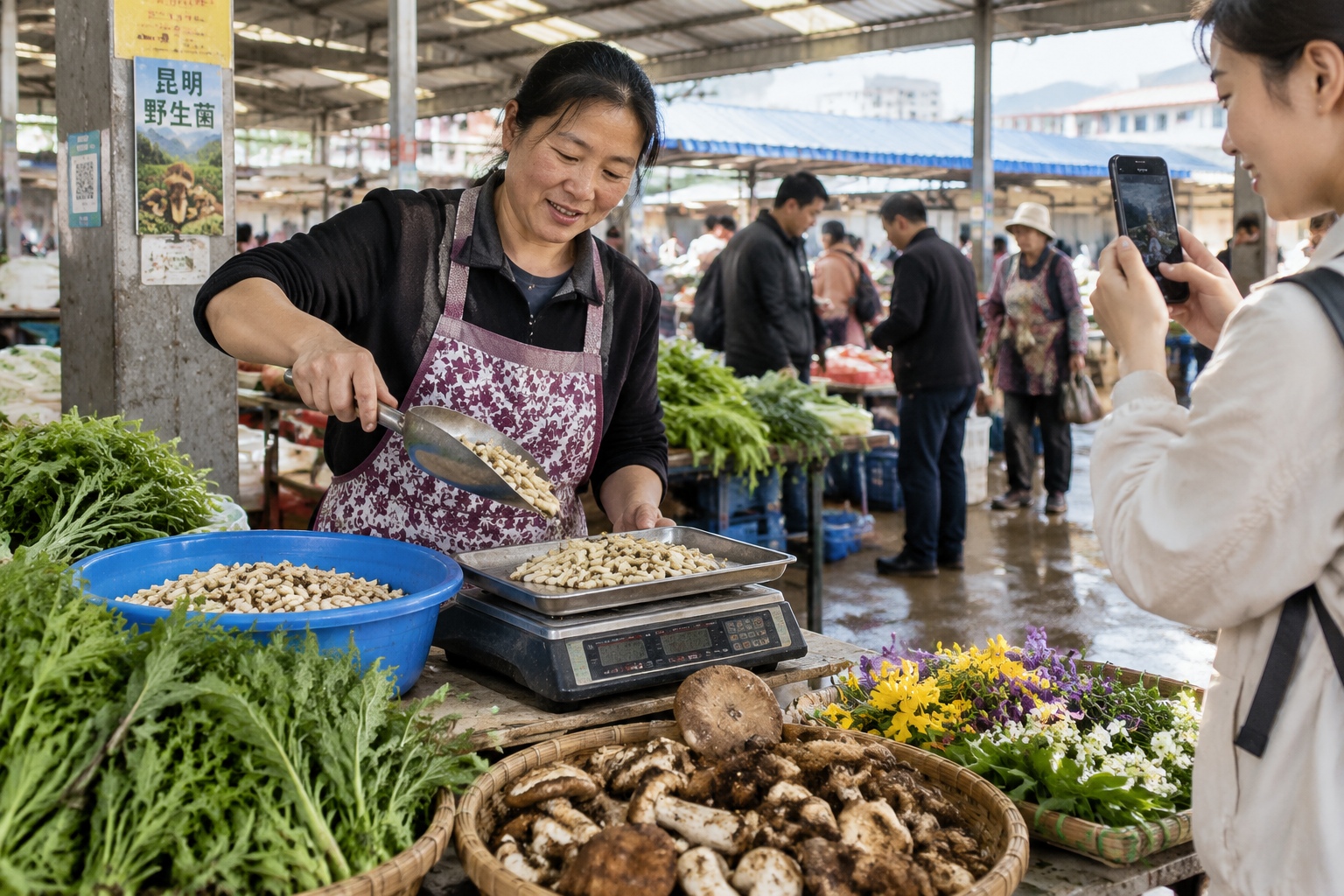

At 7:20 on a June morning in Kunming’s Zhuanxin market, a woman in a pink fleece stops at a blue plastic basin, points at a heap of pale, wriggling bamboo worms, and asks the price the way someone in London might ask about salmon. Eighty yuan a jin — about 500 grams, more than pork costs that week. She buys half a jin, watches it tipped into a bag, and moves on to the bitter greens.
Two metres away, a visitor from Guangdong films the same basin on his phone. “Do people actually eat this?” he asks. The vendor, who has already answered some version of that question five or six times before eight o’clock, says yes, and keeps sorting.
The distance between those two reactions is what this article is about. The same 500 grams of protein: one person sees lunch, the other sees a video.
“Weird” is a measure of distance, not a property of food
Yunnan is a fair place to test that idea. The province borders Myanmar, Laos and Vietnam, drops into tropical river valleys and climbs toward the eastern edge of the Himalayas, and is home to 25 officially recognised ethnic minority groups. All of that lands on the plate: more than 880 species of wild edible fungi have been recorded here, the highest count of any province in China, alongside edible flowers, ferns, insects, and a whole vocabulary of sour and bitter flavours that rarely travel far.
But “weird food” is not a category that exists inside a kitchen. Nobody in a Yunnan home wakes up planning to eat something strange. They work out what is in season, what is affordable, what fits the soup, and what the children will actually swallow. The word “weird” gets attached later, usually by someone holding a phone.
Three days, two kitchens, one market
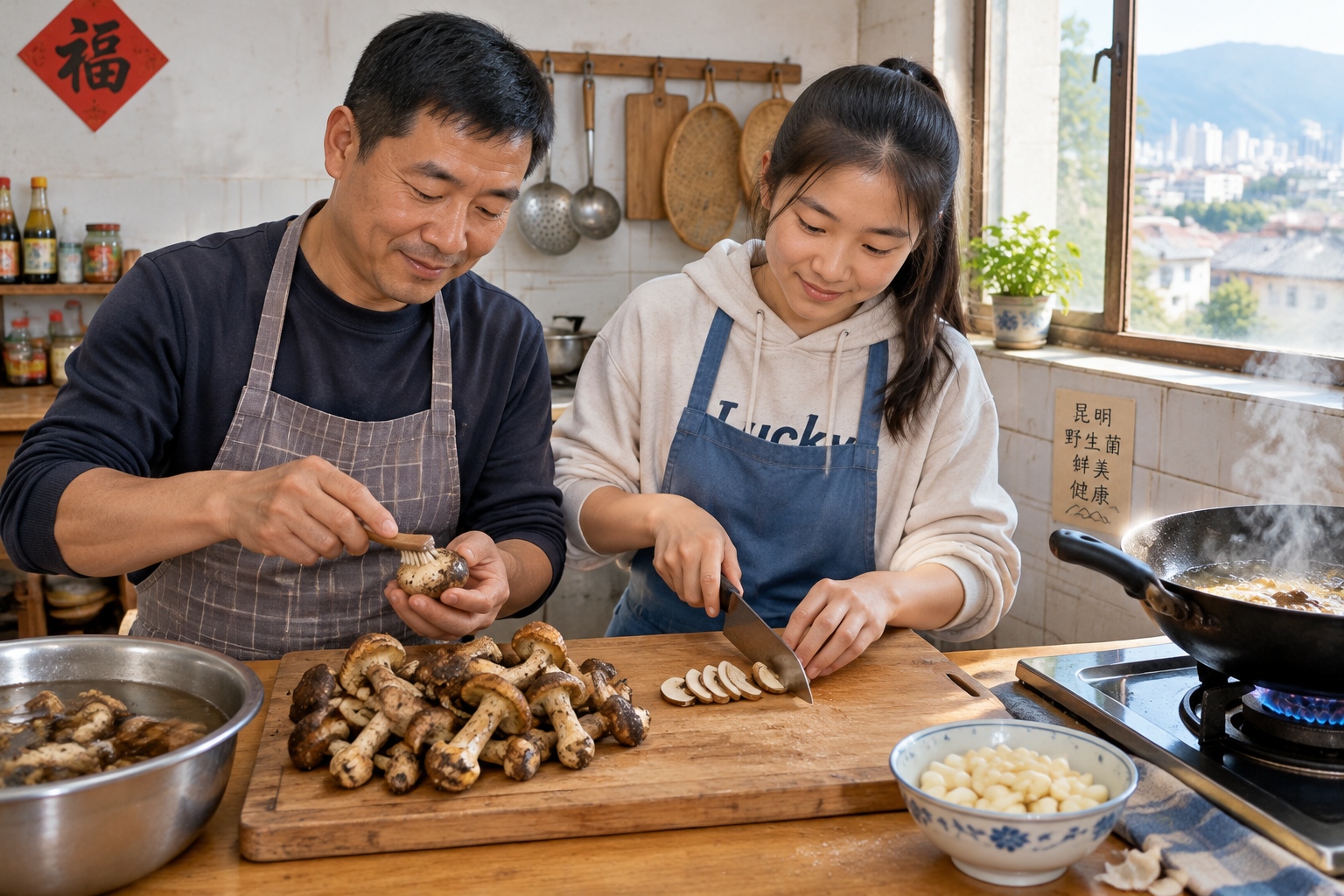
For this piece I spent three mornings in wet markets — Zhuanxin, and a smaller neighbourhood market in Guandu district where the tourists do not go — and two afternoons in family kitchens. I talked to half a dozen vendors, a mushroom wholesaler who supplies restaurants in three provinces, two university students, and a Kunming native in her twenties who now works in Shanghai and comes home twice a year.
What I was listening for was not whether people liked these foods, but how they explained them. Almost nobody mentioned courage. Almost everybody mentioned method.
Where the “courage” actually comes from
Yang Xiulan, 58, retired from a state-owned textile plant, was buying 折耳根 (fish mint) by the bundle. She grew up in a village south of Kunming with six siblings. “My mother never asked whether we dared,” she said. “She asked whether we had picked enough.” In her childhood kitchen, bitter greens were not a challenge; they were a vegetable, the cheap one that arrived before the rice.
That is the first mechanism: exposure, early and unremarkable. The second is cost. Wild mushrooms in July are free to anyone with a forest and a relative with a car; bamboo worms, by contrast, have become expensive enough that they are a treat, and treat logic is its own kind of training.
The third mechanism is more interesting. Risk in Yunnan cooking is handled in the kitchen, not at the table. One family I cooked with has a house rule for 见手青, the blue-staining bolete that makes people hallucinate if it is underdone: sliced thin, dry-fried, no less than fifteen minutes, nobody stirs who has not done it before, and no alcohol at dinner. A grandmother in the same kitchen still puts garlic in the pan, an old habit that the provincial health commission has spent years politely telling people to abandon — garlic does not turn black when the mushroom is toxic. She knows this. She does it anyway, then cooks the mushrooms for twenty minutes.
The fourth mechanism is social. Praise a child for finishing the fish mint and you have done more than any documentary. Food habits are learned as membership, not as an extreme sport.
Four foods that stop being strange once you know the rules
Fish mint (折耳根)
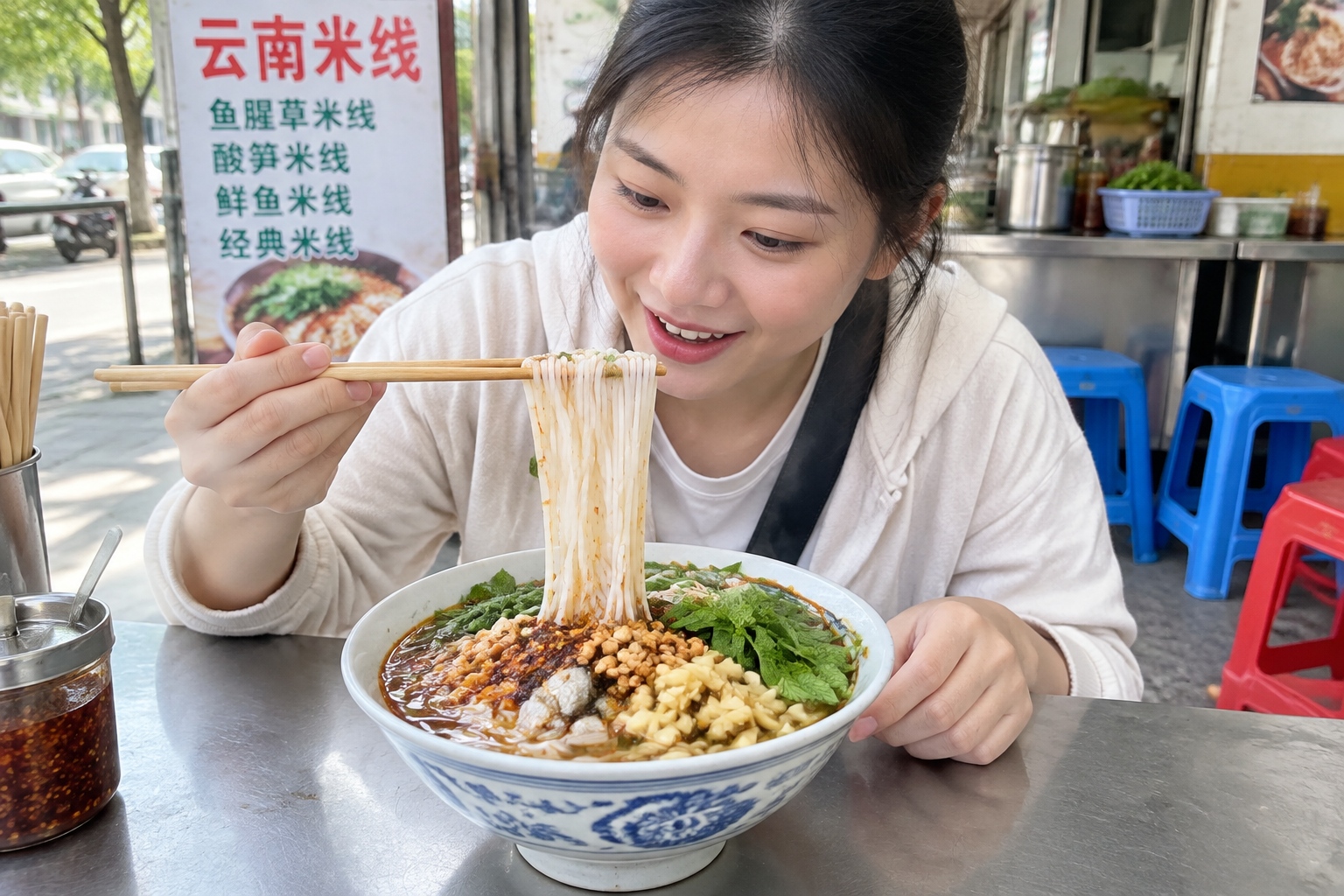
To a first-timer, Houttuynia cordata tastes of raw fish, wet metal and soap, in roughly that order. In Kunming it is a seasoning, chopped into a dipping sauce for grilled tofu or piled onto a bowl of rice noodles. The trick locals use is dosage: a little, with fat and chili, and the medicinal edge becomes a cooling note. Eat a whole sprig on camera and of course it is awful.
Wild mushrooms
Between June and September, Yunnan eats its way through a forest. Prices are quoted per half-kilo and change daily: 干巴菌, 松茸, 鸡枞, 见手青. Every summer the provincial health authority issues warnings about mushroom poisoning, and every summer there are cases. Locals treat this the way people elsewhere treat raw oysters or rare steak — a known risk, managed by knowledge of which mushroom, which pan, how long. That fifteen-minute rule is not folklore. It is a rule that people can explain, and the reason a family can eat the same dish every week without fear.
Insects
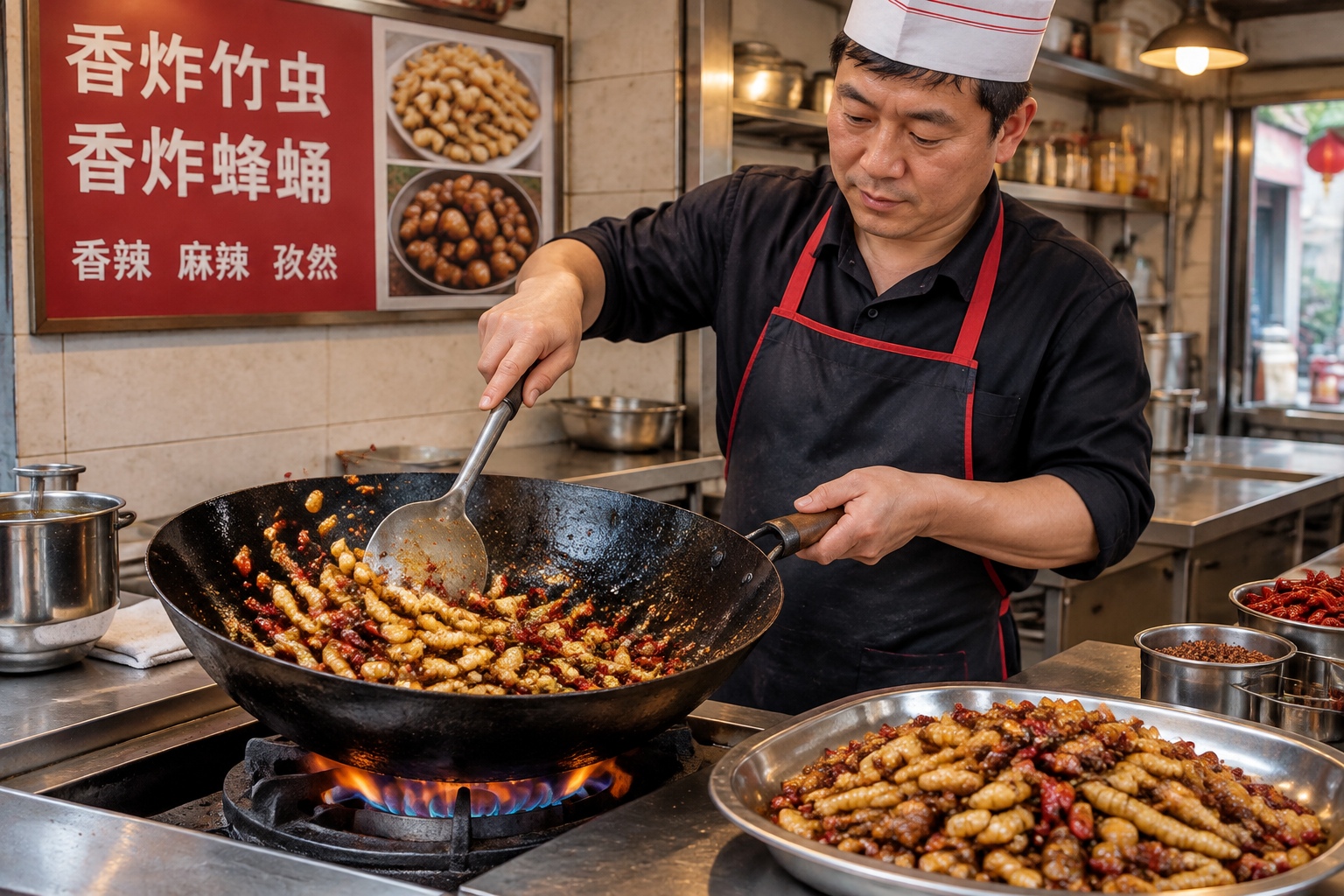
The worms from the market are rinsed, dried briefly, and deep-fried with salt and Sichuan pepper until they crackle. Texture is the point, more than flavour — somewhere between a prawn and a potato chip. Bee pupae are richer and sweeter; grasshoppers are eaten with beer. The cooking method is deliberately boring, because boring is what makes an unfamiliar ingredient safe to serve to a nine-year-old.
Sour and bitter
Fermented bamboo shoots (酸笋) smell strong enough to clear a room and taste mild and savoury in a bowl of hot rice noodles. Bitter greens are stir-fried with garlic and eaten for the same reason people elsewhere drink tonic water. In Dehong, near the Myanmar border, Dai cooks make 撒撇, a dish built around bitter bile. My first spoonful was unpleasant. My third was interesting. That sentence is more or less how taste adaptation works.
The tourist wants a story; the local wants dinner
Vendors in Kunming have adapted quickly. In Zhuanxin, one stall now sells vacuum-packed fried bamboo worms with a printed QR code linking to a cooking video; another keeps a small English sign for the fungus trade. A mushroom seller told me he does most of his price research on short-video apps, because that is where demand moves.
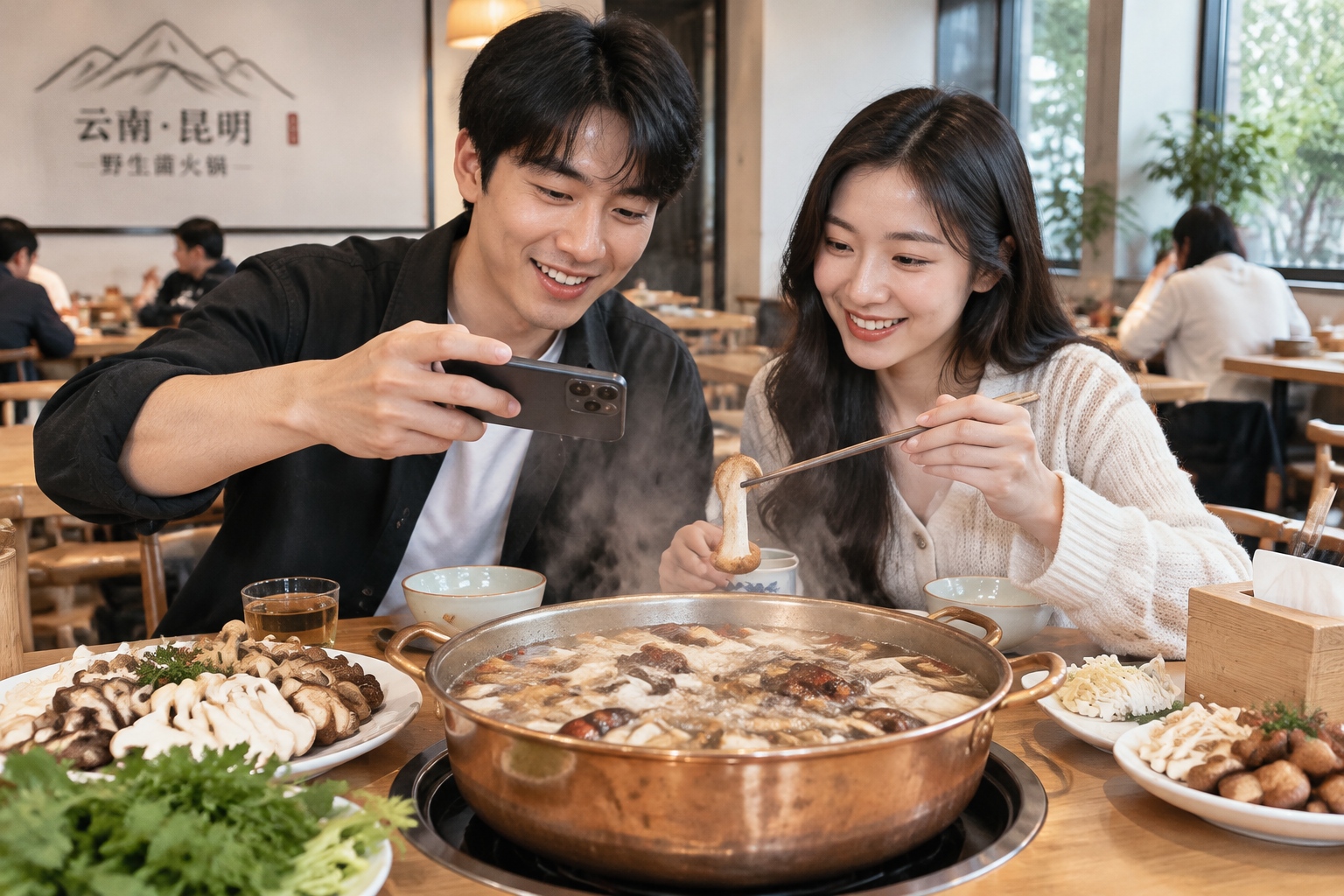
But the two customer types are not really buying the same thing. A visitor is buying one intense experience on one evening, usually photographed, usually at a restaurant with a set menu. A Kunming family buys fresh, in season, from the same vendor as last week, and argues about whether the mushrooms should be fried dry or with ham. One is a story about yourself; the other is dinner.
Young Yunnan people live in both worlds. Two students I met order mushroom hotpot to a dormitory through a delivery app and film the simmering pot for friends. But they also corrected me on the mushroom time rule before I finished asking.
What is changing on the table
City kitchens are smaller than village ones, so fewer families make their own pickles; supermarkets sell 酸笋 in sealed packets. Delivery platforms have flattened seasons a little — you can now get wild mushroom hotpot in any month, farmed, in a chain restaurant with air conditioning. Some of the old bitterness has been reformulated into a garnish.
Meanwhile the next generation is not automatically tougher than the last. The daughter of a taxi driver I interviewed in Guandu is fourteen, grew up in a high-rise, and refuses 撒撇 entirely. She likes avocado, Japanese food and cheese. Her father finds this funny and slightly sad, and cannot explain where his own tolerance went.
What an outsider can take from this
Every cuisine carries tastes that have to be learned: blue cheese, oysters, Marmite, a properly bitter beer. Yunnan is only unusual in how visible the learning stage still is, because so much of it happens in open markets where outsiders walk around with cameras.
Back in that kitchen in Guandu, the worms went into a hot wok with salt and chili, and the granddaughter — nine years old, doing homework at the table — ate them the way children elsewhere eat crisps. She did not find them strange. She asked whether there were more.
That is the whole field study, really. “Normal” is not a fixed standard that some people find easier than others. It is something each family quietly builds, one season, one market trip and one hot pan at a time.
Start the discussion at forum.chinacomes.com