

The First Thing an American Notices in Chengdu
“Where are the guns?” Marcus asked me about six hours after landing in Chengdu. He’s 34, a software engineer from Portland, Oregon, and he had spent the week before his first trip to China reading everything he could find. He expected either chaos or checkpoints — he wasn’t sure which.
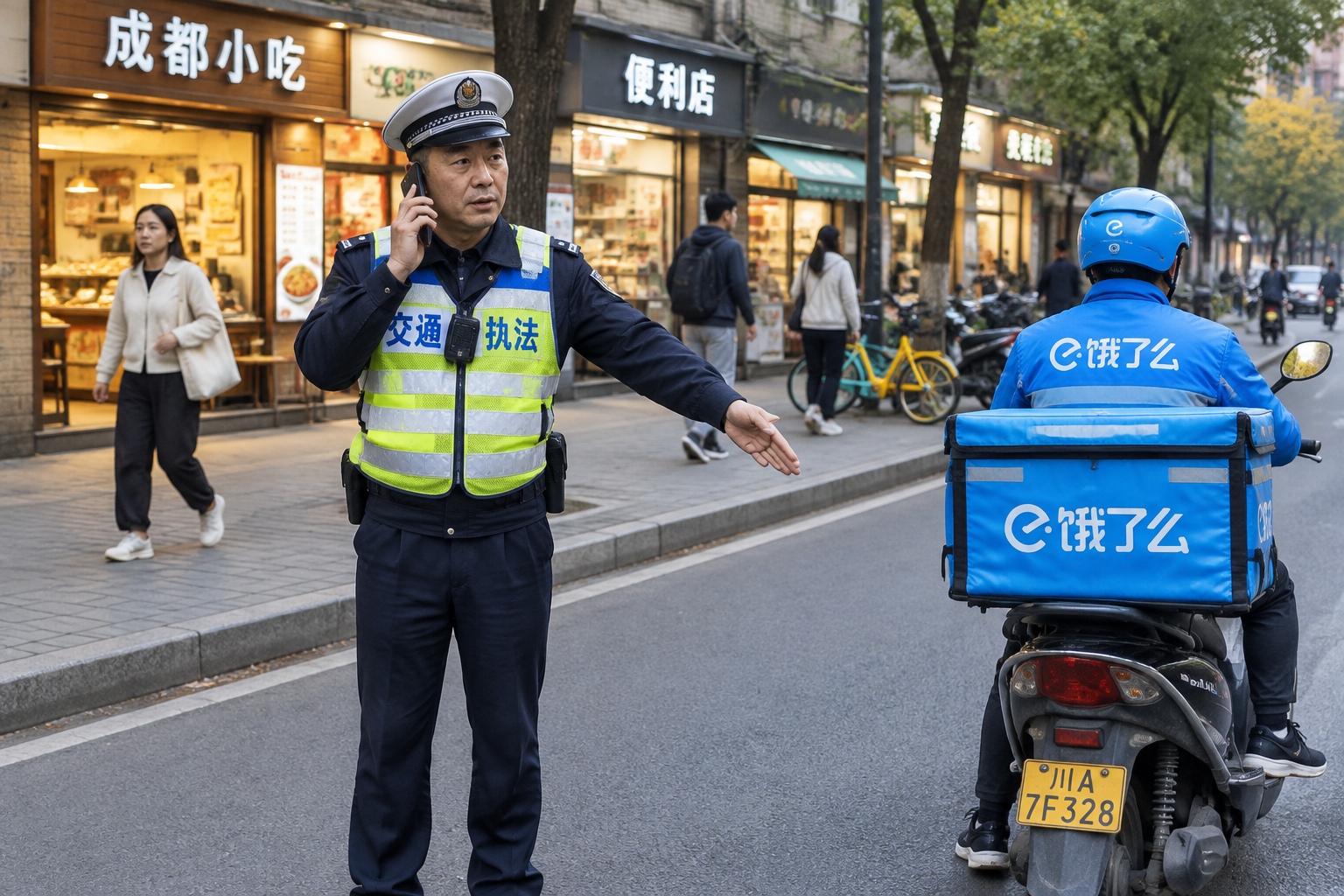
What he found outside his hotel on a Tuesday evening was a middle-aged traffic officer in a blue-and-yellow vest, steering a scooter around a stalled delivery van with one hand while holding a phone to his ear with the other. No rifle. No tactical vest. No partner scanning the crowd behind him.
He photographed the officer and sent it to his brother: “this is the entire police force on my block.”
That mismatch is what surprises first-time visitors from the United States, and rarely in the direction they expect. China is not short of security. It is short of visible weapons. The authority that shows up on an ordinary street corner usually arrives in a blue shirt, unarmed, and distinctly unimpressive.
What Street Policing Actually Looks Like
In most Chinese cities, the officer on the corner is a 民警 — a regular public security officer. Beat officers generally don’t carry firearms on routine patrol. Weapons are stored at the local station and signed out for specific operations. Traffic police are unarmed by design. So are the 辅警, auxiliary officers who direct traffic, staff checkpoints and fill in paperwork; they wear uniforms that look almost identical to police uniforms but carry no weapon and have no power to arrest.
Then there’s a layer foreigners rarely register as policing at all: 保安, private security guards. There are several million of them in China, working the gates of apartment compounds, shopping malls, schools, hospitals and office towers. They are usually middle-aged men in dark uniforms, and their main job is logistics — checking that delivery riders are expected, logging visitors, raising the barrier.
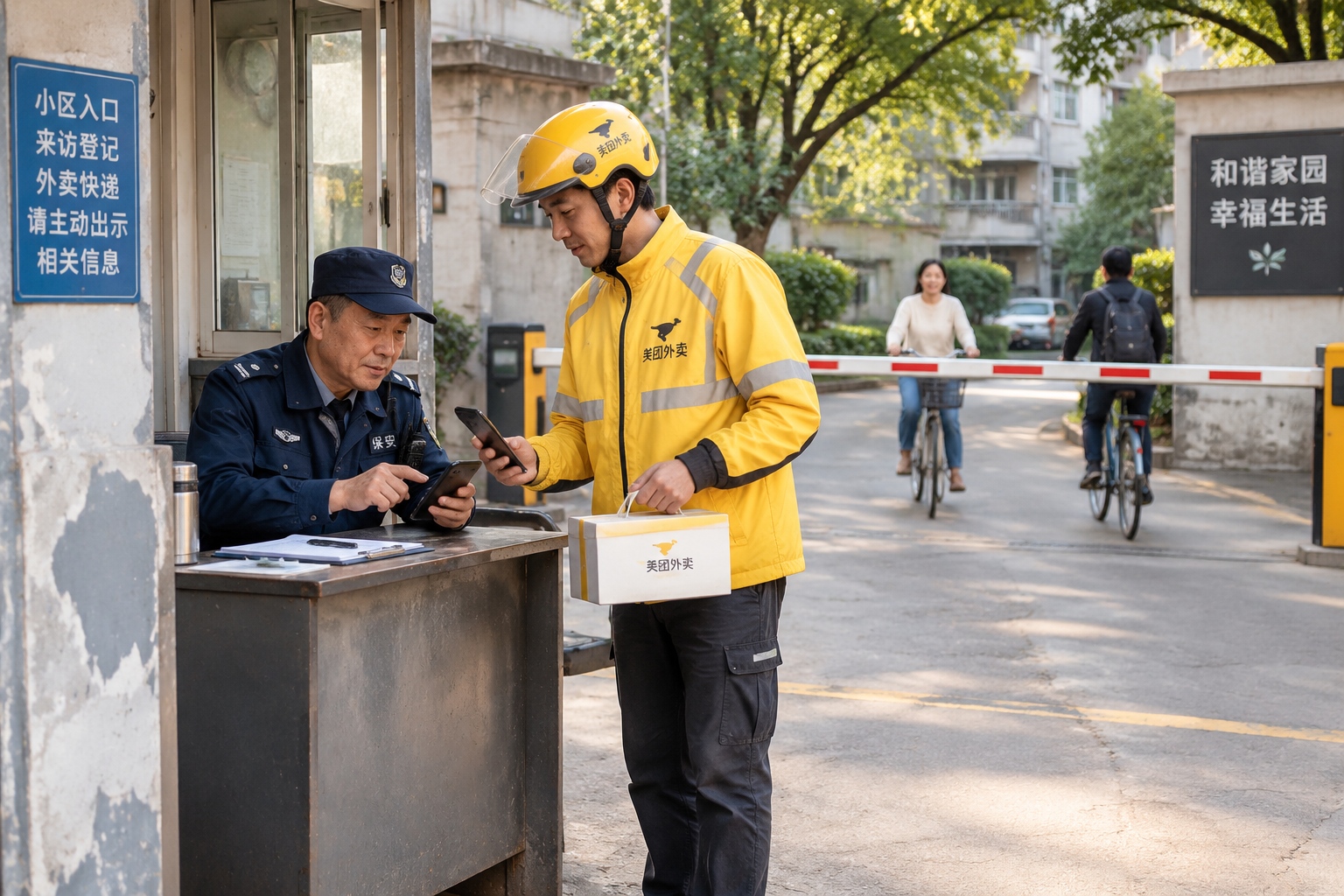
Walk through a Chinese neighborhood at 10 p.m. and you will pass more of these uniforms than police uniforms. That’s the first clue: the visible density of “security” in China is mostly not state force. It’s private labor, doing low-level crowd and access management.
The Security You Can’t See
Ask a Chinese friend why the streets feel calm and they probably won’t mention police. They’ll mention the subway.
Every metro station in a major Chinese city runs bags through an X-ray scanner. Beijing’s subway handles something in the range of 10 million trips on a normal weekday; Shanghai’s is similar. Every one of those riders puts a backpack on a belt and walks through a gate. It’s slow, it’s occasionally irritating, and it is so routine that nobody looks up. Marcus described it as airport security that everyone treats like a bus stop.
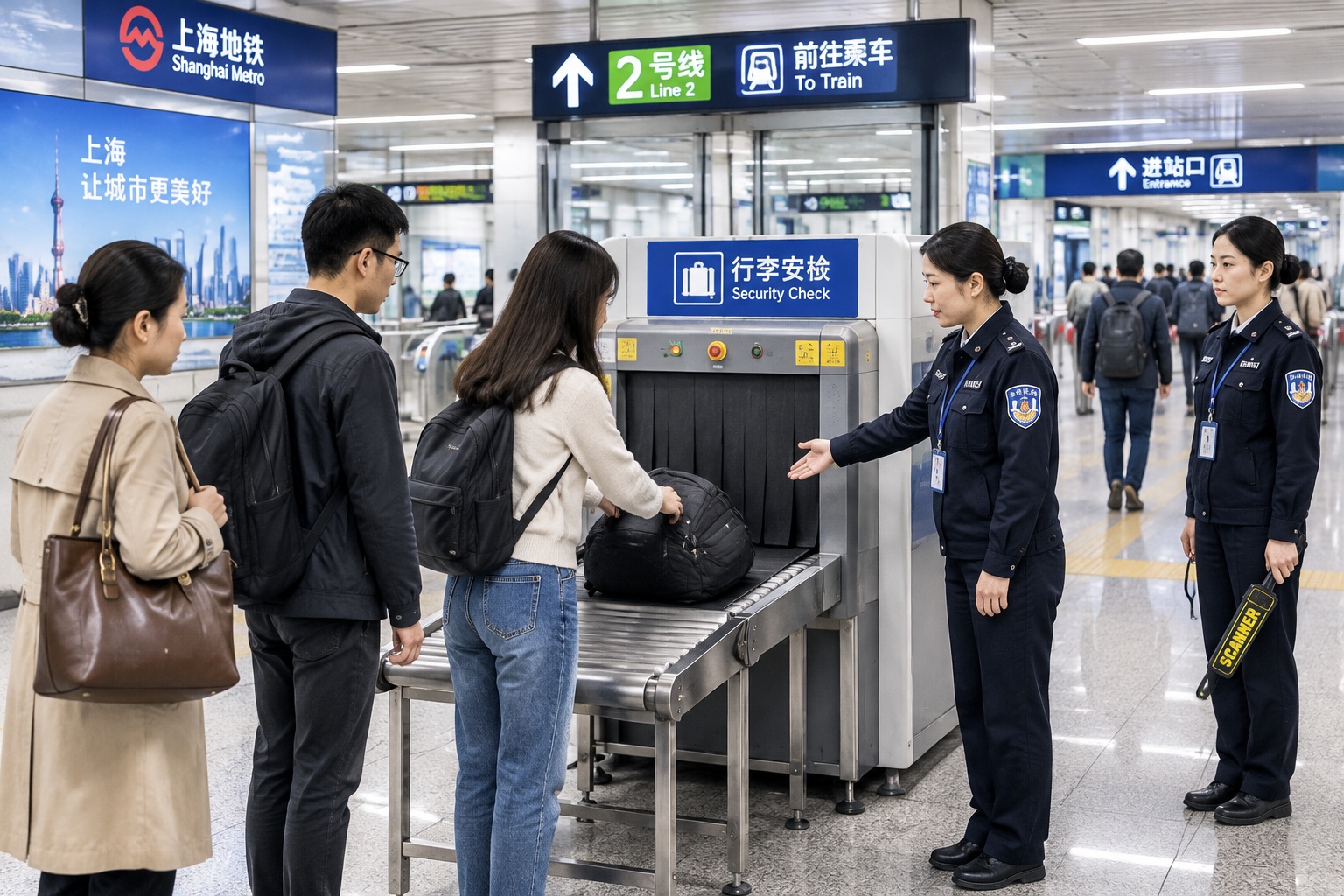
Above the turnstiles are the cameras. Estimates of how many surveillance cameras operate in China vary wildly and can’t really be verified — the widely cited numbers run into the hundreds of millions. What a visitor can verify is the density: cameras on intersection poles, above shop doors, at the entrance to every residential compound, inside elevators, on the platforms.
Below the cameras sits something more human. Neighborhood committees, grid workers (网格员) and retired volunteers with red armbands know which apartment is rented to students and which elderly resident lives alone. Beijing has a famous nickname for its most enthusiastic neighborhood watchers: the “Chaoyang masses.” Some of this work is genuine community care — helping with paperwork, keeping an eye on a sick neighbor. Some of it is monitoring. Often it’s both at once, and Chinese people generally describe it that way, without much drama.
The Numbers Behind the Calm
There’s a measurable reason the streets feel the way they do. China’s intentional homicide rate has hovered around 0.5 per 100,000 people in recent UN data. The US rate is roughly ten times higher. Robbery and burglary are lower as well, though differences in how crimes get reported make exact comparisons slippery.
Some of this comes from gun control. China banned private handgun ownership in the 1990s and enforces it seriously. The odds that a parking dispute turns into a shooting are close to zero, and that changes how strangers behave toward each other in public.
Some of it comes from speed of response. The emergency number is 110, and in big cities a patrol car often arrives within minutes. Some of it comes from mediation: a large share of disputes — a spilled drink, a contested parking space, noise from upstairs — get resolved by an officer sitting both sides down at a local station and talking it through, rather than through the courts.
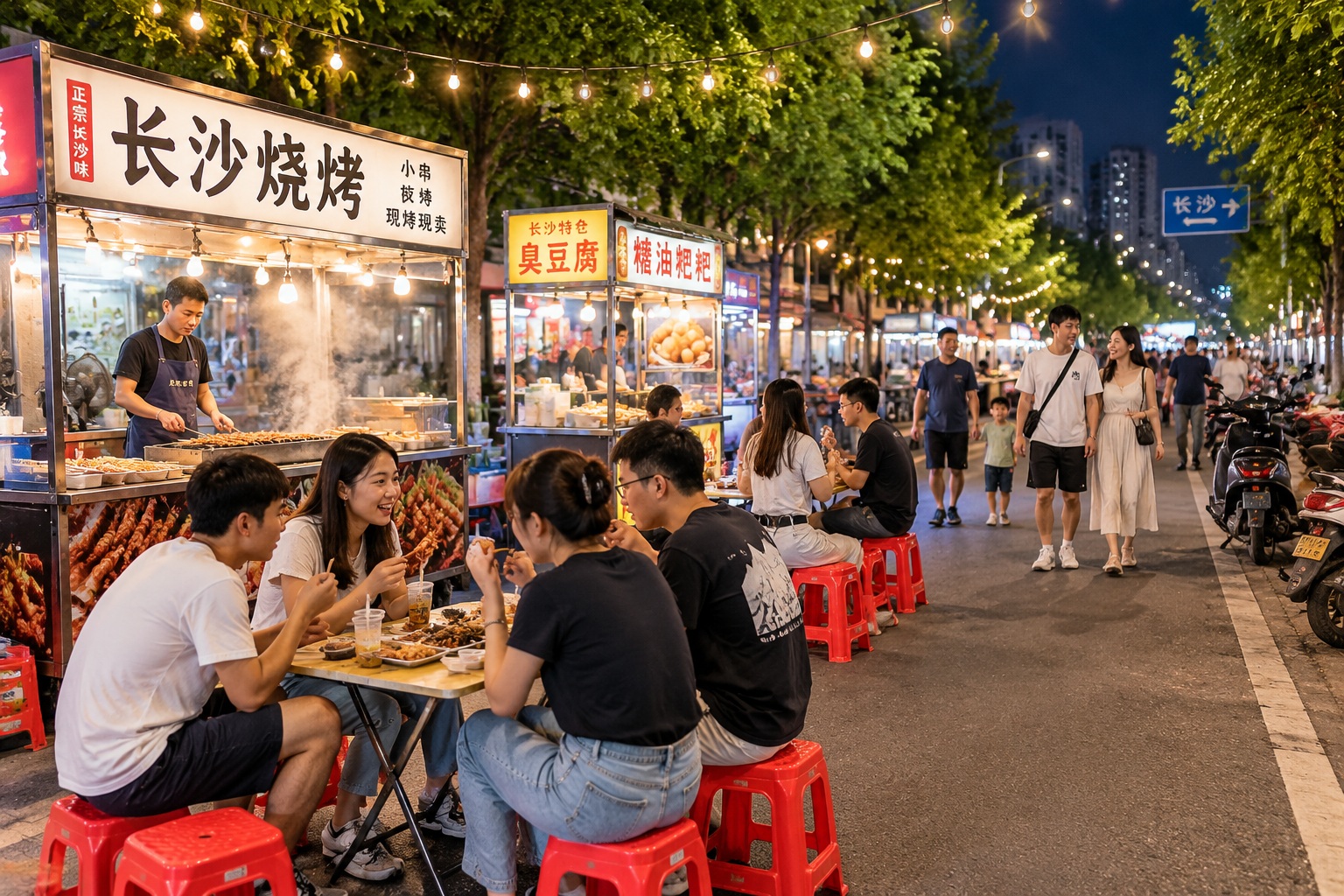
Everyday experience reinforces this. A colleague left her phone in a Chengdu taxi and had it back before lunch, tracked down through the driver’s WeChat group. Women walk home alone at 1 a.m. through Changsha’s night markets, buying grilled skewers on the way. That kind of ordinary, unremarkable safety is what visitors notice most, because it’s the thing they can’t buy at home.
Armed Police Do Exist — Here’s Where
None of this means China has no armed police. It means they’re concentrated.
Since the 2014 knife attack at Kunming railway station, cities have stationed 特警 — tactical units in dark uniforms with rifles — at fixed posts outside major railway stations, airport terminals, landmark squares and tourist sites. They stand still. They do not walk beats or chat with shopkeepers. They are there to be seen from a distance and to respond to a specific kind of event.
Armed People’s Police (武警) units guard government buildings, some bridges and major public events. In Xinjiang, the overall security presence is far heavier than in Shanghai or Chengdu — more checkpoints, more visible personnel, a genuinely different street experience. Anyone who tells you China looks the same everywhere has not traveled much in China.
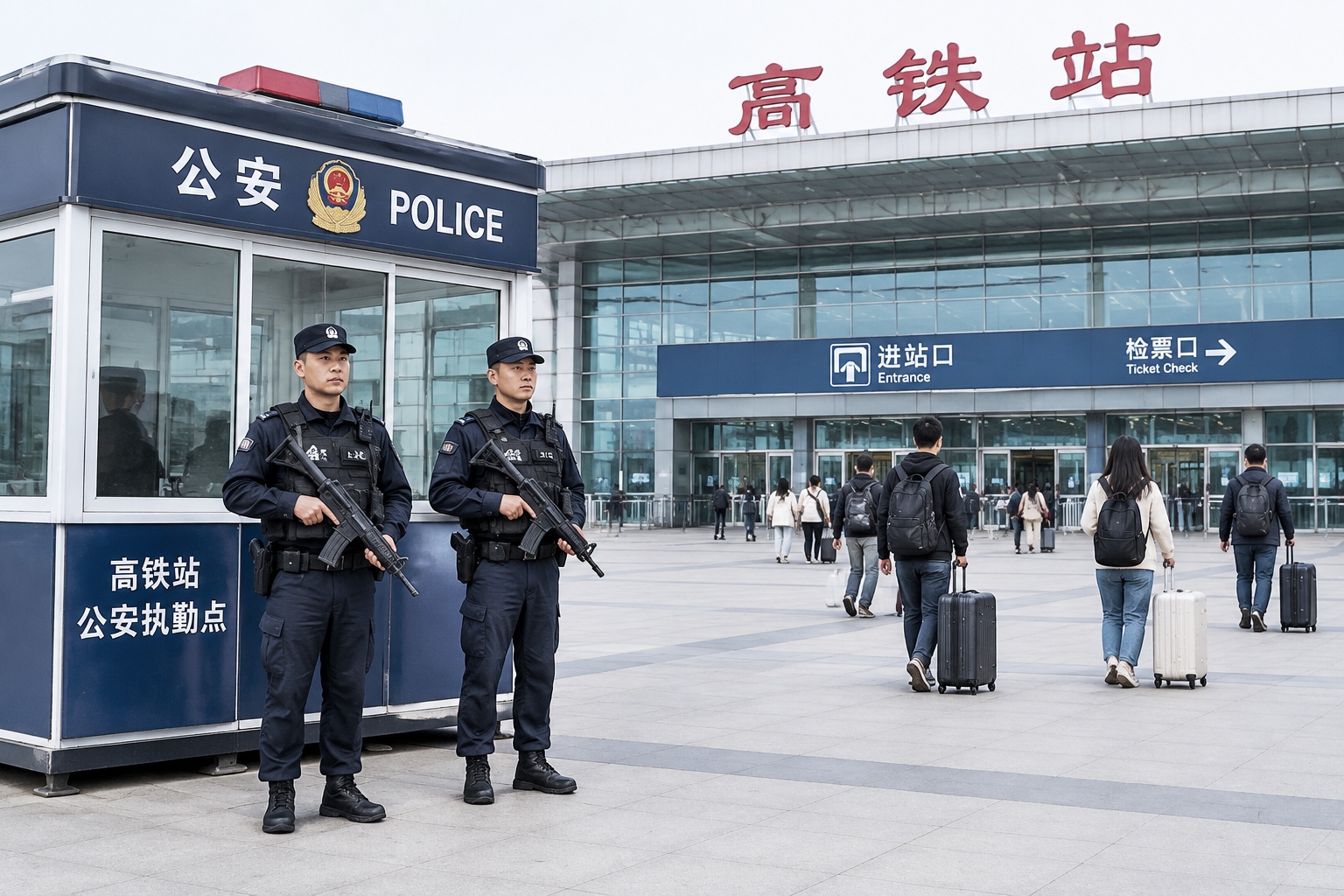
So the honest answer to Marcus’s question isn’t “China has no armed police.” It’s that China puts them in a small number of predictable places and relies on cameras, screening and social density everywhere else.
The Trade-Off Chinese People Actually Argue About
This is where the picture gets less comfortable, and Chinese people say so themselves.
Living inside this system means showing ID at some subway entrances, at hotels, at event venues. Some apartment compounds and tourist attractions use facial recognition to open gates. Foreign residents get asked for passports in situations locals never are. The word you hear most often is 安全 — safe — followed, in the same breath, by an acknowledgment that being safe and being unobserved are not the same thing.
Crime also hasn’t disappeared; it has moved. Violent street crime is rare, but telecom and online fraud is a massive, well-documented problem, with losses reported in the tens of billions of yuan a year and elderly people as the most common targets. Bike and phone theft still happen in big cities. Cameras don’t stop a scam call from a call center abroad.
What Marcus Took Home
On his last night in Chengdu, Marcus sat at a plastic table by a barbecue stall at midnight, surrounded by families with children still awake, students on scooters and an elderly couple arguing softly over the bill. The only uniform in sight was a security guard carrying a folding chair back into his booth.
“I came expecting to see rifles and I saw a guy with a phone,” he said. “I don’t know if I’d want to live inside all of it. But I get why people here don’t think about it the way I do.”
That’s probably the most useful thing a visitor can carry home. The absence of armed police on a Chinese street doesn’t prove anything simple. It’s the visible tip of a system built on low violent crime, strict gun laws, hundreds of millions of cameras, millions of unarmed guards and a state that would rather watch than be watched. You can find that reassuring, or unsettling, or both. What you can’t do is keep pretending it looks the way you assumed it would.
Start the discussion at forum.chinacomes.com