
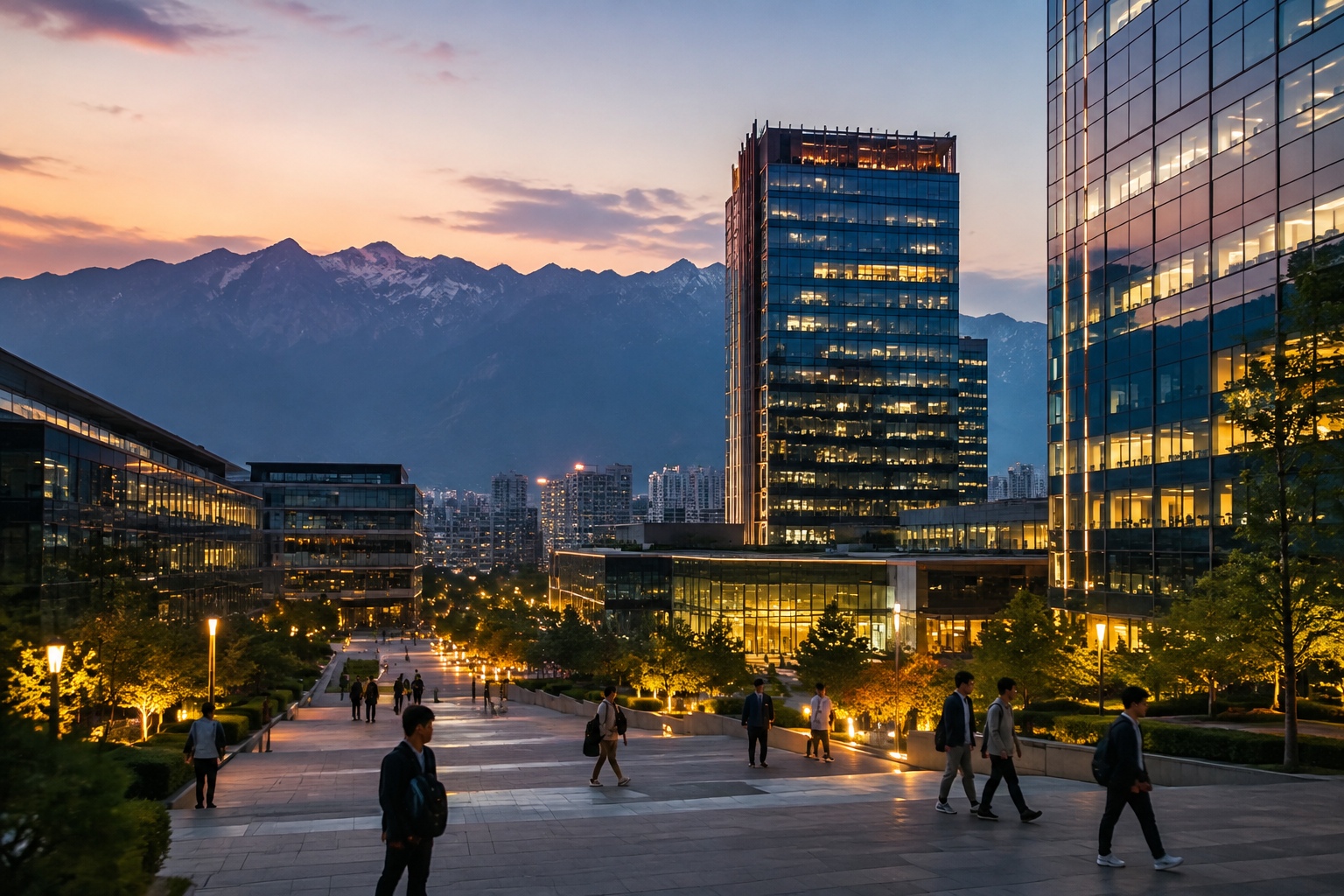

It is early evening in the Xi’an Software Park. Groups of young programmers stream out of glass towers, some grabbing a quick dinner from food stalls that sell roujiamo (a fragrant pork-stuffed flatbread), others heading to the subway. On one side of the road, a large metal sculpture catches the last sunlight; on the other, the distant Qinling Mountains are turning purple in the twilight. This is not the Xi’an of the Terracotta Warriors, but it’s a growing part of the city — a place locals often call “the Western Silicon Valley.”
As a label, “Western Silicon Valley” is both catchy and misleading. It suggests Xi’an is trying to copy California’s tech ecosystem. The reality is more subtle: the city has become one of China’s largest software hubs by leveraging its own mix of universities, state-backed investment, and lower costs. To understand how it works, it helps to walk through the park and talk to the people who work there.
From farmland to a digital city
The Xi’an Software Park is located in the high-tech zone, about a 40-minute drive from the Bell Tower. In the early 2000s, this area was covered with wheat fields and workshops. The central government selected Xi’an as one of the first national software bases, offering tax incentives and land. Local authorities then built modern infrastructure, gradually turning the farmland into a grid of office buildings, apartment blocks, and shopping malls.
Today the high-tech zone sprawls over 100 square kilometers. The software park alone hosts more than 4,000 companies, from homegrown startups to R&D branches of global tech names like Huawei, ZTE, ThoughtWorks, and Siemens. In 2019, the city opened a new “Software New City” district with futuristic offices and wide boulevards. Walking through it, you might think you were in the middle of a North American tech campus — except that the employee cafeterias serve Shaanxi specialties like biang-biang noodles and cold liangpi.
One programmer’s typical day
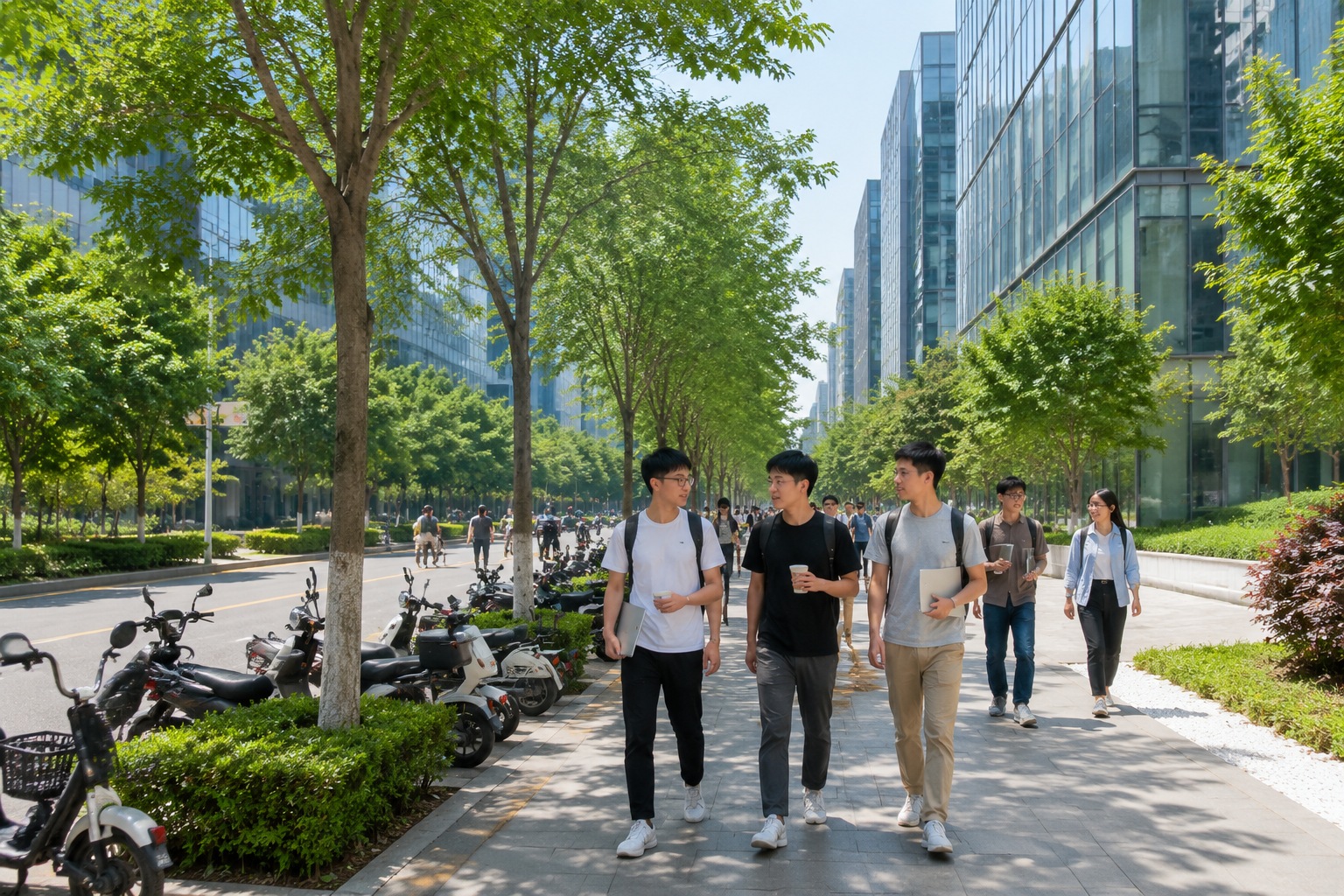
Li Wei is a 30-year-old backend engineer at a chip-design company. He has worked in the software park for five years. On a normal morning, he buys a roujiamo and a cup of soy milk from a street vendor, then rides an e-bike for eight minutes to his office. “There are so many buildings here that you can’t walk everywhere. The e-bike is life,” he jokes.
His office is sleek and airy, with rows of desks and dual monitors. The team is young and mostly local — many graduated from Xi’an Jiaotong University or Xidian University, two of China’s top engineering schools. A typical day includes a short stand-up meeting, long stretches of coding, and a lunch break where colleagues debate tech news over steaming bowls of noodles.
But unlike in Beijing or Shenzhen, Li Wei’s life is not only about work. After dinner, he sometimes rides to the ancient city wall and runs along the 14th-century fortification. On weekends, he meets friends at Daming Palace’s enormous public park, or takes the metro to a shopping quarter near the Big Wild Goose Pagoda. “I get to work on serious technology, but I can also breathe. There is a human scale here,” he says.

Why Xi’an? Education, policy, and cost
Xi’an’s rise did not happen by accident. The city has always had a deep well of technical talent. With more than 40 universities and roughly 1.2 million college students, it is one of the most university-dense cities in China. Long before the tech boom, national defense and industrial research were located here. That heritage left a legacy of skilled engineers.
The government also played a major role. The software park offers low corporate tax rates for research-intensive firms, and young professionals can receive housing subsidies or discounted apartments. The city built a subway line that connects the park to the center, a high-speed rail link to Zhengzhou and Beijing, and an increasingly connected international airport.
Cost is the final factor. A mid-level back-end developer in Shanghai easily earns 30,000–40,000 RMB (about $4,000–5,500) per month. In Xi’an, the same role might pay 20,000–25,000 RMB. But monthly rent for a comfortable one-bedroom apartment near the software park is perhaps 2,500 RMB, while in Shanghai you’d pay three times as much. For many young people, the trade-off is clear: they give up some salary, but gain a bigger home, shorter commutes, and a slower rhythm of life.
This is not a Silicon Valley-style start-up ecosystem. In California, the university’s garage culture and venture capital fuel freewheeling innovation. In Xi’an, the model is more systematic: large companies set up engineering centers to hire from the massive talent pool. The result is less flashy, but it provides stable employment for thousands.

The struggles behind the label
Ask programmers how they really feel about the “Western Silicon Valley” label, and you get mixed answers. “It’s just a slogan from the marketing department,” one software engineer says, laughing. “We don’t wake up thinking about that.” Many acknowledge that Xi’an is still a branch-office city. Key strategic decisions are made in headquarters located in Shenzhen, Beijing, or overseas. Funding, too, tends to flow through coastal networks.
Salaries have not kept up with housing costs. The average home price in Xi’an has tripled since 2015, though it remains about half of Beijing’s. The global tech downturn has also hit the sector; some companies have paused hiring or laid off junior staff. Young programmers worry about the industry’s perception that 35 is old for a coder. “If you don’t get promoted to management, what do you do?” asks Li Wei.
Still, the label has practical benefits. It attracts conferences, government attention, and foreign investment. It creates a sense of pride. Rather than a second-best Silicon Valley, Xi’an might be better compared to Bangalore or Dublin — a lower-cost alternative where companies set up technical centers that are cheaper than the original hub but still highly skilled.
From Xi’an to a bigger picture
Xi’an is not alone. Throughout China’s interior, cities are using the same playbook: universities, infrastructure, and cost advantages to attract technology industries. Chengdu, Wuhan, and Changsha have all made significant strides. The Chinese government’s long-term “Go West” policies and massive rail investments have shrunk distances. Meanwhile, the rise of remote work and cloud-based tools means that “location” matters less for certain software tasks.
For ordinary people, this shift opens up options. A graduate from rural Gansu no longer has to move to Beijing or Shanghai to build a career. A former factory worker can take online courses to become a data analyst. The concentration of technology in coastal cities is slowly loosening, and Xi’an is one of the places where this is most visible.
A work in progress
Standing on a rooftop overlooking the software park, you see a sea of glass and steel stretching toward the Qinling Mountains. The noise is not of ancient bells but of server fans and construction. The “Western Silicon Valley” is not there yet, if by that you mean a self-driving engine of innovation. But it doesn’t have to be. It’s a regional tech hub with a distinctly Chinese, and distinctly Shaanxi, character.
So the next time you travel to Xi’an, don’t just visit the warriors. Spend an hour walking through the software park. Watch the young engineers chat over jianbing, ride their electric bikes to work, and slowly turn a city of history into a city of code. The real story of China’s west is being written there.
Start the discussion at forum.chinacomes.com