

The Double Harvest
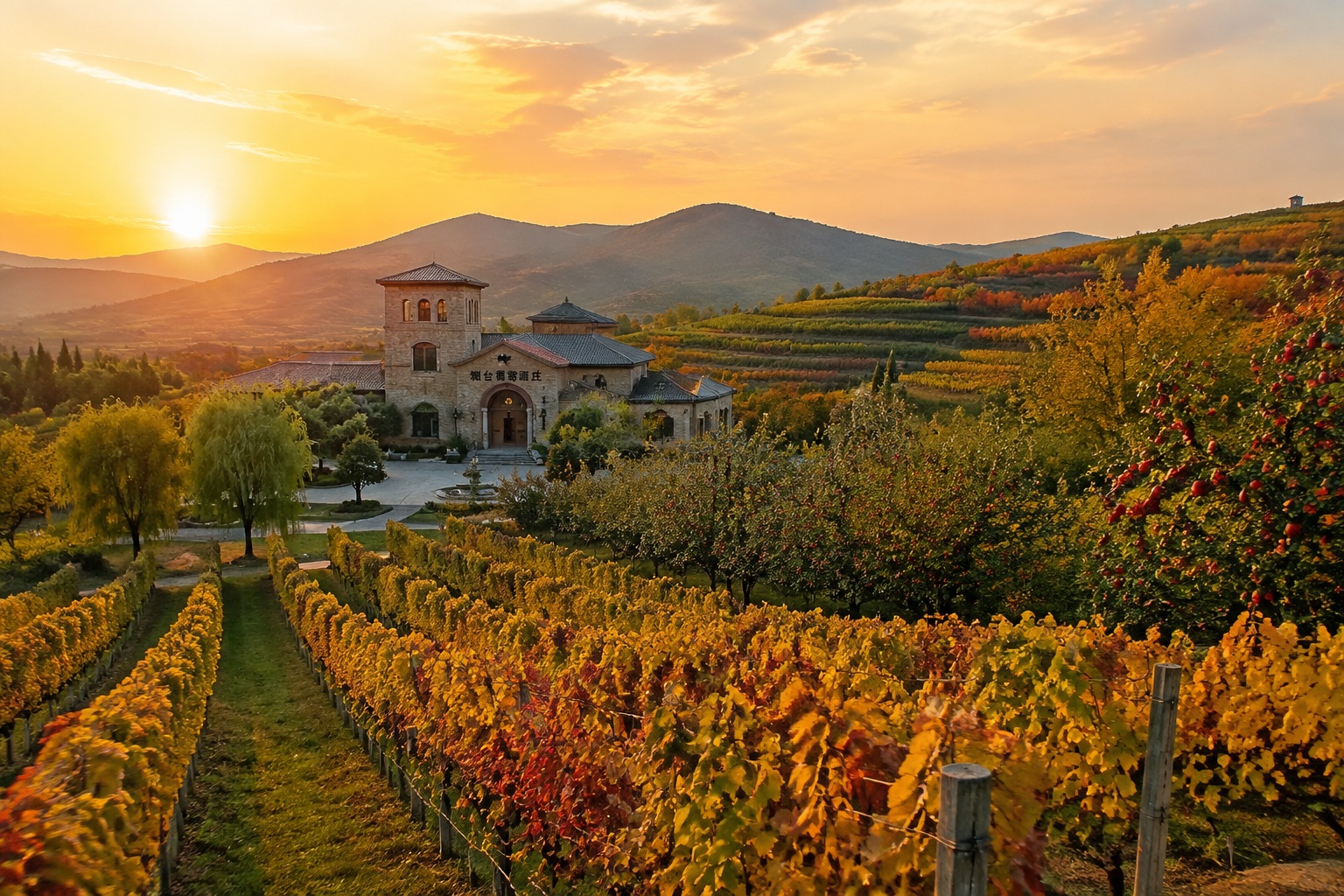
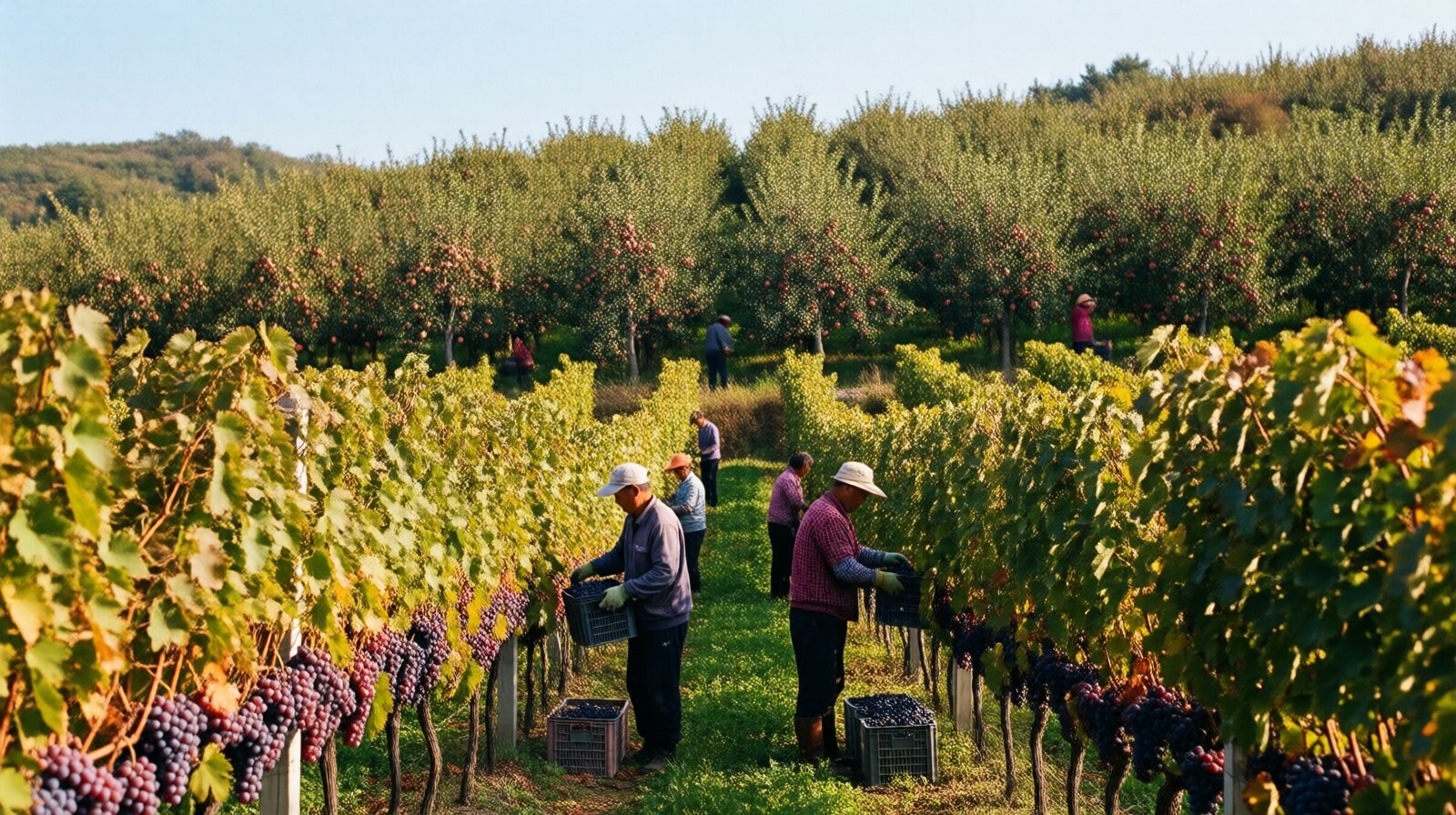
October is the busiest month in Yantai, a seafront city on China’s Shandong Peninsula. On the rolling hills west of the city, rows of grapevines heavy with fruit glow in the low autumn sun. A few hundred meters away, farmers are loading baskets of bright red apples onto flatbed trucks. The air carries a sweet, yeasty smell of crushed grapes from a nearby winery.
I had come to Yantai to understand one thing: how two very different fruits — wine grapes and apples — became the twin engines of a regional “sweet economy.” What I found was not just a landscape, but a way of life.
Why the Hills Are Different
Yantai sits at roughly 37°N latitude, on the same line as Spain’s Priorat and Japan’s Aomori Prefecture. The sea moderates the climate, and the hillsides provide good drainage and sunlight. The soil varies from sandy loam to clay, giving grapes complexity and apples that signature crisp bite. This is why Yantai has a growing season long enough for wine grapes and apples, but cool enough to slow ripening and concentrate flavor.
Apples were first planted here in 1871 by American Presbyterian missionaries, who brought varieties like Red Delicious. Wine came later, in 1892, when Zhang Bishi, a Chinese merchant, founded Changyu winery with imported European vines. Today, Changyu is a global wine company, and Yantai is home to over 160 wineries, from giants to tiny garagistes. The apple acreage covers about 270,000 hectares, producing an average of 5.5 million tonnes a year — roughly one in every ten apples grown in China.
Where Wine and Apples Share the Same Fields
I spent an afternoon at a small winery called Lan Pi (Blue Skin), tucked into a valley in Penglai. The owner, Chen Ning, left a career in architecture in Beijing to grow grapes. “I wanted to make wine from this place, not from a recipe,” she said.
Lan Pi uses organic methods: chickens patrol for insects, geese weed between the vines. In the cellar, oak barrels age a Chardonnay that smells of honey and wet stone. Chen poured me a glass. “See that hill across the stream? That’s where my grandfather had an apple orchard. I planted grapes here, but the old trees are still there. My first vintage was made from grapes that grew on the hill where he used to pick apples.”
That overlap is everywhere in Yantai. Drive along the coast and you’ll see vineyards next to orchards, sometimes in the same field. In spring, pink apple blossoms and pale green vine leaves appear together. In autumn, both are golden.
Apple Country
About 70 kilometers inland, in the county of Qixia, the hills are covered with apple trees. Qixia is to apples what Napa is to wine: a name that guarantees quality. The region has a long history of apple cultivation, and its high altitude and big day-night temperature difference produce exceptionally sweet, crisp fruit.
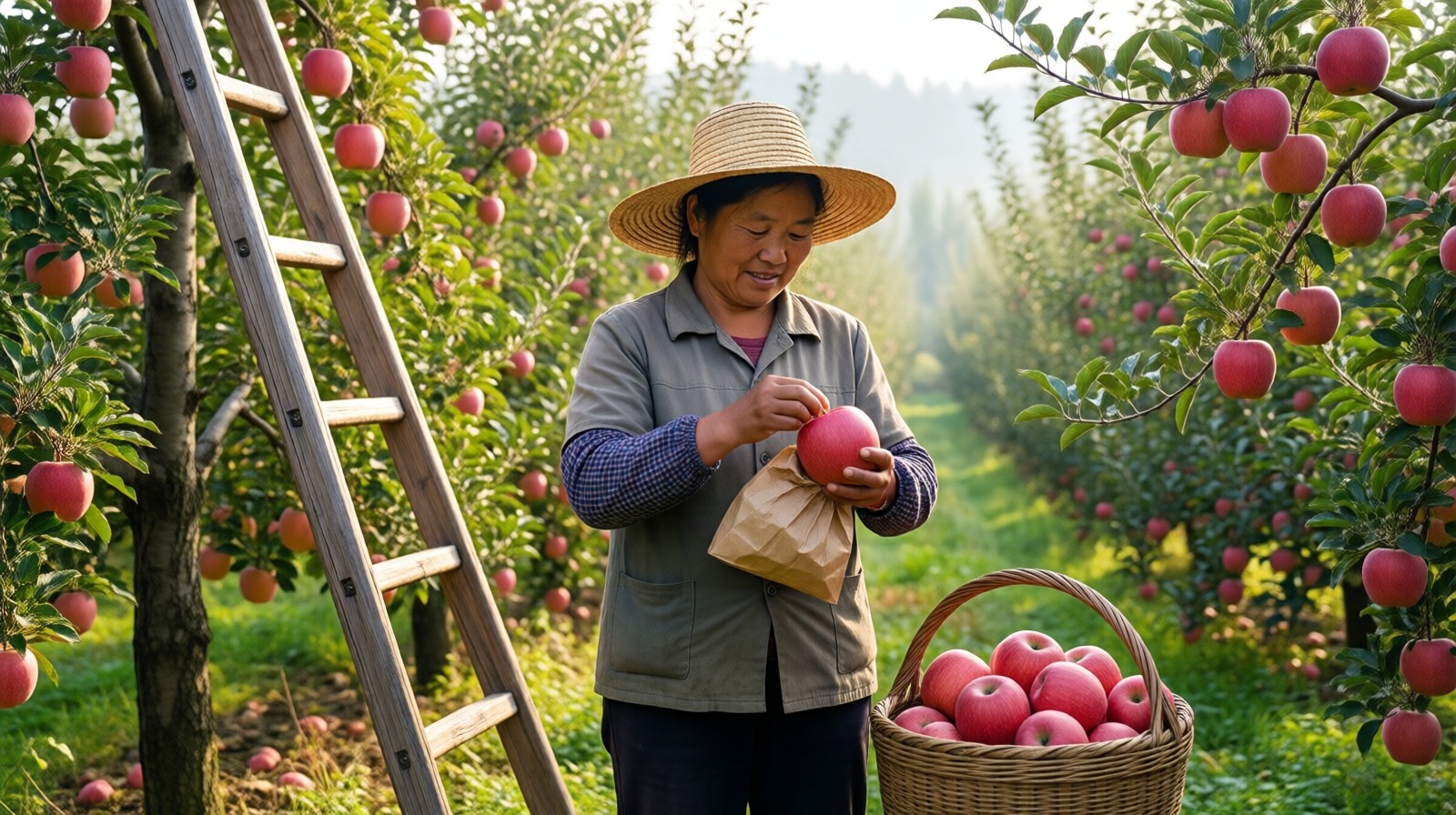
I met Wang Xiulan, a 55-year-old fruit farmer, in her orchard. She grows Fuji apples, the most popular variety in China. “When I was young, we used to sell apples for a few cents a kilo. Now good ones can fetch 10 yuan. But the work is harder,” she said, wiping her forehead. She showed me her trick: each apple has a small paper bag covering it to protect from pests and sunburn. Removing those bags has to be done one by one, then the apples need to be flipped on the ground so they color evenly. It’s backbreaking, yet her rows of trees looked immaculate.
Wang’s family earns about 150,000 yuan a year from their six acres. It allowed them to send their son to college in the provincial capital. “He doesn’t want to come back and pick apples,” she laughed. “But who knows? Young people are starting to return because of the internet.”
The Internet, Wine, and New Money
That son might yet come back. In Yantai, a quiet revolution is happening. Farmers and winemakers are using short videos and social commerce to sell directly to customers. I visited a young couple, Zhang Lei and Xu Fang, who run a farm-stay and cider business. Zhang, a former software engineer, now manages their family’s apple orchard with an app that tracks soil moisture and insect counts. Xu streams live from the orchard every day during harvest.
“Last year we sold 20,000 boxes of apples online,” Xu said, showing her phone with thousands of comments. “We also make hard cider from the less pretty apples. That sold out in a month.”
Nearby, the wine industry is also changing. Instead of only selling bulk wine to large brands, small wineries like Lan Pi are building tasting rooms and hosting yoga weekends. Wine tourism in Yantai has grown by more than 20% a year in recent years. The city government has built a network of scenic routes linking wineries, orchards, and coastal villages. On weekends, city visitors pour in to wander the vineyards and buy fresh apple pies from farm stands.
The Limits of Sweetness
It would be easy to paint a rosy picture, but farmers are quick to talk about the challenges. Climate change is real. A typhoon in 2022 destroyed more than a tenth of the apple crop in some areas. Hailstorms can ruin a season in minutes. Water is scarce in the hills, and many orchards rely on costly drip irrigation.
Then there’s the labor problem. As in many rural areas, young people move to cities. Apple picking is still done by hand, and wages for seasonal workers have doubled in five years. Some orchards have been abandoned for this reason. The oldest apple trees in Yantai are more than 100 years old, but new dwarf varieties are being planted to allow easier harvesting. The question is whether tradition can compete with efficiency.
Wine faces a different kind of pressure. While Chinese wine consumption has been rising, it’s still a small fraction compared to beer or baijiu (a strong grain liquor). The market for premium wines is growing, but slowly. That’s why wineries need to sell more than just the liquid — they need to sell a lifestyle.
An Evening in the Orchards
On my last evening, Wang Xiulan invited me for a simple dinner at her home: pork dumplings, cucumber salad, and a bottle of local Yantai red wine. She poured a glass and laughed. “I grew up hating this stuff. Now I drink it to my health.” Her husband, who had spent the day pruning trees, raised a toast: “To the hills.”
Outside, the sunset turned the orchard into a golden bronze. A neighbor was still out, tying a strip of cloth to scare off birds. The air smelled of apples, earth, and something else — maybe a hint of wine from the small cellar under the house.
I realized that Yantai’s sweet economy is not really about exporting apples or selling wine. It’s about a community that has learned to wring a living from a hillside, and to love what they do. In a country modernizing at breakneck speed, that’s a taste worth preserving.
Start the discussion at forum.chinacomes.com