


A coastal city that catches you by surprise
When Dr. Rui Zhang left a Boston research lab for a job in Zhuhai in 2019, some of her colleagues assumed she was retiring to a resort town. In a way, they were right. Zhuhai has palm trees, seaside cycling paths and one of the best air-quality records among China’s larger cities. But Zhang did not move to lie on the beach. She came to run a drug-discovery team at a local biopharmaceutical company.
Zhuhai is a city of about 2.5 million people on China’s southern coast, a 20-minute drive from Macau and about an hour from Shenzhen by the Hong Kong–Zhuhai–Macau Bridge. For outsiders, it is not the first name that comes to mind for Chinese biotech. Beijing, Shanghai and Shenzhen take most of the headlines. Yet a quiet biomedicine cluster has been taking shape here, and a growing number of researchers trained in China and overseas are choosing it for their careers.

The interesting question is not whether Zhuhai will replace those bigger hubs. It almost certainly will not. The question is why a trained scientist would move to a smaller city and what makes it worth the risk. The short answer: lower pressure, faster decisions, and a support system that takes care of the boring parts of life.
What a biotech lab in Zhuhai actually looks like
West of the city center, in Jinwan District, streets are lined with medical-device workshops and pharmaceutical plants. One of the most established names is Livzon Pharmaceutical Group, a major drugmaker based in Zhuhai. Around it, smaller companies are working on diagnostic kits, medical plastics, synthetic compounds and biological materials. Industry people in Zhuhai call the area a health-and-medicine industrial cluster.
The reason it works, according to early-career researchers, is that the city has built shared infrastructure. Instead of every start-up buying a million-dollar machine, they can use centralized testing labs, pilot production lines and certification centers run by the local government or by a consortium of companies. This is a big deal for young firms. It shortens the distance between a molecule in a paper and a product in a clinic.
The cluster also benefits from its location. Zhuhai sits in the Guangdong-Hong Kong-Macau Greater Bay Area, a 70-million-person urban region with universities, hospitals and investors scattered around Shenzhen, Guangzhou, Hong Kong and Macau. Researchers can recruit from these nearby cities without forcing everyone to live in the lab’s own backyard.
Why would someone move here? The talent policy deep dive
Ask any researcher who recently arrived, and the conversation turns very practical: housing, school, tax, lab space. Zhuhai, together with Guangdong province and, in some areas, the central government, has built a support system that feels less like an incentive package and more like relocation logistics.
Take housing. Early-career researchers can apply for subsidised apartments or rental allowances. Team leaders moving with a group of students or staff may get a settlement package that includes laboratory space, a startup grant and help enrolling children in local public schools. This matters. When a company recruits a scientist from another country, the first question after salary is usually about their family. Zhuhai tries to answer that question before it is asked.
There is also an income-tax advantage. In the nearby district of Hengqin, which operates as a special cooperation zone between Guangdong and Macau, qualified workers in industries like biomedicine can have their personal income tax capped at a maximum effective rate of 15 percent. Any amount collected above that is returned through a subsidy from the local government. For senior researchers with high incomes, the savings can be enough to change a career decision. Unlike a temporary bonus, the subsidy applies as long as the person is working and living in the zone.
Money is only part of the story. Many researchers say Zhuhai’s real advantage is time. Lab space is easier to get, construction of facilities is faster, and the city is less bureaucratic at the project approval stage than some larger Chinese cities. That sounds hard to verify, but ask people in the industry and you hear the same phrase over and over: things just move faster here.
Hengqin: the special district next door
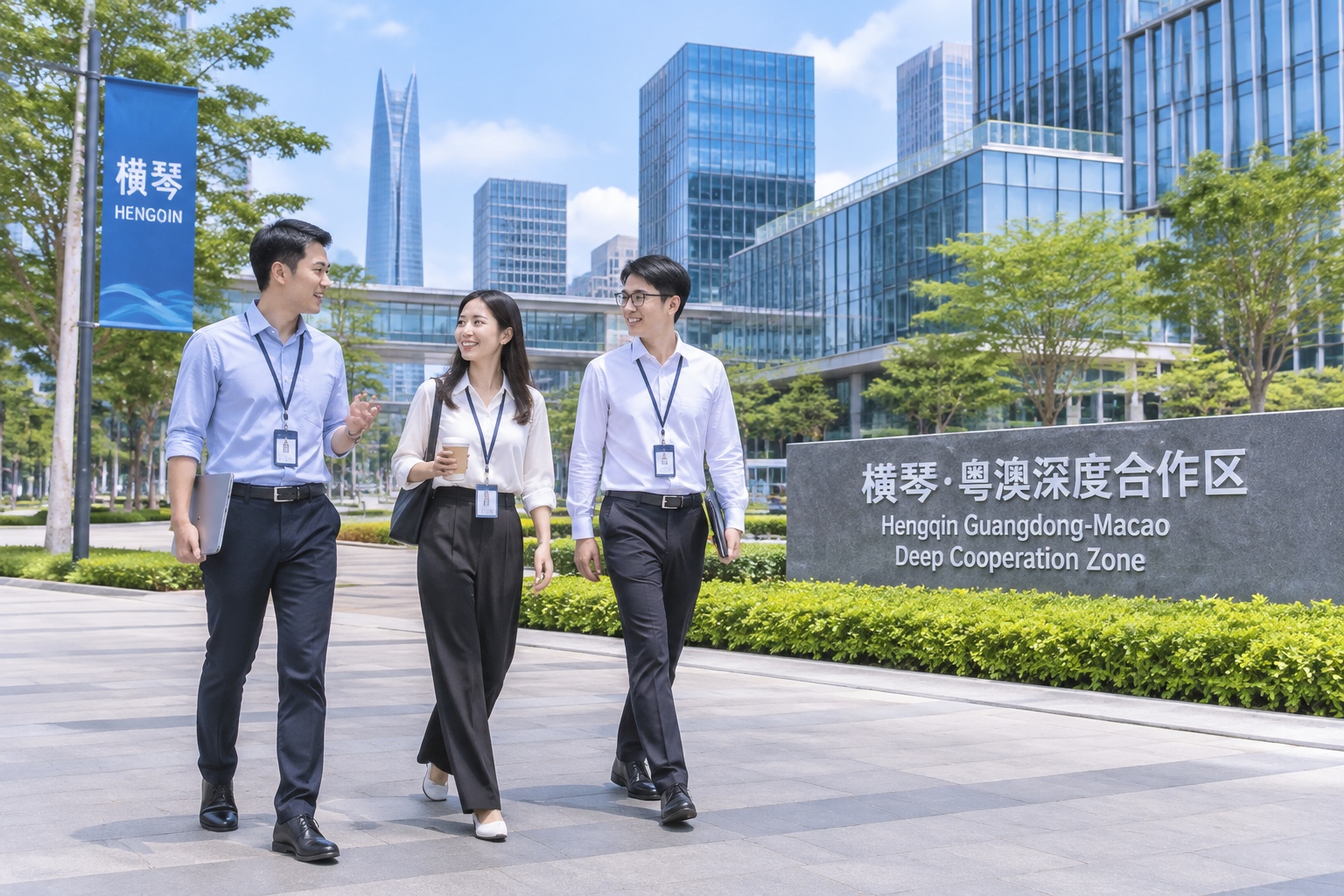
No article about Zhuhai biotech can ignore Hengqin. Until the early 2010s, Hengqin was mostly farmland and empty beach. Since the creation of the Guangdong-Macau Traditional Chinese Medicine Science and Technology Industrial Park and, in 2021, the formal Guangdong-Macau Cooperation Zone, it has become a thin but busy strip of glassy office buildings and clean streets.
For global talent, Hengqin offers two things. First, companies in certain encouraged sectors — including traditional Chinese medicine, modern health care, and medical devices — can receive a reduced corporate tax rate. Second, it sits within walking distance of Macau, a city with a strong Portuguese heritage and a set of pharmaceutical rules that are recognized in many Portuguese-speaking countries. For a drug company interested in exporting to a market like Brazil or Portugal, being in Hengqin makes that easier.
Researchers in Zhuhai do not see Hengqin as a separate town. They see it as part of the same professional space: a lab in Hengqin, an apartment in Zhuhai, a dinner meeting in Macau — all within 30 minutes.
Life outside the lab: the genuine appeal
Living in Zhuhai changes how a workday feels. Compared with Beijing or Shenzhen, the commute is short. Housing is substantially more affordable. There is green space everywhere and no smog alert days as common as in the Pearl River Delta’s industrial heartland. On weekends, people go island-hopping or hiking on Lover’s Road, the city’s famous waterfront promenade.

The gap between work and life is often the reason scientists stay. But it would be dishonest to pretend Zhuhai is the perfect place for everyone. The international community is still small. You will not find the density of seminars, meet-ups and venture capital networking events that you get in Cambridge or Shenzhen. International flights require a trip to Shenzhen or Guangzhou. Some researchers worry that a stay in Zhuhai will make them less visible in the global science network. For some, that anxiety wins, and they leave.
For the people who stay, the trade-off feels acceptable. “I can spend an hour a day with my daughter instead of in a car,” one scientist, who moved back from Singapore, told me. “My research has enough funding. My life has enough quiet. That is a combination I did not think I would find in China when I started looking.”
The playbook: what other cities can learn from Zhuhai
Zhuhai is not trying to win every industry. That is the first lesson. It chose one niche, health and medicine, and wired its talent policies, tax incentives and public infrastructure around that choice. Smaller cities that copy Shenzhen and try to do everything usually end up with nothing.
Second, livability is a talent policy. A city that can offer clean air, safe streets, short commutes and affordable housing will always beat a bigger city that offers only a higher salary and a longer commute. The researchers do not need to be told that; they feel it every day.
Third, remove friction for families. School enrollment, visas, spouse support and housing are not side issues for internationally mobile talent. They are the main issues. Zhuhai’s willingness to handle those early, and in writing, is a major reason its offers are not rejected.
Finally, use nearby special zones. Zhuhai leveraged Hengqin’s unique status to attract companies and individuals that might otherwise fly to Hong Kong or Singapore. Even a smaller city can build a bridge to a bigger financial and governance system if the regional and national governments support it.
Facts and numbers: is Zhuhai really growing?
Let’s be honest: Zhuhai will not overtake Shanghai in the next decade. But it has become a place where biotech careers can be launched without needing to be in a top-10 city. Companies in the area produce active pharmaceutical ingredients, generic drugs and medical devices sold across China and beyond. The local government’s industrial plans identify biomedical and health industries as a key growth engine. Funds have been set up specifically for biotech startups, and a number of local factories export to markets in Asia and Latin America.
Is Zhuhai’s model a match for you?
If you are a scientist wondering whether cities like Zhuhai matter, the answer is not about the city rankings. It is about what you value. If you care about owning a lab, working with a smaller team, and being able to cycle to work along the sea, Zhuhai is genuinely attractive. If you need the constant buzz of a global supercity, it may feel like a downgrade. The city is not a compromise; it is a different choice.
Start the discussion at forum.chinacomes.com