
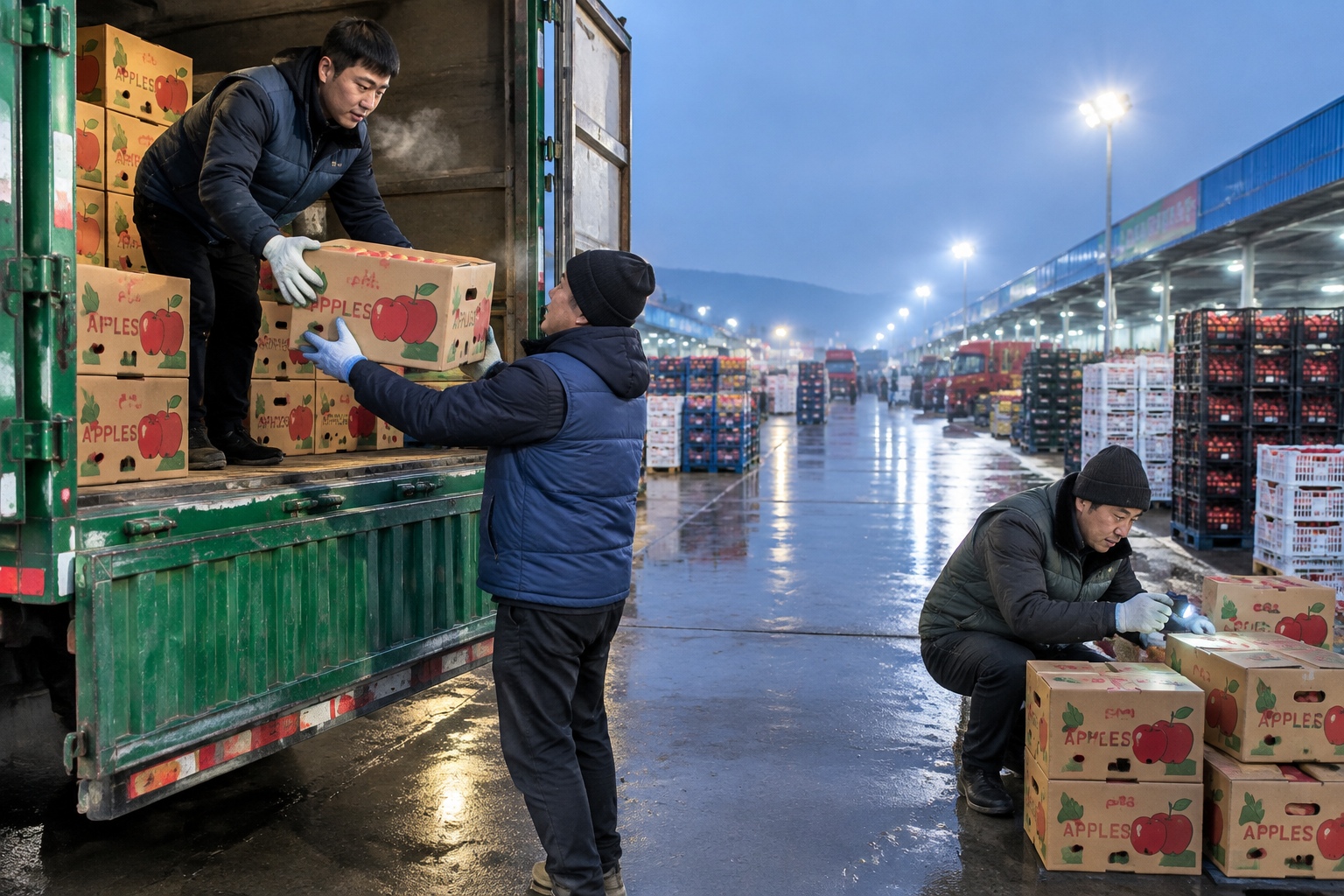

3:20 a.m., bay 47
At 3:20 in the morning, the air in the fruit section of Xinfadi smells of cardboard, diesel and something sweet-sour leaking from a crate that split somewhere in the dark. It is four degrees. A green truck from Yuncheng, in Shanxi province, has backed into its bay with the tailgate down, and a man in a padded vest is standing inside the box, handing cartons of apples down to two others who stack them on a trolley without much talk.
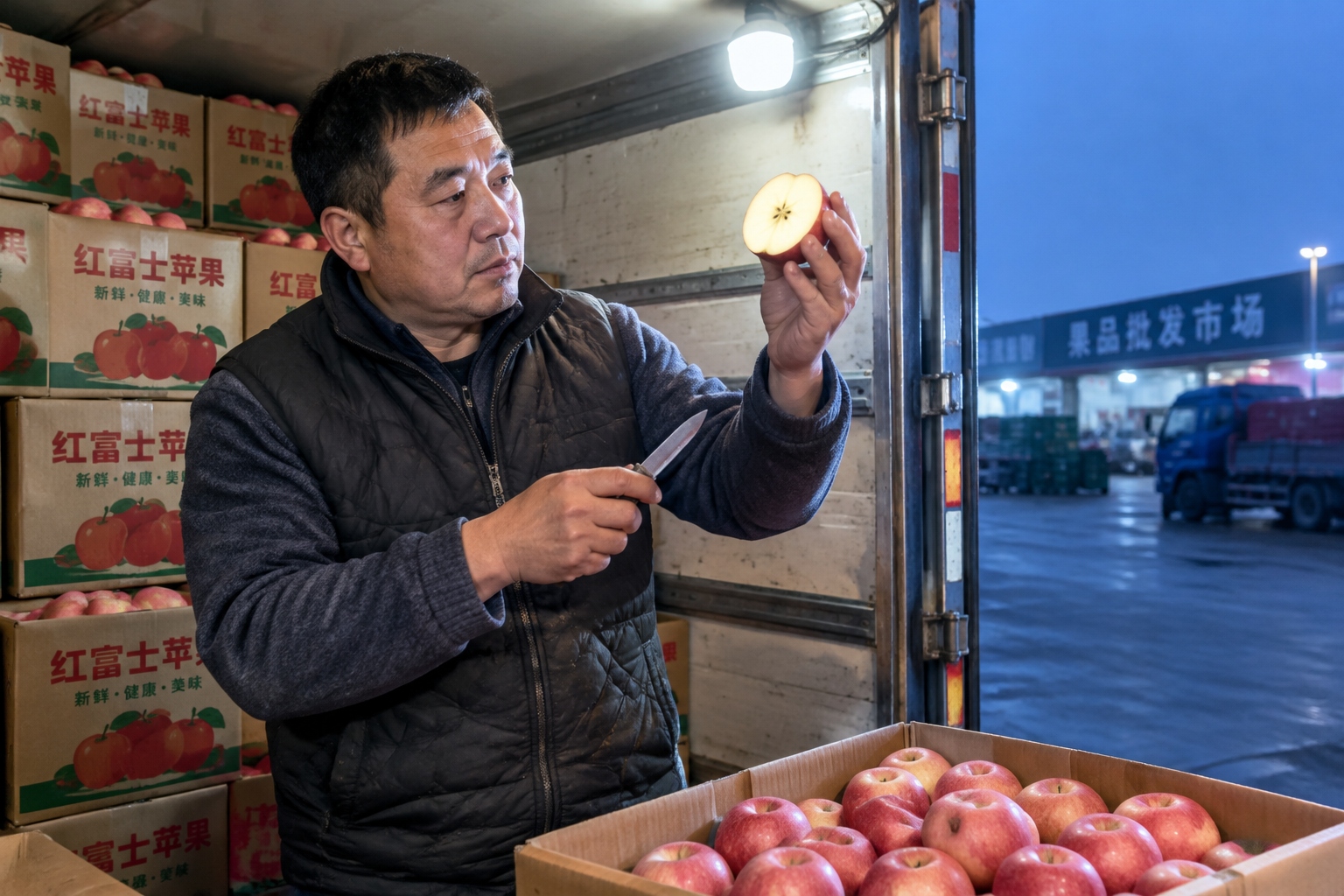
The man’s surname is Liu. He is 46, he has driven this route for eleven years, and he has not slept properly since Wednesday. He takes a paring knife from his pocket, cuts an apple in half, holds the cut face under the truck’s interior light, and gives me the number before I ask: 2.6.
Two point six yuan per jin — half a kilo. Call it 70 US cents a kilogram, at the wholesale gate, before dawn, in one of the most expensive cities in China.
By seven, that apple will be on a shelf fourteen kilometres away at five yuan a jin. By nine it may be in a schoolbag. The same fruit in a British supermarket, on the same day, would likely cost at least twice as much per kilo.
Visitors ask this constantly, and almost nobody standing in the cold here finds it interesting: why is fruit in China so cheap?
What one box of apples actually costs
Follow a single carton through the chain.
Liu’s apples were bought at the orchard gate near Yuncheng for about 1.9 yuan a jin. Washing, grading, and the foam tray and plastic wrap on the top layer add around 0.3. The carton, the label, the loading crew — another 0.15. Then 800 kilometres of highway.
Here is one of the least visible reasons Chinese fruit is cheap. Since 1995, trucks carrying fresh agricultural produce have been exempt from tolls on China’s national road network, now the largest expressway system in the world at roughly 180,000 kilometres. A truck hauling apples from Shanxi to Beijing pays nothing at the barriers. On an 18-tonne load, that exemption is worth several hundred yuan — a saving that reappears, faintly, in the price of a bag of apples in a Beijing hutong.
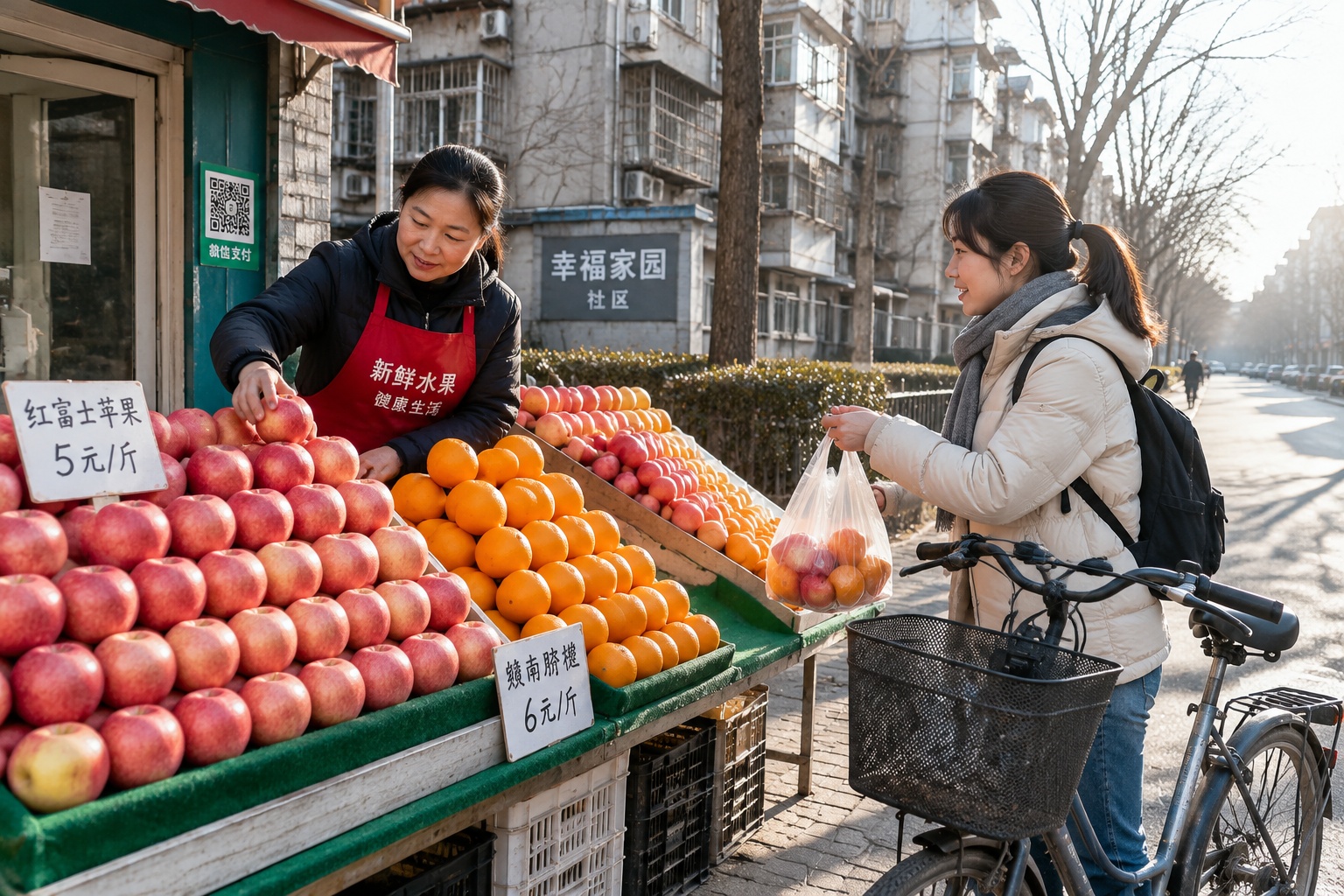
At Xinfadi the carton is weighed, sold through a stall that pays rent and a market commission of a few percent, and reloaded onto a three-wheeled cart. By the time it leaves the gate at six, the cost is around 2.6 yuan a jin. A neighbourhood shop adds rent, staff and its margin, throws out the bruised ones, and sells at five.
Between the orchard and the fruit bowl there are five or six pairs of hands. Each takes a slice, and the slices are thin. That is the whole mechanism, and it is not a secret.
Scale — and the fights it produces
China grows close to 300 million tonnes of fruit a year, roughly a third of the world’s supply. It produces about half the planet’s apples and more than a quarter of its citrus. Shaanxi and Shandong alone grow more apples than most countries do.
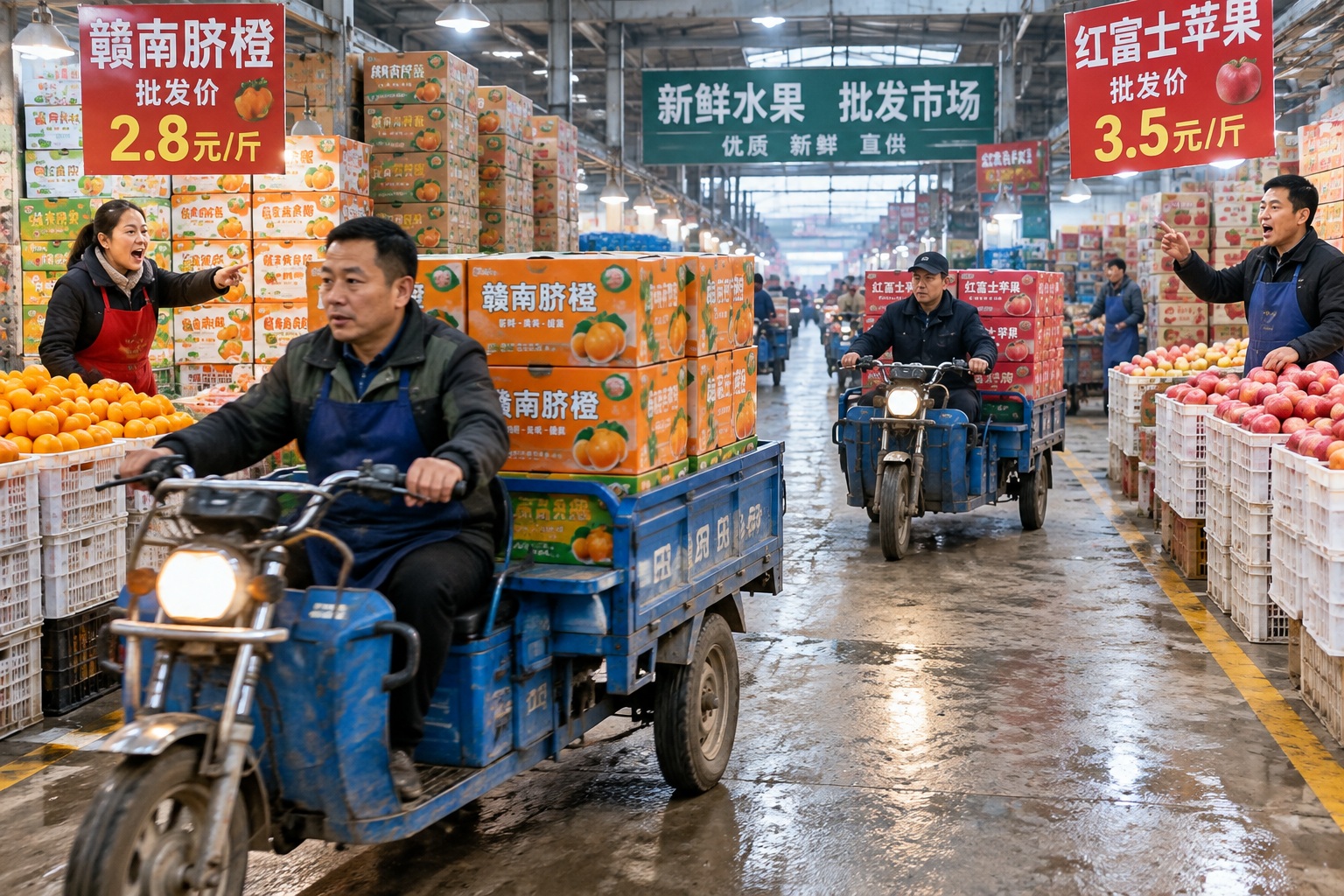
Volume alone does not make anything cheap. Volume makes things cheap when there are enough sellers fighting over the last crate. Xinfadi is less a market than a small town of traders: thousands of stalls, each with its own suppliers and its own regulars, all pricing within earshot of one another. When two trucks of the same variety arrive on the same morning, the price drops before either driver has finished unloading. The traders call it 拼价 — fighting on price — and they say the word with a grimace.
The same logic runs all the way down to the pavement. A Beijing housing compound of 2,000 households might have four fruit shops, two supermarkets, a wet market, three roadside stalls and a community group-buying pickup point where a five-kilo box of oranges goes for 19.9 yuan. Nobody in that ecosystem can hold a fat margin for long.
The cold room and the clock
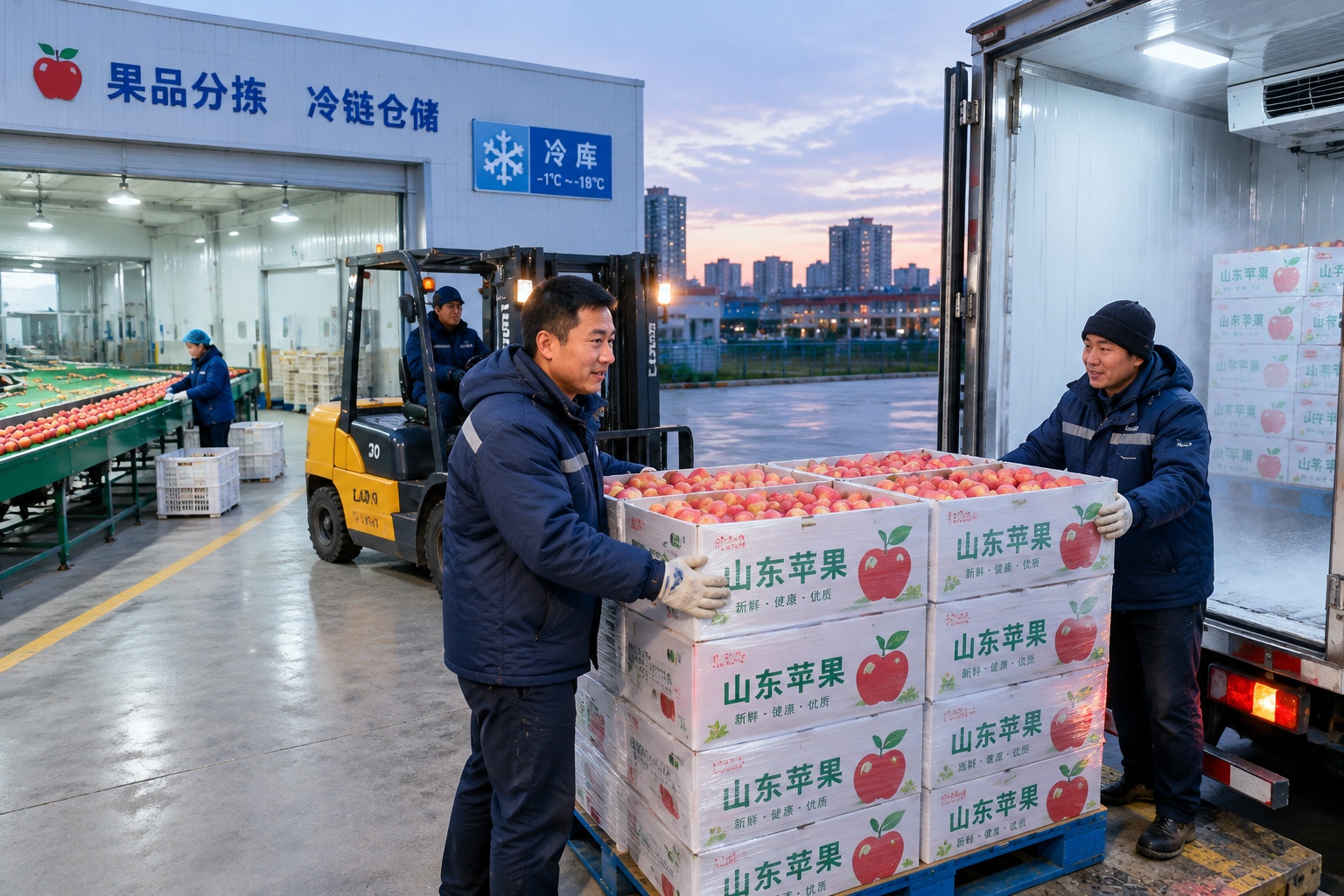
Cheap fruit is mostly a story about time. A decade or two ago, a large share of China’s fruit and vegetables was lost between field and table — bruising, mould, a crate left in the sun. Cold storage has spread fast and losses have fallen, but industry estimates still put them above the levels common in Japan or Western Europe. Chinese fruit is cheap despite this, not because of it.
What has changed is speed. Pre-cooling rooms at the packing house, refrigerated trucks, and sorting centres on the edge of cities compress the journey. Cherries picked in Yantai at dawn can be in a Beijing distribution depot the same evening. E-commerce sellers who ship straight from the orchard — the model behind platforms such as Pinduoduo — cut out two layers of middlemen, though growers complain that the platforms then set the price themselves.
Seasons, plastic greenhouses and the exceptions
It would be wrong to say fruit here is always cheap. It is cheap in autumn, when apples, pears and citrus all land at once and the market cannot absorb them fast enough. It is not cheap in February, when a jin of cherries can cost 80 yuan and a box of strawberries is a small luxury.
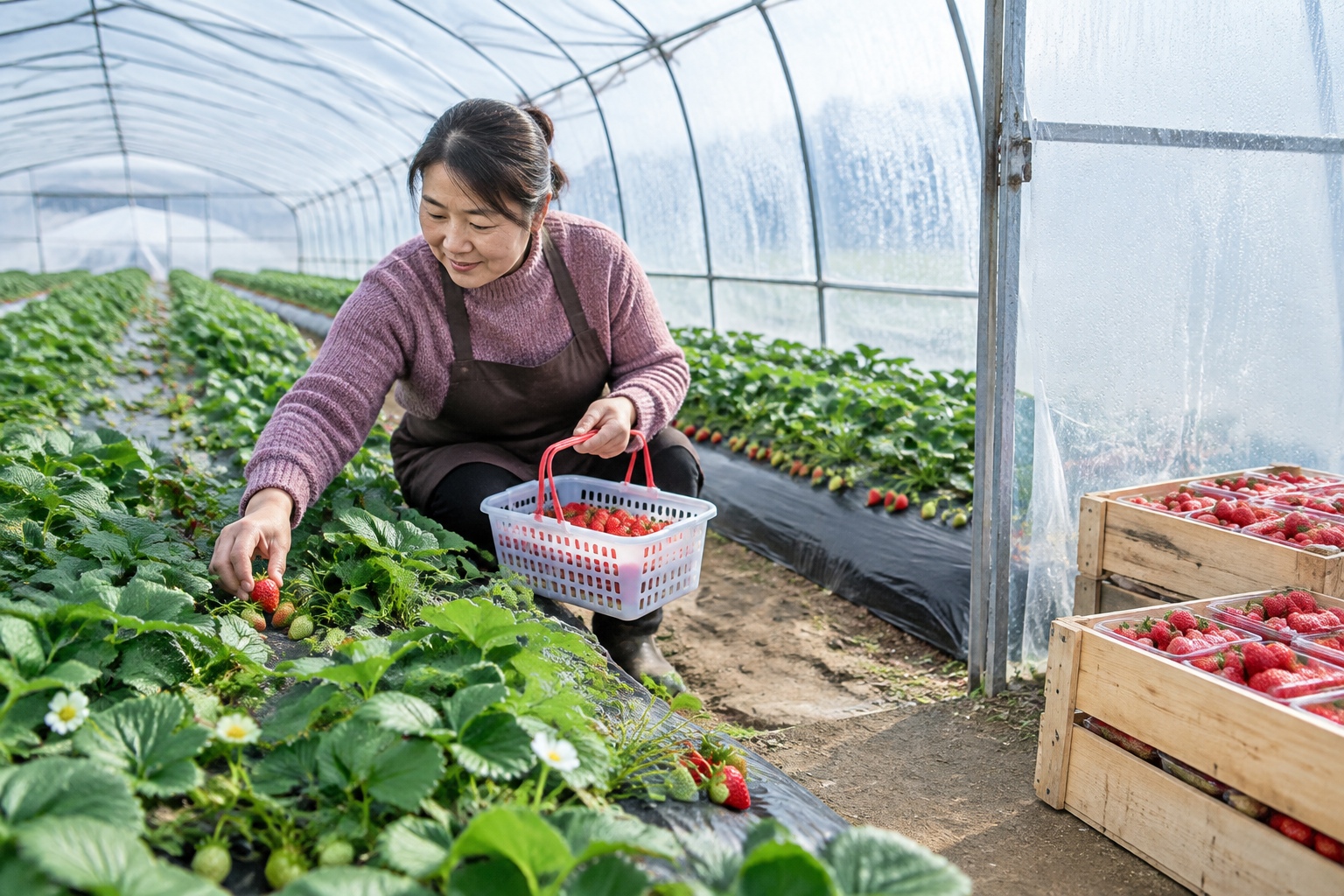
Two things have shifted the calendar. First, greenhouse growing: strawberries in December, grapes in April, grown under plastic sheeting in Shandong and Liaoning, at a cost that is high per kilo but low enough to break the old winter scarcity. Second, import substitution. Chilean cherries once defined the Chinese winter gift box; now domestic greenhouse cherries and imported varieties grown in Yunnan compete with them, and the price of the whole category has slid.
The variation matters to any honest answer. A cheap punnet of grapes in October and an expensive one in March are the same product under two different supply conditions.
The ledger of the people who set the price
Liu keeps his accounts in a notebook app on his phone. Diesel for the 800-kilometre run, the truck loan, the unloading crew, his own eleven hours at the wheel. On a good week he clears one thousand to fifteen hundred yuan; on a bad one, a load rejected for soft fruit costs him the whole trip.
Ms. Wang has run a stall here for nine years. She pays several thousand yuan a month in rent and commission, employs two workers, and moves two to three tonnes of apples a day at a margin she describes as “a few mao per jin” — a few cents. Her risk is the clock: fruit that is not sold in three days is fruit she pays to throw away.
A retiree two kilometres away buys two jin of apples every second day and compares the price with the supermarket downstairs. She is not thinking about cold chains. She is thinking about whether five yuan is too much for fruit that cost five last week.
What the low price is built on
Nights, mostly. The market’s busiest hours are the ones nobody photographs: three to six in the morning, in the cold, with a torch. The work is physical, the margins are thin, and the failure mode is a crate of fruit going soft in the sun.
There are harder edges too. Price competition pushes growers toward whatever variety everyone else planted two years ago; when the acreage matures, the price collapses, and the farmers who borrowed to plant it absorb the loss. Grading is uneven — a box can hide a disappointing bottom layer — and the market’s own testing centre runs residue checks on samples every day, a system that catches problems but not all of them.
Cheapness also has a cost that does not appear on any receipt. It is paid in the eleven-hour drive, in the two workers lifting cartons at four in the morning, in the stallholder’s waste bin.
By sunrise
At 6:40 the floodlights go off along the aisle and the sky above the roofline turns the colour of weak tea. The three-wheeled carts are already streaming toward the gates, loaded with apples, bananas, and boxes of oranges with the leaves still on. Liu climbs into his cab, pulls the curtain across the windscreen and sleeps for four hours before the empty run home.
The answer to the question is not a miracle and not a slogan. It is toll-free highways and 180,000 kilometres of road, orchards planted at a scale no other country matches, thousands of traders packed close enough to undercut each other by the minute, cold rooms that keep the clock from running out, and a great many people awake at three in the morning so the rest of the city can buy fruit for five yuan a jin.
Start the discussion at forum.chinacomes.com