
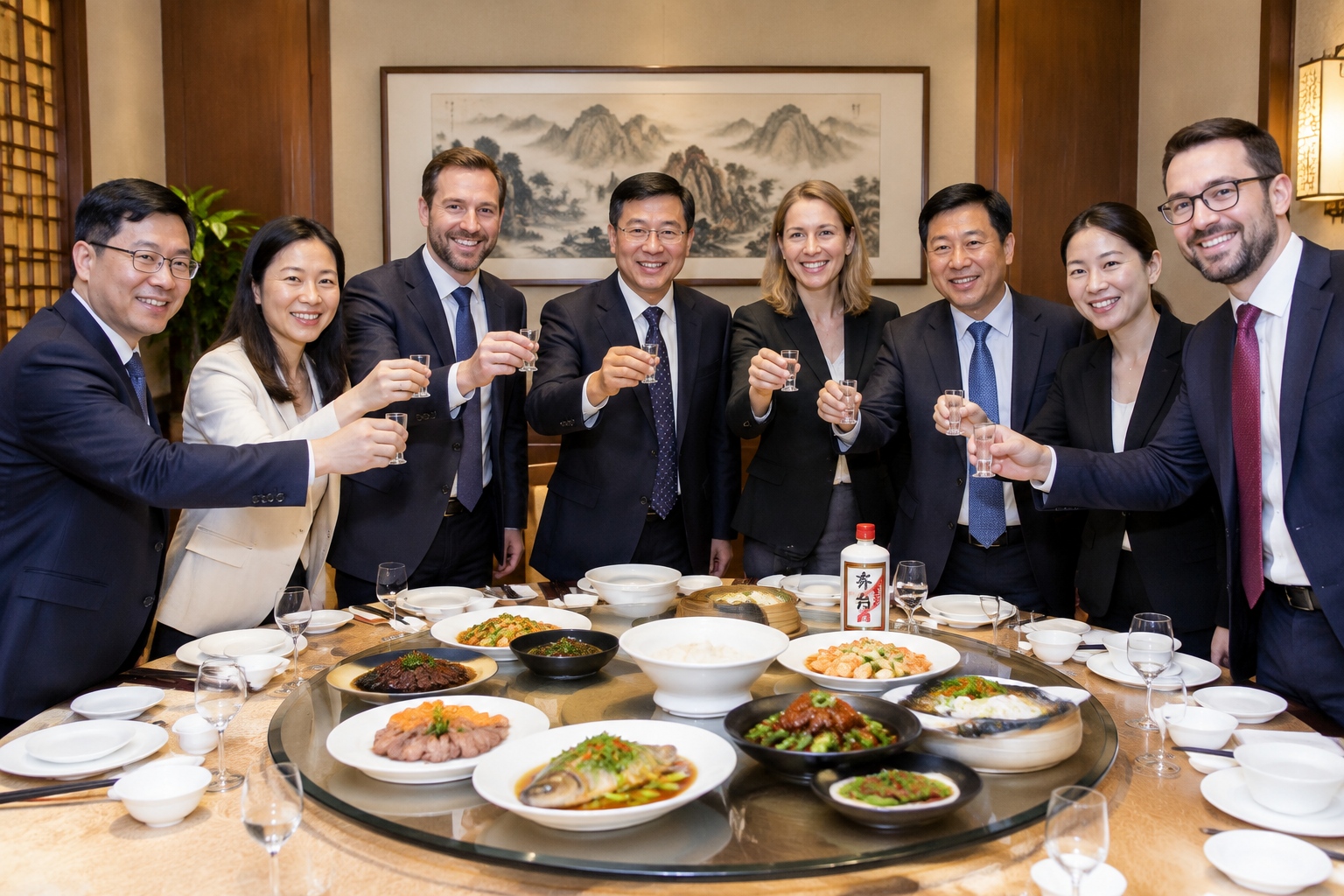

It starts around 7 p.m. You’ve just finished a full day of meetings in Shenzhen, and your Chinese distributor invites you to “a simple meal.” You imagine a quick bite. But you find yourself at a round restaurant table with a towering lazy Susan, fifteen cold and hot dishes, and a bottle of Maotai. A glass is placed in front of you, and before you know it, someone is giving a toast. Others stand up, glasses raised, eyes on you. This is the Chinese business dinner. It’s not just about eating. It might be the most important step in the whole deal.
In China, business is often done on relationships, not just on contracts. The dinner is where you build “guanxi” (关系), where you show your character, and where trust is formed over shared dishes and glasses of strong liquor. If you know how to behave, you can open doors. If you don’t, you may still get the deal, but you may never become the preferred partner. This survival guide for foreign executives covers everything you need to know: seating, ordering, toasting, conversation – and getting out with grace.
Why Dinner Matters in Chinese Business Culture
Chinese business culture is relationship-driven. In the West, you often separate work and social life. In China, the boundary is blurrier. Yes, contracts and spreadsheets matter, but people prefer to do business with those they trust. Dinner is a low-key (though high-intensity) way to test your behavior when you’re not in the boardroom. Are you respectful? Are you willing to follow customs? Can you take pressure? The Chinese phrase “喝酒看人” (look at the person while drinking) means drinking reveals personality.
Also remember “mianzi” (face, 面子). Inviting you for a meal is a way of giving you face. If you react with warmth, your behavior can reflect a positive light on you. But if you shun a toast or slouch over food, you lose face and indirectly insult your host. Understanding “face” is key to navigating these events.
Before the Dinner: Invitation, Punctuality, and Gifts
The invitation to a business dinner is often a test of your attention. If you are invited, accept graciously. If you need to refuse, do it with an honest reason, apologize, and suggest a make-up date. Cancelling after you have accepted is a major faux pas.
Being on time is non-negotiable. In China, the invited guests usually arrive a little early or at least exactly on time. If you are late, the host will be worried. Ten minutes early to a reserved private room is safe. Once you arrive, it is good to greet people with a light nod or a handshake, and present your business card with two hands if you have one.
Who pays? The person who issues the invitation is the host and pays for everything. If you are hosting, you should not split the bill. If you want to show equal intention, plan a return banquet at another time – do not fight over the bill at this dinner.
You can bring a small gift. A nice tea set or a bottle of local food products from your home region is fine. But don’t bring watches or expensive pens to a first get-together. The more important thing is to show that your company respects local customs.
At the Table: Seating, Ordering, and the Right Way to Eat
Business dinners usually take place in a private room with a round table and a Lazy Susan (turnable tray). There are rules for seats. Let the host show you where to sit. In general, the host sits facing the door. The most important guest (often you) sits to the host’s right. That seat is considered the seat of honor. The second-highest ranking guest sits to the host’s left. Other people fill in around the table in rank order.
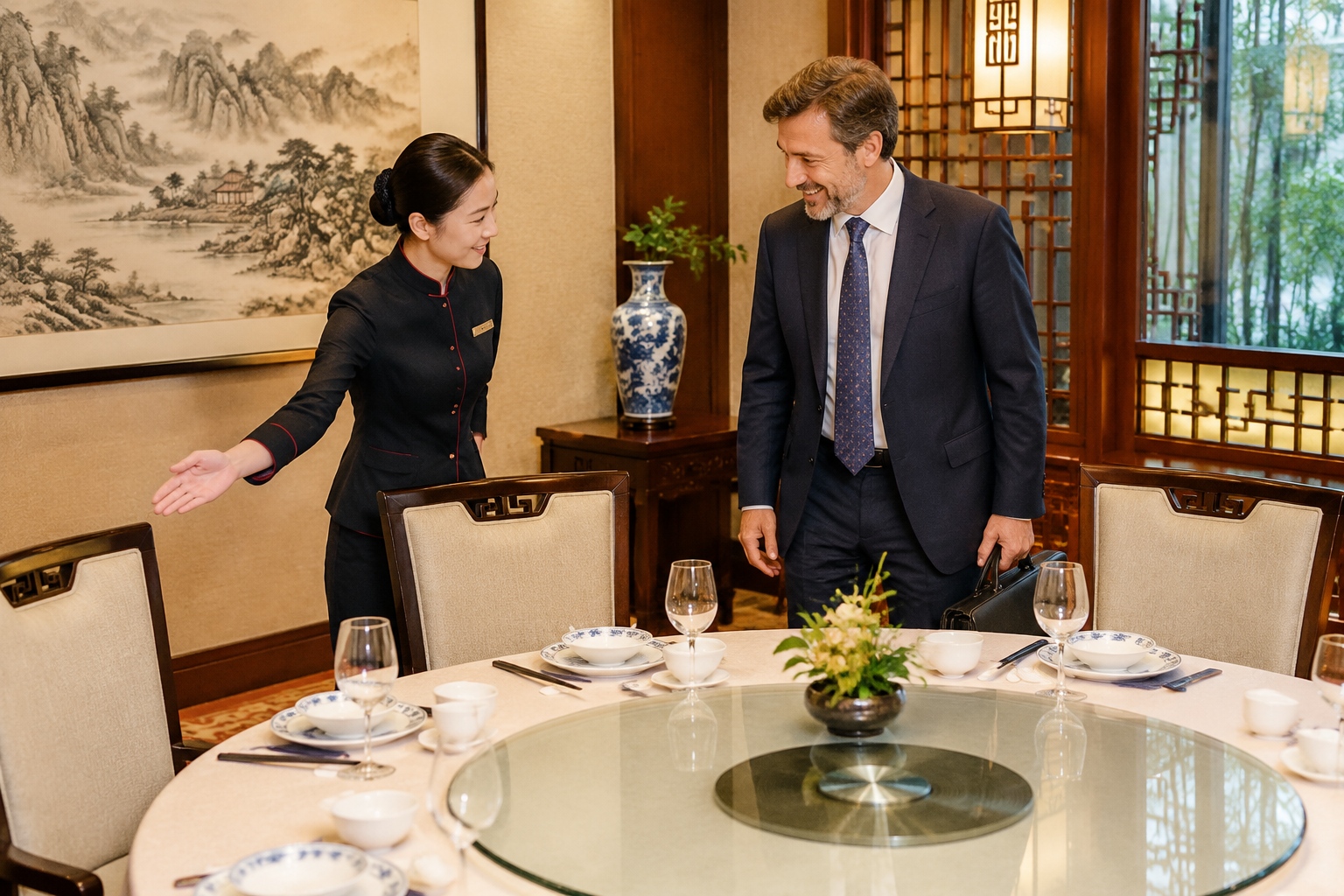
If you’re not the main guest, don’t rush to the best seat. Wait until the host gestures. When you are seated, remember not to start chatting while the host is arranging.
Ordering the Menu
In China, ordering is done by the host. If you are the host, order two or three dishes more than the number of guests, and include a whole fish or chicken as a sign of wealth and completeness. If you are the guest, just recommend a couple of your favorite dishes. The host will decide. But if you have food allergies or religious restrictions, tell your host in advance, not at the last minute.
Table Manners: The Little Things That Create a Big Impression
Before you take a bite, wait for the host. The host will often begin by saying “请” or “大家动筷子” (let’s all use chopsticks). Do not start first. When you use your chopsticks, don’t hold them up as if pointing at someone. Never put them upright in your rice – this reminds people of funeral incense. And don’t use your own chopsticks to serve yourself from the dish – always use a serving spoon or the serving chopsticks. If you need to rotate the Lazy Susan, check that no one is about to take a bite or pick something up. Usually the person in the center or the host will decide when to turn it. If you are unsure, do not spin aggressively. After you’ve taken food, let go – don’t dig around in the dish. Chew without open mouth, of course.
Toasting and the Unspoken Rules of Drinking
Now to the heart of the banquet – toasting. Chinese business dinners are known for the wine. “Ganbei” (干杯, dry the glass) is the most common toast, often followed by a full glass of baijiu. The first toast is usually made by the host, a short welcome to the guests. Everyone stands, and the host might say “感谢各位” (thank you all) or “干杯!” Let’s dry our glasses. At this moment, unless you have a strong reason, it’s common to drink your entire glass. Then later, people may toast each other individually. You can toast the host by saying “敬你” (to you) and lifting your glass.
Importantly, never toast people at a higher level than yourself – actually, toasting someone more senior is fine, but you should make sure your glass is lower than theirs when clinking. In China, holding your glass lower signifies respect. Also use both hands to hold your glass when offering a toast, or support your elbow with your other hand. If you’re sitting at a large table and toasting across distance, tap your glass lightly on the table instead of clinking or raising it.
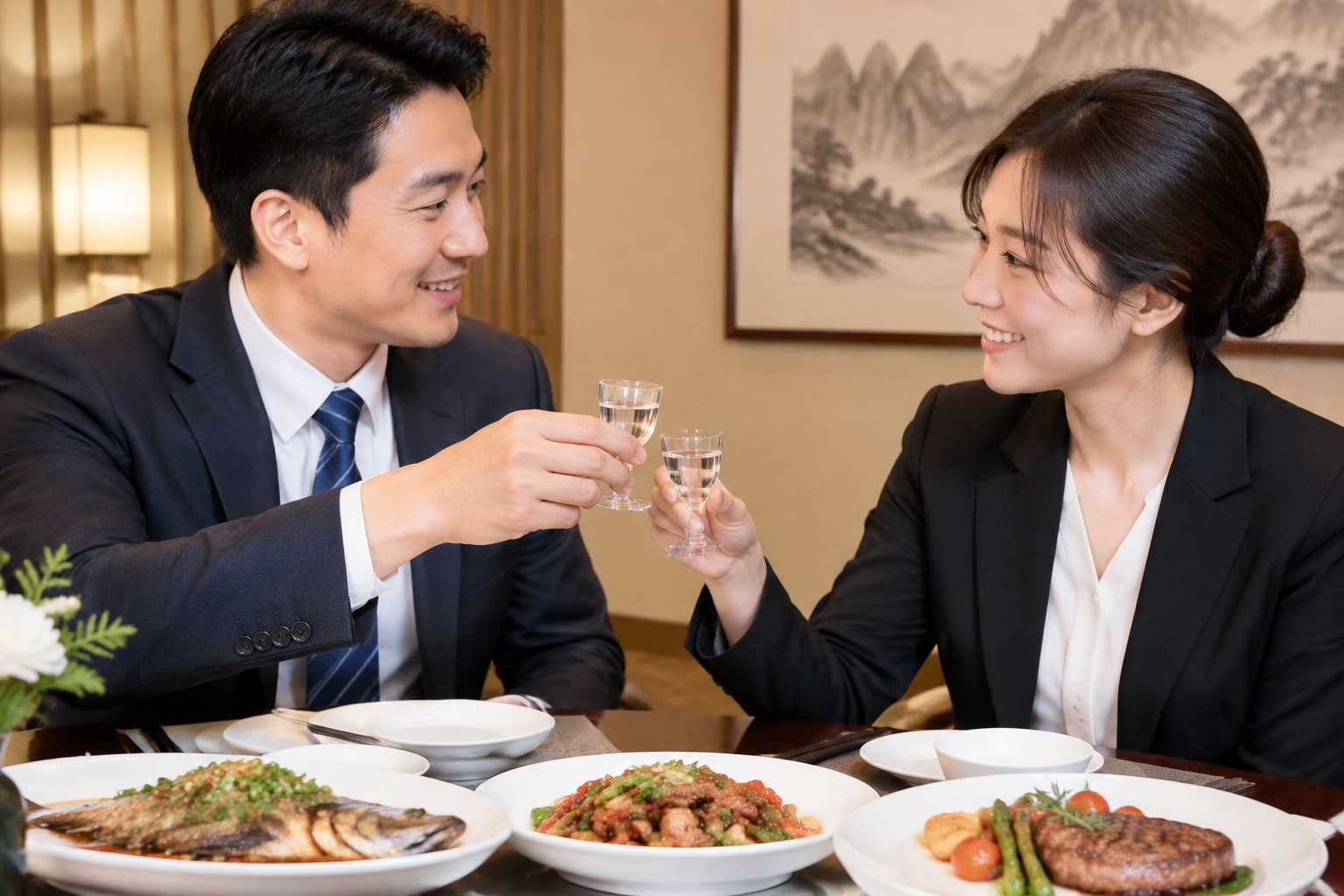
You’ll likely face pressure to drink, especially when the host offers a “ganbei.” If you want to survive, you can use a standard trick: say you have a medical reason why you cannot drink. For example, hold up your glass barely full and say, “对不起,我不能喝酒” (I’m sorry, I can’t drink). But a skilled host might still propose tea as a substitute. If you intend to drink but don’t want to get drunk, you can pour less or use the sip-and-toss method. Yet in a formal setting, that’s frowned upon. Instead, you can politely say, “我酒量有限, 我们随意吧” (My tolerance is low, let’s take it easy). That’s acceptable. If someone teases you for not drinking, laughing at yourself works best.
Reading the Drinking Subtext
It’s crucial to understand that the offer of alcohol – specifically baijiu – is a tool for building trust and testing flexibility. When a host insists that you “ganbei” more than once, they are checking whether you are willing to set aside your resistance for the relationship. However, in modern Chinese business environments, many hosts respect limits and will accept a polite refusal. As a foreign guest, you are not expected to match locals shot for shot. The trick is to consistently stay sober enough to observe what is actually happening – hints, non-verbal communication, and also when the host expects the negotiation to progress.
Conversation Minefields: What to Talk About and What to Avoid
Small talk at these dinners resembles the appetizer – it sets the flavor for the evening. Safe topics: Chinese cuisine, tea culture, sports (football, basketball, table tennis), your family travels, and the city you’re visiting. Ask your host about local restaurant recommendations; this gives them a chance to show off.
Avoid politics, religion, sensitive territorial issues (Taiwan, Tibet, Xinjiang), and any problems with Chinese government policies. Don’t criticize Chinese food culture. Also, avoid boasting too much about your own track record. Humility is more appreciated.
If you encounter a question that’s too personal, such as your salary or age, deflect with a smile: “这是秘密” (That’s a secret), or joke about it. In Chinese culture, personal questions can be casual, but as a foreign guest, you don’t need to answer.
Common Faux Pas to Avoid
- Do not put your elbows on the table.
- Do not blow your nose loudly in front of others.
- Avoid coughing or spitting without covering your mouth.
- Never click your chopsticks against your bowl or glass, as that is a form of begging according to Chinese superstition.
- Do not pour your own drink without first offering a pour to nearby attendees.
- When a waiter approaches, let elders or superiors take the first portion.
The End of the Meal and Following Up
The dinner may stretch until 9 or 10 p.m. The real ending is also a ritual. You should not stand up and leave abruptly. Let the host decide when to finish. If the host stands and thanks everyone, that’s your cue. When departing, thank the host sincerely for “今晚的盛情” (tonight’s generous hospitality). If it was your turn to host, ensure that every guest leaves with a taxi or a prepared ride. Afterwards, send a thank-you message within 24 hours. Mention something specific, like “I enjoyed the Peking duck,” or “That was a great evening.” Keep it warm and professional. Then, within a few days, follow up on next steps in the meeting, perhaps mentioning something you talked about at dinner. This modest behavior shows you value the connection beyond the contract.

Quick Checklist for the First-Time Guest
We’ve covered seating, toasting, and conversation. Here’s a cheat sheet. Do arrive on time. Do accept the seat you’re given. Do wait for the host to begin eating. Do stand when toasting with your host. Do hold your glass lower than a senior’s. Do use both hands when presenting a business card. Do send a thank-you message.
Don’t: show up with no gift and no card. Don’t sit down before the host. Don’t order for the group unless asked. Don’t drain your glass at almost every toast unless you’re ready. Don’t talk about Taiwan or politics. Don’t stick your chopsticks vertically. Don’t tap your bowl. Don’t stack dishes. Don’t complain about dizziness or blame the food. And don’t invite yourself to dessert – the dinner is over when the host says so.
In the end, remember that a Chinese business dinner is a dance of respect. If you watch, learn, and join, you’ll find it’s not as intimidating as it sounds. Many executives have made some of their closest partners across such a table. You’re now equipped to walk in, handle the toasts, smile, and close your next deal – one dish at a time.
Start the discussion at forum.chinacomes.com