
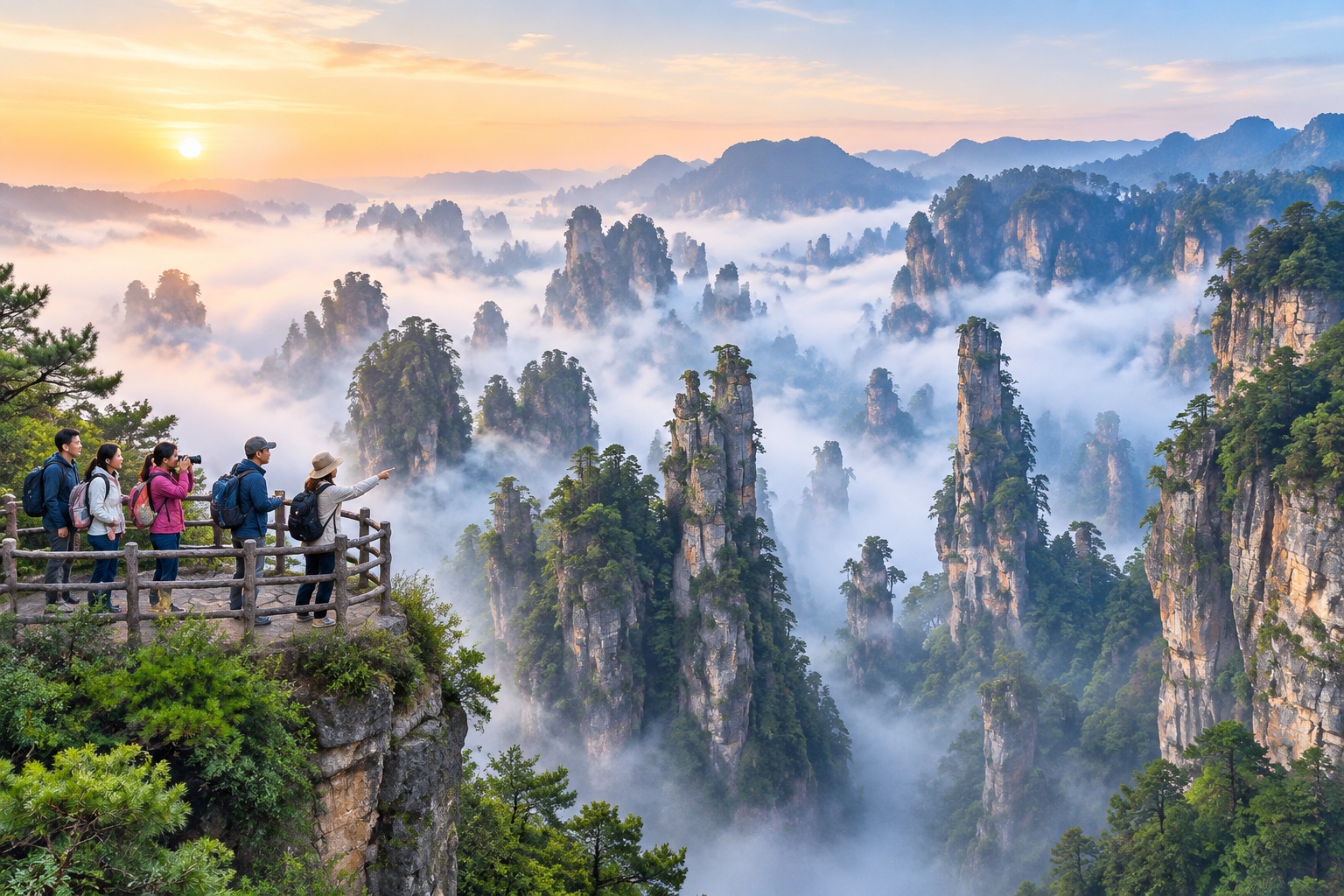

Arriving at the Stone Forest of the Sky
The first thing you notice is not the mountains. It’s the sound of the cable car humming above your head, a low metallic drone that cuts through the wet air. Then the mist parts, and you see them: hundreds of yellowish stone towers, each one dozens of storeys tall, rising like the ribcage of a giant that fell asleep under the forest. I am in Zhangjiajie, Hunan Province, and I’ve been standing at the edge of a viewing platform for long enough that my knees have gone weak.
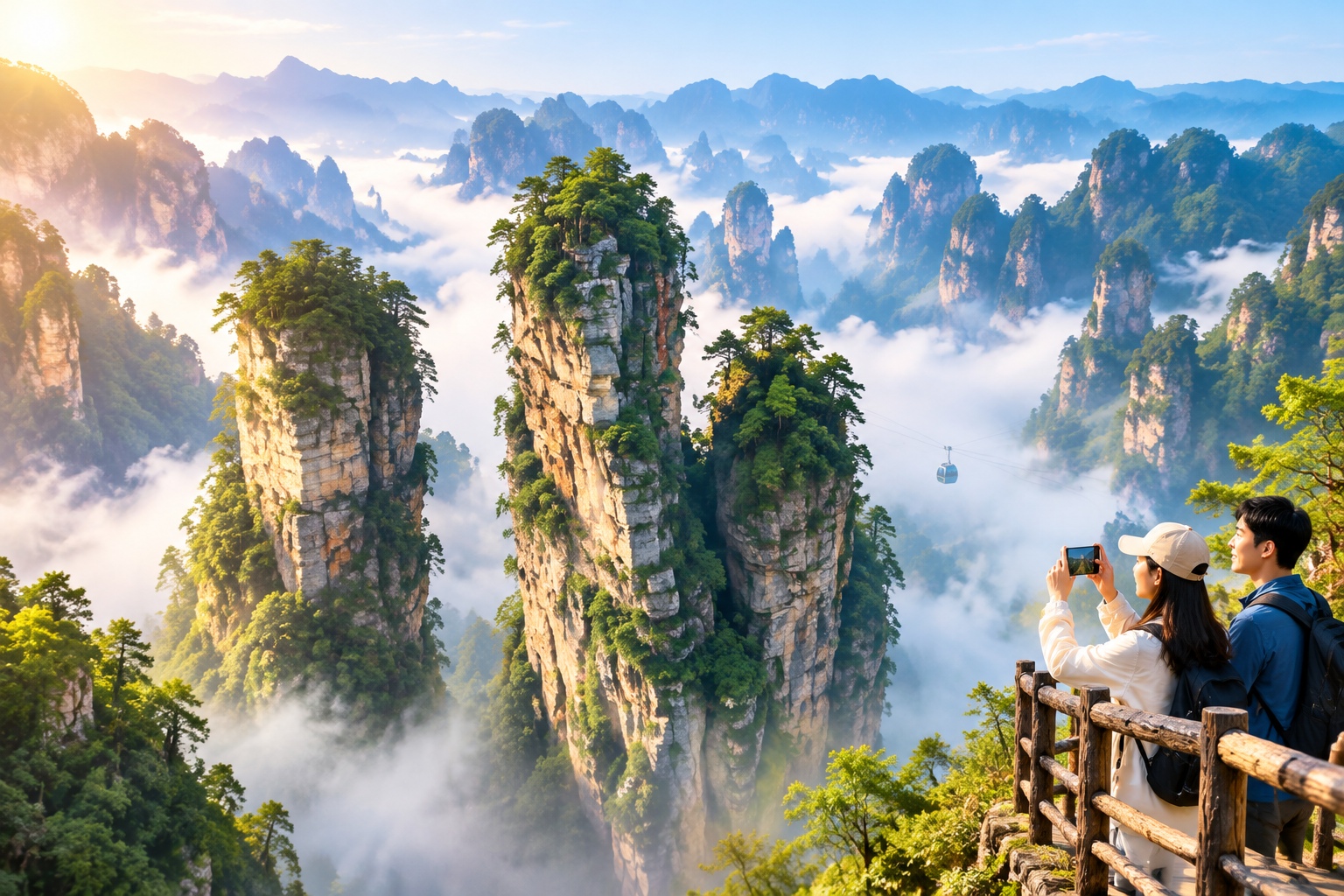
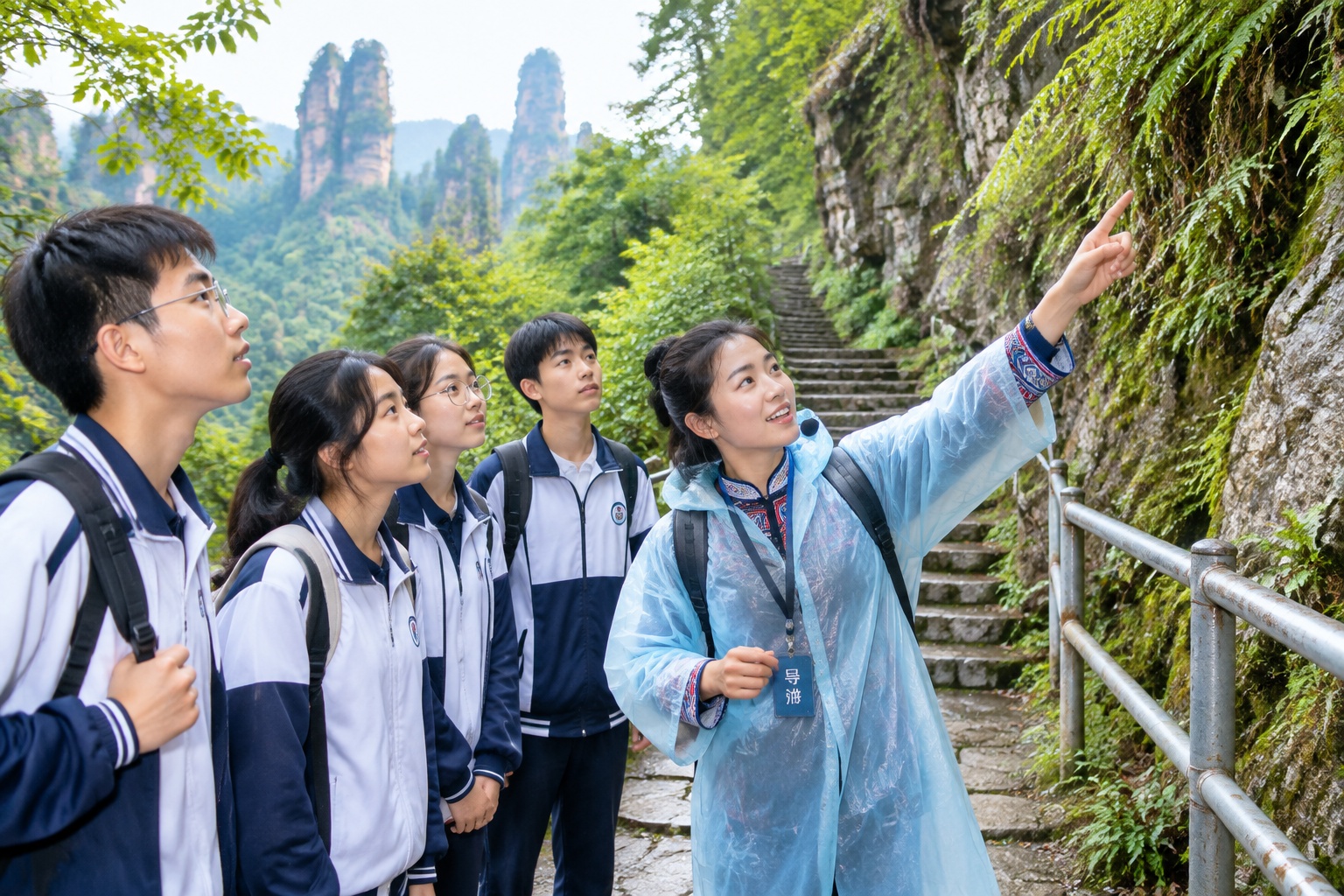
The Tujia woman beside me, a local guide named Xiang Mei, laughs. “Everyone feels like that the first time,” she says. “They think it looks like the computer, but it’s real.” She tilts her head toward a pillar topped by a thin tree. That one, she tells me, is directly across from the mountain that locals call “Avatar’s Hallelujah.” In 2008, a crew from James Cameron’s film team came to Zhangjiajie with a helicopter and spent a week hovering around these pinnacles. Three years later, the movie opened, and “the computer” became a tourist catchphrase.
But Zhangjiajie is not a green screen. It is a geological oddity called quartz-sandstone pillar karst, a forest of more than 3,000 individual stone columns, some exceeding 200 metres in height. They were carved over 300 million years from ancient beaches and deserts, then lifted and fractured by tectonic pressure. Rain and wind did the rest, chiseling every pillar into a separate character. Walking beneath them, you feel less like a visitor and more like an intruder in a valley that belongs to something else.
What the Peaks Hide
Most visitors spend only a few hours at Zhangjiajie National Forest Park, hopping from one panorama to the next. I spent two days, partly because I wanted to understand why locals whisper that the park “opens at the top but hides at the bottom.” Away from the glass viewing decks, there are footpaths that follow the original stone steps, carved into the cliff before the park became a world-famous site. These steps turn off from the main trail, and the crowd disappears instantly.
In the quiet, you can hear the forest for real: the drip of water off glossy magnolia leaves, the rustle of wild monkeys, and the chattering of birds that sound like someone striking a bamboo stick. Xiang points out an old trail marker, faded red paint reading “1974.” She explains that her grandfather helped carry wood and rivets to make these stairs for the first surveyors. “He didn’t think tourists would ever come,” she says. “He thought they’d only sent soldiers.”
For a Tujia family, the mountain was never seen as an empty fantasy. It was a hunting ground, a source of herbs, and a sacred space. Every year, the Tujia still perform a festival on the summit where they burn incense and sing an ancient story of the hero who defeated the dragon spirit of the mountain. “Maybe the dragon was just the wind that gets trapped between towers,” Xiang jokes. “You hear it howl at night. Sound like an animal. But not from this world either.”
The Machine That Climbs the Cliff
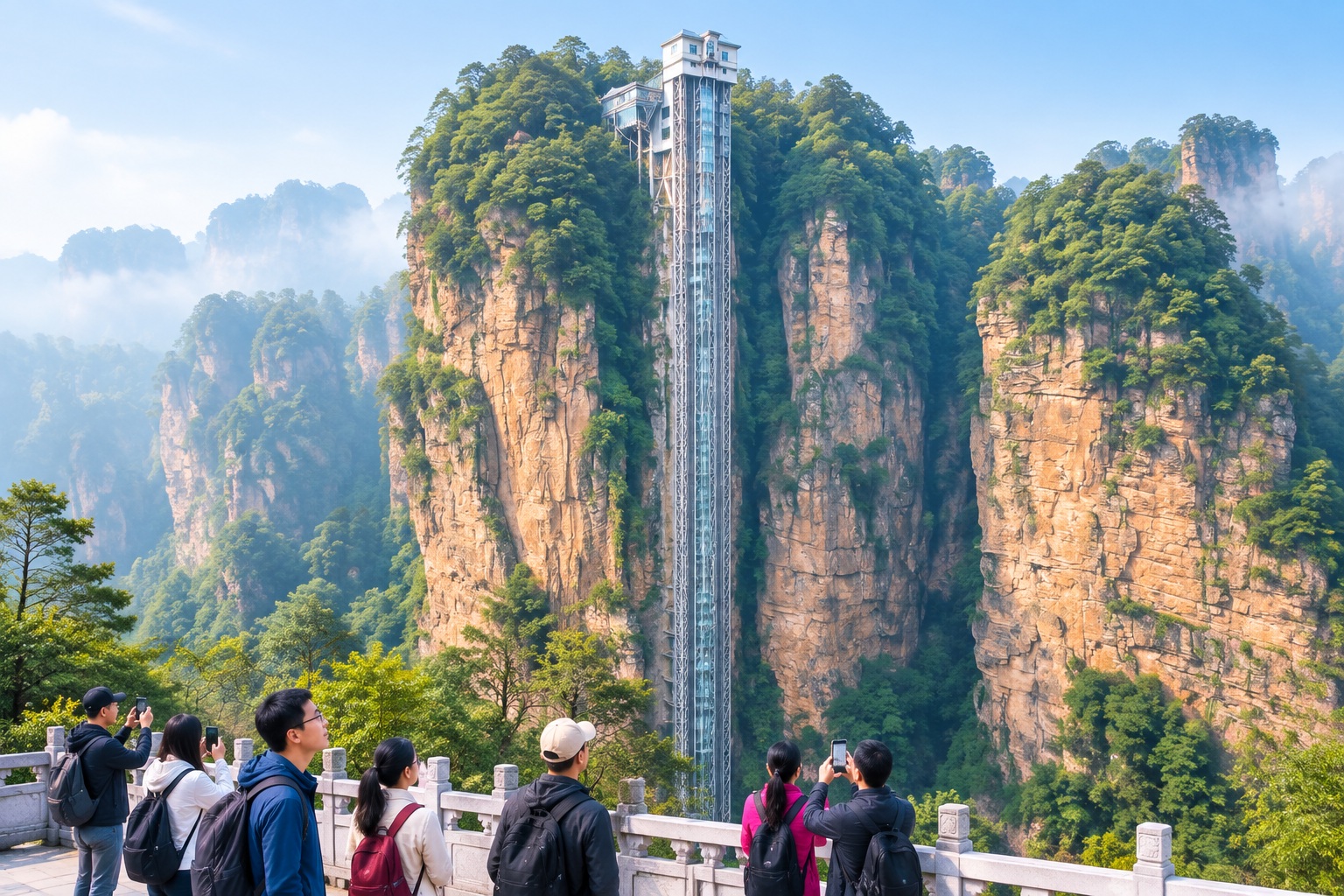
The easiest way most people enter the park is the Bailong Elevator, a glass-bottomed lift bolted to a vertical cliff face. It carries visitors up 320 metres in 88 seconds, and for many overseas travellers, it feels like a ride inside a science-fiction filmcrane.
I wait for the elevator with a group of Chinese high school students on their spring break. A girl from Shanghai presses her phone against the glass and recites a fact: “This is the highest exposed outdoor elevator in the world. It is powered by hydroelectricity.” She told me she doesn’t feel scared, but when the lift clears the treeline and the entire valley opens below, she grabs her friend’s arm.
The elevator is an engineering contradiction: a human machine embedded in a wilderness. Yet it solved an environmental problem. Before it was built in 1999, the only access to the top of the mountain was a 6-kilometre hiking trail that damaged the fragile soil. Now, a two-hour climb takes a minute, and more than 60 percent of the park’s land is closed to the public for regeneration.
Not far from the elevator is another marvel of ease: a cable car that travels over 7 kilometres across the tops of the peaks. My driver, a young man named Wang Qiang, has been running the same cable route for seven years. He glances through the side window, not at the scenery but at a sequence of blinking lights on a panel. “I watch the equipment, not the view,” he says. When I ask if he gets bored, he smiles. “No. I tell stories to tourists… with my driving.” He taps a button, and the cabin slows down over the mistiest part of the valley, allowing everyone a moment of silence.
Cameron’s Unspoken Endorsement
Long before the Avatar mania, Western visitors were already comparing Zhangjiajie to something out of a fairy tale. But the decisive moment came when Cameron’s set designers visited the park
in 2008, and the director later admitted he had been “blown away.” He never called the flying mountains of Pandora a direct copy. Instead, he said that when the Chinese landscape “exists in a fantasy film, some elements seem borrowed from real geology.”
The exact wording matters less than the cultural domino effect. Local officials quickly renamed a towering sandstone column to “Hallelujah Mountain,” and Baidu search data shows that “Avatar Zhangjiajie” has been typed more than 700 million times in China alone. That curiosity cut both ways: many Chinese tourists who had never heard of the movie went to see the mountain, and many foreigners who saw the movie began to search for the real place.
For a country anxious to show a modern face to the world, Zhangjiajie became a low-cost ambassador. It required no star actors or modern studios—just an ancient landscape with a screen-friendly silhouette.
What Tourism Does to a Small Town
Less than an hour from the park entrance is the town of Wulingyuan, once a quiet farming settlement. Now it’s a functional city of hotels, restaurants, and souvenir stalls. I had expected to find cheap tourist traps, and there are plenty. But there’s also a younger energy.
At a coffee shop run by two cousins in their twenties, I ask why they came back home after studying in Beijing. One of them, Li Jie, tells me she spent two years working in marketing before realising she was “a fortune only on a map,” burying herself in a cubicle. She now runs a company that organises photography tours through the mountains. “The old generation took tourists to the main viewpoints and shouted at them,” she says. “We take them to the little temples on the backside, teach them how Tujia plant honey, and let them stay at a farmhouse.”
The results are visible in the number of fresh noodles being made in shop windows and the quiet humming of delivery scooters that carry takeout to nearby staffed outposts. Wulingyuan has a young nightlife now—not the intense partying of Chengdu or Shanghai, but smoky barbecue stalls, music cafés, and selfie lights flickering around the river.
Not everything is perfect. In the summer rush, people wait in line for three hours in the sun, and the shuttle buses run like exhausted ants. But in the off-season, I saw the value that many global parks suppress: the mountains have created local jobs, including for the ethnic minority Tujia who used to subsist on farming at 1,400 metres. A museum inside the park displays traditional silver embroidery, but on the steps, you’ll see young Tujia women wearing modern Tibetan-influenced clothes and working as guides for Chinese tourists from the coast.
The Sound That Stays
On my last morning, I stepped out of a small hotel near the park gate at six in the morning, before the ticket office opened. A half-moon still hung in the pale sky, and last night’s drizzling made the peaks look like a charcoal drawing being erased. A few farmers walked past, carrying bamboo poles, heading for fields inside the government-protected buffer zone.
They didn’t speak to me, but one stopped and watched the mountains, pulling out a small plastic flute from his pocket. The tune he played sounded like a folk song, but with a rising melody that carried the same tension as the “Avatar” score. For a second, I saw the scene without a camera lens. The fantasy mountain had become a daily mountain.
Practical Tips for Visiting Zhangjiajie
Zhangjiajie is best visited from April to November, when the vegetation is dense and the mist is often trapped between pillars. For less crowds, go on wet weekdays in May or September. The park entrance fee (around ¥225) lasts four days, and the high places are connected by shuttle buses.
The international airport is directly connected to Beijing, Shanghai, and some Southeast Asian cities. From the airport, a dedicated bus takes you to Wulingyuan, the main gateway. The Hallelujah Mountain viewpoint is near the Yuanjiajie area, which is most easily reached by the Bailong Elevator.
Arrive early: first buses leave around 6:30 am, and by eight the main spots get busy. Wear waterproof shoes and bring a jacket even in summer — the mountain is often 10°C cooler than the valley below. Booking a night in Wulingyuan will allow you to enter the park at dawn, when the light and the sound of birds are at their best. Some parts of the park close at 5:30 pm, so do not begin the longer trails after noon.
Note that wild monkeys sometimes snatch transparent plastic bags. I learned that the hard way.
Start the discussion at forum.chinacomes.com