
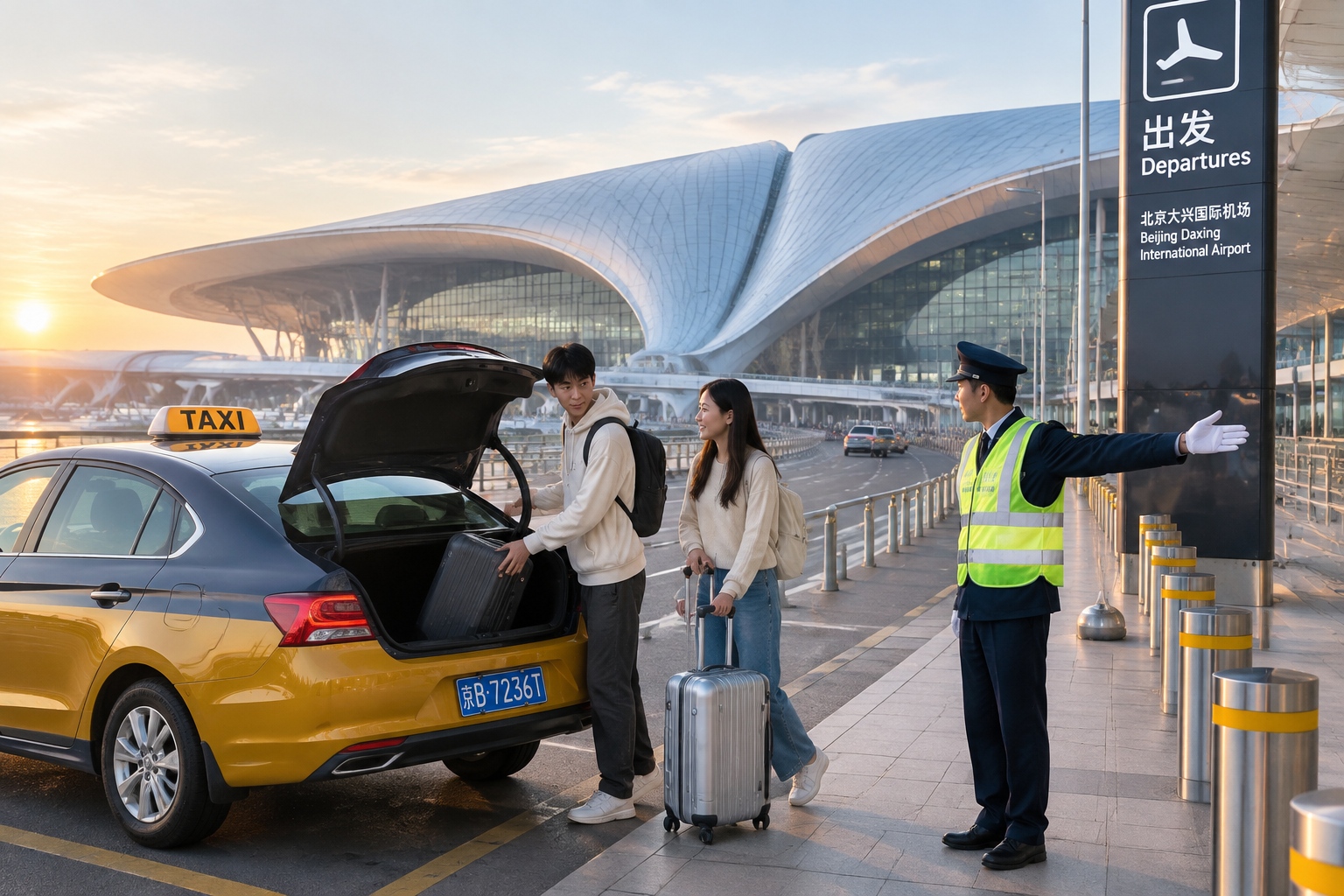

It is 6:40 on a Tuesday morning, and the escalator out of the underground railway station is lifting me into a room the size of a small city.
The ceiling is white, curved and very far away. A family pushes four suitcases toward the check-in islands. A man in a courier’s jacket sleeps upright on a bench. Two flight attendants walk past in step. And the hall is still quiet enough that I can hear the wheels of my own bag on the floor.
This is Beijing Daxing International Airport. Its code is PKX. It sits about 46 kilometres south of Tiananmen Square, in Daxing district, right on the seam that separates Beijing from Hebei province. When it opened in September 2019, newspapers in Britain and the United States put it on lists of “new wonders of the world.” The label stuck. It also tells you almost nothing about what the building is like to use on an ordinary Tuesday.
A building shaped like a starfish, and planned like one
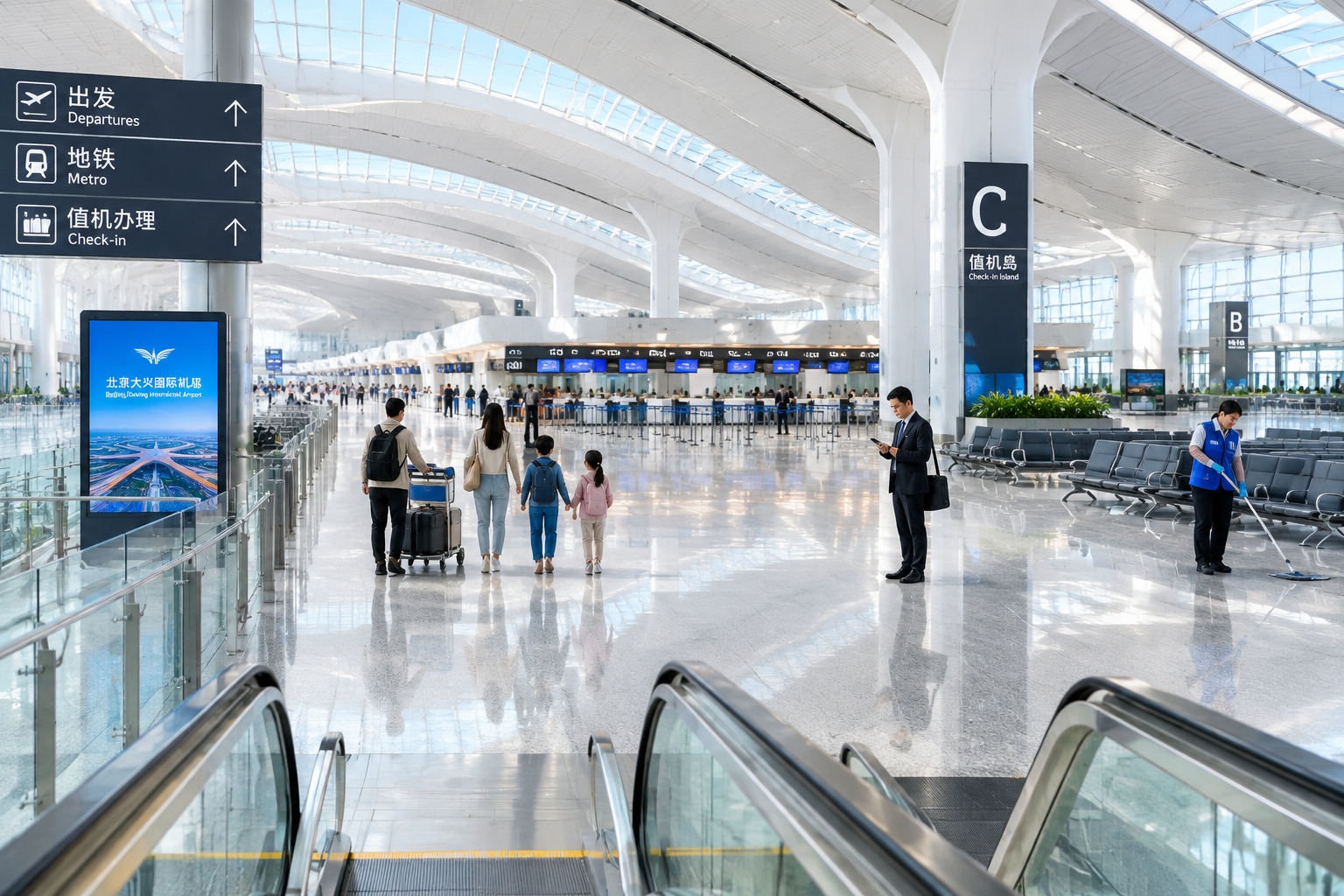
Look at any floor plan on the wall of the departure hall and the shape is obvious: a central hub with five long concourses radiating outward, like the fingers of a hand or the arms of a starfish. The official Chinese nickname is different — fenghuang zhanchi, “the phoenix spreading its wings” — and it refers mostly to the curve of the roof.
The design came from Zaha Hadid Architects, working with the French engineering firm ADP Ingénierie and a Beijing design institute. Hadid died in 2016, three years before the airport opened. The five-finger plan is not decoration. It solves a very specific problem.
In most large airports the building is a long line, or a main hall with satellite terminals connected by trains. The walk from security to a far gate can take 25 minutes, plus a ride. At Daxing, every gate sits inside the same building and is reached from a single central security checkpoint. The airport’s own figure is that no boarding gate is more than roughly 600 metres from that checkpoint — an eight-minute walk. That number, more than the roof or the glass, is what a passenger actually feels.
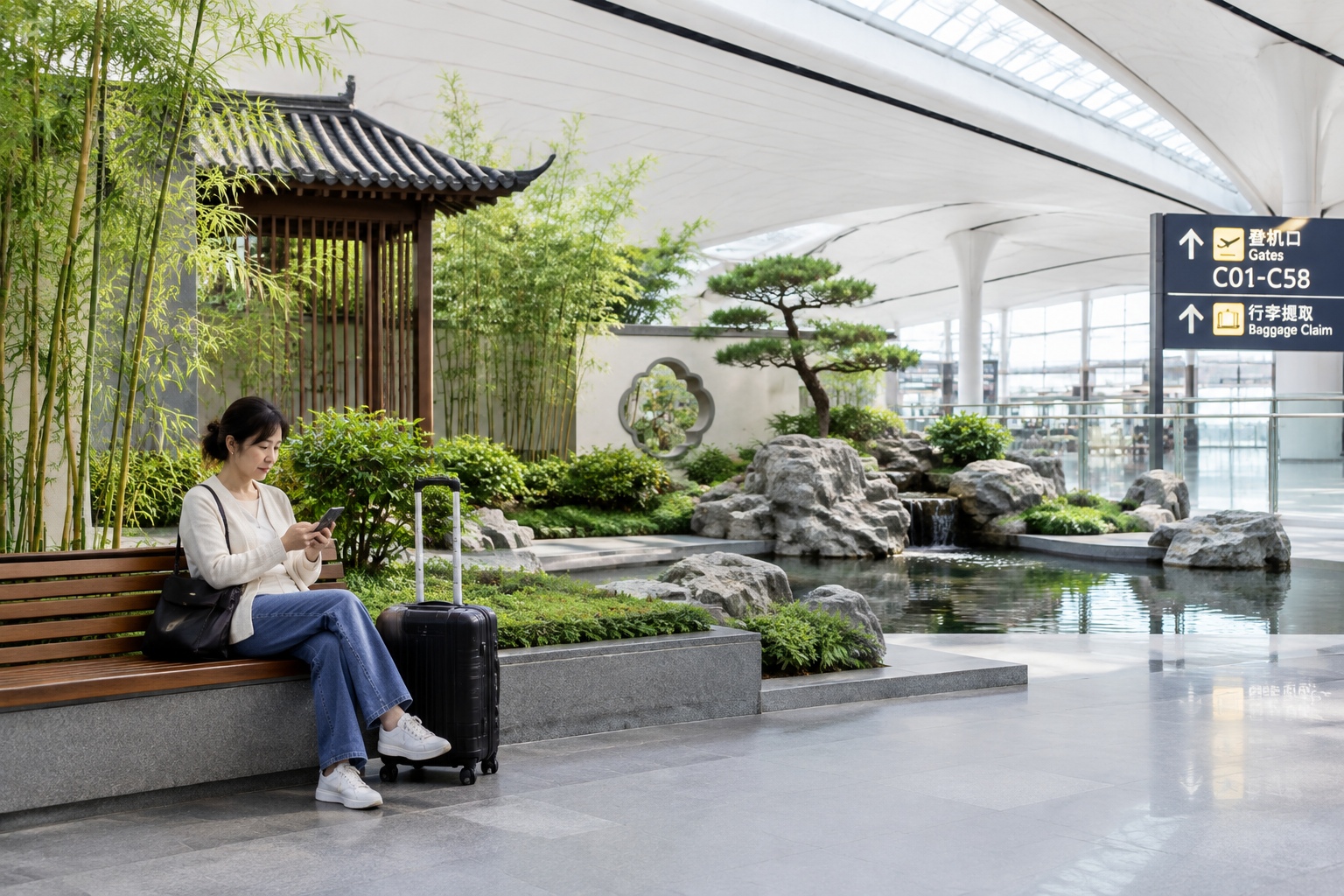
Two more decisions matter. Arrivals and departures are stacked on separate floors, so the two flows never cross. And each of the five concourses ends in a small landscaped courtyard: five Chinese gardens with themes of silk, tea, porcelain, countryside and classical garden design. They have real plants, real daylight and benches. On a long connection, they are the only place in the building where you can sit under a tree.
The numbers, and what they mean for you
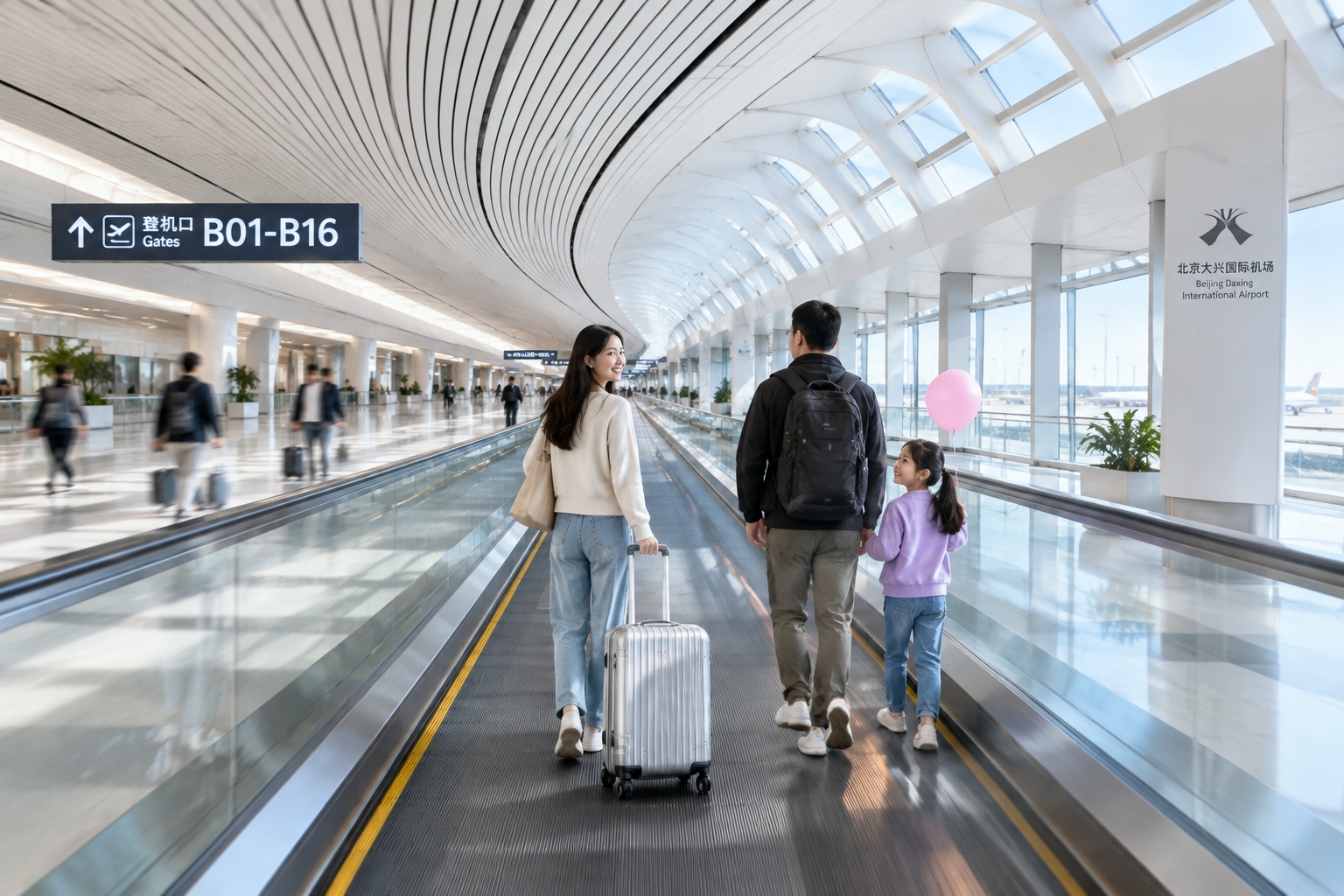
The terminal building covers about 780,000 square metres. One roof, eight curved C-shaped columns holding it up, and thousands of glass panels dropping daylight into the middle of the floor.
The first phase has four runways, and the site is planned for as many as seven. Designed capacity: 72 million passengers a year, 620,000 aircraft movements, 2 million tonnes of cargo.
That capacity was the whole point. Beijing Capital International Airport, 45 kilometres to the northeast, was built for around 80 million passengers and handled more than 100 million in 2018. It was full the way a highway is full at six in the evening.
Daxing’s job was to take the overflow. It got an unusual start. The airport opened on 25 September 2019, six days before the 70th anniversary of the founding of the People’s Republic of China. Less than five months later, the pandemic shut the borders. For almost three years, one of the largest airport buildings on earth ran at a fraction of its capacity. Photographs of those empty halls travelled a long way and were often read as a symbol of something they were not — a shiny building with nothing inside it.
By 2024, Daxing was handling close to 50 million passengers a year. That is a real recovery, and it is still only about two-thirds full. The building was designed for a busier future than the present.
Security, bags and the eight-minute walk
So what does all of this feel like at ground level?
Domestic travellers can use their face as a boarding pass. Daxing was the first airport in China to roll out end-to-end facial recognition for domestic flights — at check-in, at security and at the gate — so an ID card is read once and after that your face carries you through. Foreign passengers still use a passport and a boarding pass, and the process is unremarkable.
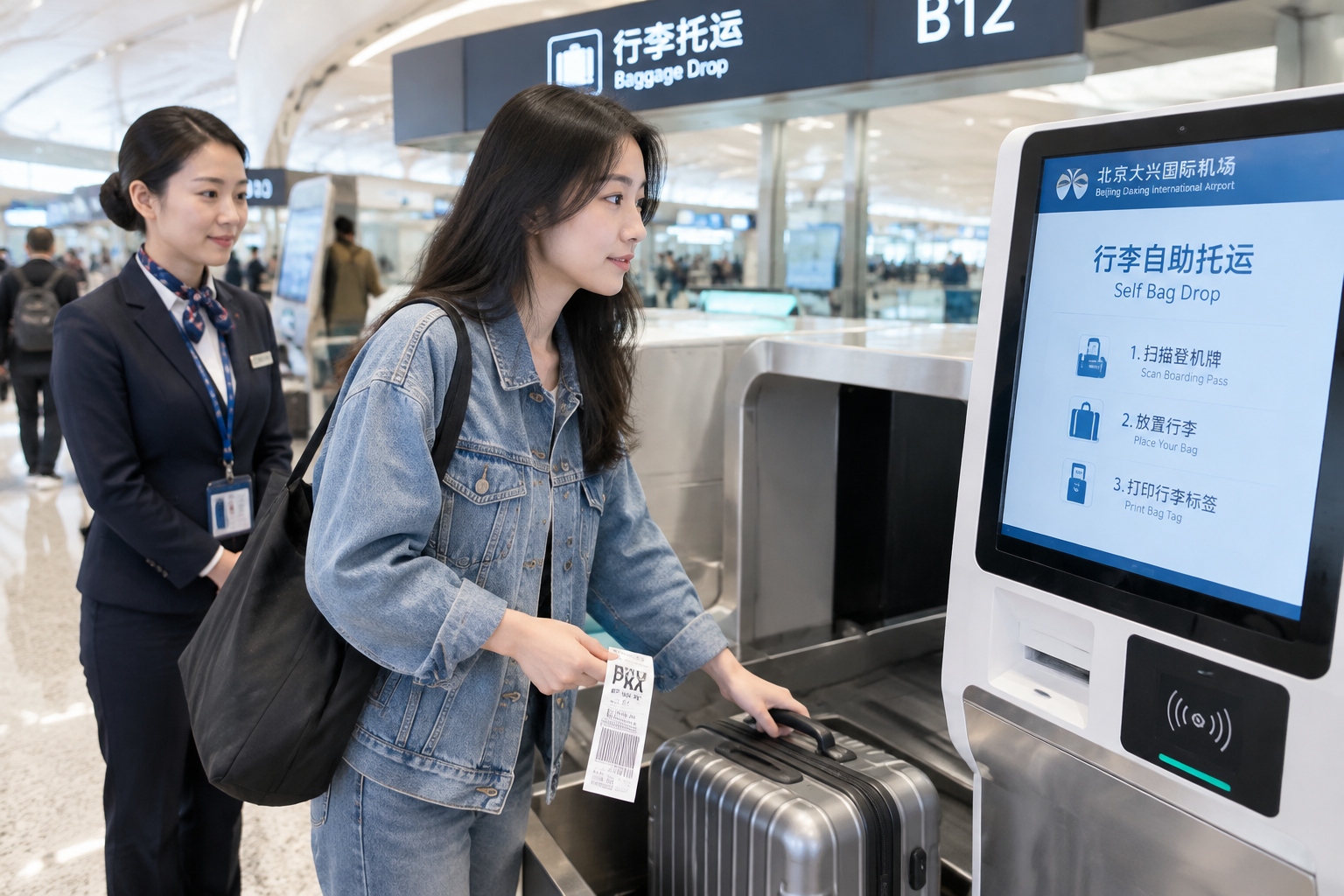
Baggage is where the airport quietly improved on its rivals. Daxing was the first airport in China to attach RFID tags to every checked bag, which means you can open the airline app or the airport’s mini-program and watch your suitcase move from the counter to the belt. If your bag is delayed, you usually find out before the airline tells you.
Then there is the walk. After a single central security check, you are through and free: any gate in the terminal, no second checkpoint. I timed it from the end of security to a gate at the far end of the second concourse — nine minutes at an ordinary pace, with a stop for coffee. There is no shuttle train to catch and, in normal operations, no bus to a remote stand.
Transfers are where the layout pays off. Moving from an international arrival to a domestic departure at Daxing is designed to take under an hour, most of it inside one building. At airports built around satellite terminals, the same transfer routinely eats two.
Getting in and out: trains, cars, and Beijing’s two-airport trap
The fastest way into the city is the Daxing Airport Express, which starts at Caoqiao station on the southeast ring road. The run is 41.4 kilometres and takes about 19 minutes, with the train touching 160 km/h in the tunnel. A standard one-way ticket costs 35 yuan, about five US dollars; a business-class seat is 50. At Caoqiao you can check in and drop bags for several airlines before you even board the train, which is genuinely useful if you are coming from downtown.
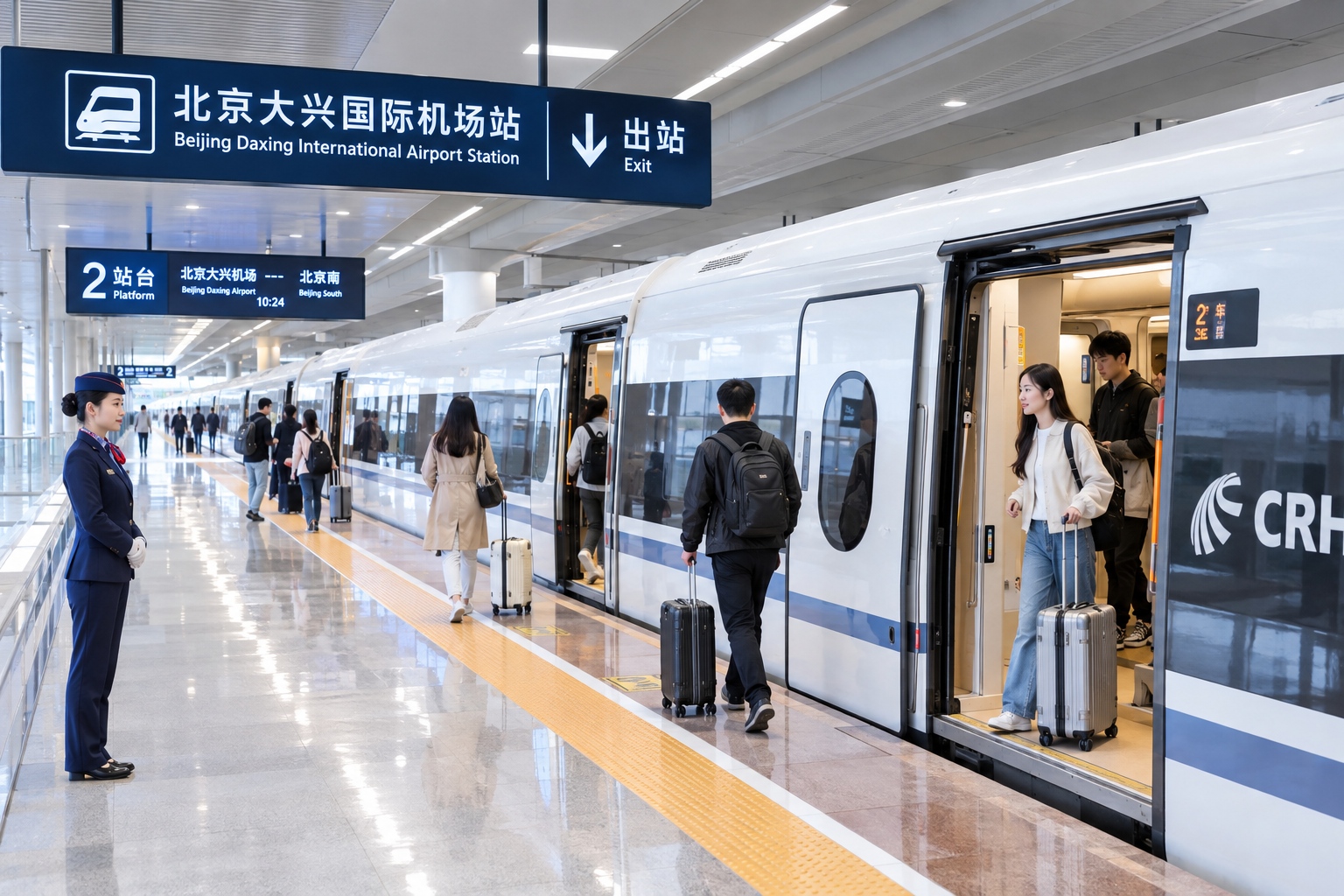
Directly beneath the terminal there is also a national railway station. The Beijing–Xiongan Intercity Railway stops here, putting Beijing West station about half an hour away and the Xiongan New Area — the new city being built roughly 100 kilometres south of Beijing — about the same distance in the other direction. For people in Hebei, this is the change that matters most. A trip to the airport that once meant a two-hour bus ride to the far northeast of the city is now a short train ride south.
Here is the practical warning no brochure gives you. Beijing now has two big international airports, and they are on opposite sides of the city. Capital Airport (PEK) is in the northeast. Daxing (PKX) is in the south. A hotel in Sanlitun plus a flight from PKX is a 60-minute commitment on a good day, and 90 minutes in the morning rush. Check the three-letter code on your ticket before you book anything.
How a “wonder” becomes an ordinary workplace
The scale of the place only makes sense through the people who run it every day. Daxing employs tens of thousands of them: airline staff, security officers, cleaners, cooks, shop assistants, baggage handlers, engineers. A large share commute from Hebei, crossing a provincial border on the way to work, because the airport was deliberately built on the seam between Beijing and its neighbour.
Around the airport, a 150-square-kilometre economic zone has been laid out across that seam — roughly 50 square kilometres in Beijing’s Daxing district and 100 in Hebei’s Langfang. The two halves answer to different provincial-level governments, which makes it an unusual piece of planning in China: a zone where Beijing and Hebei have to agree on tax, land and transport. Aviation maintenance, logistics, cold-chain warehouses, cross-border e-commerce and a duty-free shopping complex have grown up inside it.
For southern Beijing, the airport reversed a long-standing imbalance. The north of the city had the old airport, the exhibition centre and the embassies. The south had less. New expressways, a new metro line and the airport itself pushed investment outward, and the city government wrote a dedicated action plan for its southern districts to go with it.
Up on the departures floor, none of that is visible. What is visible is a woman in a blue vest wiping down a row of seats at seven in the morning, before the first wave of flights. She has worked here since the year it opened. The first two years, she says, were strange — “too empty, you could hear everything” — and now the early shift is busy enough that she doesn’t sit down.
If you go: the practical bits
Allow: two hours for a domestic flight and three for an international one. With no checked bag and a mobile boarding pass, 75 minutes is workable because the walks are short — but security queues between 7 and 9 a.m. can be long.
Best time to look at the building: early morning, when low sun comes through the roof panels on the departure level and the hall is half empty. The five courtyard gardens at the ends of the concourses stay quiet all day.
Food: the airport has pushed restaurants and shops toward “same city, same quality, same price,” so a bowl of noodles costs roughly what it costs downtown rather than the usual airport markup. Level 5 has the biggest cluster of restaurants.
Late arrivals: the airport express stops running around 22:30–23:00. If you land after that, plan on a taxi — roughly 200–300 yuan to central Beijing — or the night bus. Ride-hailing pick-up is on a designated level, not at the kerb outside arrivals.
Wi-Fi and power: free and reliable. Sockets and USB ports are built into most seating rows and under the charging desks.
What the wonder actually is
Foreign coverage of Daxing tends to be about the roof, the curve, the size and the speed of construction — a building finished in under five years. All of that is true, and none of it is the point.
The thing that actually changed is smaller and duller. You get from the train to your gate in a few hundred metres and about twenty minutes. You know where your suitcase is. You can make a connection without leaving the building. And close to 50 million people a year now pass through a building that, six years ago, was farmland on the wrong side of town.
That is what a wonder of the world looks like on a Tuesday morning: a long white hall, a woman with a mop, and a flight to catch.
Start the discussion at forum.chinacomes.com