
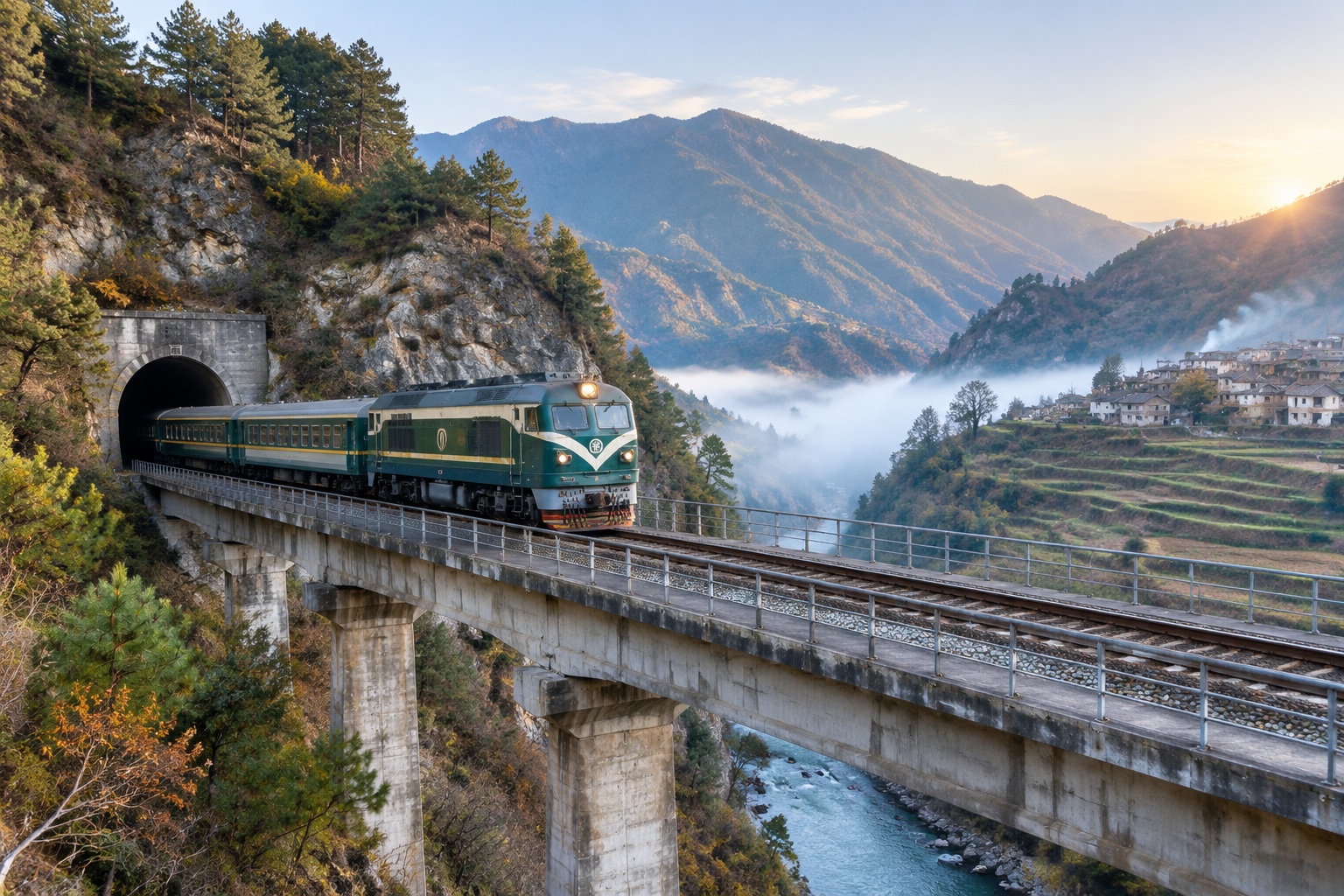

At the face of the Huomaling tunnel
In the spring of 2017, the face of the Huomaling tunnel looked less like rock than like wet clay. The siltstone was grey-brown, laid down in the Tertiary period, soaked with groundwater and soft enough to crumble in a hand. Water ran down the walls and pooled around the sleepers. Behind the crew, a line of pumps pushed the inflow back up the tunnel towards daylight, twenty-four hours a day. The engineers working there borrowed a phrase from the kitchen to describe the job: they were digging through tofu.
They had been digging through the same 13.6 kilometres for eight years. Huomaling was the last tunnel on the Lanzhou-Chongqing Railway to break through — in June 2017 — and for part of that spring it looked capable of holding up the entire project. On 29 September 2017, the line opened from end to end.
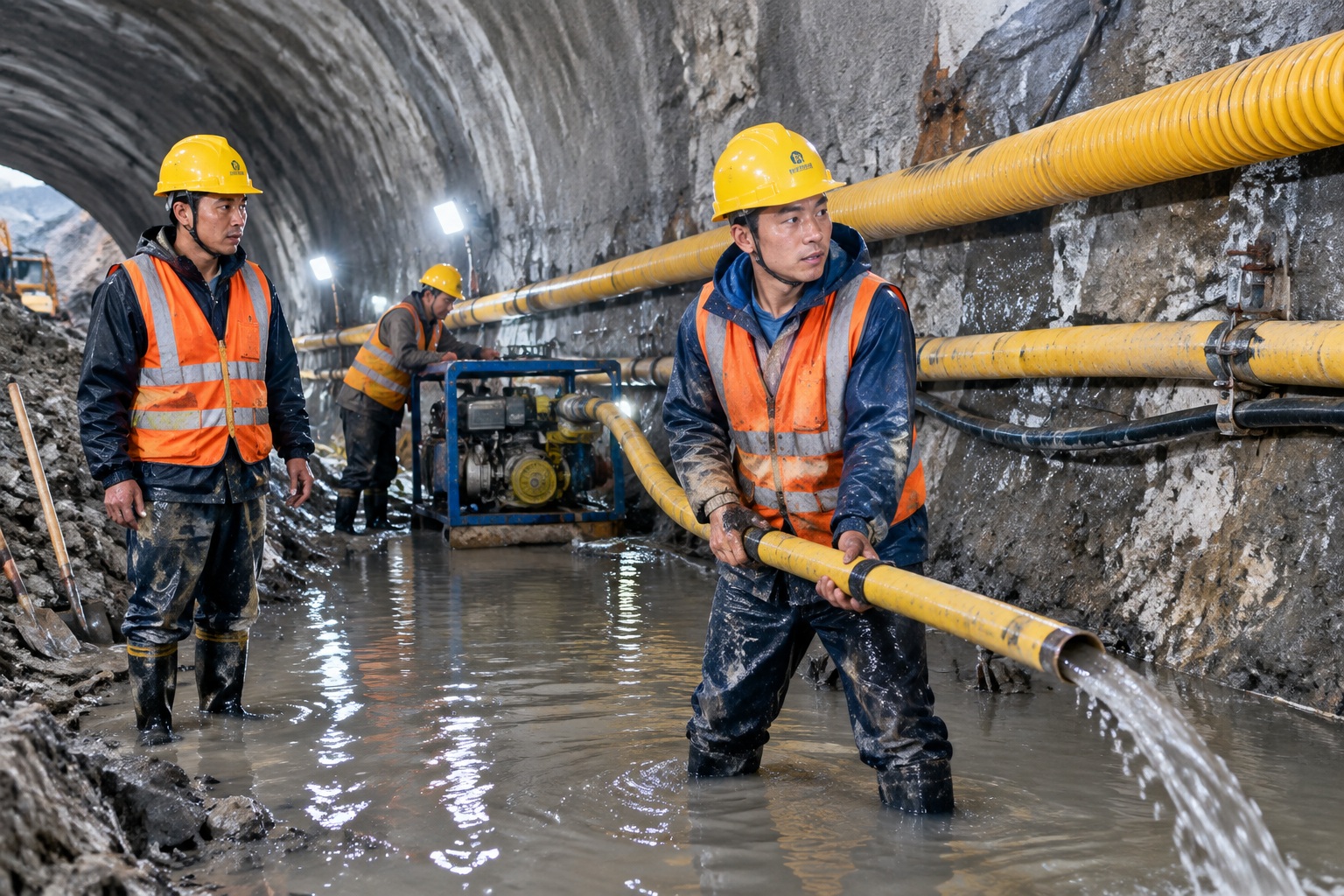
Why the railway spends most of its life underground
Lanzhou sits on the Yellow River at roughly 1,500 metres above sea level. Chongqing sits in the Sichuan Basin at about a quarter of that. In between lie the western end of the Qinling mountains, the Min Mountains, and the Bailong River, which has spent a few million years cutting gorges through both.
For most of the twentieth century, trains between the two cities took the long way round: east along the Longhai line to Baoji, south down the Baocheng line to Chengdu, then east again. It was a journey of more than twenty hours, much of it in the dark.
The Lanzhou-Chongqing Railway cut straight across the grain of the mountains instead. Trains cannot climb the way trucks can, so the engineers traded altitude for excavation. The 886-kilometre (550-mile) line contains 226 tunnels and 396 bridges; roughly 72 percent of the route is either underground or on a pier. The result behaves, for long stretches, like a subway that happens to connect two provinces. The design speed is 160 km/h — modest next to China’s high-speed network, and deliberately so. This is a mixed line built to move freight as much as people.
Anyone who traces a terrain profile of the route sees the same shape repeating: a few kilometres along a valley floor, then straight through a ridge, out onto a bridge over the next river, and again. In the Bailong valley, the alternative to a viaduct is a switchback that no freight train could climb.
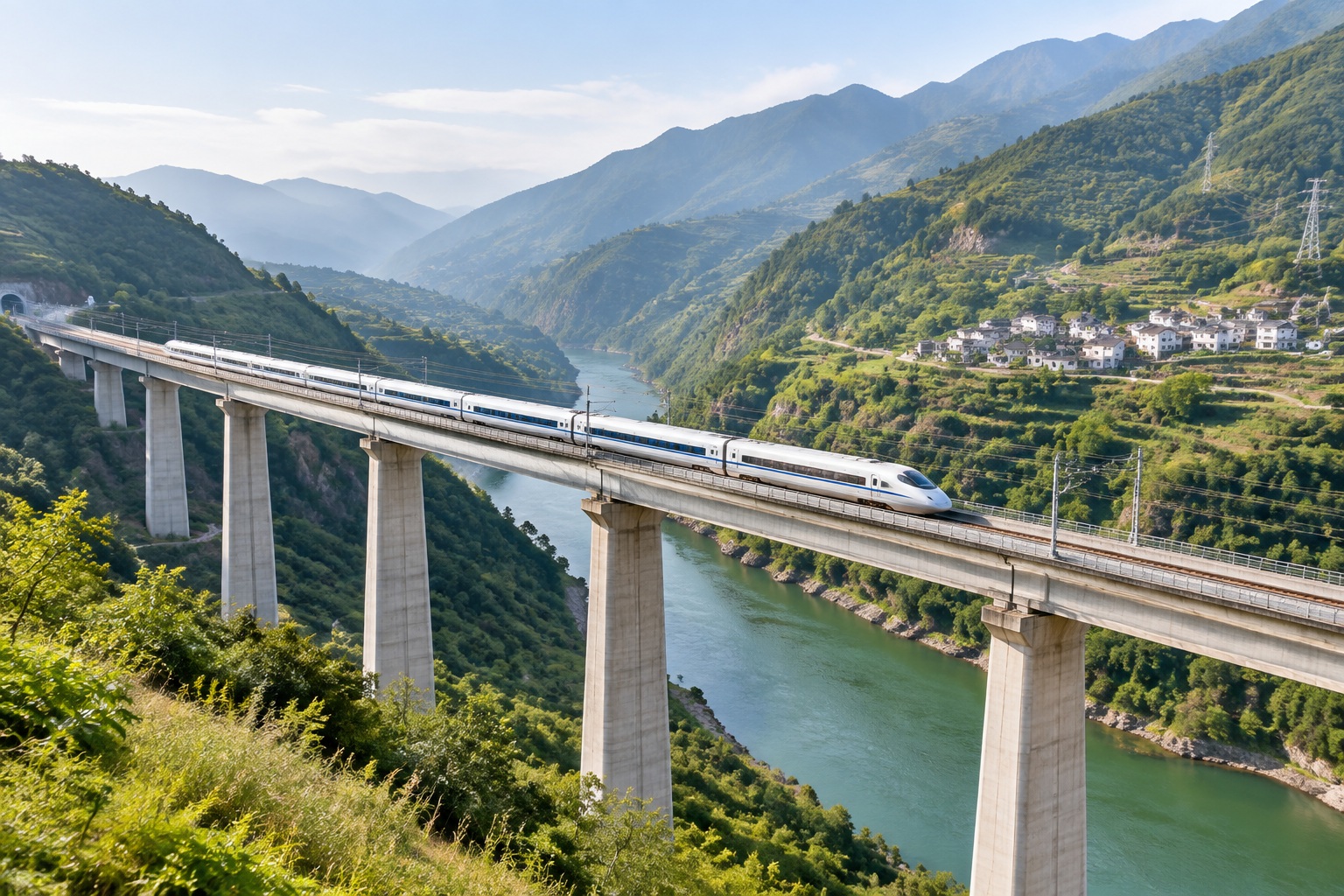
The route crosses 22 counties and districts in Gansu, Shaanxi, Sichuan and Chongqing. Several of them, including Longnan, had never had a railway. It also runs close to the fault systems that produced the 2008 Wenchuan earthquake, which shaped the way the tunnels and viaducts were designed.
Digging through tofu: the Huomaling tunnel
Huomaling is 13.6 kilometres long, and the geology was the problem: not hard rock but soft, water-bearing fine siltstone. Groundwater turned the working face into slurry. Inrushes sometimes arrived faster than the pumps could move the water out. Push forward too quickly, and the face slumped.
The fixes came in layers. From the surface above the alignment, crews drilled hundreds of dewatering wells to pull the water table down before the tunnel reached it. Inside, they injected grout in curtains around the heading to firm up the ground ahead. Excavation rounds shrank from the usual few metres to less than one, and in the worst stretches to half a metre. There were months when the tunnel advanced only a few metres in total.
Eight years for 13.6 kilometres. When the last section broke through in June 2017, the line was three months from opening.
Rock that pushes back
Further north, the difficulty changes. There the rock is under enormous stress, and it fails in two very different ways. Where it is brittle, it explodes: small slabs snap off the wall without warning, which is why tunnelling crews work behind protective screens. Where it is soft, it squeezes. At the Muzhailing tunnel, steel arch supports bent under the pressure and the walls crept inwards — in places by more than a metre. Crews cut a wider profile than they needed and rebuilt the lining behind them.
The longest bore on the line, the Western Qinling tunnel, runs about 28 kilometres. It was driven from several faces at once, using tunnel boring machines on some sections and conventional drill-and-blast on others. Advance geological forecasting became routine: probe holes drilled 30 metres ahead of the face, radar and seismic readings, so crews had some idea what they were walking into.
Conditions above ground were not gentle either. Camps sat at 2,000 metres and higher. In winter, temperatures dropped to minus 20, so concrete was mixed with heated water and aggregate and covered after pouring. In summer, rock temperatures inside some tunnels climbed past 35 °C. Work ran around the clock in shifts, with ventilation, water supply and medical cover for thousands of people in valleys where the nearest sizeable hospital was hours away.
What changes when the map shrinks
The passenger timetable tells part of the story. Lanzhou to Chongqing went from more than twenty hours to about seven. The Guangyuan-Chongqing section opened at the end of 2015; the Gansu section followed in September 2017.
Freight matters more. Wudu district in Longnan grows most of China’s domestic olives, and the same hillsides produce Sichuan pepper, walnuts and apples. Further north, Minxian county is known for angelica root and other medicinal herbs, and Dingxi for potatoes. Before the railway, all of it left by truck on narrow mountain roads that snow or a landslide could close, and the cost showed up in the price farmers were paid. Now it moves by rail, and cold storage has gone up near the stations.
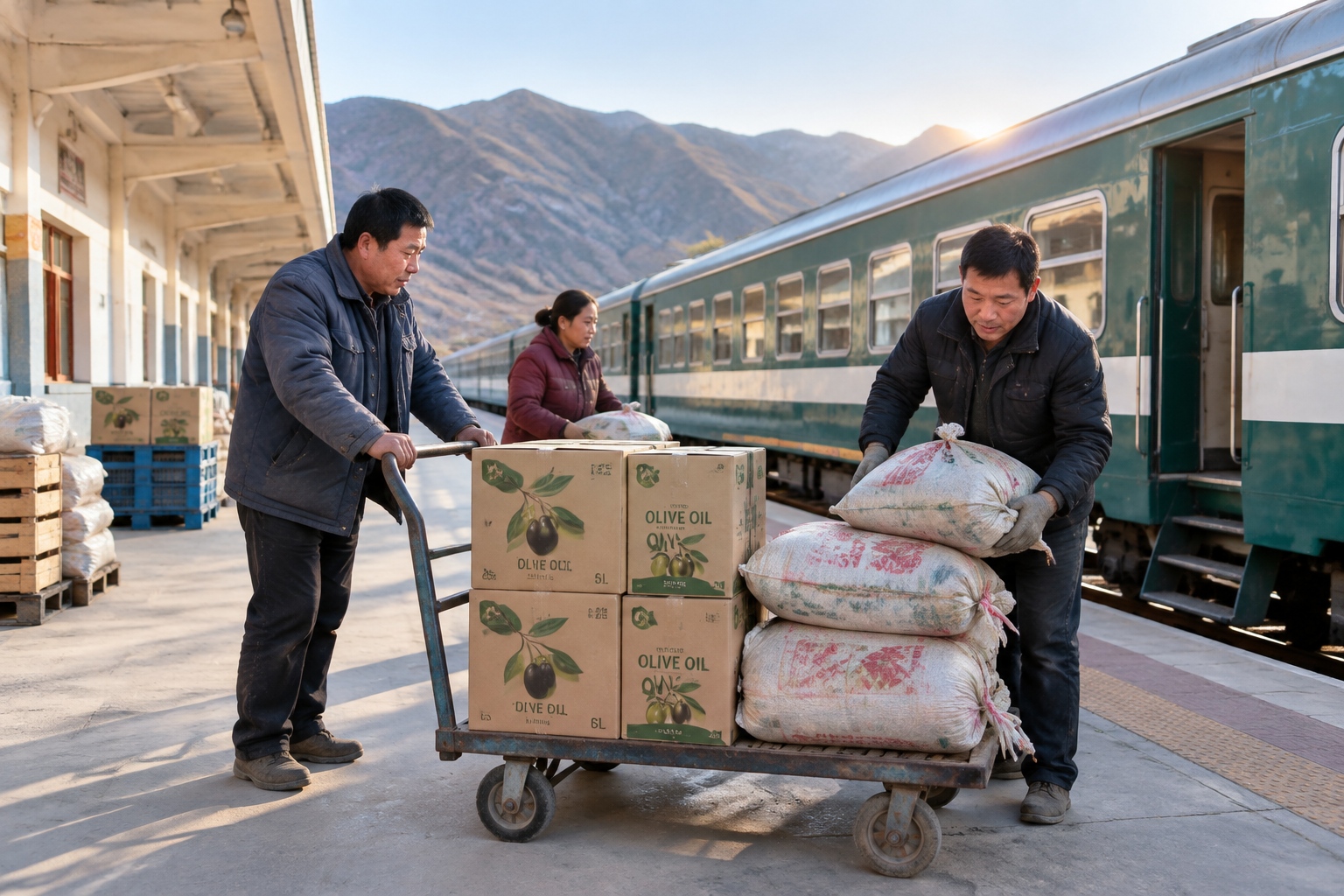
People move differently too. Longnan and Minxian send migrant workers to Chongqing, Chengdu and Xinjiang; students travel to universities in Lanzhou; patients take the train to larger hospitals. Tourism followed: Langzhong’s old town in Sichuan and Guan’egou in Tanchang county, Gansu, both saw visitor numbers rise after stations opened nearby — a pattern that has repeated across western China wherever a line reaches a place that used to be a long bus ride from anywhere.
The more concrete change is logistics. A box of Sichuan pepper that took two days by road to reach Chongqing can now go overnight, and the same trains carry fertiliser, cement and consumer goods back up the line. For Chongqing’s China-Europe container trains, the new route northwest cut several hundred kilometres off the trip towards Xinjiang and the border crossings beyond.
The view from seat 12A
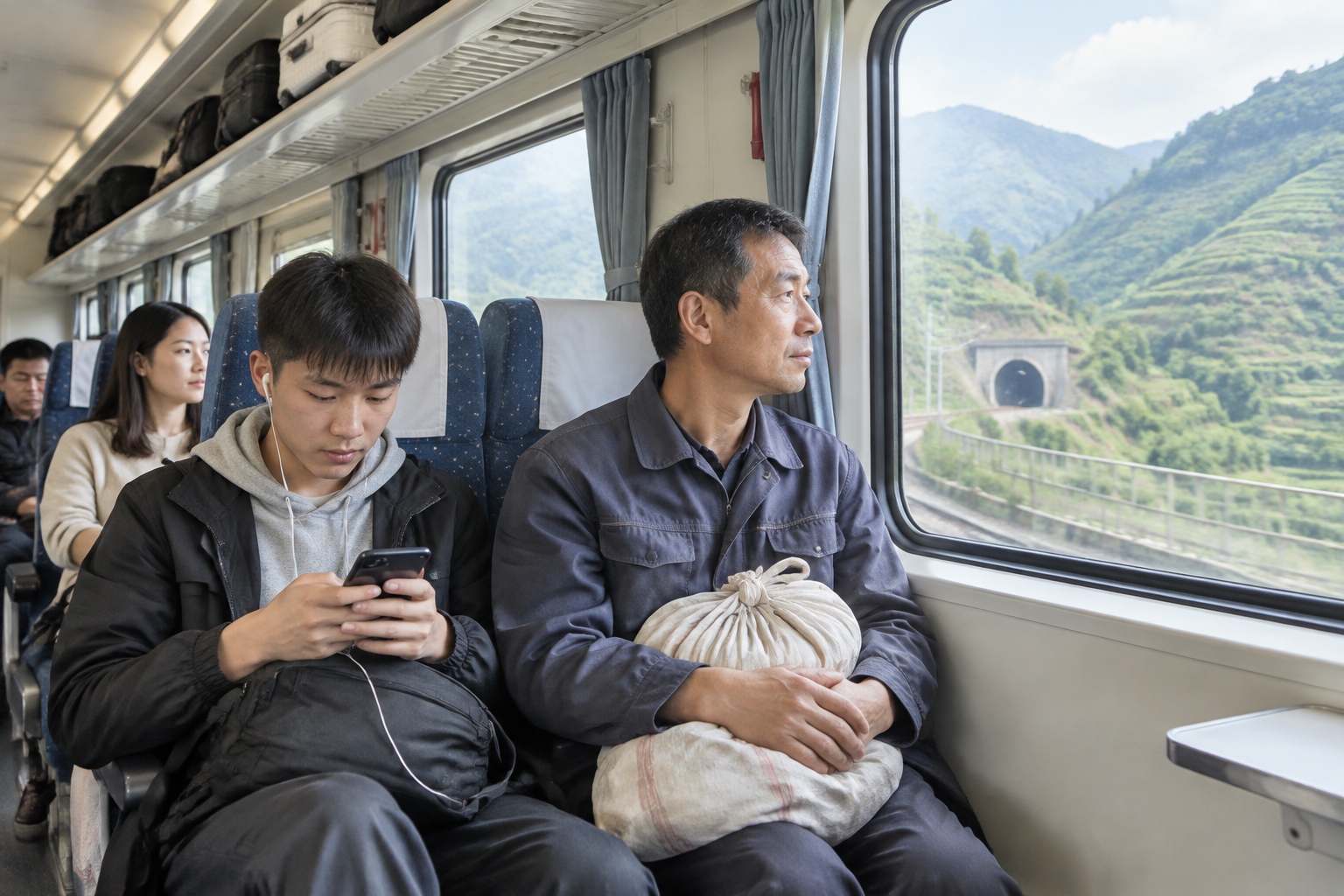
On an ordinary morning, the train out of Longnan leaves the platform, crosses the Bailong River on a concrete viaduct and is inside a tunnel before most passengers have found their seats. Then the pattern repeats: a minute or two of green terraced hillside, a village, a stretch of river; a dark window and the pressure change in your ears; light again.
In one carriage, a man in a work jacket keeps a cloth bag of Sichuan pepper on his lap, tied at the neck. Two rows back, a student watches a downloaded lecture with headphones in. Somewhere past the fourth or fifth tunnel, the woman opposite stops counting them.
Li Bai, writing about the roads into Sichuan in the eighth century, produced a line every Chinese schoolchild knows: the road to Shu is harder than climbing to heaven. The mountain he was describing is still there. The difference is that trains now go through it — 226 times, one tunnel at a time.
Start the discussion at forum.chinacomes.com