
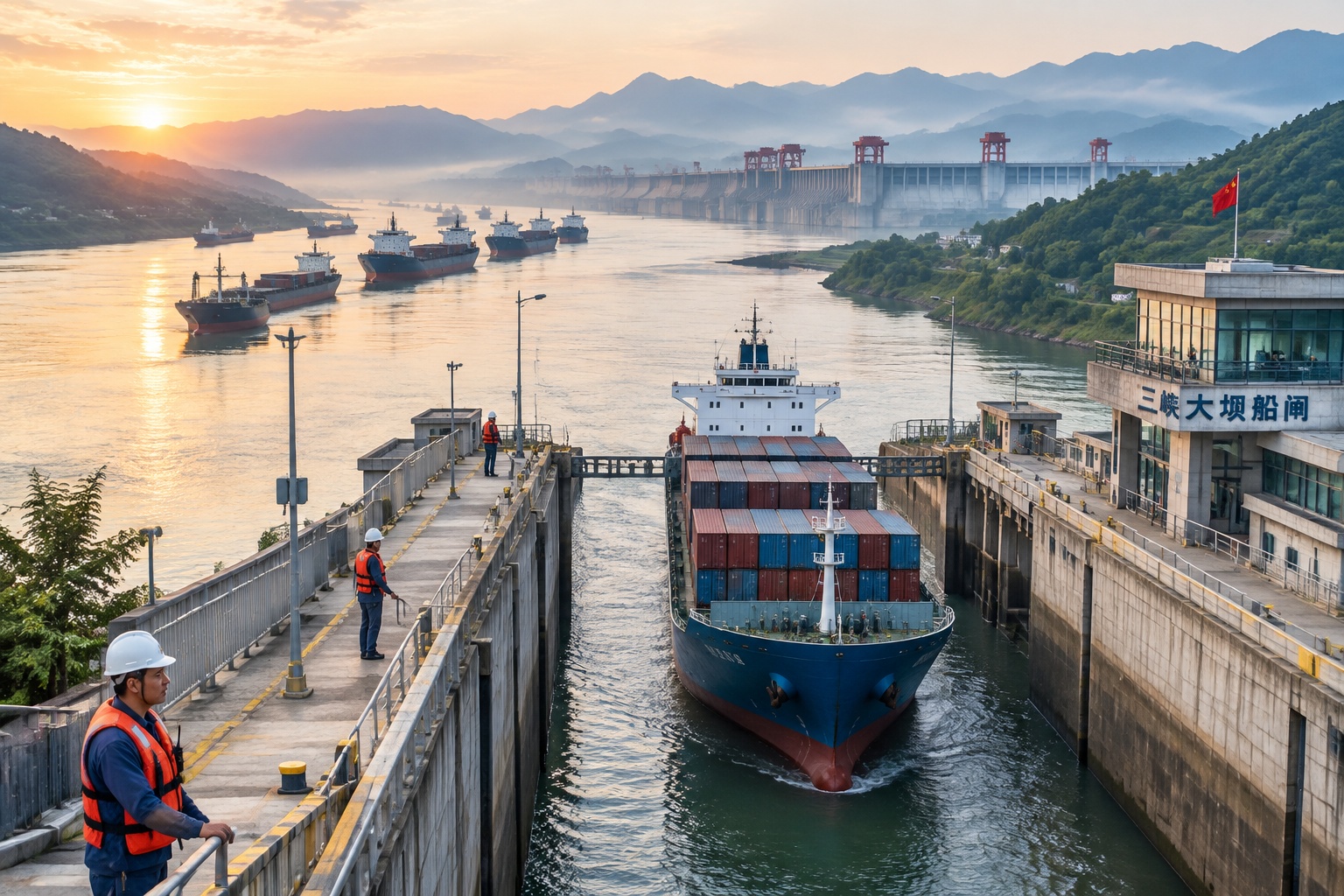

A Line of Ships Waiting at the Three Gorges
At the Maoping anchorage near the Three Gorges Dam in Yichang, Hubei Province, a bulk carrier captain checks his phone for his queue number. His ship is carrying auto parts from Chongqing to Shanghai. He has been waiting for more than a day, and the app says it may be another 20 hours before his vessel enters the lock. Around him, dozens of cargo ships are anchored in rows, their engines idling, their crews waiting. This is not a postcard view of the Yangtze. It is a traffic jam on water, and it explains why China is about to build a second shipping channel at the Three Gorges.
The Three Gorges ship lock opened in 2003 with a designed annual capacity of 100 million tonnes. That seemed generous at the time. It was not. As factories moved inland and Chongqing, Sichuan, Hubei and other upstream provinces became major manufacturing and logistics hubs, the Yangtze became busier than planners expected. In 2023, the lock handled about 168 million tonnes of cargo. In 2024, it handled about 159 million tonnes. Both figures are far above the original design. The result is chronic congestion, especially during maintenance periods, dry seasons and peak shipping months.
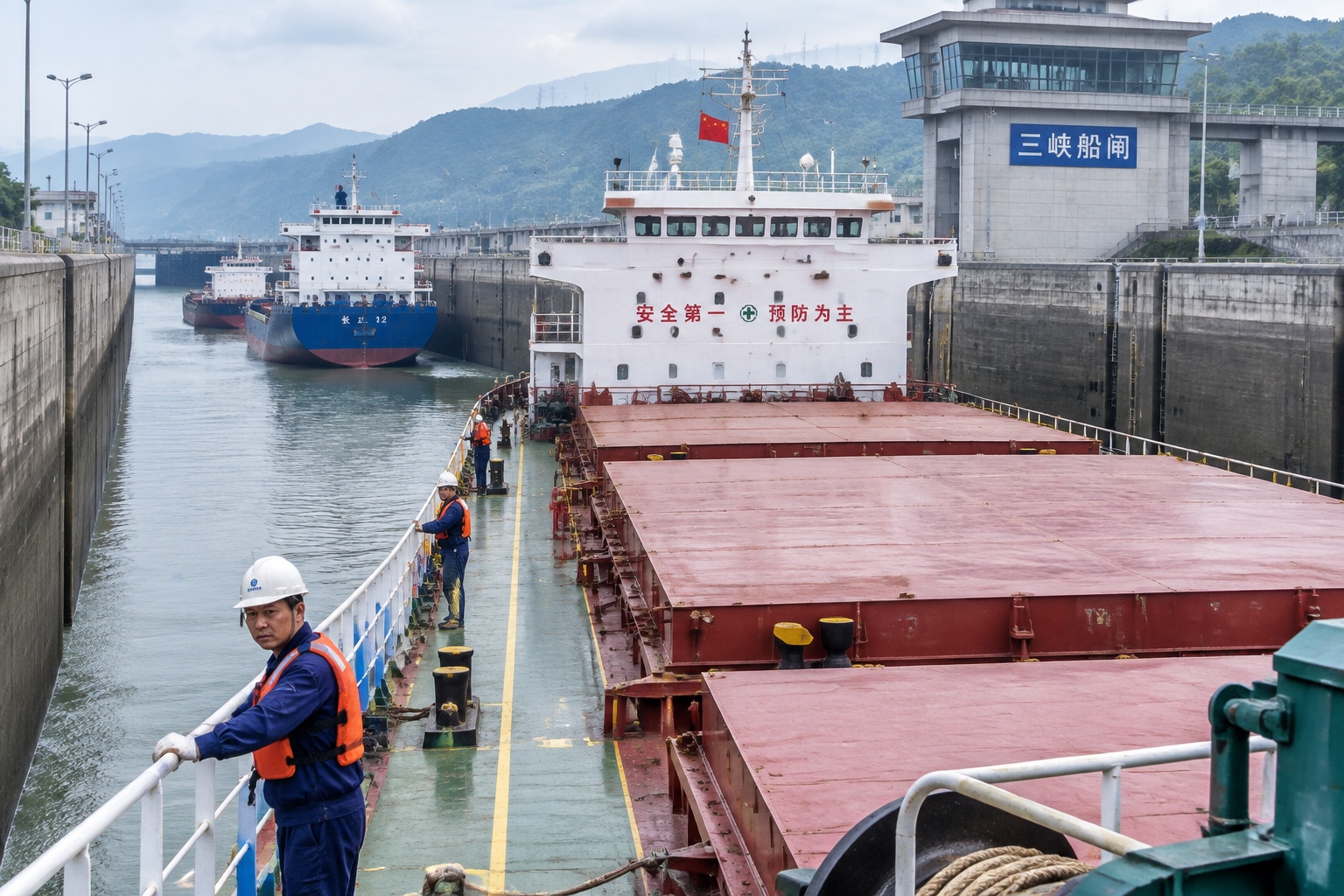
What the New Three Gorges Shipping Channel Actually Is
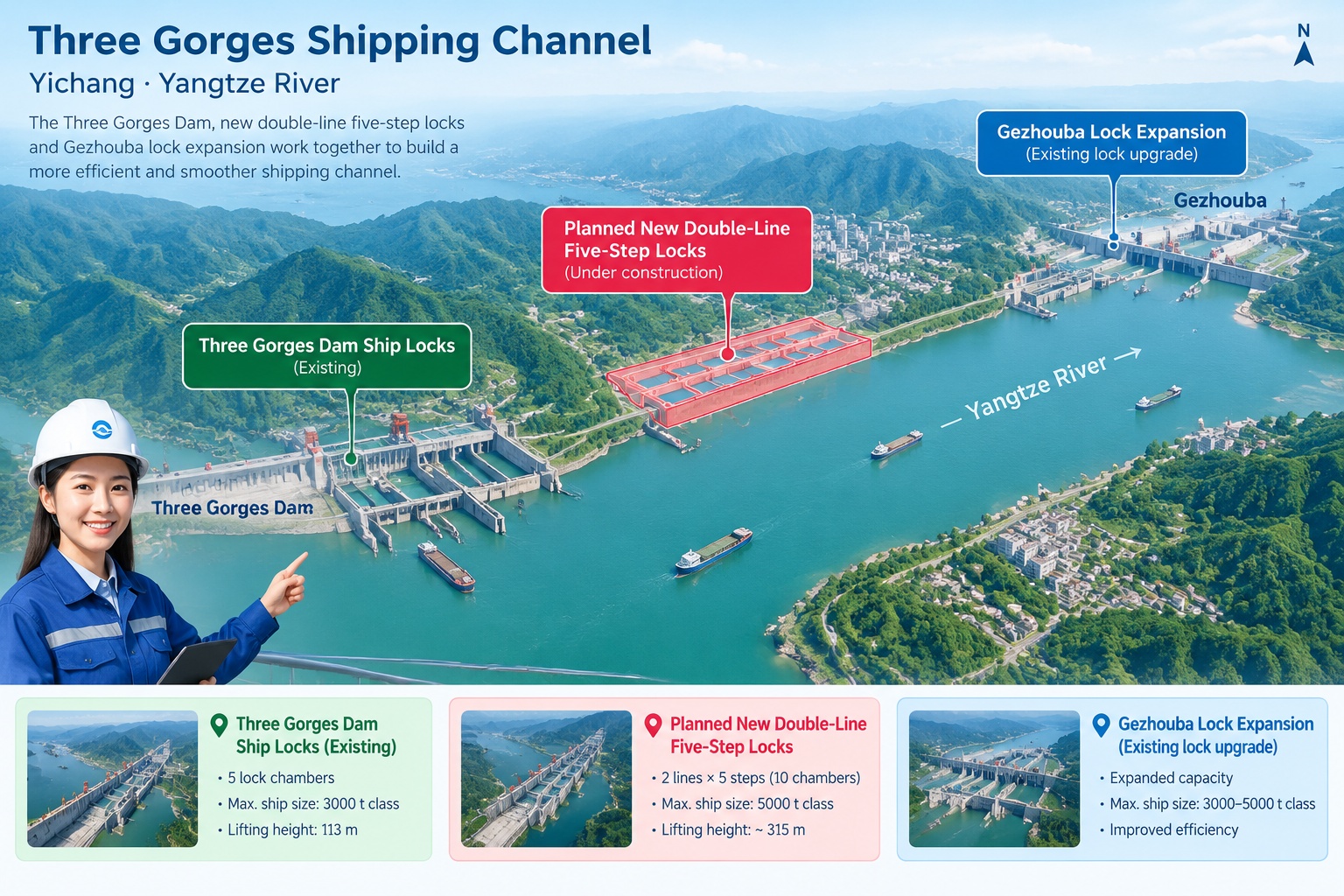
The project is often described in English as a new Three Gorges shipping channel. It is not a second dam. It is not a new reservoir. It is a set of new locks and channel improvements built around the existing Three Gorges and Gezhouba hydroelectric complexes near Yichang, where the Yangtze drops from the Sichuan Basin to the central Chinese plains.
The plan has two main parts. First, at the Three Gorges hub, a new double-line, five-step ship lock system will be built on the north side of the existing locks. Second, at the Gezhouba hub downstream, the navigation capacity will be expanded with new lock facilities and channel works. The existing locks will continue to operate during construction, though shipping schedules will be adjusted.
When completed, the total capacity of the Three Gorges hub is expected to rise from about 100 million tonnes per year to about 280 million tonnes per year. The official total investment is about 76.6 billion yuan, or roughly 10.6 billion US dollars. The main construction period is about 100 months, or more than eight years. That means the project is not a quick fix. It is a long-term bet on the future of inland shipping.
Why the Existing Locks Are Congested
The numbers tell a simple story. The lock was designed for 100 million tonnes. The Yangtze now moves far more. In 2024, ports along the main Yangtze trunk handled more than 4 billion tonnes of cargo, the highest of any inland waterway in the world. Not all of that cargo passes through the Three Gorges lock, but a large share of upstream traffic does. Ships carrying coal, iron ore, automobiles, containers, chemicals and building materials all queue at the same bottleneck.
Waiting times vary. On ordinary days, the average wait can be around 40 hours. During peak periods, it can exceed 100 hours. For a shipping company, that is not just inconvenience. It is fuel burned while anchored, wages paid while waiting, and contracts delayed. Some cargo is diverted to rail or road, which is more expensive and produces more carbon emissions per tonne-kilometre. The new channel is meant to remove that bottleneck, not just for a few years but for decades.
How the 15th Five-Year Plan Turns a Megaproject into a Schedule
For readers outside China, the phrase 15th Five-Year Plan may sound like bureaucratic language. In practice, it is a planning rhythm. Every five years, the Chinese government sets broad priorities for infrastructure, industry, energy and social policy. The 15th Five-Year Plan covers 2026 to 2030. Being listed as a landmark project in this plan means the project gets priority in approval, funding, land use and inter-provincial coordination.
The new Three Gorges shipping channel has been identified as one of the first landmark projects to start under the 15th Five-Year Plan. Its feasibility study was approved by the National Development and Reform Commission, China’s top economic planning body. Construction is beginning in phases. The existing locks will keep working. Engineers will build new locks beside them, piece by piece, while managing water levels, sediment, fish protection and navigation safety.
This is how major Chinese infrastructure often works: a long approval and design period, then a visible start, then years of construction. The public may see a ceremony or a news headline, but the real change arrives slowly, when the first commercial ship passes through the new lock.
What It Means for Companies and Households
For companies along the Yangtze, the most direct benefit is time. If a ship saves 20 or 30 hours at the Three Gorges, it can complete more trips per year. A container line can schedule more reliably. A car factory in Chongqing can receive parts and ship finished vehicles with less uncertainty. A steel mill in Hubei can move iron ore more cheaply. These gains are not glamorous, but they add up.
Water transport is already the cheapest way to move bulk goods in China. Depending on the route and cargo, it can cost roughly one-fifth of road transport and one-third of rail. That cost advantage matters most for heavy, low-value goods: coal, ore, grain, cement, steel and chemicals. It also matters for containerized exports from inland provinces, which must reach Shanghai or Ningbo before sailing to Europe, Southeast Asia or the Americas.
Will the new channel lower prices in supermarkets? Not directly, and not soon. Shipping is only one part of the final price of most consumer goods. But for products with thin margins and heavy inputs, lower logistics costs can help keep prices stable and make inland factories more competitive. The effect is more visible in jobs and investment than in a price tag on a shelf. Ports, shipyards, repair yards, warehouses and trucking companies all depend on reliable river traffic. When the river works better, those local economies have more room to grow.
The Yangtze Economic Belt covers 11 provinces and municipalities, home to about 600 million people and more than 40 percent of China’s GDP. A faster river does not transform that entire region overnight. But it strengthens the logic of moving goods along the river instead of around it.
Not Just China: Inland Waterways as Economic Infrastructure
China is not alone in investing in river logistics. The Rhine in Europe and the Mississippi in the United States have both faced aging locks, low-water bottlenecks and pressure to move more cargo by barge. In the United States, the Army Corps of Engineers has worked for years to modernise locks on the upper Mississippi River. In Europe, low water on the Rhine in 2018 disrupted chemical and steel supply chains and pushed some cargo onto trucks and trains. Inland waterways are slow, but they are cheap and relatively low-carbon. That combination keeps attracting public investment.
The Yangtze is unusual in scale. Its annual cargo volume is larger than any other inland waterway. That is why a bottleneck at the Three Gorges has national consequences. It is not just a local traffic problem. It affects the cost of moving goods between China’s coastal export hubs and its inland industrial base.
One common misunderstanding outside China is that the new channel is another giant dam. It is not. The dam and the existing locks are already there. The new project is about adding lock capacity and improving navigation. It will change how ships move, not where the river flows.
What to Watch
Several questions will shape whether the project delivers. Can construction avoid serious delays? Can the new locks operate reliably with the sediment and water-level conditions of the Yangtze? Will the promised capacity of about 280 million tonnes be reached, and when? How will shipping be managed during the years of construction? And will the new capacity simply fill up with new traffic, as the old lock did?
Those questions matter beyond China. They are part of a broader global experiment: whether large inland waterways can be upgraded fast enough to serve modern supply chains without unacceptable environmental or social costs.
Back at the Maoping anchorage, the captain is still waiting. His phone shows a queue number. On the bank, a small market sells noodles and bottled water to crew members who come ashore. The river is wide and grey, and the ships stretch upstream until they disappear around a bend. When the new locks open in the 2030s, will that line disappear? Or will it simply grow longer, as the Yangtze finds new cargo to carry?
Start the discussion at forum.chinacomes.com