
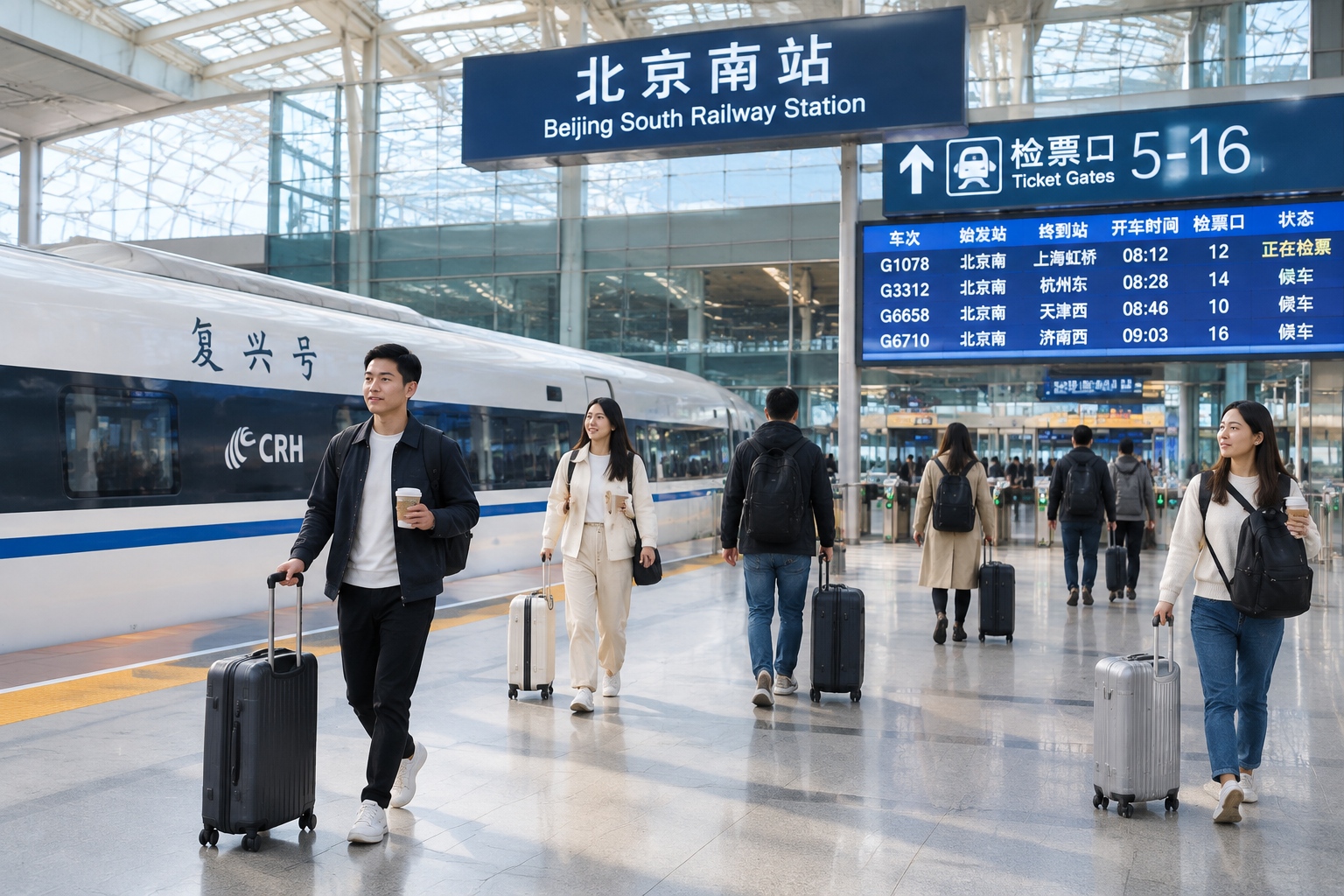

A departure board that explains the line better than any statistic
At Beijing South Railway Station on a weekday morning, the board above the escalators lists trains to Shanghai Hongqiao at 7:00, 7:12, 7:20, 7:35 and 7:43. That is only the first hour. The fastest of them covers the 1,318 kilometres — 819 miles — between China’s political capital and its financial capital in 4 hours 18 minutes.
Nobody on the platform looks impressed. Travellers queue with coffee and rolling suitcases, scan a code at the gate and walk down to the train as if boarding a suburban service. That ordinariness is the point. The Beijing-Shanghai High-Speed Railway has stopped being an event, and becoming unremarkable is the hardest thing a piece of infrastructure can achieve.
The basics: 1,318 km, two dozen stations, four hours
The line opened on 30 June 2011, running from Beijing South to Shanghai Hongqiao through Tianjin, Jinan, Xuzhou, Nanjing, Wuxi and Suzhou, with roughly two dozen stations in total. Trains were scheduled at 300 km/h at first; since September 2017 the Chinese-built Fuxing trainsets run the route at 350 km/h, the highest scheduled commercial speed anywhere in the world.
A full-fare second-class ticket costs 553 yuan, about $77; first class is 933 yuan and business class 1,748 yuan. For comparison, an overnight conventional train takes roughly 12 hours, and a flight spends about 2 hours 15 minutes in the air but five hours or more door to door once airport transfers, security and baggage are counted. High-speed rail stations in China sit in the middle of cities, not an hour outside them.
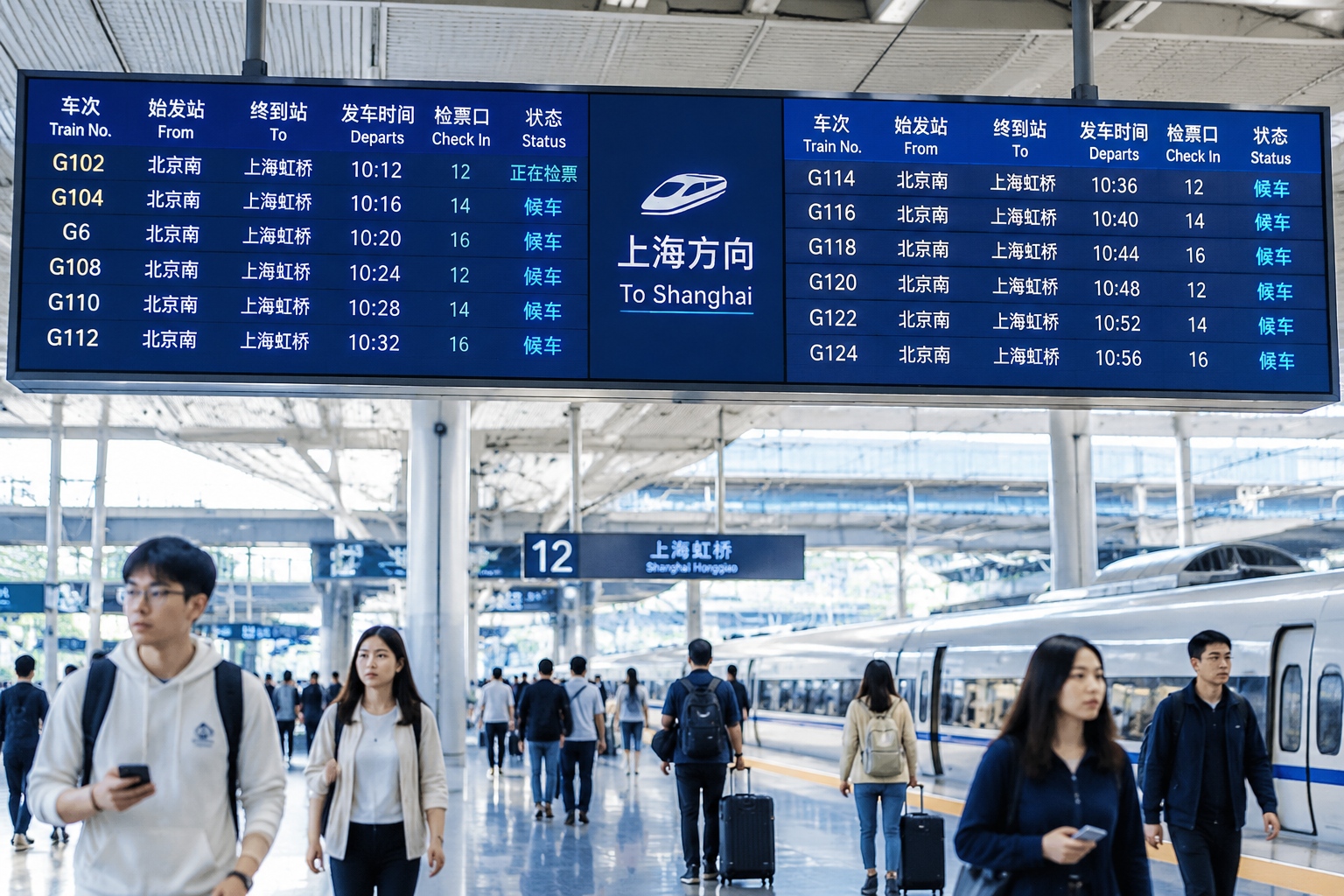
Why “built in one go” matters more than it sounds
Construction began in April 2008 and finished 38 months later, with around 130,000 workers at the peak and a total investment of 220.9 billion yuan — about $33 billion at the time. All 1,318 km opened on the same day, to a single design standard.
Interfaces are where speed and reliability usually get lost. Running end to end at 350 km/h requires every section to share the same track geometry, signalling logic, power supply and platform height. When a line is stitched together from phases designed years apart, trains slow down or switch systems at the seams. Here, they do not.
Where the high standards actually live
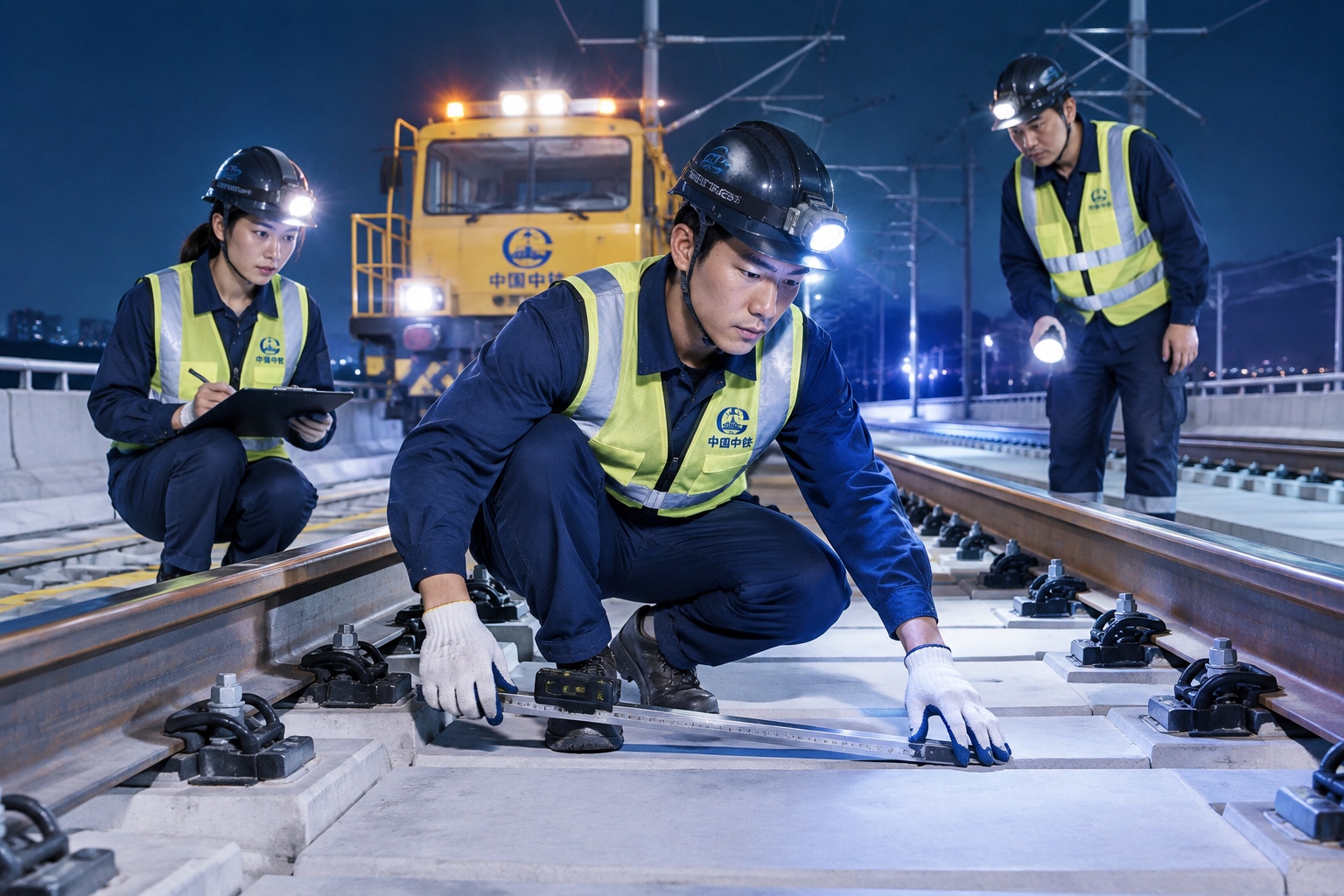
Three technical choices define the route. The first is the track itself: almost the whole line uses concrete slab track instead of the crushed stone laid under conventional railways. Slab track holds its geometry at high speed, needs far less maintenance and removes the loose stones that passing trains would otherwise throw up.
The second is signalling. Beijing-Shanghai was the first line in China to use CTCS-3, a cab-signalling system in which the driver reads instructions on a screen while the train continuously supervises its own speed and brakes automatically if it exceeds the limit. That is what makes it possible to run trains every few minutes.
The third is bridges. Roughly 80% of the line — about 1,061 km — runs on viaducts rather than on the ground, including the Danyang-Kunshan Grand Bridge, which stretches 164.8 km and is the longest bridge in the world. Building on piles is slower and costlier than building on the surface, but it solves two problems at once: soft ground that settles unevenly, and cities that would otherwise be cut in half by a railway.
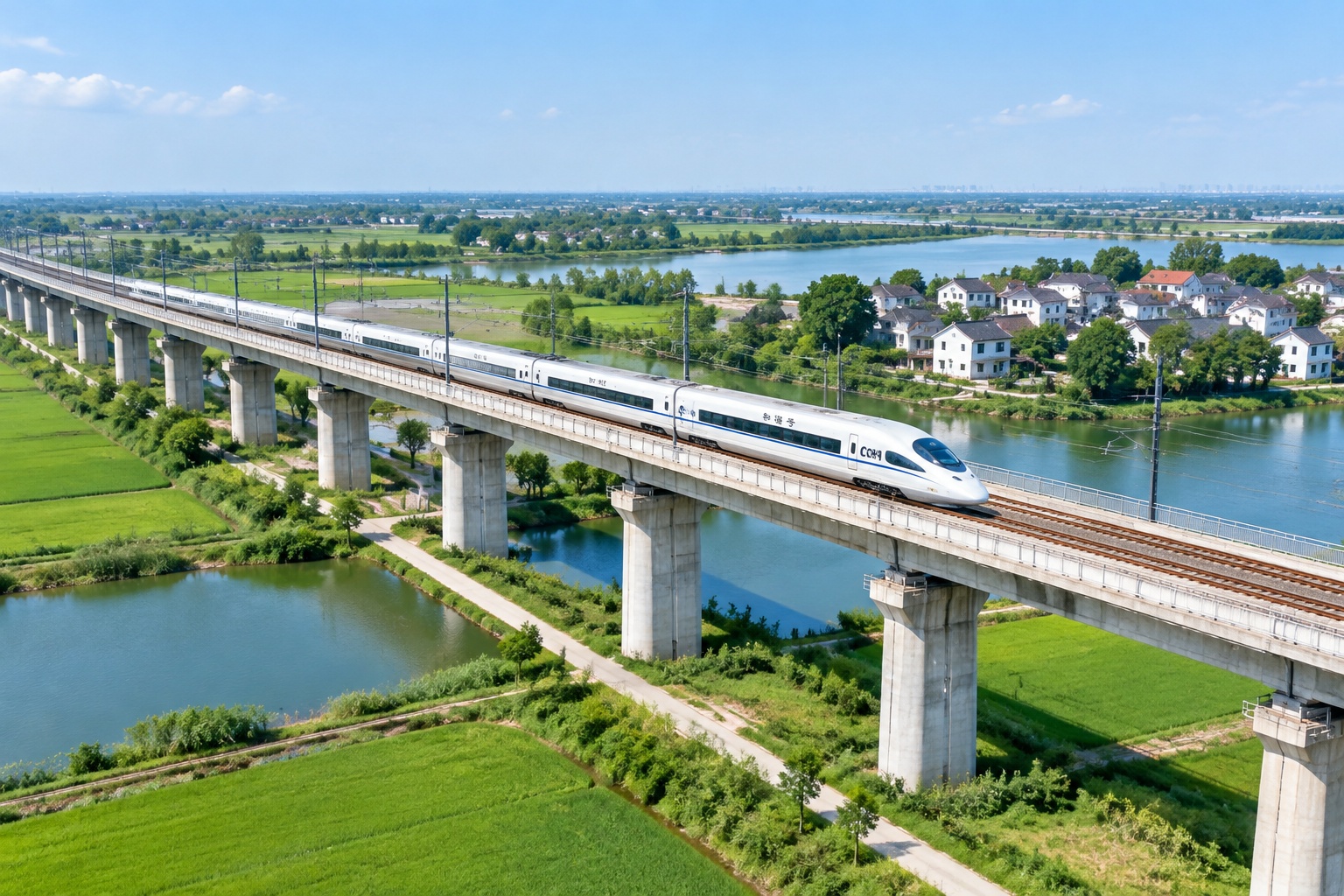
What made construction genuinely difficult
The terrain looks easy — flat plain between two big cities. It is not. The North China Plain and the Yangtze Delta sit on soft alluvial soil, and decades of groundwater pumping have caused land subsidence in parts of the delta. A track that tolerates only millimetres of movement a year is demanding to build on ground that moves.
Engineers also had to cross the Yellow River near Jinan and the Yangtze near Nanjing, thread the line through dense urban corridors, and keep the existing, heavily used conventional railway running throughout. Thousands of households were relocated along the route — a part of the story that rarely appears in engineering accounts but shapes how the project was experienced locally.
What it changed for ordinary people
The clearest change is what a day trip now means. A consultant in Shanghai can take a 7:00 train, be in a Beijing meeting room by 12:30 and be home the same evening. Doing the same trip by plane usually costs a hotel night.
The second change is commuting. Suzhou to Shanghai takes about 25 minutes; Wuxi and Kunshan sit on the same corridor; Langfang, just outside Beijing, is about 21 minutes from the capital. Planners call it the “same-city effect,” and it shows up in property prices, in where people register companies and in how often families actually see each other.
The third and fourth changes are easy to miss. Moving passengers onto the new line freed capacity on the old Beijing-Shanghai railway for containers and coal — a measurable gain, not a talking point. And Beijing-Shanghai, once among the busiest air routes in the world, has seen airlines cut frequencies on the corridor since 2011. Most of the new line’s passengers came from planes and from the old railway, not from nowhere.
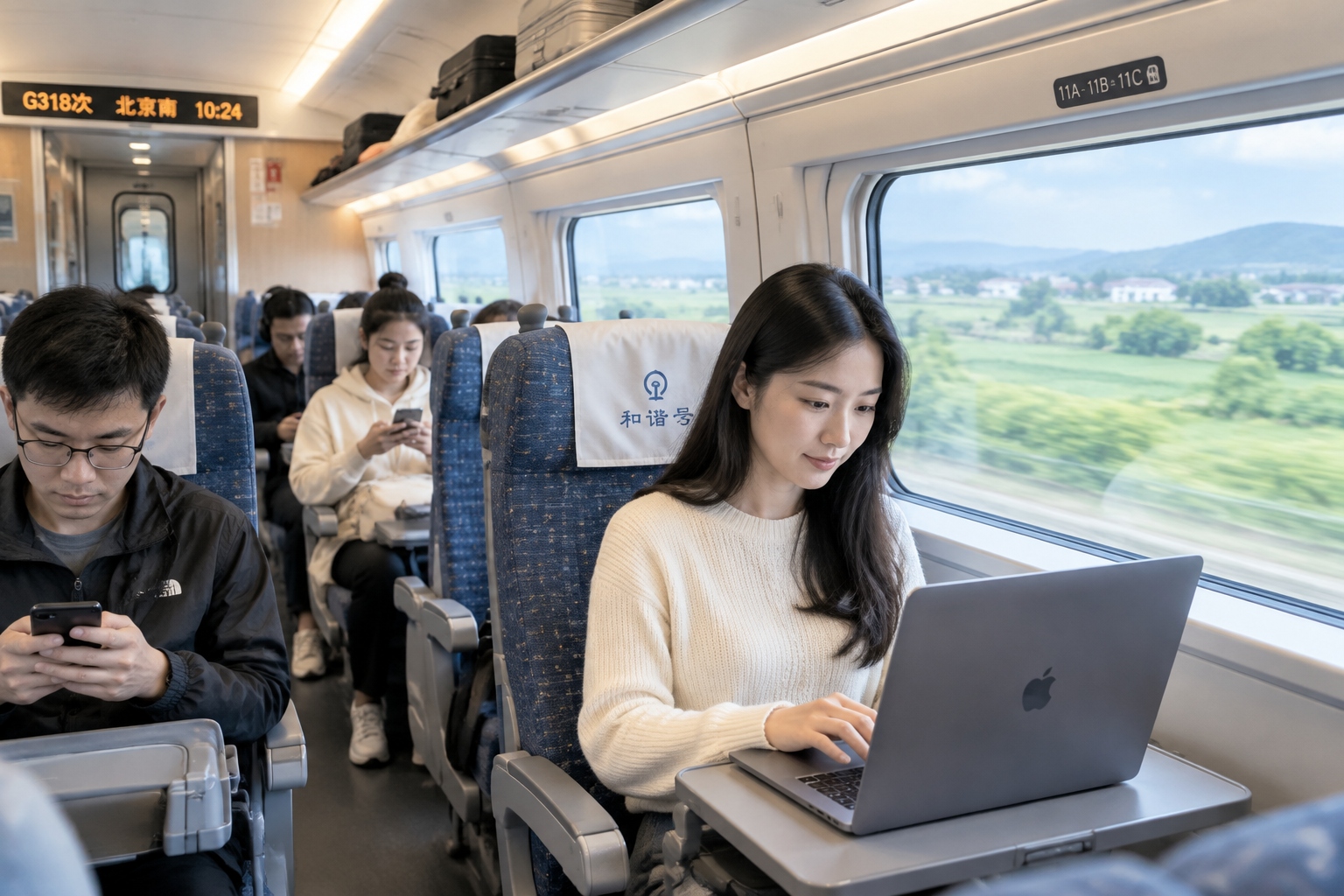
What a ride is actually like
Tickets are bought on the official 12306 app, which now has an English interface, or through booking sites. You enter a passport number, pick a train and pay; at the station you clear security and scan the passport at the gate. No paper ticket. Most people arrive 20 to 30 minutes before departure.
Inside, second class is five seats across and first class four, with power sockets at every seat and luggage racks overhead. A trolley sells drinks and snacks, and on many trains you can order a takeaway meal through an app and have it delivered to your seat during the few minutes the train stops at Jinan West or Nanjing South. The Wi-Fi exists; it is not reliable.
Punctuality on the corridor is consistently reported above 98%, and when a train is late it is usually weather — snow in the north, typhoons on the coast. Doors close about a minute before departure.
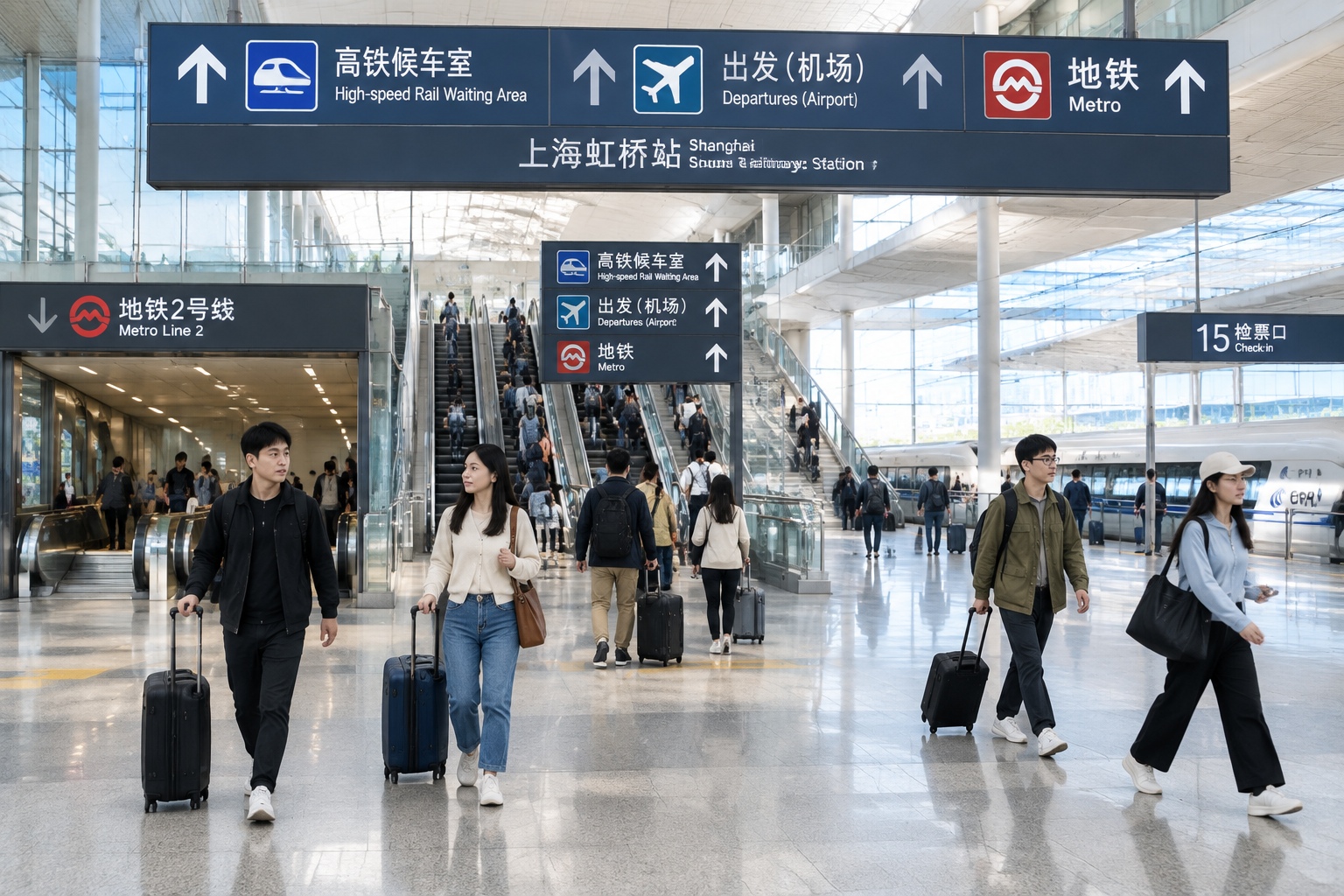
The stations were designed as interchanges rather than as railway buildings. Beijing South connects directly to two metro lines; Shanghai Hongqiao connects to the metro and sits beside the city’s airport, about a ten-minute walk from the high-speed platforms to the domestic terminal.
The line that became the template
Almost everything that defines Chinese high-speed rail today was proven at scale here first: slab track, CTCS-3 signalling, the 350 km/h Fuxing trainsets introduced on this route in 2017, and the idea of a station that doubles as a metro and airport hub. Later lines inherited those standards instead of reinventing them.
China’s high-speed network passed 48,000 km at the end of 2024, up from roughly 9,000 km when this line opened. Beijing-Shanghai remains the busiest, and one of the very few high-speed lines anywhere that reports a profit: about 12 billion yuan in 2019, the year before it listed on the Shanghai Stock Exchange. On peak days the corridor moves several hundred thousand passengers, and during Spring Festival or the October holiday every seat on every train still sells out.
The parts that don’t generalise
That profit deserves a careful reading. It comes from linking two of the largest and wealthiest cities in the country, on a corridor that already had an enormous business-travel market. Most high-speed lines in China do not make money, particularly in the west, and they are built as public investment rather than as businesses. Beijing-Shanghai is the exception, not the average.
Fares are not small either. A 553-yuan second-class ticket is roughly a week’s minimum wage in some inland provinces, and millions of people still take the 12-hour overnight train. In 2024 the railway introduced dynamic pricing on the corridor, so the same seat can cost different amounts on different days — worth remembering the next time someone describes Chinese high-speed rail as uniformly cheap.
What to watch
The interesting question is no longer whether China can build high-speed rail. It can, and it now exports both equipment and standards. The question is what happens once the easy corridors are finished. Lines across flat plains between megacities have clear economics; lines into mountains and deserts do not, and that debate is live inside China too.
For now, the measure of this line is not its speed record. It is that a 1,318-km journey has become boring. Infrastructure people stop noticing is infrastructure that worked.
Start the discussion at forum.chinacomes.com