
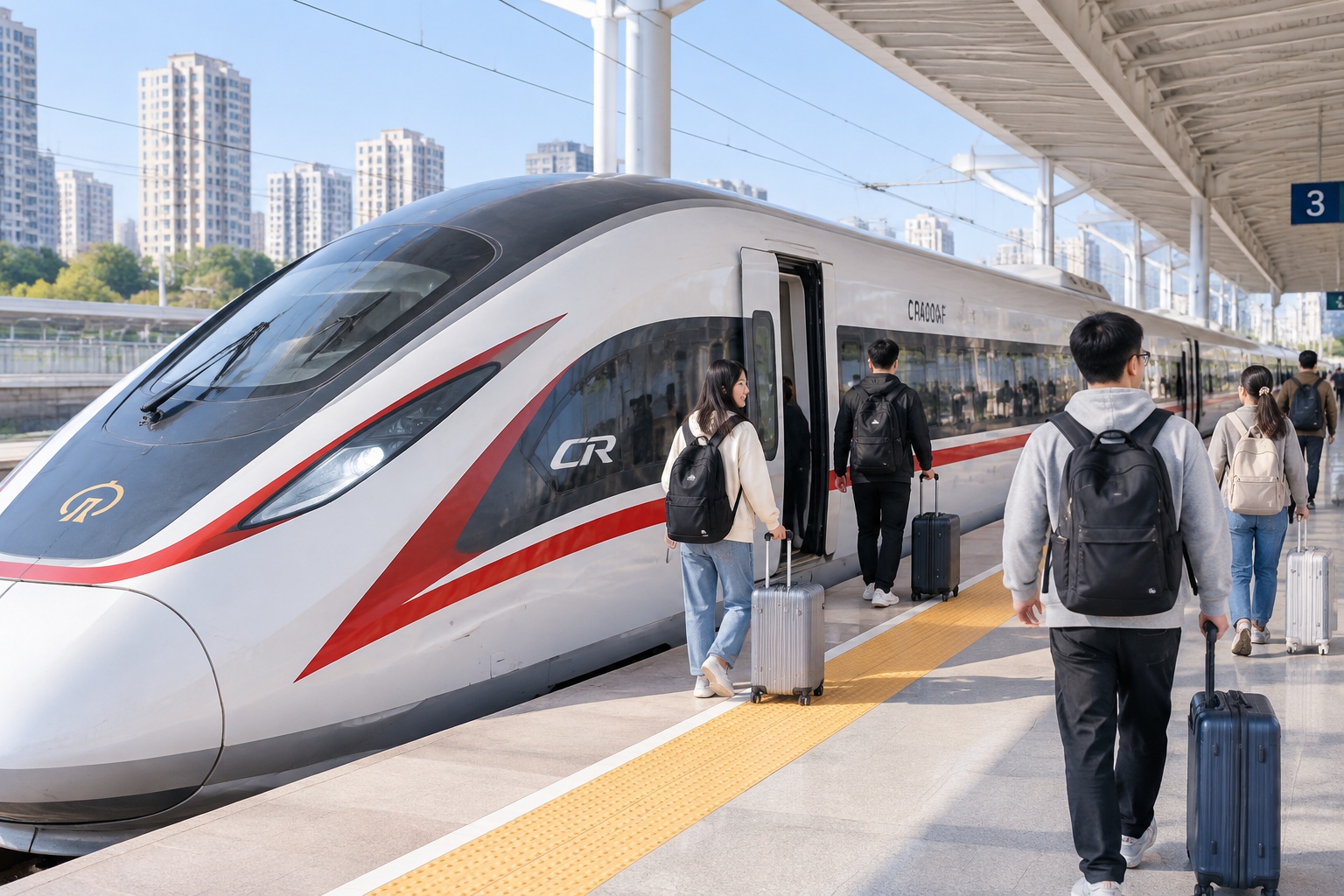

A Tuesday Morning at Beijing South
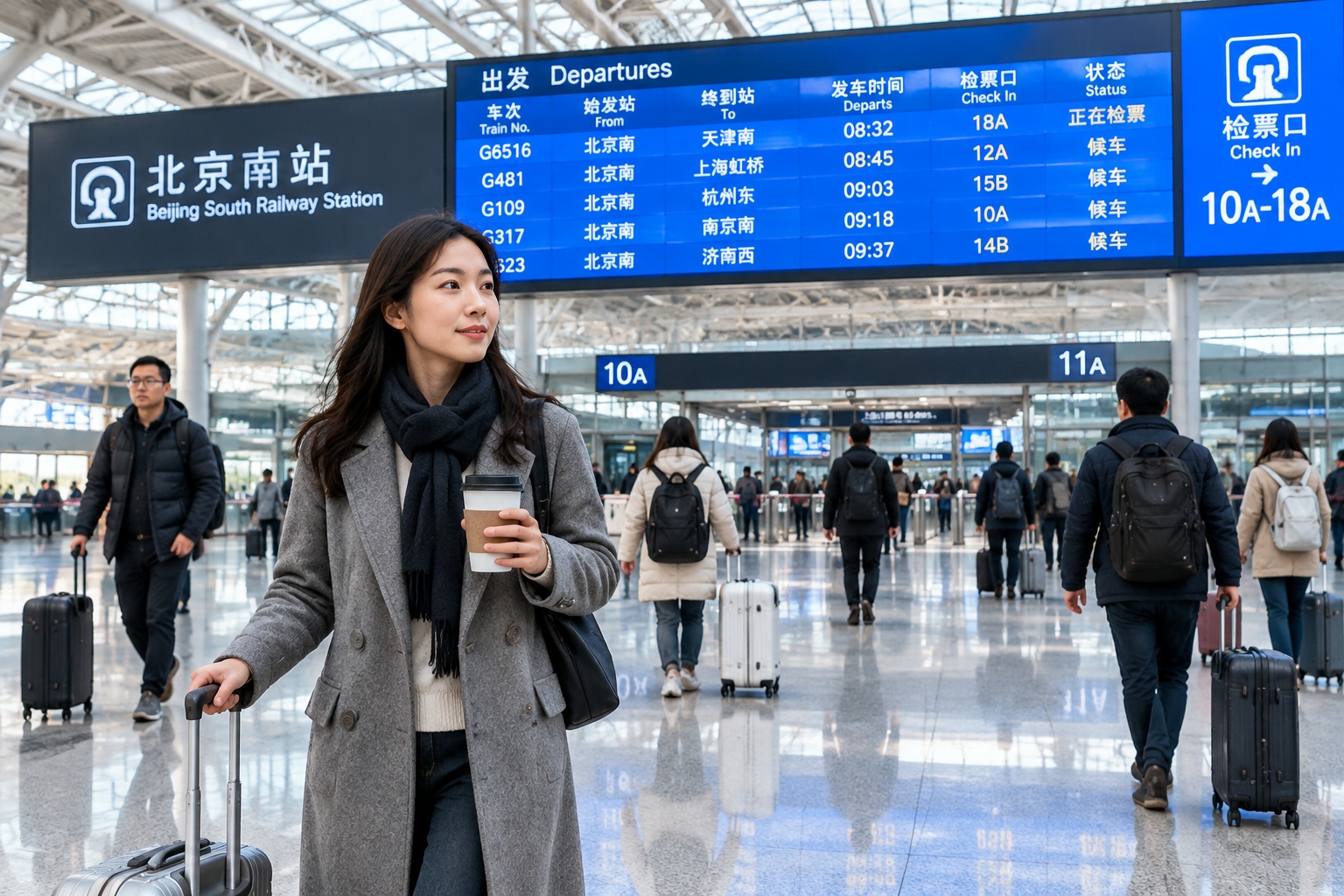
At seven on a Tuesday morning, the departure hall at Beijing South Railway Station already feels like a commuter terminal. A woman in a grey coat steers a rolling suitcase with one hand and a paper cup of coffee with the other. Three university students in matching hoodies photograph themselves under the departures board. A man in a suit walks toward Gate 12 without looking up from a video call.
Nearly all of them are waiting for the same thing: a Fuxing. Since 2017, these white-and-red trainsets, officially called the Chinese Standard EMU, have become the default way to cross long distances in China. The 7 a.m. departure to Shanghai Hongqiao covers about 1,300 kilometres in four and a half hours. A second-class ticket starts at 553 yuan, roughly 77 US dollars, though prices now float with departure time and demand.
What makes the Fuxing notable is not raw speed. Japan’s Shinkansen has run since 1964 and France’s TGV since 1981. What matters is the word “standard” — and what that word changed for the people sitting in carriage 7.
From a Patchwork Fleet to One Standard
Before the Fuxing, China’s high-speed fleet was the Hexie family, introduced in 2007. Those trains came out of joint ventures with Bombardier, Kawasaki, Alstom and Siemens, and they performed well. But the fleet was a patchwork: different models had different cabs, different software, different spare parts and different maintenance manuals. A train built by one manufacturer often could not be coupled to a train built by another, which complicated emergency rescue.
Development of a single national standard began in 2012. The first prototype rolled out in 2015, and the train entered passenger service on the Beijing–Shanghai line on 26 June 2017. Two companies build it: CRRC Qingdao Sifang makes the CR400AF, nicknamed the “red dragon,” and CRRC Changchun makes the CR400BF, the “golden phoenix.”
The letters carry meaning. CR stands for China Railway; 400 is the speed class; A and B identify the manufacturer; F means distributed power, with motors spread along the carriages instead of concentrated in one locomotive.
The payoff of standardisation sounds mundane and matters enormously. The two versions can be coupled together and pull each other after a breakdown. A driver trained on one can operate the other. Depots stock one set of parts. For passengers, that becomes more trains available, faster turnarounds and fewer cancellations.
One Family, Several Speeds
CR400: the 350 km/h workhorse
The CR400AF and CR400BF run at 350 km/h and are built for 400. They come in 8-car and 16-car versions; the 16-car train seats 1,193 passengers. In January 2019 an extended 17-car version entered service on the Beijing–Shanghai line with 1,283 seats, adding capacity on China’s busiest corridor.
CR300 and CR200J: the lines that are not 350 km/h
Not every route was built for 350 km/h. The CR300 series runs at 250 km/h on lines with tighter curves. The green-and-white CR200J, known to passengers as the “green giant,” runs at 160 km/h on upgraded conventional tracks, quietly extending the Fuxing name to hundreds of smaller cities that never received a flagship high-speed line.
The plateau version
Since June 2021, a dual-power Fuxing able to draw from overhead wires or run on its own diesel generators has served the Lhasa–Nyingchi railway in Tibet, where more than 90 percent of the 435-kilometre route sits above 3,000 metres.
By the end of 2024, China’s high-speed network had reached roughly 48,000 kilometres, and Fuxing trains were running in all 31 mainland province-level regions.
What Passengers Actually Notice
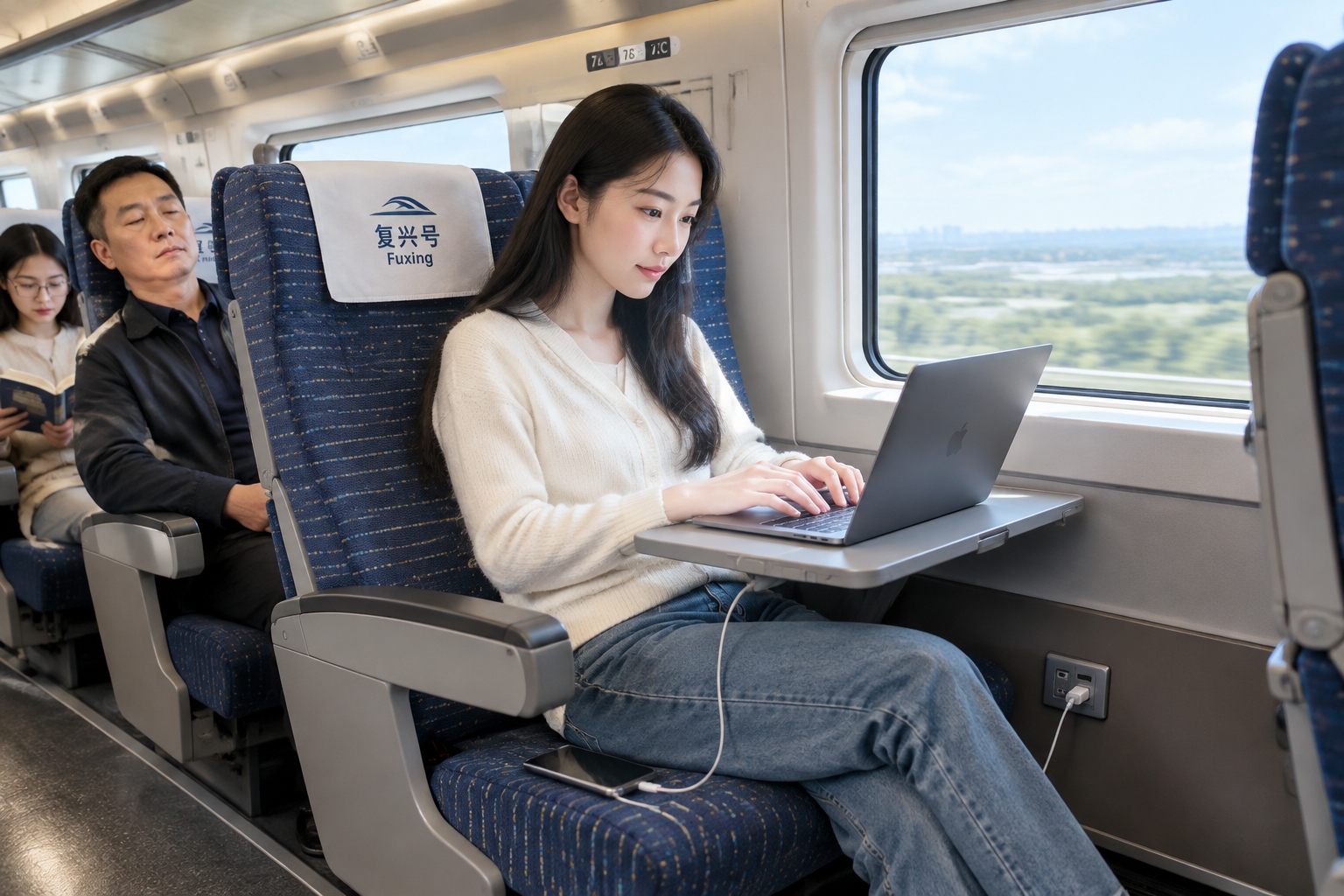
Ask a regular passenger what changed and you will not hear about traction converters.
You will hear about the power socket. Every Fuxing seat has one, including in second class, plus USB ports on newer units. On a four-hour run, that is the difference between a laptop that dies at Jinan and one that lasts to Shanghai.
You will hear about Wi-Fi, free and genuinely usable in open country, though it still drops inside long tunnels. You will hear about the seats: second class is laid out 3+2, first class 2+2 and business class 1+1 or 1+2, with noticeably more legroom and wider seats than the previous generation. The ceiling is higher and the luggage racks deeper, which matters more than it sounds when four people are trying to stow hard-shell cases at once.
You will hear about noise. Variable-frequency air conditioning and better sealing hold interior sound at around 65 decibels at full speed, about the level of an ordinary conversation. Videos of a coin standing upright on a windowsill during a 350 km/h run have circulated online for years precisely because the ride is that steady.
The Engineering You Never See
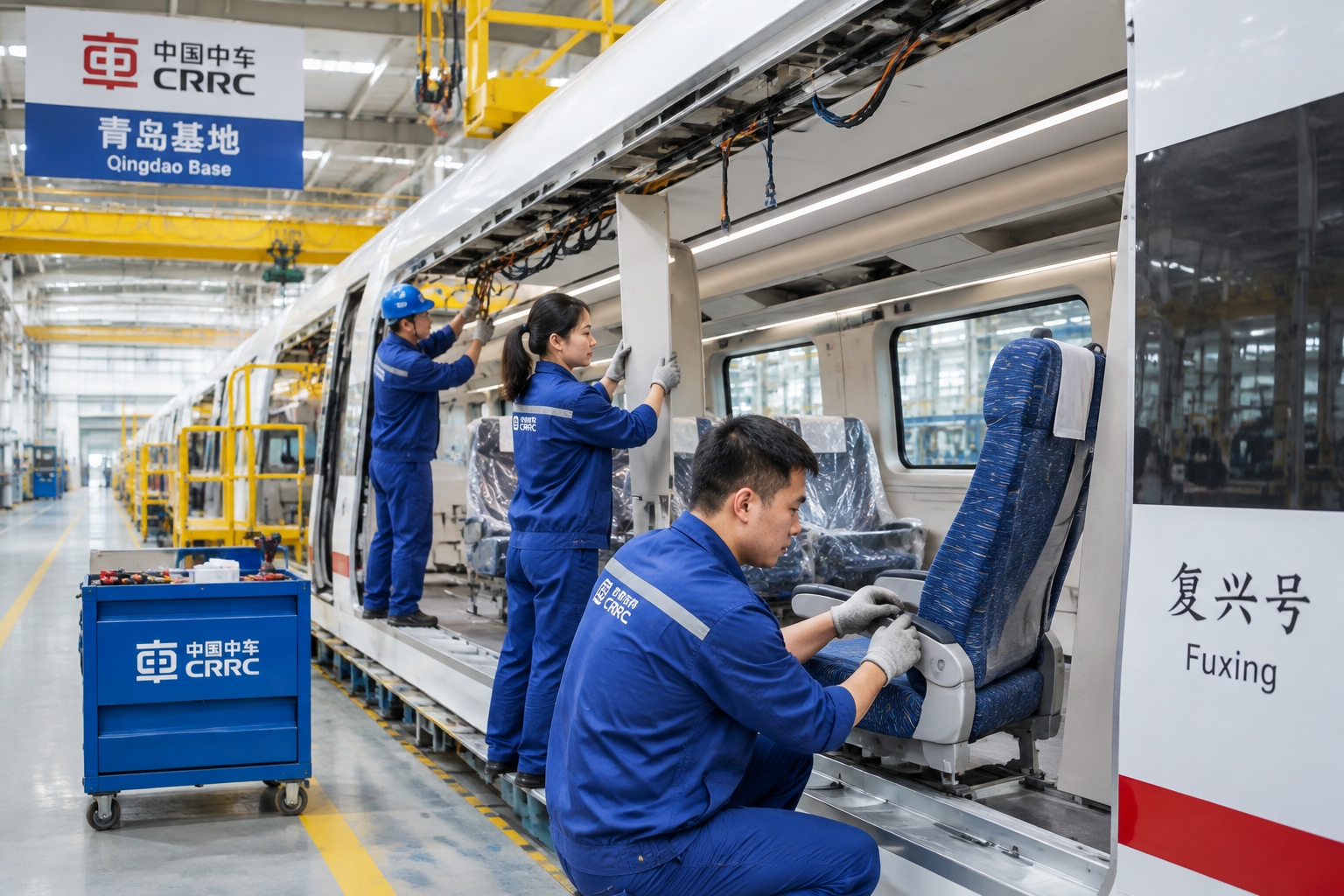
Under the floor, the traction system converts electricity from the overhead wire into motion. Fuxing uses domestically developed converters and motors, a break from the imported systems of the Hexie era.
Above the passengers’ heads sits the train control and management system, developed in China, which acts as the train’s nervous system. It collects data from roughly 2,500 monitoring points across the trainset and reports faults back to the depot while the train is still moving, so maintenance crews can be waiting on the platform when it arrives. Design life is 30 years, up from 20 for earlier models.
Safety redundancy is the least visible feature. Braking is distributed across multiple systems, and the aluminium-alloy body and streamlined nose cut aerodynamic drag, which is why CRRC claims the Fuxing uses less energy per seat at 350 km/h than the previous generation did at 300 km/h.
Why It Is Called Fuxing
“Fuxing” means rejuvenation. The name was announced as the train entered service in 2017, following the “Hexie” — harmony — generation, and it deliberately echoes the phrase “the great rejuvenation of the Chinese nation.” The engineering and the politics cannot be separated here: the train is both transport infrastructure and a national symbol, and state media has treated it as both. For a traveller, what matters is that the standardisation programme behind the name produced everyday improvements in how often trains run and how reliably they arrive.
What It Changed for Ordinary Travel
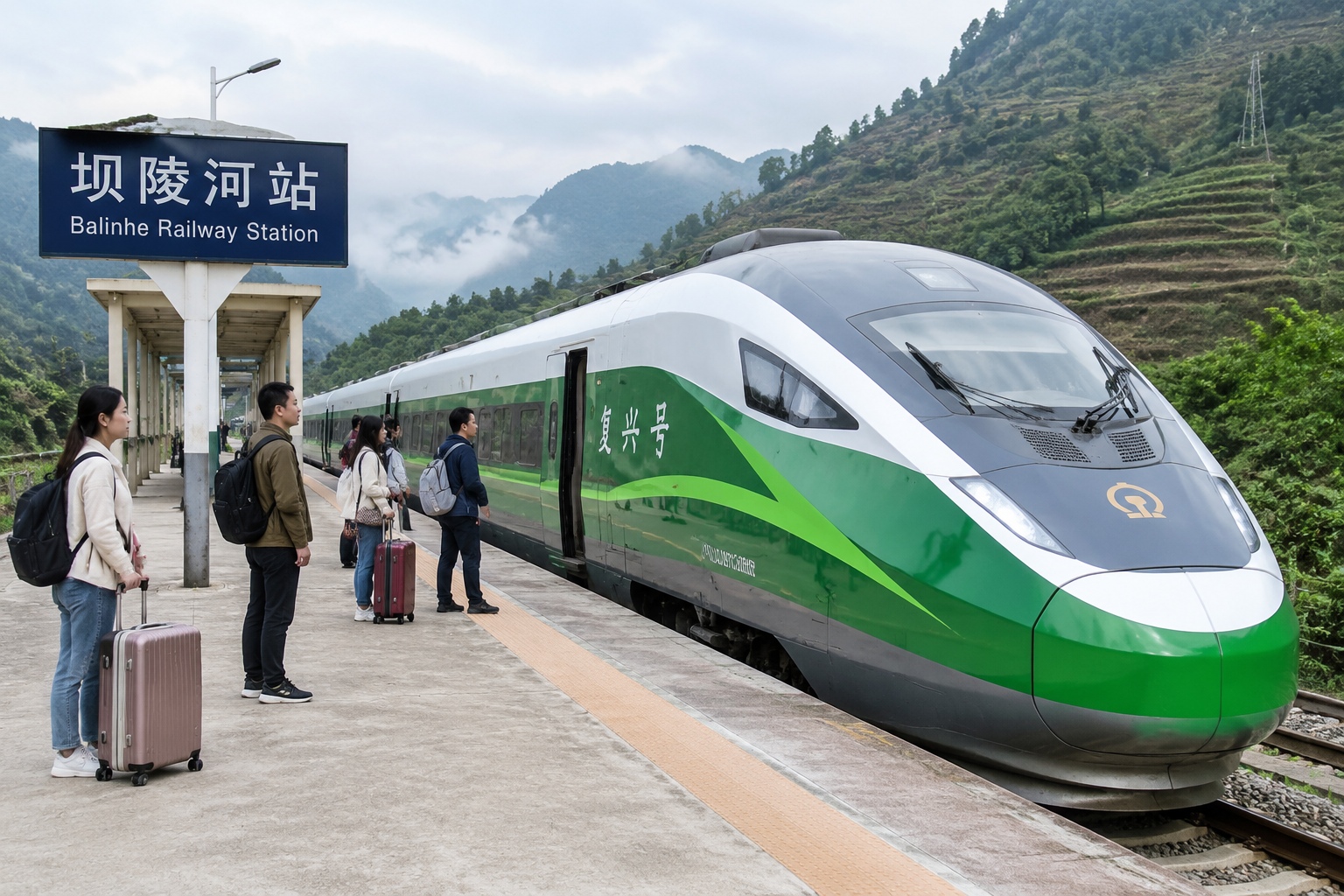
The most visible effect is frequency. On the Beijing–Shanghai corridor, Fuxing trains leave every few minutes at peak times, closer to a metro timetable than a traditional rail service. A trip that once meant an overnight sleeper is now a morning meeting and an afternoon back.
Scale shows up in the numbers. In 2024, China’s national rail network handled just over 4 billion passenger journeys, and single-day records during holiday periods now exceed 20 million trips. That volume only works because standardised trains are easier to maintain, rotate and repair.
For individuals, the change is smaller and more specific. A sales representative in Suzhou can take a 25-minute intercity train to Shanghai for a meeting. A student from a county in Guizhou can board a green CR200J and reach the provincial capital the same morning. Families who once met once a year after a 20-hour hard-seat journey now meet for a weekend.
What Still Frustrates People
Honesty matters here. Many Chinese high-speed stations sit well outside the city centre they serve, and the taxi or metro ride at either end can rival the train journey itself. Public holidays turn major stations into crush loads, with standing room only on some services. On-board Wi-Fi fails in tunnels, the food is famously forgettable, and popular trains sell out days ahead despite the frequency.
The next step is already visible. A prototype of the CR450, designed for 450 km/h and intended to operate at 400, was shown publicly in December 2024. If it enters service later this decade, it will shave time off the longest routes rather than change the experience of the average passenger.
On a midday train from Shanghai to Beijing, a woman who boarded with a coffee sleeps through Shandong, wakes near Tianjin, and reaches the city in time for a late lunch. A generation earlier, the same trip meant a berth and a night. That gap — between what travel used to cost in time and what it costs now — is what the Fuxing actually changed.
Start the discussion at forum.chinacomes.com