

Saturday Morning on the Third Floor of a Mall
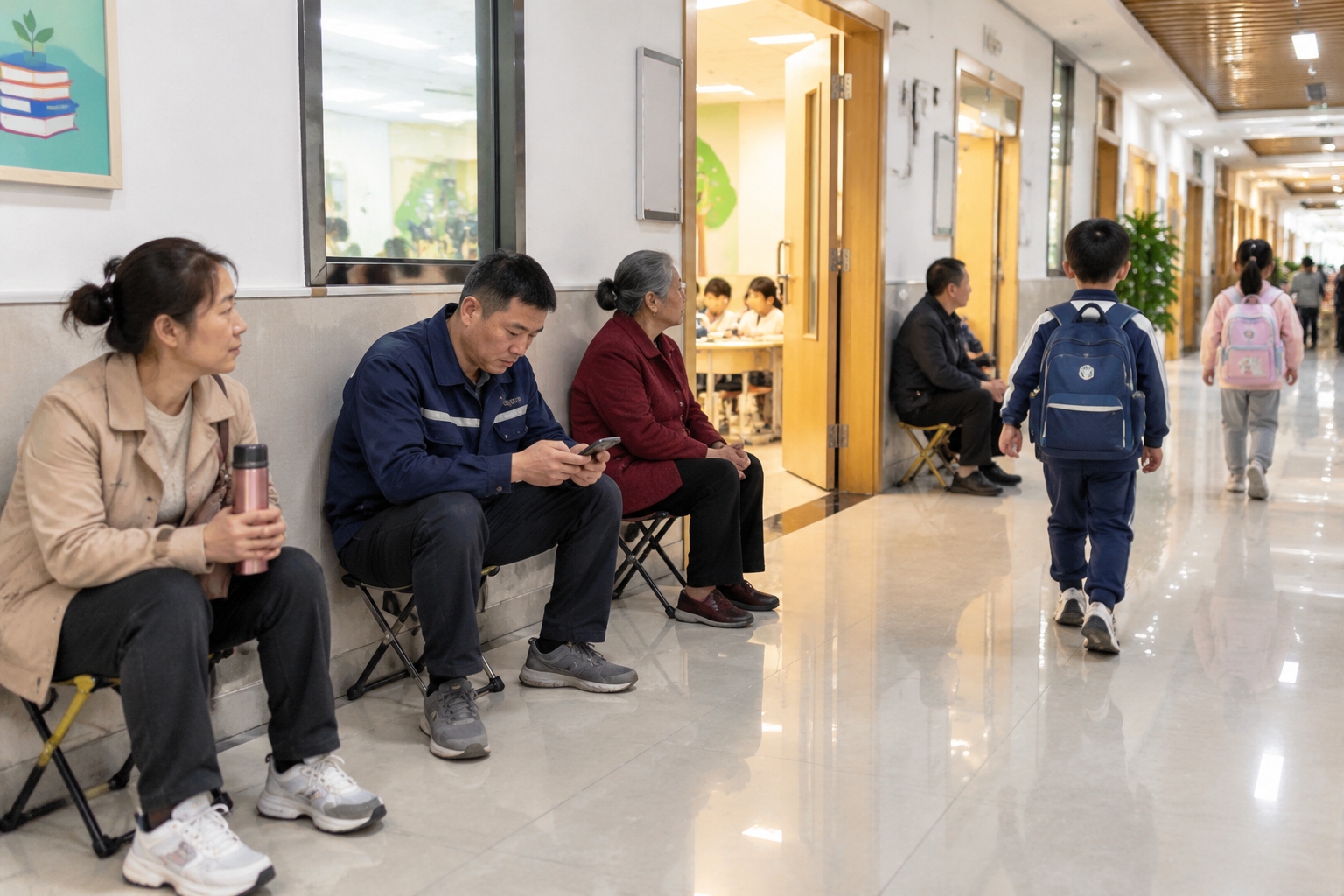
It is 8:40 on a Saturday in Hangzhou, and the third floor of a shopping mall is already busy. The clothing shops are dark behind their shutters. Light spills out of the units that don’t sell anything you can carry home: a maths classroom, a coding lab, a studio where twelve nine-year-olds are practising the guqin, and a small office with “study abroad planning” on the door.
In the corridor, parents wait on folding stools. A grandmother has brought a thermos of hot water and a bag of oranges. A father in a delivery jacket answers work messages. Two mothers who have clearly done this before have claimed the bench next to the power socket. Nobody talks much. At 11:30 the doors open, and the corridor fills with children dragging bags and arguing about lunch.
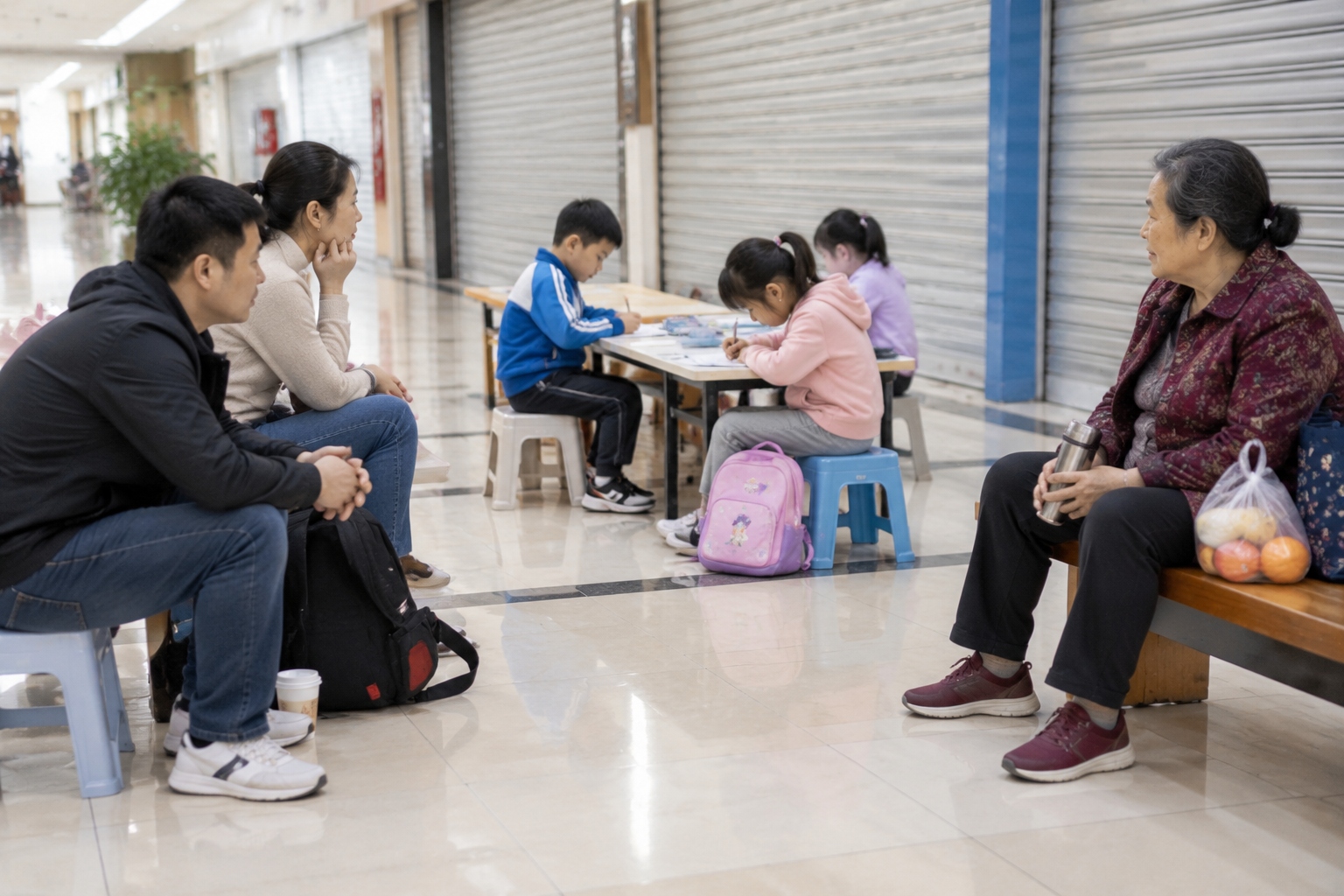
Here is the part that surprises foreign visitors: officially, none of this is supposed to be happening. In July 2021, Beijing introduced the “double reduction” policy, which banned for-profit tutoring companies from teaching core academic subjects to compulsory-education students on weekends, public holidays and school vacations. An industry worth an estimated 800 billion yuan a year lost most of its market value within weeks.
Four years on, the demand has not gone away. It has gone quiet. Some classes moved online, some were rebranded as “consulting” or “study tours”, and some moved into rented apartments where you need a referral from another parent to get in. The corridor on the third floor is thinner than it was in 2019, but it is not empty — and what survives is more expensive, which is its own kind of problem.
Why One Exam Carries So Much Weight
To understand the pressure, you have to understand the gaokao. It is China’s national university entrance exam: one set of papers, taken in June, scored in numbers, used to allocate places at roughly 3,000 universities. It has existed in some form since 1952, was abolished during the Cultural Revolution, and was restored in 1977 — a year many Chinese families still describe as the moment ordinary people got a route back into the middle class.
Admission is almost entirely by score. There are no essays, no interviews, no legacy preference, no athletic recruitment in the American sense. You can be the son of a billionaire or the daughter of a vegetable seller in Gansu; the paper does not know. Chinese parents will tell you this is exactly what makes the system fair. It is also what makes it unforgiving: there is nothing to negotiate with except points.
Where you land determines a great deal — which cities you can plausibly work in, which graduate programmes will look at you, and, in the eyes of many families, what kind of life you can expect. Employers screen by university tier, and the labels “985” and “211”, referring to two lists of elite institutions, still appear in job advertisements.
The Squeeze Has Moved Up the Ladder
It was not always like this. In 1998, fewer than one in ten young Chinese went to university. In 1999 the government expanded enrolment sharply, and today gross enrolment in higher education is around 60%. That was one of the most consequential education policies of the modern era, and it also changed what a degree is worth.
A bachelor’s degree is now the baseline, not the prize. Around 12 million students graduate from Chinese universities every year — more than the entire population of Belgium — into a job market where youth unemployment has been running at double-digit rates. So the competition simply moved: from “will you get into university” to “which university”, then to a master’s degree, then to the first job, then to the second.
Housing adds another layer. In most Chinese cities, children are assigned to public primary and middle schools by home address. The result is the xuequfang, the “school district flat”: a small, often barely livable apartment near a good school that sells at a large premium. In 2016, an 11.4-square-metre room in central Beijing, close to a well-regarded primary school, was widely reported to have sold for 5.3 million yuan — roughly $770,000 at the time. The family was not buying a room. It was buying a place in the queue.
What Parents Are Actually Afraid Of
Foreign readers often file Chinese parenting under culture: Confucian discipline, tiger mothers, a society that worships exams. That reading misses the machinery underneath.
Most parents of school-age children in Chinese cities were born between 1975 and 1985. They grew up with far less than their children have, and many of them watched the state-owned enterprise layoffs of the late 1990s, when tens of millions of urban workers lost jobs that had been described as iron rice bowls. The lesson they took away was not “study hard”. It was “no institution will catch you if you fall”.
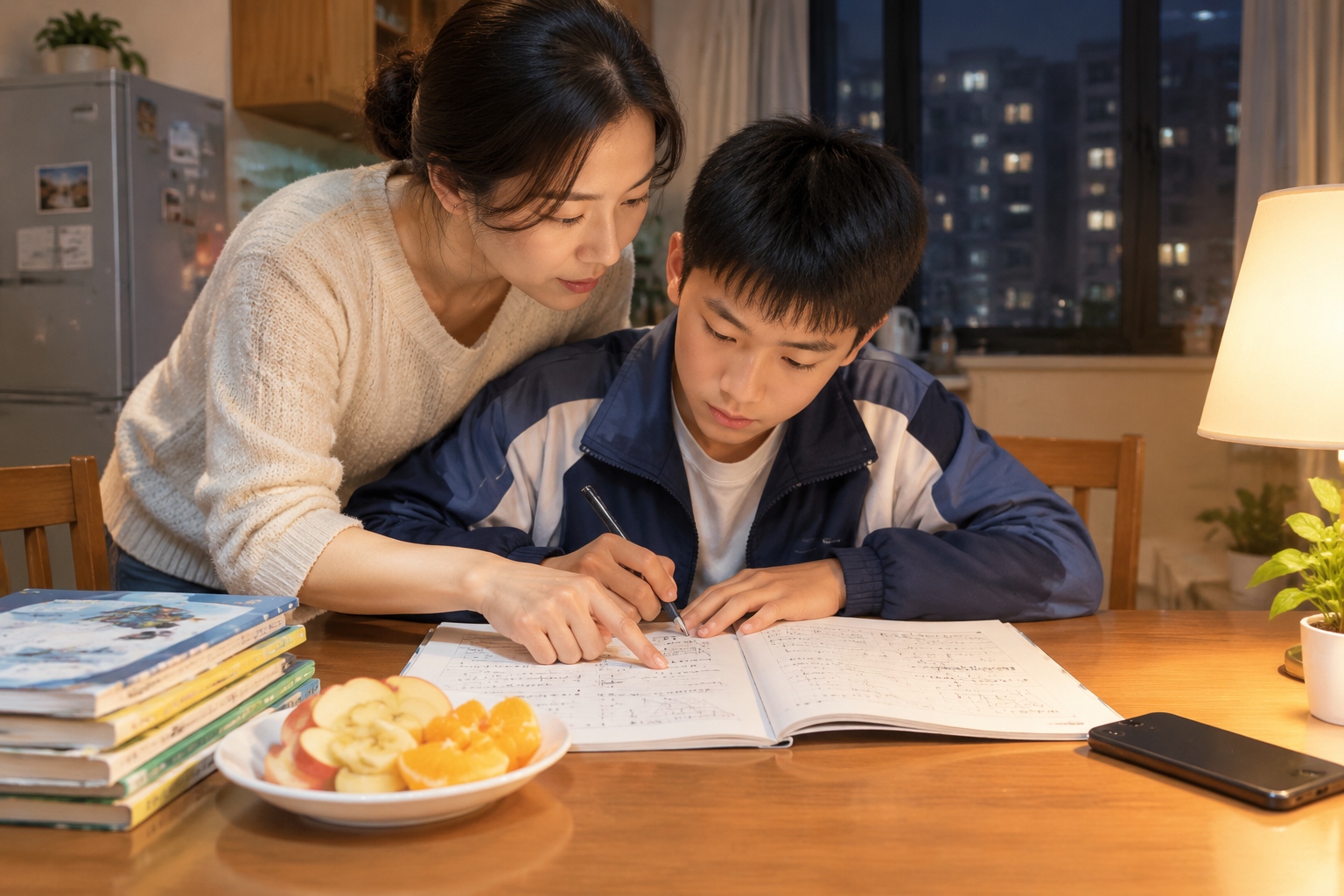
Add the one-child generation. A child in a Chinese city may have two parents and four grandparents whose savings, hopes and retirement plans all converge on one person. Then add a simpler psychological fact: of all the things a family might try to control — the property market, hiring, the direction of the economy — homework is the one they can supervise at the kitchen table at ten o’clock at night.
This is where the term jiwa comes from. Literally “chicken baby”, it means pushing a child the way livestock are fattened for market. It entered common use around 2018, and it is almost always said with irony — usually by the parents doing it.
The View From the Desk
Ask teenagers about this and you rarely get pure resentment. You get something more negotiated.
The typical answer sounds like this: “I understand why they do it. The world they describe is real. I just wish they would let me be tired.” This is a sentiment that shows up over and over in Chinese interviews and school counselling rooms — a belief that the parents are not wrong about the competition, only about how much of it a fifteen-year-old is supposed to absorb alone.
Children here are not passive. They bargain: grades in exchange for a phone, a summer without classes in exchange for a class ranking. Chinese social media handed them a vocabulary for it — neijuan (“involution”, endless competition that produces no gain for anyone), tangping (“lying flat”), and more recently bailan (“let it rot”). All three mean roughly the same thing: the ladder is moving faster than I am.
The strain is real, and the state has noticed. In 2023, seventeen government departments jointly issued an action plan on student mental health, and schools now run screening and employ counsellors. Surveys of Chinese adolescents have repeatedly found high rates of anxiety and depressive symptoms — though similar surveys in the United States and South Korea find similar things, and self-reported mental health data is notoriously slippery everywhere.
The Counter-Current: “Happy Education” and Its Limits
There is a quieter trend running the other way. Some urban parents — usually the ones with money, connections or a second passport — are opting out. “Happy education” (kuaile jiaoyu) has become a real phrase in Chinese parenting talk, alongside “Buddhist parenting”, which means deliberately choosing not to compete.
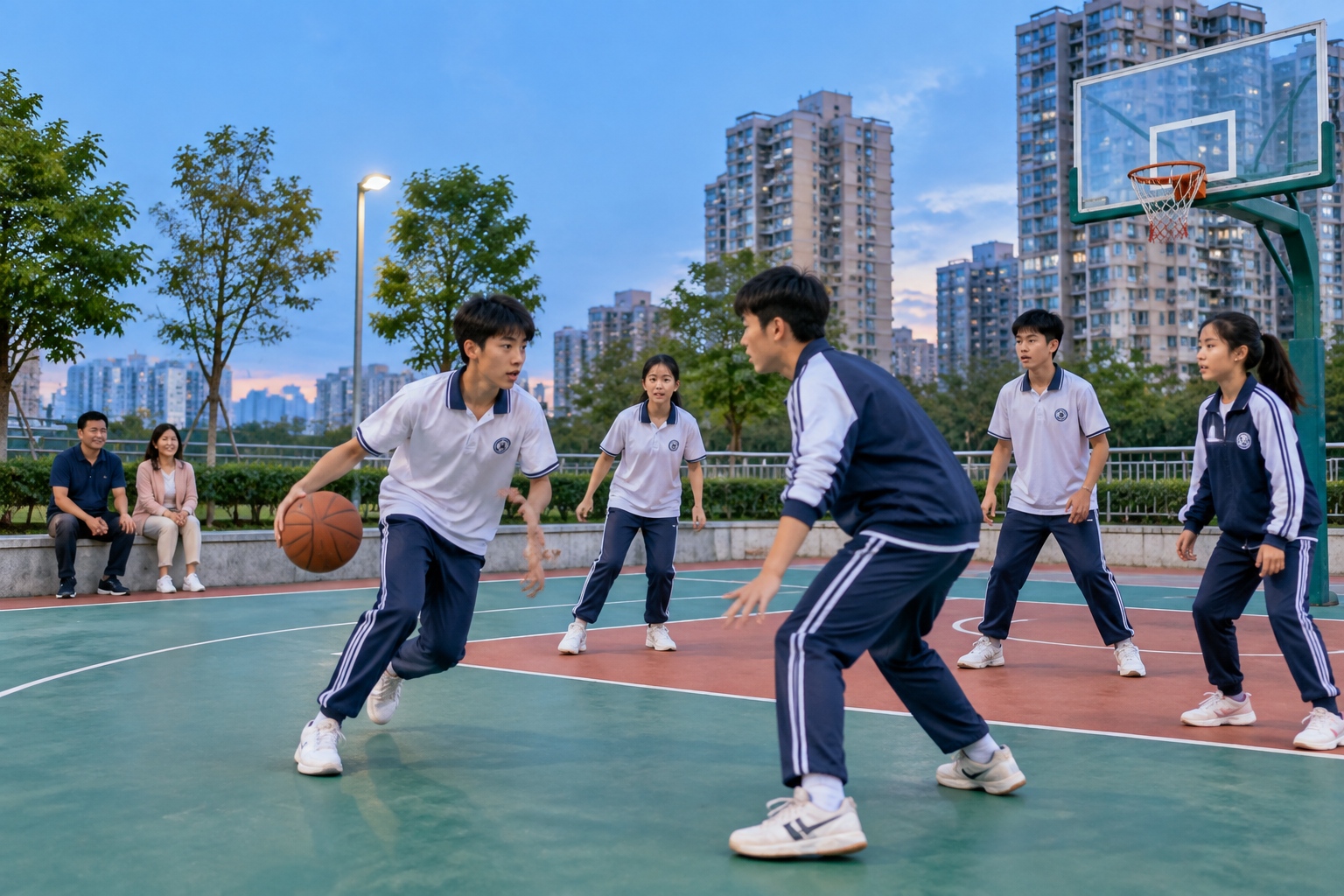
Concretely, this looks like families leaving Beijing and Shanghai for Chengdu, Dali or a smaller city with a slower rhythm; children enrolled in international or small progressive schools; weekends spent climbing instead of drilling. Public schools have changed too. The “5+2” policy keeps children at school for two extra hours, five days a week, so homework is finished with a teacher rather than at a paid centre — one reason the mall corridors are thinner than they were.
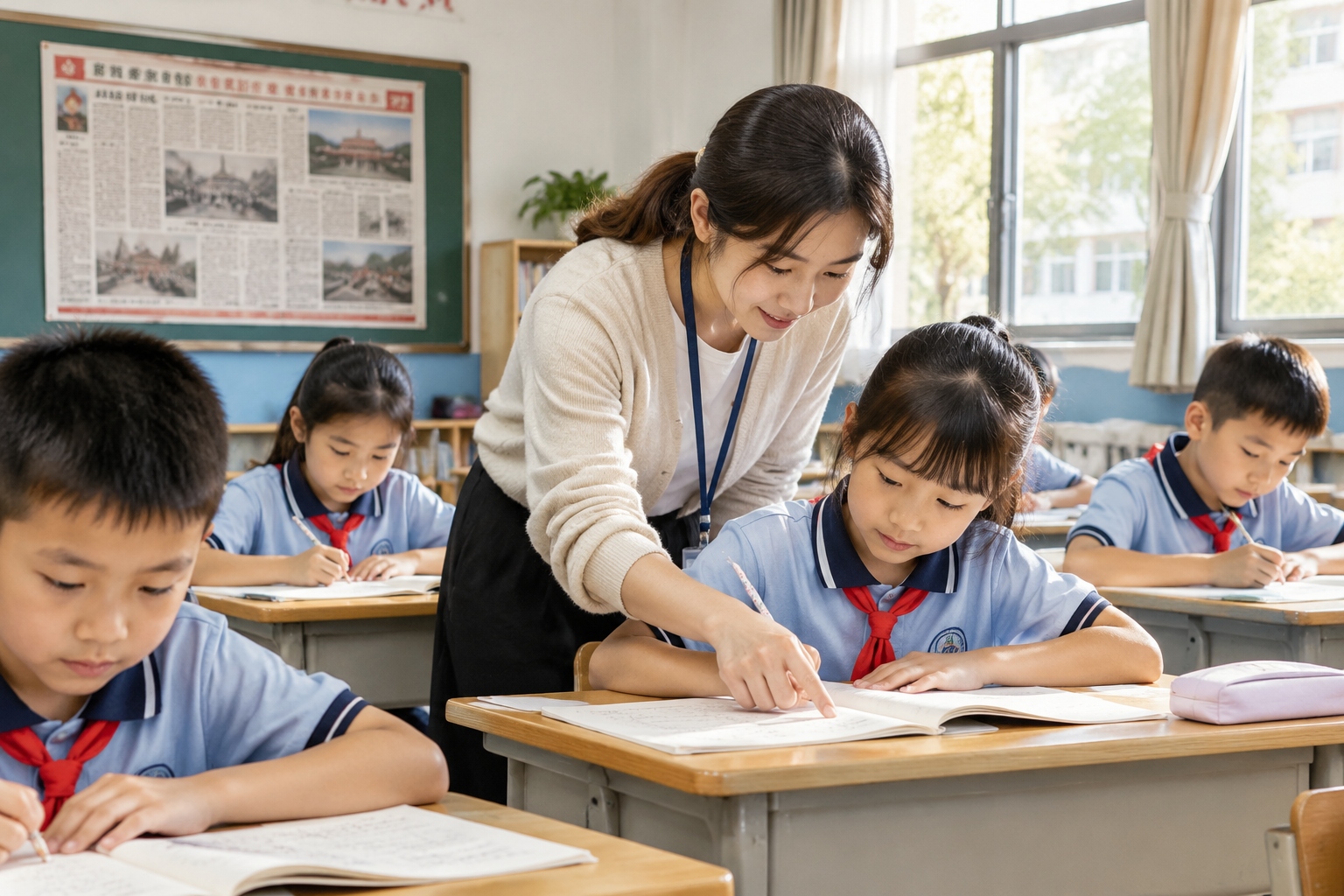
But opting out is expensive, and it is only reversible at a price. The gaokao still exists. A child who spends six years in a relaxed school and then wants back into the race usually cannot get back in. The double reduction also had an unintended effect: when mass-market tutoring was shut down, families with money simply bought private tutoring, one teacher to one child, at two or three times the old price. The competition did not disappear. It moved somewhere harder for a working-class family to reach.
It also helps to remember who is not in this story at all. Education anxiety, as foreigners usually encounter it, is a middle-class urban phenomenon. For the tens of millions of children whose parents have migrated from the countryside to work in cities, the problem is not too much pressure but too little access: because of the household registration system, many cannot sit the gaokao where they live and must return to a home province they barely know. In some rural counties, the bigger worry is that a child drops out at fifteen.
So Why Do They Push So Hard?
Because in a system where scores are the one thing that cannot be bought, and where a degree is the main insurance policy against falling, pushing is a rational response to a real set of incentives. Chinese parents are not labouring under a misunderstanding. They are reading the labour market, the housing market and the welfare system correctly — and adjusting to what they see.
If you are a parent in London or Ohio, the feeling will be familiar. What differs is the scale and the cost of exiting. In the United States, a weak school district can be worked around with a move, a scholarship or a community college route. In China, a single exam and the hukou system make the exit narrower, and it closes later.
The interesting question, then, is not “why are Chinese parents like this”. It is “what would have to change for them to relax”. The honest answer has very little to do with classrooms. It depends on whether a decent job can be had without an elite degree, whether a family can settle in the city where it works, and whether a forty-year-old who loses a job has anything to fall back on. Parents will stop pushing when pushing stops paying.
Start the discussion at forum.chinacomes.com