

When Your Office Window Is the Gobi Desert
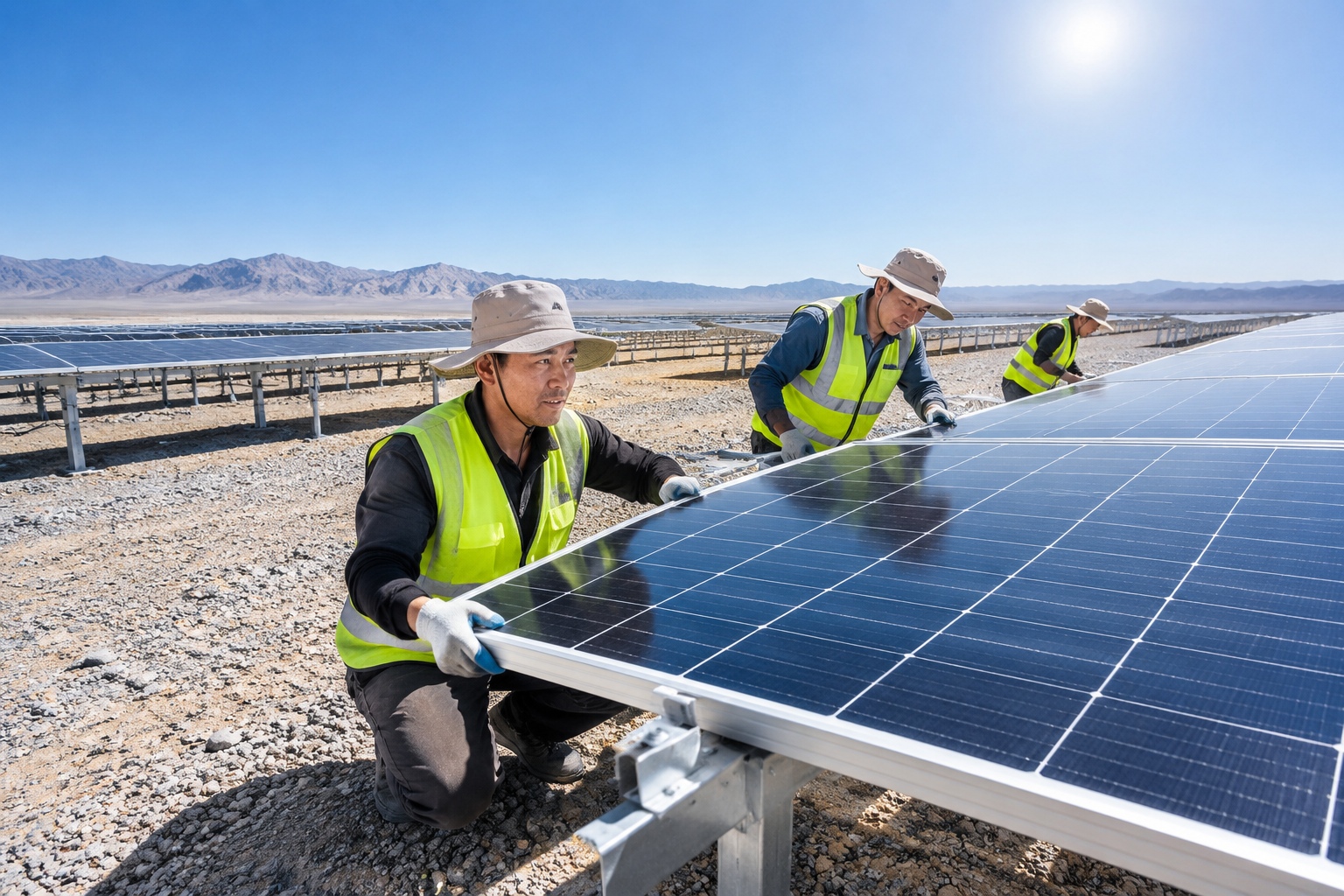
If you’ve ever sat at a desk and wished the sky were your ceiling, the solar panel installers of Xinjiang, in northwest China, might seem like they have the dream job. They work outdoors all day, earning a paycheck under open blue skies. But here’s the catch: that blue sky is basically a giant heat lamp, and the ground beneath their feet is gravel-studded desert.
I visited a construction site about 40 kilometers outside Hami, a city in eastern Xinjiang, last July. The temperature was 41°C in the shade — if you could find shade, which you couldn’t. Workers shuffled along rows of solar panels wearing long sleeves, neck flaps, and hats that made them look like a hybrid of a beekeeper and a traffic officer. One guy caught me squinting and shouted, “Welcome to the free sauna!”
Who Takes a Job Nobody Envies?
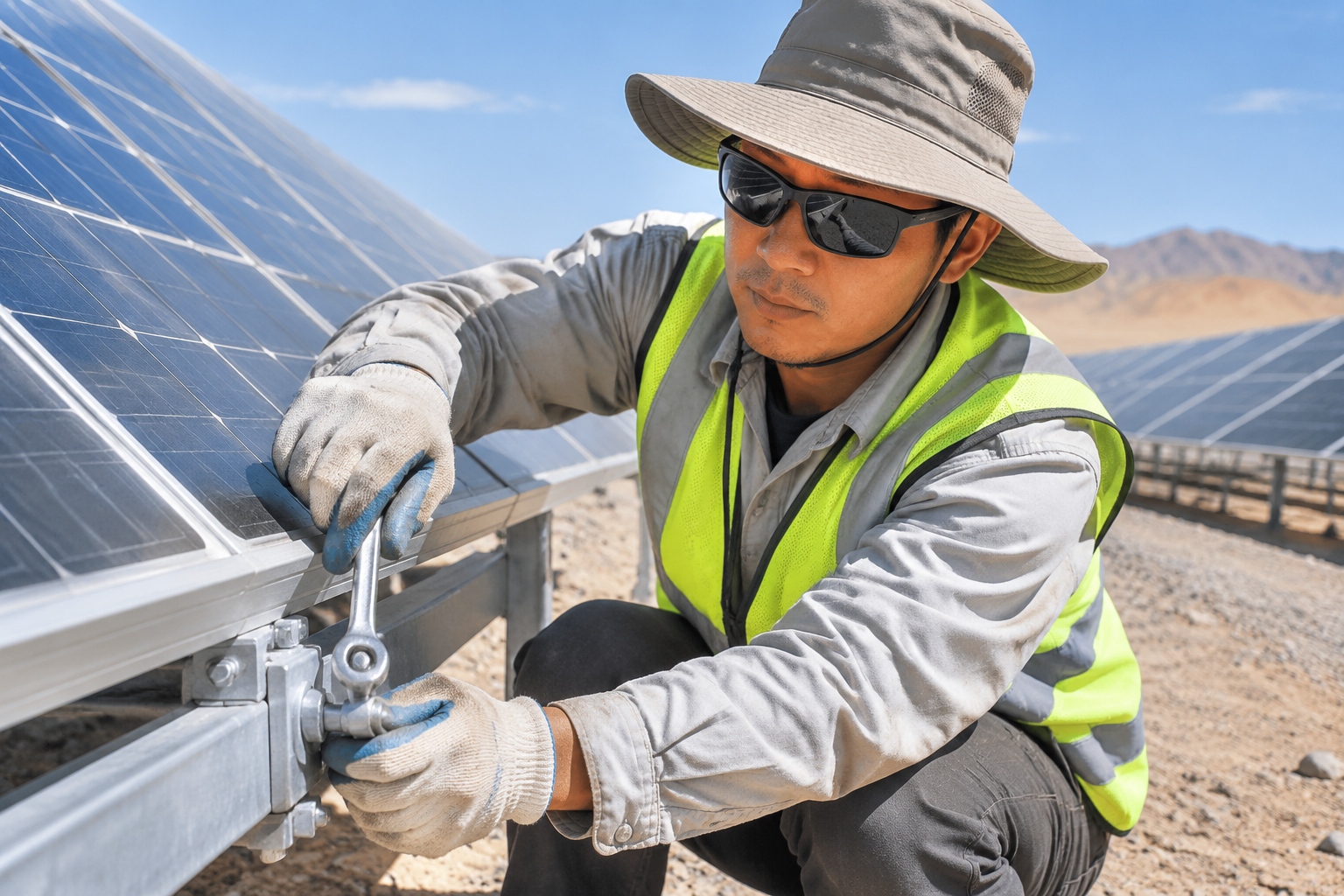
Most crew members are migrant workers from inland provinces like Sichuan, Henan, and Gansu. They came because the pay is better than ordinary construction work — a skilled installer can earn 350 to 500 yuan per day, about $50 to $70, plus overtime. For young men from rural villages, that’s a serious income. One foreman told me, “In a month, a hardworking installer can make about as much as a bank clerk in the nearest town. And the bank clerk doesn’t have to stand in the sun, but he also doesn’t get to sleep right next to a $20 billion power plant.”
The money, though, doesn’t soften the heat. At noon, the surface of a solar panel can hit 70°C. Workers carry thick gloves because the metal frames burn bare skin instantly. They also carry something I didn’t expect: large bottles of SPF 50+ sunscreen.
Surviving the Free Sauna
I assumed veteran construction workers would mock sunscreen as a luxury. Instead, a young man from Liangshan, in Sichuan, gave me a serious look. “Sunburn hurts worse than a hammer on your thumb,” he said. “And you can’t miss the back of your neck. First thing to peel, every single time.” He pulled a jumbo bottle from his bag. “We buy this in bulk. One bottle lasts about ten days.”
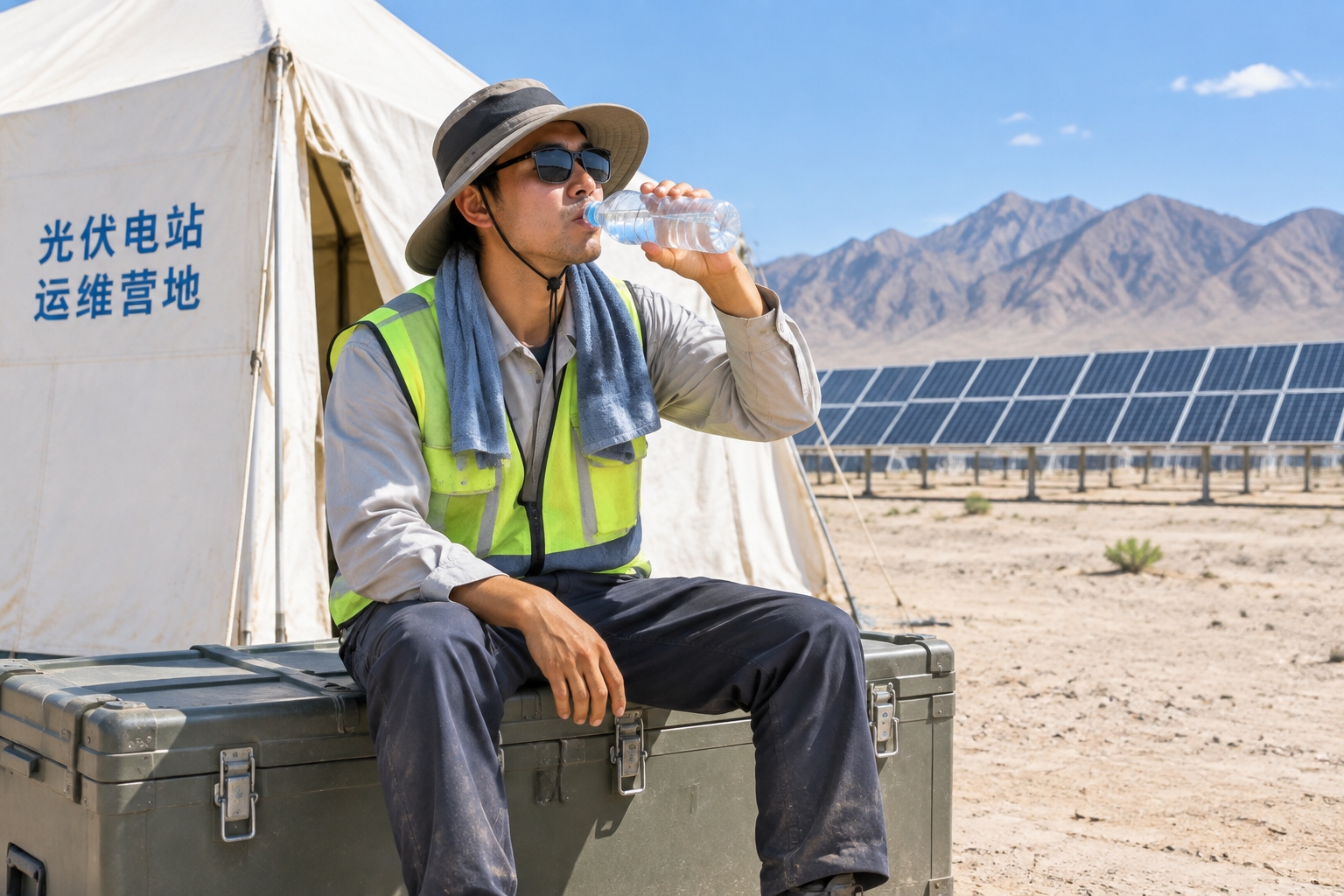
The only piece of gear more important than sunscreen is the wet towel. Every worker wears one around the neck. At first, I thought it was just a sweat rag. But the trick is to keep it soaked. When the afternoon wind blows across the desert, the wet towel turns into a personal air conditioner. “You re-wet it every twenty minutes,” a worker explained. “It’s the difference between remembering what cool feels like and forgetting forever.”
The crew follows a brutal daily schedule designed to beat the heat. They start at 6:30 a.m., before the sun gets serious. They take a long break from noon to 3 p.m., when the Gobi becomes a convection oven. During that break, they retreat to white tents with evaporative air coolers, gulp down saltwater, and attack watermelons with enthusiasm normally reserved for lottery wins. Then they’re back at it until sunset, when the air finally softens and the sky turns a shade of orange that looks like a filter.
The Gobi Is Empty, Until It Isn’t
It’s easy to describe the Gobi as lifeless — a flat, endless stretch of rock and sand. But the place has a strange, humbling beauty. The scale of the solar farm only adds to it. Row after row of panels extend to the horizon like a silver sea. A worker walked out with me and said, “We’re building a rectangle that’s bigger than a small country.” He wasn’t exaggerating: the China Power project in Hami is planned to generate 10 gigawatts — enough to power millions of homes.
The desert gives and takes. At dusk, the sky becomes a palette of pink and violet, and the panels reflect it so perfectly that you lose the line between earth and sky. But then a dust storm arrives — literally an orange wall that swallows everything in minutes. Workers use the word “elegant” when they talk about it, but that’s from a distance. Up close, it means sand inside your ears, inside your lunch, and in places you didn’t know could hold sand.
One worker showed me a video from last spring. A wall of dust rises, then hits the camp like a wave. Tents bend, hats fly, and everyone scrambles to grab loose tools. The storm lasted half an hour. “It’s like a free exfoliation,” he said, wiping a layer of grit from his arm. “But for your whole body.”
The Numbers Behind the Desert
If you’re wondering why anyone would go through this, you don’t have to look far. China is already the world’s largest solar power market by an enormous margin. In 2023, the country added more than 216 gigawatts of solar capacity — more than the entire United States had installed up to that point. And Xinjiang, with its 3,000-plus hours of annual sunshine and vast empty land, has become a key piece of that build-out.
The Hami site is one of dozens in western China designed for “clean energy bases” that send power east to cities like Shanghai and Guangdong via ultra-high-voltage transmission lines. These projects aren’t just about technology; they’re about geography. A square kilometer of Gobi that once hosted nothing but sand now holds enough panels to power a small city.
For the workers, though, the grid is abstract. What’s real is the rhythm of the day: the crunch of boots on gravel, the clink of steel bolts, the wind hissing across the panels. One installer summed it up simply: “We’re not building a power station. We’re building a place for sunlight to retire.”
Life After the Sun Goes Down
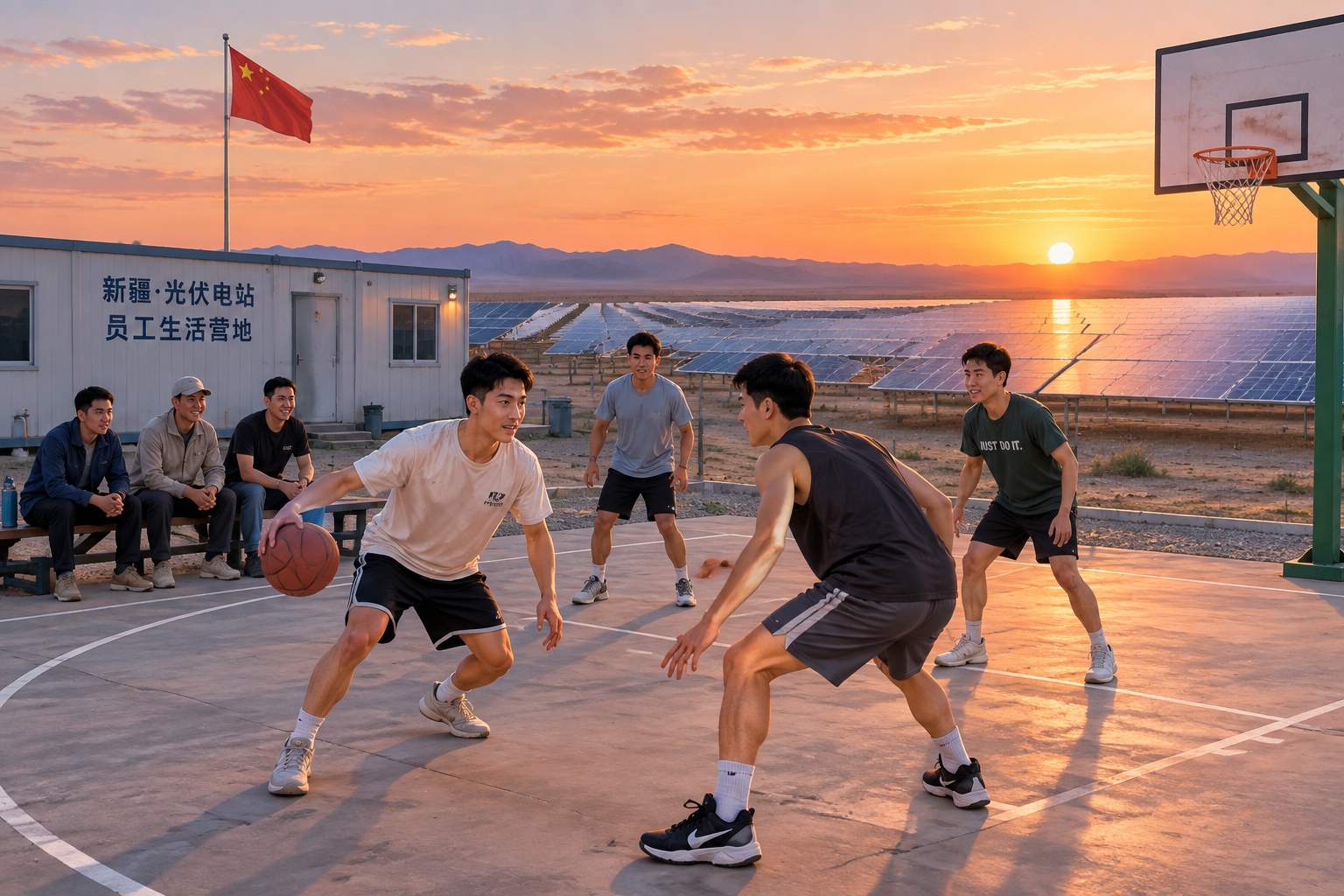
When the last shift ends, the camp comes alive in a low-key way. Workers live in prefabricated containers with air conditioning — a non-negotiable luxury in this climate. They cook together, eat in a shared mess hall, and play basketball or poker during the cooler hours.
A woman in her forties who runs the camp’s small shop likes the job because it’s hard to spend money. “No malls, no delivery apps, no bars. Just the desert and a good sleep.” She showed me a photo of her daughter and explained that the girl was taking a “solar farm field trip” at school. “She told her classmates her mom’s job is to make electricity from sunshine. They think it’s cool. I think they’re right.”
Most workers video-call their families every evening. The internet connection is surprisingly decent, a small miracle they don’t take for granted. A man from Gansu facetimed his son while I was there. The boy asked if the solar panels were like the ones on their roof. “Bigger,” the father laughed. “A million times bigger.”
More Than Sunbathing
So, yes, the workers are “getting paid to sunbathe” — if you ignore the aching muscles, the dry skin, the dust storms, and the 70°C panels. The phrase is a joke wearing a slightly tragic mask. It’s true that they spend all day in the sun. It’s also true that they’re building the infrastructure China believes will define the next five decades.
When I left the site, I bought a bottle of water from the shop woman. She handed it to me with an amused look. “You’ll need this,” she said. “You have office skin.”
She wasn’t wrong. I spent two hours in the Gobi and returned with a sunburn and a new respect for the people who don’t get to fly back to a city. The next time you hear about China’s solar boom, remember there’s a human layer between the glass panels. They wear sun hats, drink saltwater, and wet their towels every twenty minutes. And they’re doing just fine.
Start the discussion at forum.chinacomes.com