

A Mountain Morning
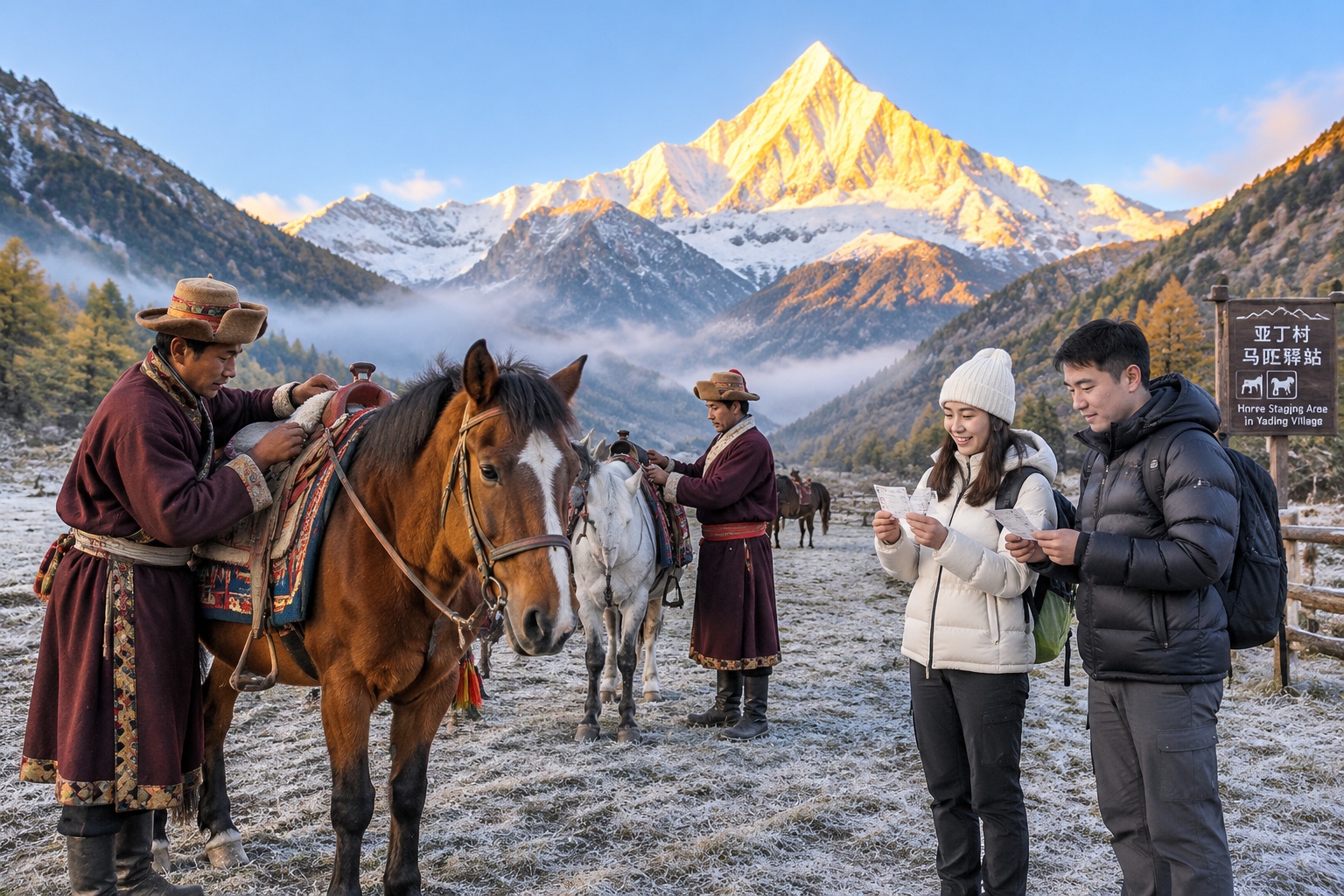
At 5:30 a.m., the air in Yading Village is so cold that it scratches the throat. The village, tucked at the bottom of a valley in Sichuan Province’s far west, is not yet awake, but the courtyard near the trailhead is alive with the sound of horses stepping on frozen mud. Tashi, a 43-year-old Tibetan herder, tightens the girth on his chestnut mare and strokes her neck, murmuring something the way people speak to old friends. Around him, a dozen other herders do the same, their breath forming small clouds in the half-light. A few tourists, newly arrived from the lowlands, try to stay warm in rented down jackets that make them look like colorful balloons. They check their phones, though there is barely any signal, and take nervous sips of hot tea from plastic cups.
The first sunlight hits the summit of Mount Xian Nai Ri, one of three sacred peaks in the Daocheng Yading National Nature Reserve. The glacier goes from icy white to molten gold in two minutes. Someone in the group says wow and lifts a camera. Tashi does not look up. He has seen this golden moment hundreds of times. What interests him more is the condition of the visitor who will ride his horse up to Milk Lake, because that determines how much weight his mare will carry and how much tip he might earn.
The Sacred Landscape and the Crowds
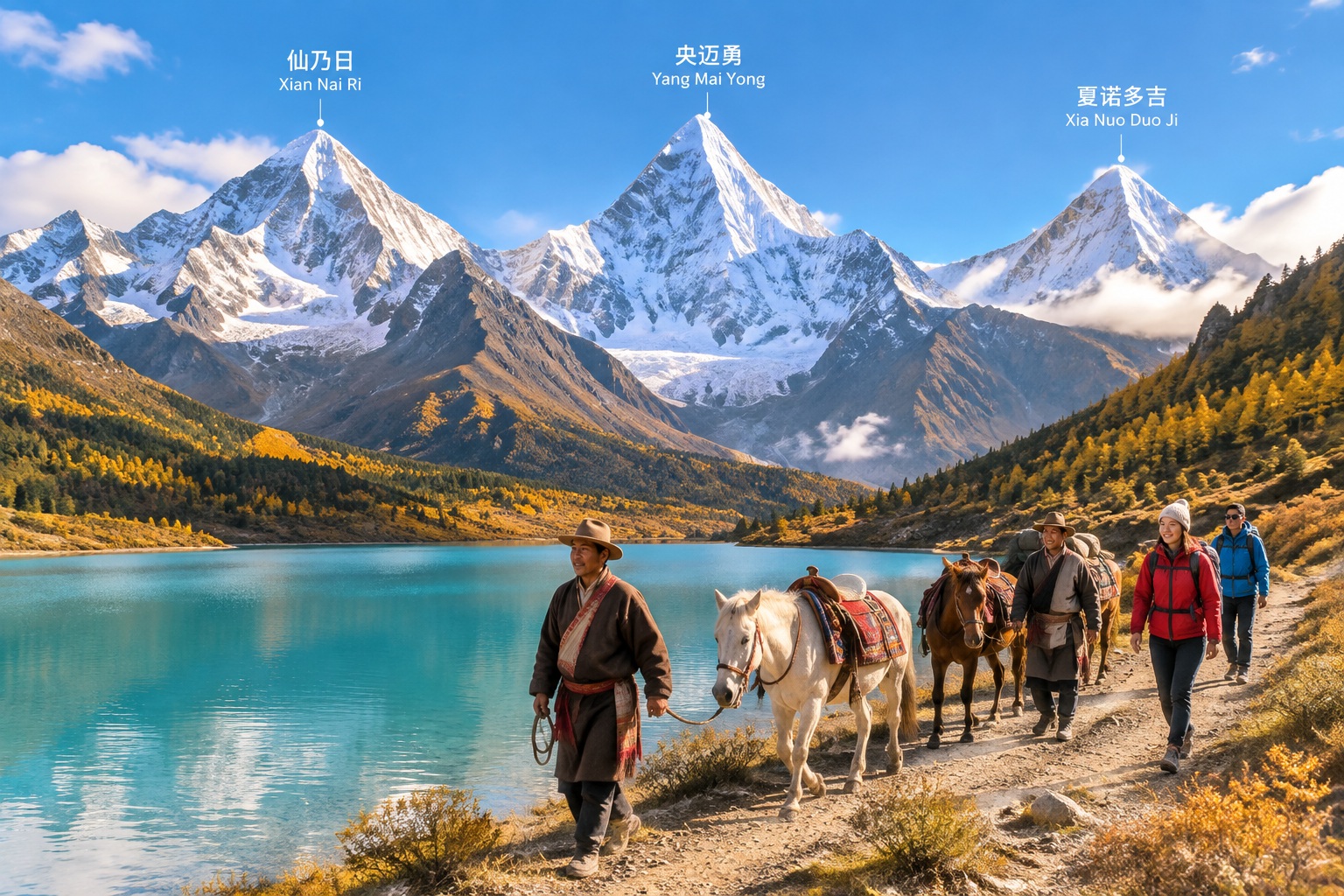
Daocheng Yading is a high-altitude nature reserve lying at the eastern edge of the Qinghai-Tibet Plateau. The area covers more than 1,300 square kilometers, but the part most people see is a narrow system of valleys and lakes beneath three snow-covered mountains: Chenresig (Xian Nai Ri), Jambeyang (Yang Mai Yong), and Choana (Xia Nuo Duo Ji). In the local Tibetan Buddhist tradition, these peaks are the manifestations of compassionate deities. Pilgrims once walked around them for days; today, tourists come by plane, bus, and 4×4.
The beauty is undeniable: turquoise lakes, yaks scattered over emerald grasslands, prayer flags snapping in the wind, and above all, the sheer verticality of the mountains. But that beauty is fragile. The reserve sits at altitudes between 4,000 and 4,500 meters, where the growing season is short and the plant cover is thin. A single careless footprint can destroy a patch of moss that took decades to form.
Tourism here did not exist in any meaningful form until the early 2000s, when a road was finally built through the mountains. By 2015, the reserve was receiving around 800,000 visits a year, a number many local officials thought was too high. The pandemic brought a pause, but the rebound after 2023 was strong. On any given day in October, the narrow trail to Milk Lake can be as crowded as a city sidewalk in Chengdu.
The core experience is a day trip: a shuttle bus from the entrance to the base of the valley, then a walk or horse ride to Milk Lake (NiuNai Hai) and the even higher Five Colored Lake (Wuse Hai). The hike from the drop-off point at Danpan is about 5 kilometers one-way, with an elevation gain of roughly 400 meters. For people who live at sea level, this is a brutal exercise. Altitude sickness, fatigue, and dehydration are common. Many give up halfway and hope to find a horse going back down.
From Herding to Hospitality: How Tourism Changed Local Livelihoods
For generations, the people of Yading Village and the surrounding hamlets were nomadic or semi-nomadic herders, moving their yaks and sheep between seasonal pastures. They traded wool, skins, and dairy products for barley, salt, and tea. Life was hard, and income was uncertain. Then tourism arrived with its own kind of currency.
Tashi remembers the first time a stranger offered him money to ride his horse up the mountain. “I thought he was joking,” he says. “In our culture, horses are for work, not for fun.” But the joke soon became a livelihood. Today, the horses in Yading are not just for plowing or herding; they are part of a well-organized ride system. The co-operative manages a quota of horses, each with a registered number, and families take turns sending their horse to the line-up. Riders pay around 300 yuan for the ascent to Milk Lake, and about the same for the return or the descent. The herder keeps a set price but can also earn tips from satisfied customers.
In the early days, the horses were often overworked. A single animal might make two round trips a day in peak season. Tourists complained that the animals looked thin and had sores. The local government cracked down: a maximum of one round-trip per day, a weight limit of 200 kilograms (including saddle equipment), and a mandatory rest day after every two days of work. The rules are not always perfectly followed, but they have made a noticeable difference. The herders now know that an exhausted horse is also bad for business.
Dawa, 29, represents the younger generation. He used to herd yaks with his father, but at 18 he left for a cashier job in the county town. When tourism began to boom, he came back. He now works as a hiking guide, leading small groups of six to eight visitors on the three-day kora (circumambulation) around the sacred peaks. “It is easier than following yaks all day,” he says, laughing. “But the guests ask many questions. Some ask me if I wear my traditional clothes all the time, or if I live in a tent. I explain that I also like pizza, and that I have a smartphone just like them.”
His family has turned part of their stone house into a simple guesthouse. There are four rooms, each with a bed, an electric blanket, and a plastic bucket for washing. The floor is made of old planks that creak underfoot, but the rooms are clean and warm. In the strict sense, this is not a luxury experience. But for many visitors, it is the most memorable night of their trip—sitting in the smoky kitchen while Dawa’s mother stirs a pot of yak meat, listening to the wind howl outside, sharing stories with people they just met.
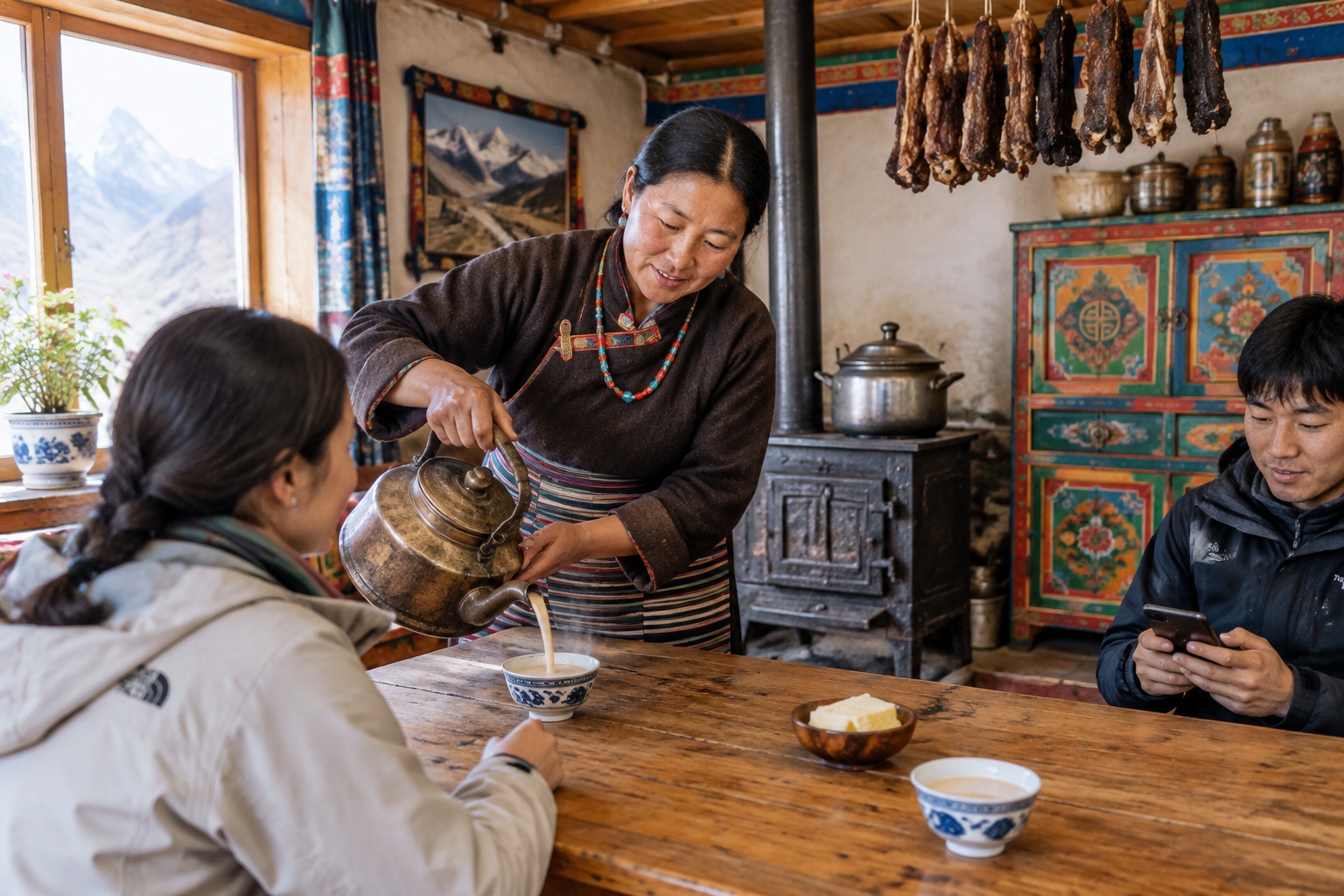
Not everyone has left herding completely. Tashi still owns nine yaks, which he calls his “pension fund.” His wife takes care of them while he works with the horses. The yaks provide milk, butter, and meat for the family, and occasionally money when he sells one. “Tourism is good, but if we depend on it too much, we lose our roots,” he says.
The Hidden Costs and the Push for Balance
More visitors mean more wear and tear on the land. The alpine meadows that once grazed only yaks are now trodden by hundreds of boots every day. The ground compacts, and the native vegetation struggles to come back. Erosion has become visible in a few spots, particularly where shortcuts have been worn into switchbacks.
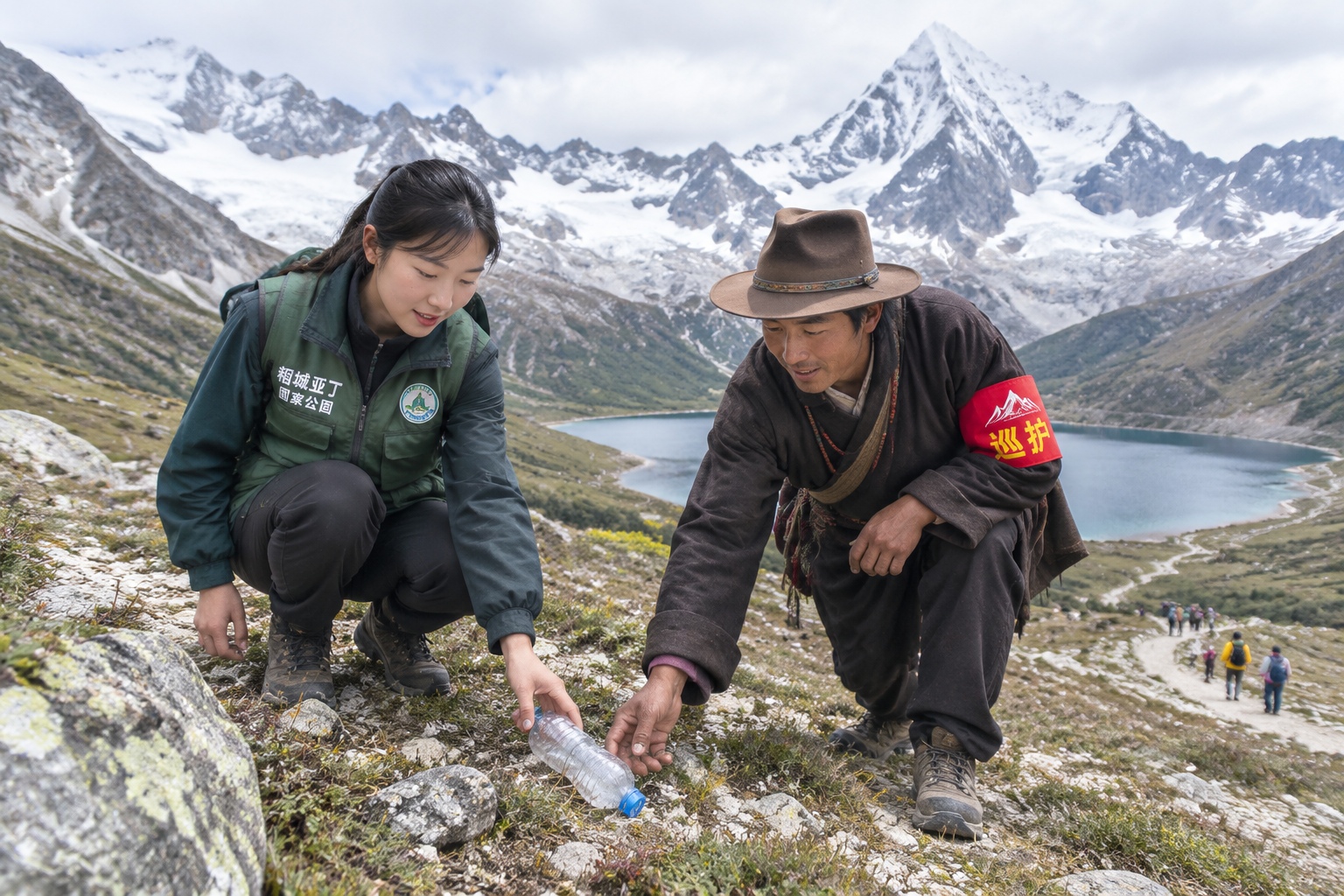
Litter has been a recurring problem. In 2017, volunteers collected more than a ton of trash, mostly plastic bottles and food wrappers, from the trail corridor. The reserve management responded by placing portable restrooms, trash collection points, and a rule that every park employee must carry out what they bring in. Some herders have taken on the role of eco-guards, patrolling the trails and politely telling tourists not to leave anything behind. They are paid a government salary for this work, which they see as a dignified extension of their old role as stewards of the land.
Then there is the question of numbers. The reserve currently caps daily entry at 7,000 people, and tickets must be booked in advance online during holidays. On busy days, the quota is reached hours in advance. This system protects the trails and the atmosphere, but it also creates an artificial scarcity that drives the black market for tickets. Scalpers have been known to buy blocks of tickets and resell them at three times the official price. The authorities have tried to control this with real-name registration and QR-code entry, but the problem persists.
Conflict between tourists and herders is usually not dramatic, but it exists. Some visitors complain that the horse ride is too short, or that the herder walked so fast they felt unsafe. Others worry about the ethics of riding animals over long distances. A few tourists have posted videos of horses with visible ribcages, triggering online criticism. Herders, in turn, can be blunt. They have little patience for visitors who expect five-star service at 4,500 meters. “They want a mountain safari, but they don’t want mountain altitude,” one herder mutters.
Looking Ahead: Can Tourism and Herding Coexist?
Daocheng Yading is often described by Chinese media as a “model of ecotourism.” That label is a little generous. The truth is messier, more fragile, and still being worked out. But the model does offer clues about how such places can survive.
The first clue is economic diversification. The families who do best are usually the ones who combine several sources of income: horse riding, guesthouse, guide work, and perhaps a small shop or café. Dawa and his wife now sell yak yogurt and homemade cheese to tourists in the village. They started with a small cooler box on the street; today they rent a stall near the shuttle-bus stop. Their income in 2024 was double what he earned as a guide five years earlier.
The second clue is community involvement in protection. The herders who patrol the trails are not just hired laborers; they are respected locals who know the terrain and the weather. They carry official badges, but their real authority comes from the fact that they are spokespeople for the mountain itself. When they ask a tourist to pull a plastic bag out of her pocket, she listens.
Third, education works. Many of the younger herders have attended training programs on mountain safety, emergency response, and basic English. They now speak to tourists with a mix of humor and authority. They explain why horses need rest days, why wildflowers should not be picked, and why the rules exist. This turns a potential confrontation into a learning moment.
For the broader region, Yading is a template. Across the Western Sichuan Plateau, other scenic areas are watching carefully. Communities in Tibet, Qinghai, and Yunnan are sending delegations to learn from how Yading manages its visitor cap and herder cooperatives. The question is whether the model can be replicated without losing human touch.
On the morning I stood there, I watched Tashi lead a young woman from Shanghai up the first steep slope. She was breathing hard, holding onto the saddle horn with white knuckles. He talked to her in a mix of Mandarin and a few English phrases: “Slow, slow. Let the horse take care of you.” At the first viewpoint, she looked over the valley and seemed to forget her fear. She asked Tashi if he had ever been to Shanghai. “No,” he said, “but my daughter is studying there now.” The exchange was brief, but it captured the strange equality of the mountain: one person from a glittering metropolis, another from a high-altitude pasture, both sharing the same thin air.
The sun was fully up when they moved on. Behind them, the prayer flags snapped in the wind, and the snow on the peaks began to melt into streams that would eventually water tens of thousands of miles of farmland. For a moment, the trail belonged to them alone—a herder, a horse, and a visitor, all part of the same ancient rhythm.
Start the discussion at forum.chinacomes.com