

Sand Meets River
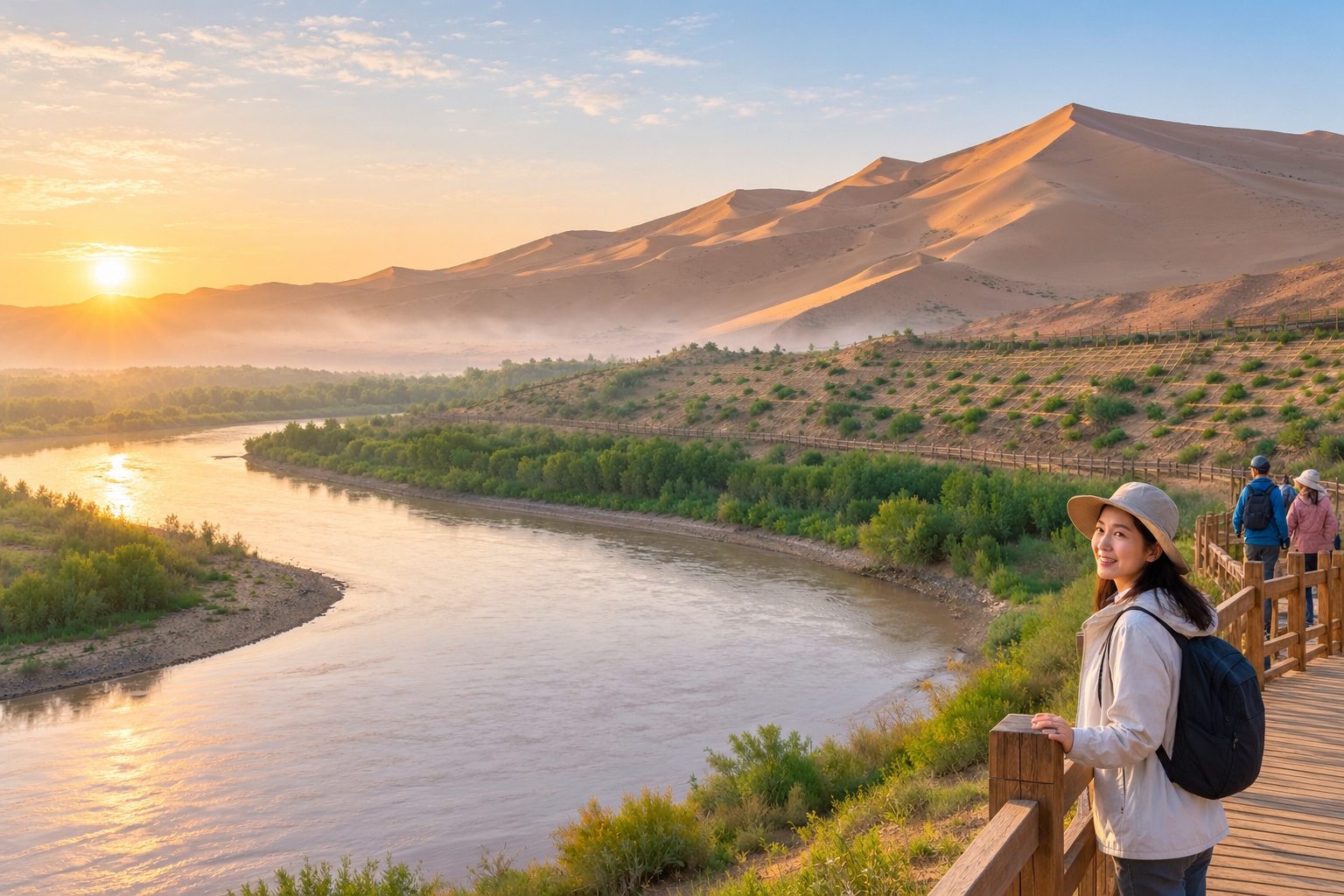
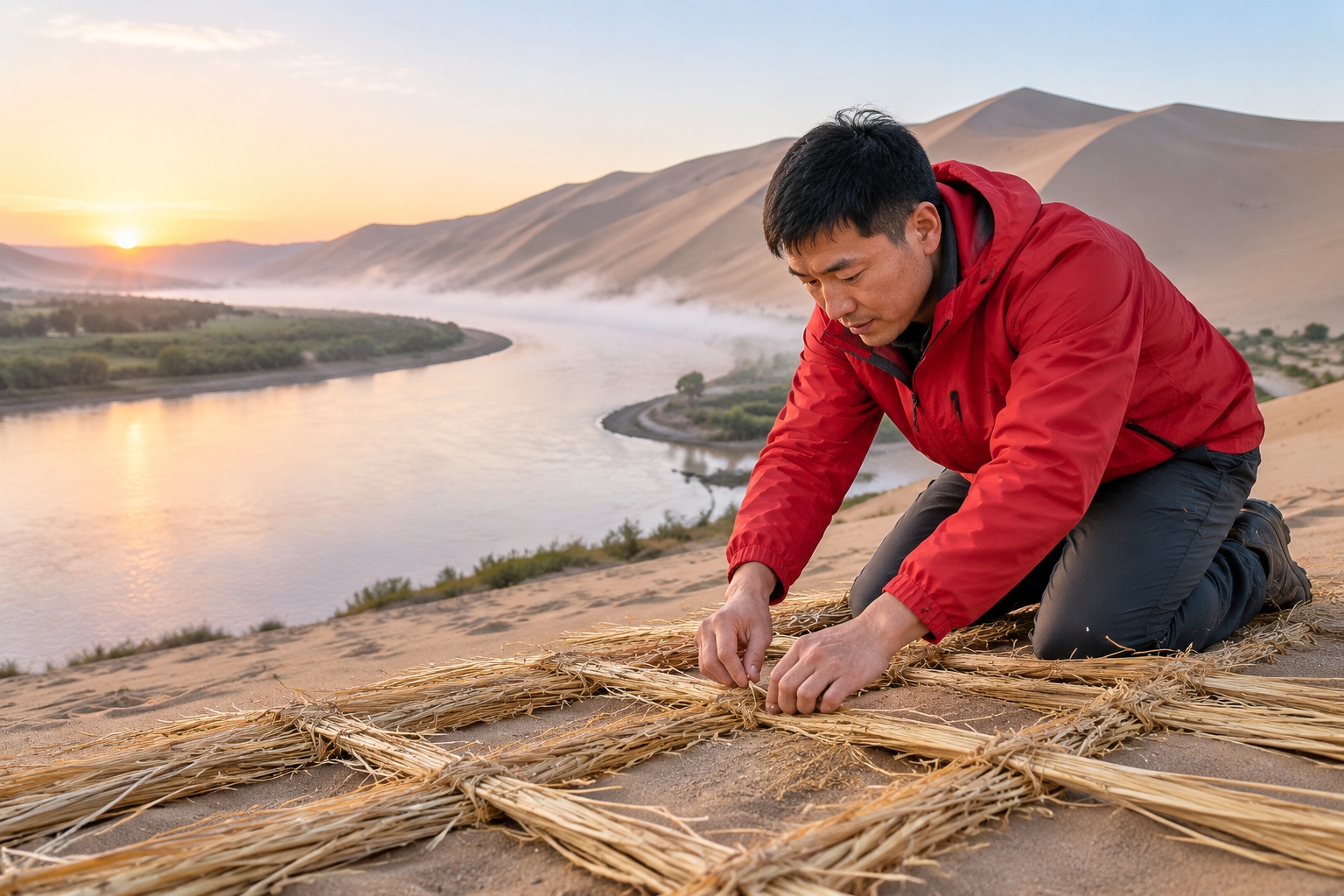
At 6 a.m., the wind is still low and the sand feels cold underfoot. I stand on a viewing platform above the Yellow River, which takes an unexpected bend here, its muddy water catching pale gold light. Behind me, the dunes of the Tengger Desert rise like a slow wall that seems to go on forever. A man in a red windbreaker, in his late sixties, is kneeling in the sand, poking dry wheat stalks into a square grid. He tells me his father pounded these very grids in the 1950s. “This wasn’t a tourist spot then,” he says. “It was just a problem we had to solve.”
For most international travelers, Shapotou is a name they won’t recognize. But in China, it’s something of a legend: a desert that was stopped, then turned into a scenic area that now pulls in more than a million visitors a year. Shapotou sits at the southeastern edge of the Tengger Desert, in Ningxia, about three hours from the provincial capital Yinchuan by high-speed train. Here, the desert’s tallest dunes reach over 100 meters, and the Yellow River curves around their base, forming a natural amphitheater of sand and water.
The Straw Grid That Held the Desert
In the 1950s, the state-run Baotou–Lanzhou railway was built right along the desert’s edge. Winds regularly buried the tracks, and keeping the line open became a nightmare. Engineers tried wooden fences, asphalt coatings, and even tree-planting campaigns, but nothing held the sand for long.
Then someone came up with a technique that looked almost comically simple. Workers would lay wheat straw onto the sand in a checkerboard pattern, with each square about one meter across. Using a spade, they pressed the straw halfway into the sand, leaving the other half standing upright, about one hand’s length. The grid—called the “straw checkboard”—slowed the winds and trapped the moving sand. Once the surface stabilized, they planted drought-resistant shrubs and grasses inside each square. Over the following decades, a green corridor grew along the rail line, and the method became a global reference for arid-land restoration, used in projects from Mauritania to Australia.

From Field Trip to Fest
The first visitors to Shapotou were scientists and engineers who came to inspect the greening. By the 1980s, the local government opened a park, and the public gradually discovered the place. Today, the scenic area feels like a theme park for desert adrenaline. You can ride a zip line across the Yellow River, swing from a bungee platform, or slide down a 70-meter sand slope on a plastic board at a steep 40-degree angle. The noise that the sand makes as you slide—a low, hissing roar—is something people remember for years.
For gentler thrills, there are camel caravans that follow the dune crests, and there are the famous sheepskin rafts: inflatable animal skins tied to wooden frames that have been used for centuries to float people and goods downriver. Nowadays, the rafts are fitted with GPS trackers, because tourists keep borrowing them for selfies and then losing them in the current.
The park has become an economic engine. On a busy summer weekend, the car park holds hundreds of tour buses and private cars. New hotels have been built among the dunes, including a “star bubble” lodge with transparent ceilings, so guests can sleep under the night sky without leaving their beds.

The Faces of the Dunes
Travelers often see only scenery, but Shapotou is also a home. I had breakfast at a noodle shop in the village just outside the scenic area. The owner, Zhang Yongxia, is in her forties. “My family used to farm the edge of the desert. We lost crops every year,” she said, placing a bowl of hand-pulled noodle soup in front of me. “Now I serve a thousand bowls on a busy day. My daughter works at the ticket counter. My son drives a shuttle bus.”
At the sliding slope, I met Ma Jun, a 24-year-old sand-sledding coach. He was carrying a bundle of plastic boards on his shoulder, his skin darkened by the sun. “When I was young, sand would come through the windows of our house,” he said. “I used to hate it. Now we sell it. But we also take care of it. It’s our home.”
The man in the red windbreaker turned out to be Li Weiguo, a retired technician from the local sand control station. He showed me how to insert straw into the sand with a metal shovel. “You’d be surprised how much work it takes to keep a desert in place,” he said. “When we stop, the sand moves again.” His father was one of the first workers to lay the straw grid in the 1950s; his son now manages a section of the green belt. “The trees are our pension,” Li said. “They give us income, water retention, shade, and a little peace.”

The Cost of Charm
Tourism has not been easy on this landscape. Water is scarce in the Ningxia Plain, yet the golf course attached to one of the desert hotels requires constant irrigation, and the manicured lawns at the scenic area entrance drink up groundwater. During China’s Golden Week holidays, the dunes can be as crowded as a beach in Shanghai, and visitors often complain about wait times.
The park has responded. Daily visitor numbers are capped, camel routes are rotated so the vegetation can recover, and treated wastewater is used for irrigation. Tour buses are required to park outside the ecologically sensitive zone, and visitors are directed along designated paths. Still, there is an unavoidable tension: this is a landscape built to control nature, and now it sells nature as a product.
Stars Over the Sand
At night, Shapotou changes again. The tour buses leave, and the souvenir stalls roll down their shutters. I walked out onto the dunes and found the air cool and dry. The sky was so dense with stars that it felt like a slow, silent explosion.
In the star-bubble rooms, guests lie in bed and watch the sky turn from peach to indigo to black. One guest, a young woman from Shanghai, told me she had expected the desert to feel hostile and empty. “But it feels alive,” she said. “You can hear the insects, and the wind in the grass, and sometimes the sound of a train passing on the old railway line.” She paused. “I didn’t know a desert could be so full of life.”

A Desert With a Job
Shapotou started as a problem. It became a proof that a piece of desert could be held back. Then it became a product. But the people I met here don’t see a contradiction. They see a place that feeds them and, if treated carefully, might keep feeding their grandchildren. The straw grids are still visible, underneath the tarps of the souvenir stalls, between the footprints of tourists. The desert was never truly defeated. It was just given a job.
Start the discussion at forum.chinacomes.com