
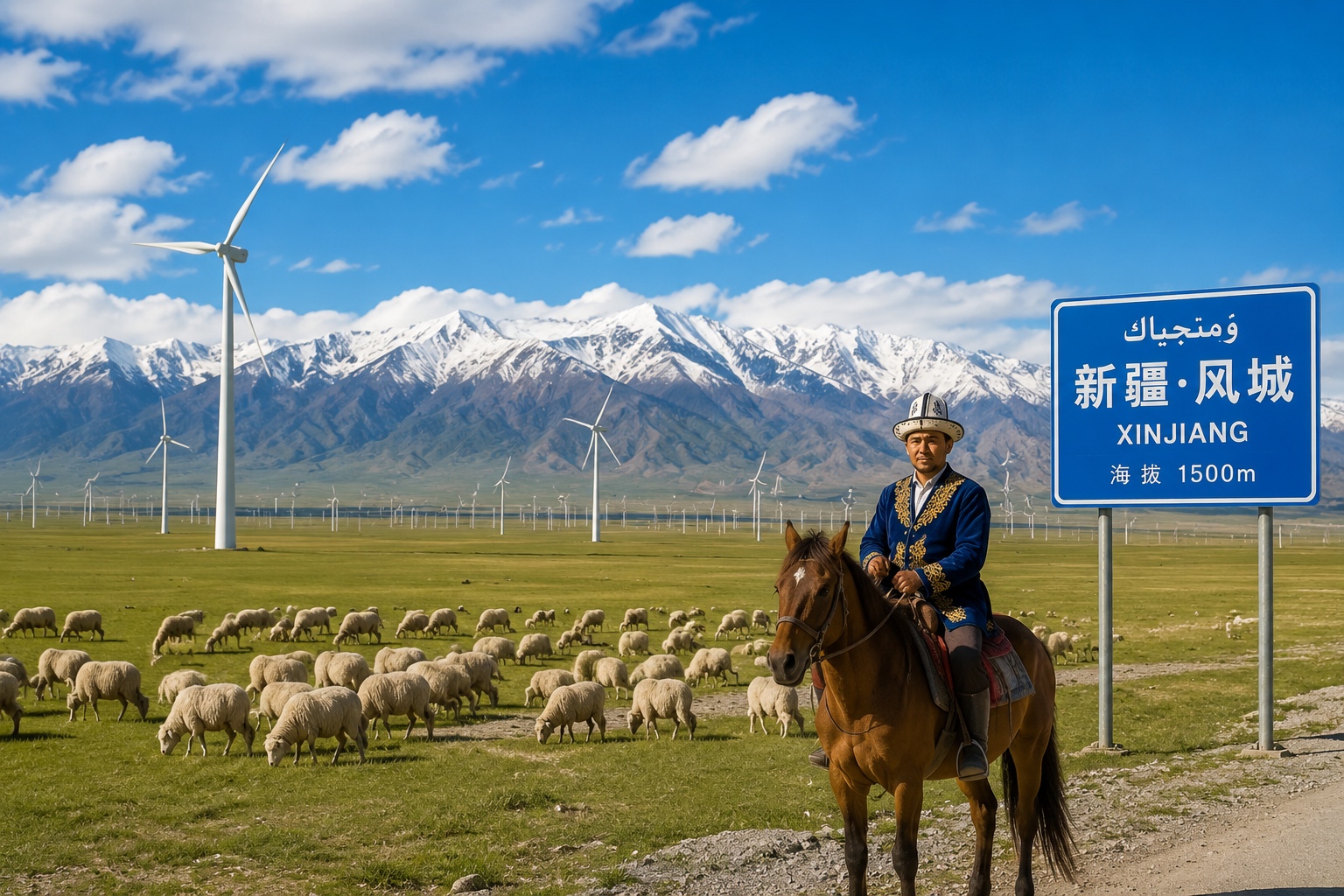

At the foot of the Tianshan Mountains, there is a place where the wind never seems to stop. Across a flat, grassy plain that stretches toward the horizon, hundreds of white wind turbines stand in neat rows, their blades tracing slow circles against a bright blue sky. Beneath them, where you might expect empty grassland, you will instead find sheep nibbling at the grass, a shepherd on a motorcycle, and clusters of small white yurts. This is Dabancheng, a windswept valley on the road between Ürümqi and Turpan, and it offers one of the most surreal sights in modern China: the marriage of the country’s renewable energy ambitions with a pastoral lifestyle that goes back centuries.
For many overseas readers, the impression of Xinjiang is often limited to deserts and ancient Silk Road cities. But the region is also one of China’s most important hubs for wind power. Thanks to the funneling effect of the Tianshan and Altai mountains, strong and steady winds rush through the valley gates, making it a natural site for harvesting energy. Since the early 1990s, Dabancheng has developed into one of China’s oldest and largest wind farms, and today the fields of turbines stretch for dozens of kilometers along the highway.
A Windy Land Becomes a Wind Power Hub
Xinjiang’s wind energy potential is no accident. The region is sandwiched between massive mountain ranges, and cold air from Siberia funnels down through narrow passes, creating some of the most consistent wind in China. According to state energy authorities, Xinjiang’s exploitable onshore wind resources rank among the top of the country. The provincial government has made wind power a pillar of its energy transition, aiming to send clean electricity to the rest of the country through long-distance transmission lines. But the wind farms themselves are not fenced-off industrial parks. Most are built directly on open rangeland, where local herders continue to graze livestock.
The result is a unique kind of cohabitation. Wind turbines occupy only a tiny concrete footprint, and the land between and beneath them remains green, turning into pasture that is often even more accessible because the wind farm roads provide easy passage for herders. To an outsider, the contrast is jarring: a fifty-meter-tall steel-and-fiberglass machine spinning silently over a patch of flowers and grazing sheep.
Under the Blades: Daily Life of Herders
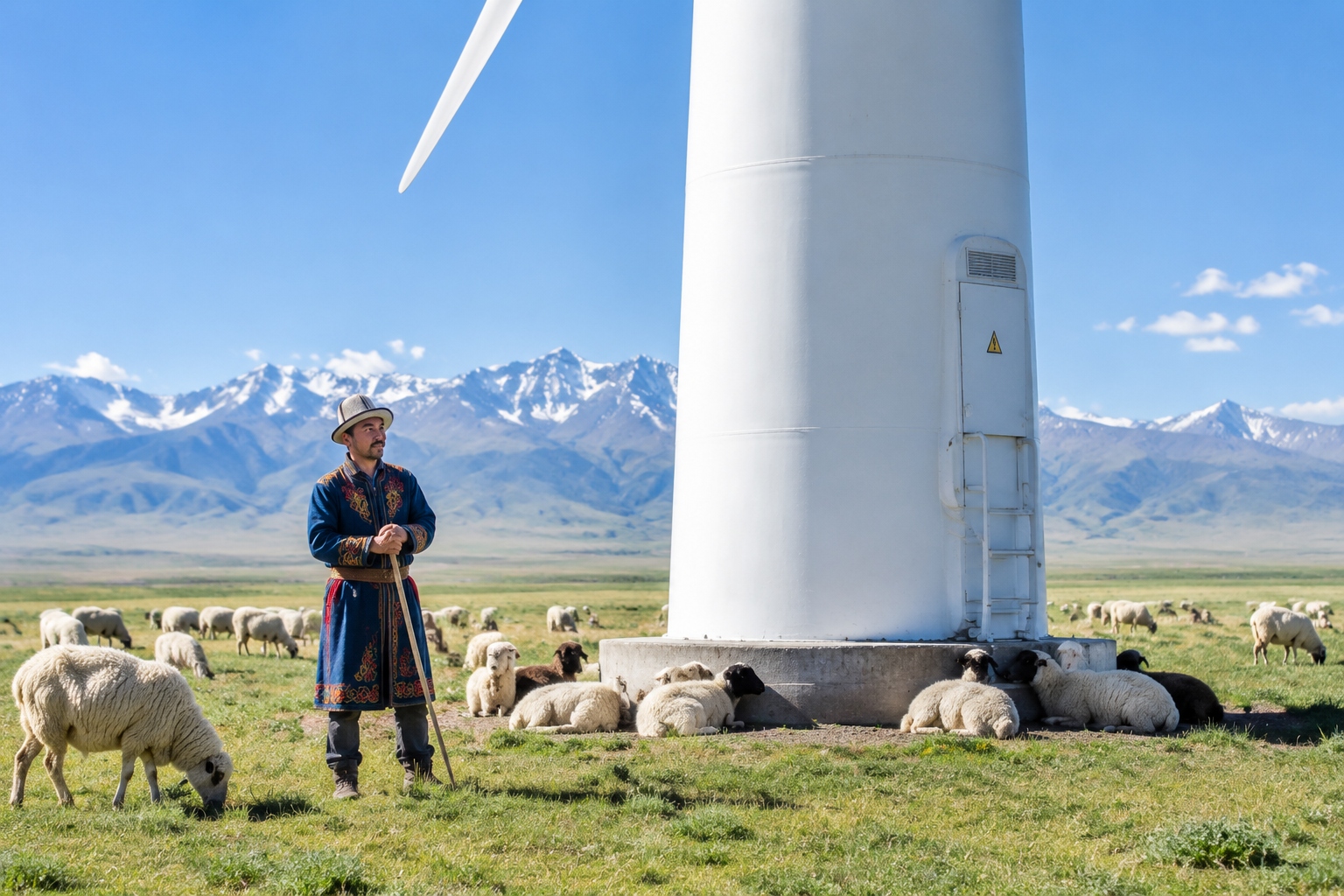
So, how do sheep and shepherds actually interact with these massive machines? We drove through a wind farm just outside Dabancheng and met a Kazakh herder named Serik, who was tending a flock of about 200 sheep under a cluster of turbines. “People think the sheep would be scared by the big blades,” he said with a laugh. “But after a few weeks, they completely ignore them. The noise is like a low hum, just like the constant wind we have always known.”
Serik explained that sheep actually seem to like the turbines. They often stand in the shade of the concrete base during summer, and in winter, the slight heat from the machinery (though minimal) can make the spot a little less cold. “They’re just another rock to us,” he added later, as a lamb wandered curiously towards the nearest tower and began sniffing the metal.
The most noticeable change for him is not the noise or the view, but the roads. When the wind farm was built, access roads were laid down across the grassland. Serik used to move his sheep on horseback over rough tracks, taking hours. Now he rides a small motorcycle, and emergencies are handled in minutes. He also uses a smartphone to check weather alerts, something unthinkable a decade ago. His wife, who stays in the yurt, uses a solar panel to power their television and recharge their phones, a small complement to the massive wind turbines spinning above.
At night, the sound of the blades is more noticeable, a steady whoosh that blends with the howling wind. Many herders say they barely notice it anymore. “When I stay in the city, I can’t sleep because it’s too quiet,” one joked. But the turbines also bring light: nearly every yurt now has an electric lamp, and some families have installed small wind or solar systems to charge phones and power small refrigerators for meat. The big turbines, some just a few hundred meters from the tents, are a constant reminder of how the landscape is evolving.
The Wind Farm Economy
Wind power has put extra money into the pockets of some local families. When a developer builds turbines on grazing land, they typically lease the land from the local government. A portion of the lease revenue is shared with the community, which has funded new sheds, wells, and better veterinary care for livestock in some villages. In one nearby township, the wind farm revenue helped build a new clinic, a fact proudly mentioned by an elderly herder who otherwise had no connection to the energy industry.
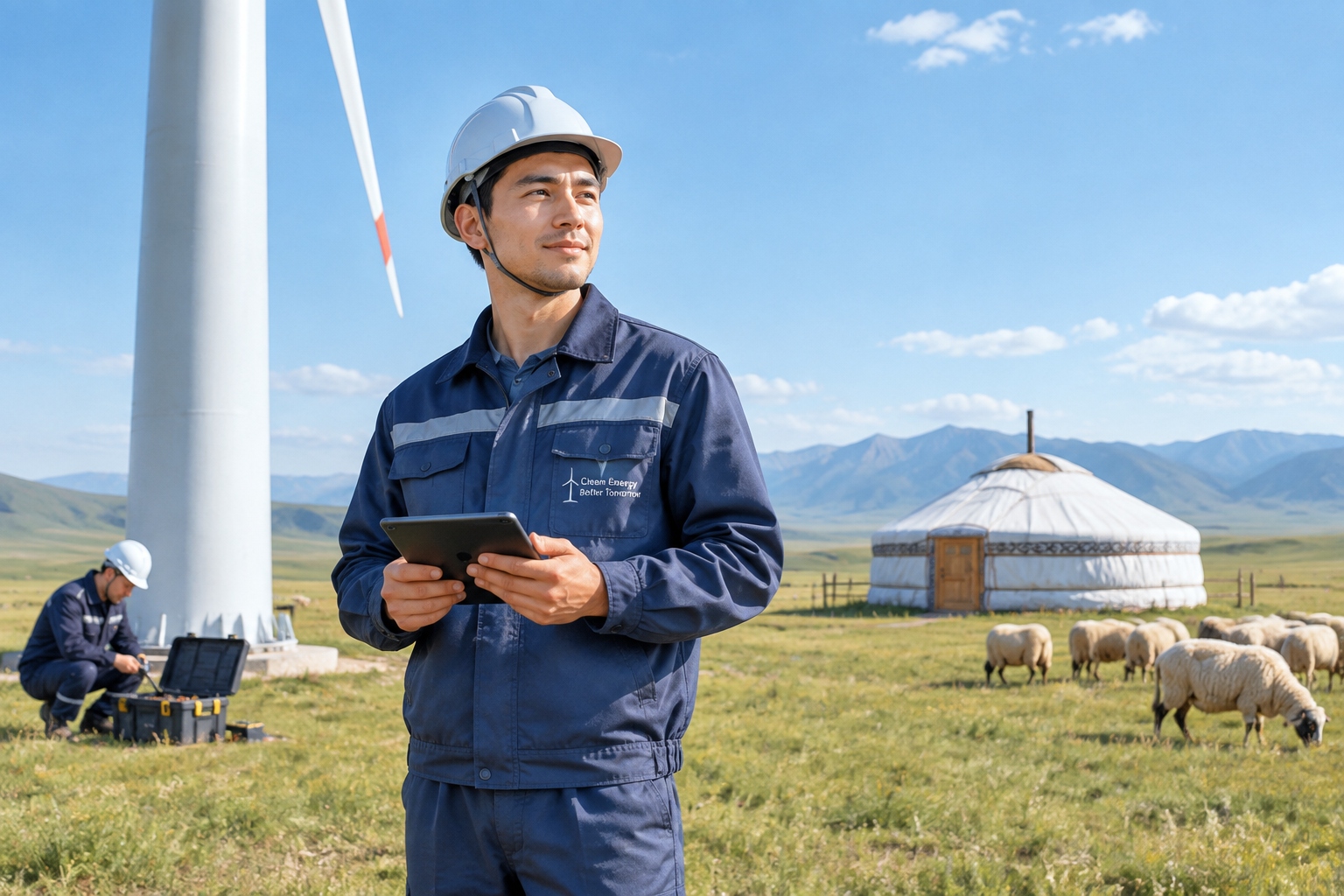
For younger herders, the wind farm is also a possible employer. Several locals we spoke with mentioned that they have family members working as turbine maintenance technicians. These jobs require training, but they pay a much steadier salary than herding alone. As one young man in his late twenties put it, “I still help with the sheep in the evenings. During the day, I climb towers and check the blades. It makes me feel useful to both my family and to the country.”
This dual income model is becoming more common in areas where renewable energy meets rural livelihoods. It means that herding culture doesn’t have to be abandoned in the name of progress. Instead, it can be complemented by new opportunities. Some herders have even invested their extra earnings in better breeding stock, improving the quality of their wool over time.
Not Without Trade-Offs
Of course, building giant machines in the middle of a pasture is not without consequences. Environmentalists point to the risk of birds striking the rotating blades, a problem common to wind farms worldwide. In some sections, herders have noticed that grass growth is slightly sparser right under the turbine foundations, due to soil compaction during construction. There is also the visual impact: no amount of landscape architecture can hide a hundred-meter-tall tower from the horizon.
The industry has responded with practical measures. Turbine blades are now painted with special patterns that make them more visible to birds, and new projects must pass strict environmental impact assessments. Operators also coordinate with herders: if machinery needs to be transported across the pasture, they give advance notice, and maintenance teams often hire local herders to guide them through the easiest routes. Subtle but important adjustments have been made, such as scheduling construction during times when sheep are moved to higher pastures.
No one here suggests that wind farms are perfect. But many residents also point out that the wind has always been a threat to humans, a force that could flatten yurts and smash livestock. To them, it is a small irony that the same wind is now being channelled into something productive. “Before, we just hid from the wind,” said one elderly woman we met. “Now we live beside it, and it brings us electricity and income. That seems like a fair trade.”
The Pasture and the Power Grid
The sight of sheep grazing under wind turbines is likely to become more common. China is currently building several massive renewable energy bases in its northwest regions, including Xinjiang, as part of a national plan to generate 80% of its electricity from non-fossil sources by 2060. These projects are deliberately located on barren or grazing land, where wind and sun are abundant but populations are sparse.
The challenge is to integrate these industrial-strength energy installations into the fabric of local life. In Xinjiang, that means working with herders, not against them. It means designing turbines that are quieter, placing them to avoid bird migration routes, and sharing the economic benefits with the communities who call the land home.
On a deeper level, this coexistence is a metaphor for China’s changing relationship with its frontier regions. The old picture of Xinjiang as a remote, untouchable land is giving way to one where modern technology and ancient customs find unexpected balance. You can see it in the neat rows of turbines echoing the lines of pack camels that used to travel the Silk Road. You can hear it in the hum of blades blending with the bleating of sheep.
As we drove away, the sun was setting, painting the snow-capped peaks of the Tianshan in hues of orange and pink. Behind us, the wind farm shimmered with the promise of a clean energy future. And right below the turning blades, a small boy on a horse was guiding his family’s sheep back to the camp. He didn’t look up at the turbines. They are just part of his world now.
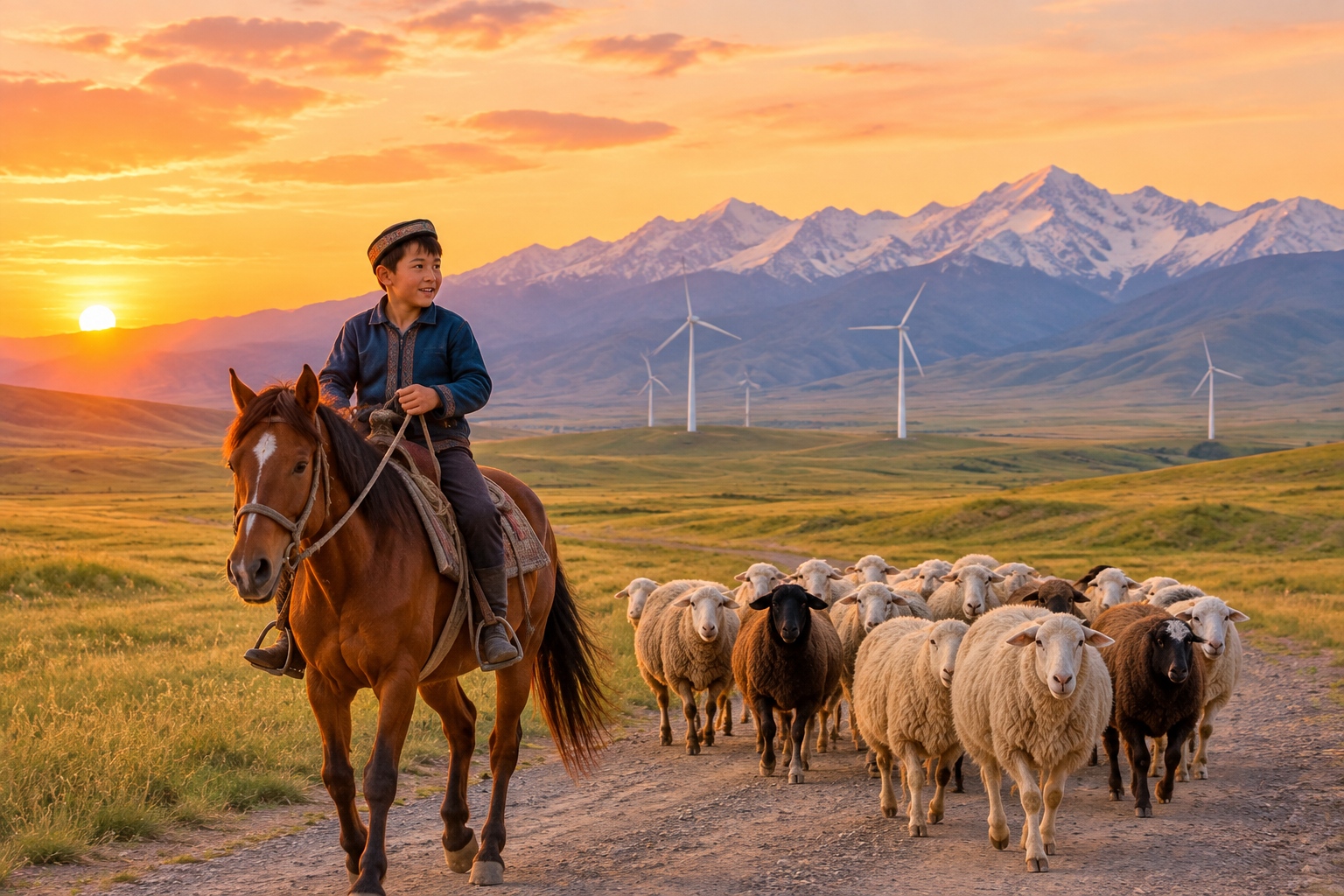
That is the real story of Xinjiang’s wind power: not a story of displacement, but of adaptation. The windmills are there, and so are the shepherds. And maybe that is not so surprising after all. The wind has always been part of this land, and now it simply has a new job.
Start the discussion at forum.chinacomes.com