

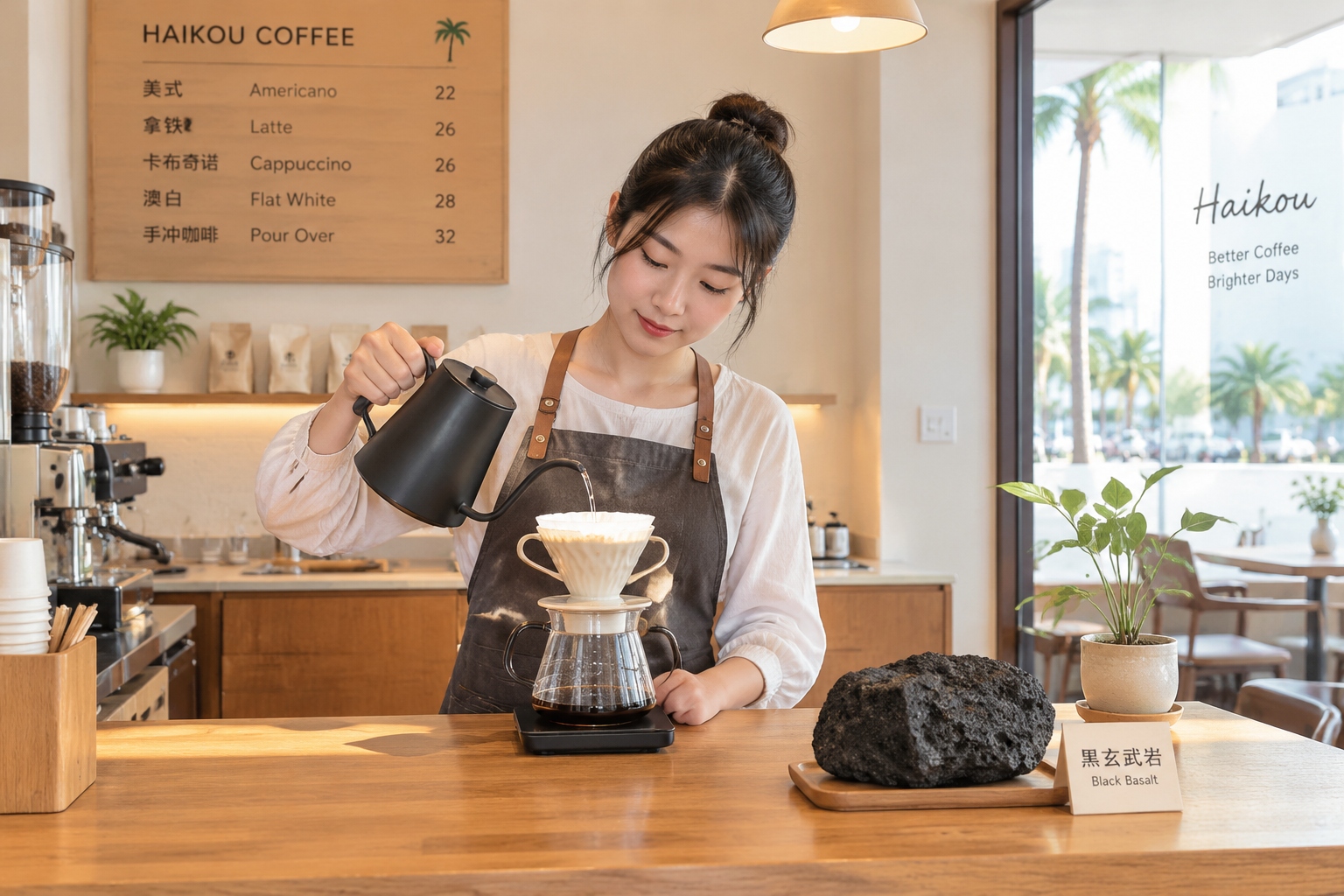
In a café less than twenty minutes from Haikou’s volcanic crater park, barista Xiao Pan pours a fresh cup and nods toward a fist-sized black rock sitting on the counter. “That’s basalt, straight from the crater,” she says. The rock isn’t a decoration. It’s a geological clue to why the coffee she serves tastes unlike any regular coffee. Right behind her, a map of the Haikou Volcanic Cluster Global Geopark shows how the city sits on ancient lava flows.
Haikou, the capital of Hainan Island, rests near the island’s northern shore. The surrounding landscape is covered with volcanic hills, collapsed craters and farm fields. Thousands of years ago, lava bursts from multiple vents cooled into thick basalt layers. Rain, wind, plants and time slowly transformed that porous rock into a fertile rust-red soil. Today, coffee trees grow directly on this soil – and their beans carry a specific character shaped by the volcanic ground.
What Volcanic Soil Does to Your Cup
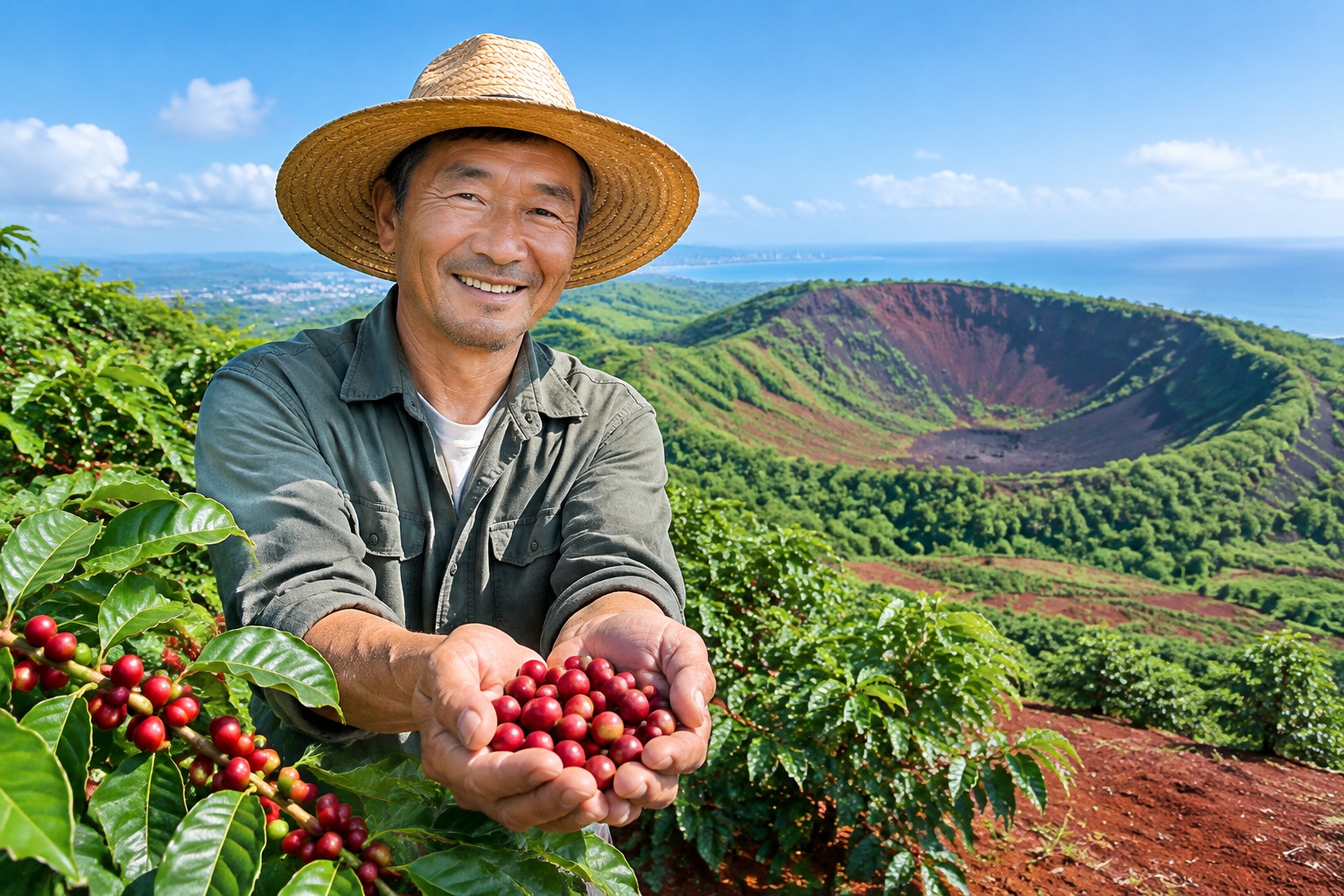
Geologist Yuan Wenlu has been studying the volcanic geology of northern Hainan for years. According to him, the region’s soil is far from ordinary dirt. “Volcanic basalt weathers into a type of soil called ‘andisol,’ which is extremely porous and rich in iron, magnesium, potassium and other minerals,” he explains. “Those minerals are slowly dissolved in the water that coffee tree roots absorb. That means every part of the coffee cherry – flesh, seed, even its aroma – is partly built from those volcanic elements.”
Coffee professionals call this ‘terroir’, the same idea used for wine. In a classic coffee-producing country like Colombia or Ethiopia, farmers often rely on high altitude, afternoon rain and sandy volcanic loam to achieve brightness in the cup. In Hainan, the altitude is modest – only a few hundred metres above sea level – but the volcanic soil acts like a slow-release capsule. It drains rainwater rapidly, preventing plant stress caused by flooding. At the same time, it holds enough moisture to keep the roots cool during dry spells. This rhythmic supply of water and minerals allows the coffee cherries to mature over a longer period, which increases sugar content and develops a denser bean.
Xiao Pan, the barista, says she notices that difference during roasting. “The beans have a very consistent colour and cracking rhythm,” she says. “You can push them a little darker, and the result is a smooth chocolatey taste rather than an ashy char.” When brewed black, the cup shows a gentle acidity, somewhat similar to a high-grown Kenyan – but with a rounder body and a long, silky finish. Some tasters find a hint of smoked wood or stone, which makes sense when you remember the rock that once carried this landscape.
A Little Story of Coffee on Tropical Farmland
Southern China is known for tea, not coffee, but Hainan is the island that turns the rule upside down. Coffee cultivation started here in the mid-20th century, when returning overseas Chinese brought their taste for the beverage and planted the first arabica and robusta trees. Later, during the 1970s and 80s, state-owned farms expanded coffee production. But for a long time, most of the harvest went to local markets as unroasted beans or instant coffee powders.
The modern boom in Chinese coffee culture changed that. In just a decade, the number of specialty coffee shops in Haikou has increased by many multiples. Young entrepreneurs look for interesting beans to serve to a city that is drinking more coffee every year. Some of them travel south to the volcano area and discover that the peasant farms were sitting on a precious source.
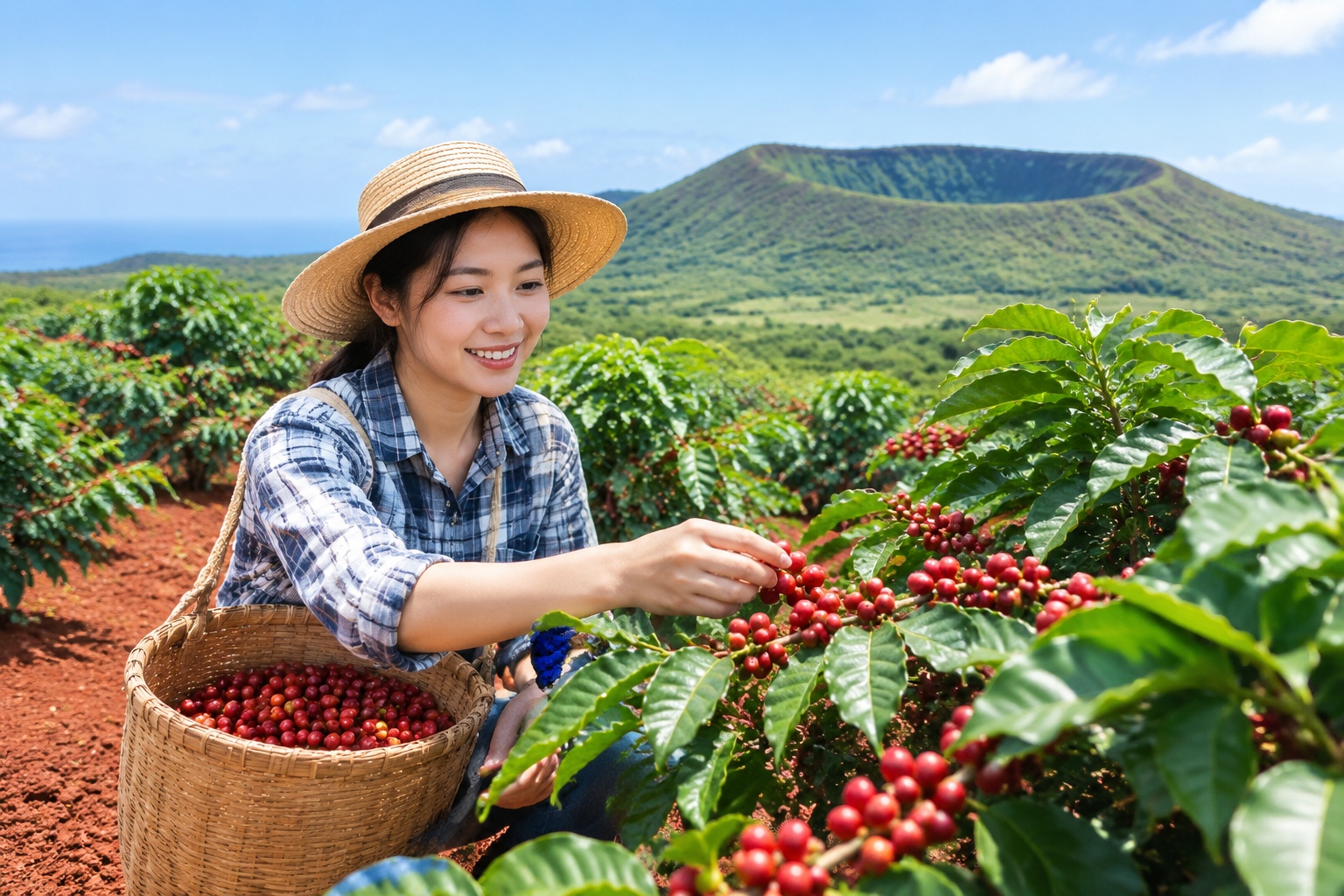
For instance, the town of Yongxing, sitting right next to the main crater park, has become a meeting point for high-quality coffee. Farmers there use careful methods: hand-picking red cherries, washing them in pure spring water, and drying them under shaded nets. Instead of selling to the lowest bidder, they now work directly with roasters in Haikou. The result is a small but thriving ecosystem of coffee growers, green buyers, roasters and shop owners.
Comparing Volcanic Coffee to Ordinary Coffee
What makes this coffee stand out, exactly? A direct taste test reveals the differences. Most commercial coffee – even in an expensive café – comes from estates that rely on synthetic fertilisers, chemical weed control and consistent irrigation. In such an environment, the coffee plant tends to absorb similar compounds from soil amendments, resulting in similar flavour profiles. Overuse of fertilisers can flatten the aromatic complexity of the bean.
Volcanic soil offers something else. Due to its high mineral diversity, coffee roots mirror that richness. The final cup often has a fuller body, a rounder mouthfeel, and a lasting sweetness. Some batches also show a subtle smoky, almost mineral note that is hard to imitate. That is why Haikou’s specialty shops love to label their offerings with the word “volcano” – not just for marketing, but because they believe the land changes the drink.
The comparison to a volcanic coffee like Hawaii’s Kona is natural. Kona sits on the slopes of ancient volcanoes, with a similar red soil and a strong, dark-roasted heritage. Hainan’s version is less well-known internationally, but people who have tried both say the island coffee tends to have a lighter body with more lively fruit acidity, likely due to the more humid tropical climate and lower altitude. That gives the coffee its own signature.
The Everyday Life of Volcanic Coffee in Haikou
For visitors exploring the city, there are plenty of places to taste this earthiness. Street-side cafés in the old quarter offer simple drip coffee, while modern spaces around Binhai Road have extensive brewing equipment and tasting flights. Locals often suggest pairing coffee with a freshly baked sponge cake from a nearby bakery, or just drinking it black and slowing down to enjoy the lingering aroma.
A visit to the volcano park is easy to arrange. From downtown Haikou, a taxi ride takes about 30 minutes. The road winds past palm trees and guava farms until you reach the geopark. At the edge of the park, you can still see basalt rocks covered with coffee bushes. Several farms have opened their doors to visitors. They show you how the coffee cherries are picked by hand, how they are washed, and finally roasted in a small iron drum. At the end, you get to brew your own cup and compare it to coffee you tasted earlier in the city. It’s a journey from volcano to cup, with a story in every sip.
What the Volcano Still Means to the Island
For younger people in Haikou, volcanic coffee is a quiet source of pride. It proves that this rapidly developing city has something unique to offer the world, beyond shopping malls and beach resorts. It supports a smarter agriculture where the value stays closer to the farm. And it creates a thread between the deep past – the volcanic eruptions that changed the land 50,000 years ago – and the daily ritual of drinking a morning cup.
To outsiders, the idea of “erupted land” might sound severe. But in Hainan, the eruption is ancient memory. What it left behind is a kind of potential: mineral-rich soil that patiently feeds both plants and stories. Next time you take a sip of a coffee labelled “Haikou volcanic,” know that you are drinking a little piece of geology – and a small, delicious piece of modern China.
Start the discussion at forum.chinacomes.com