
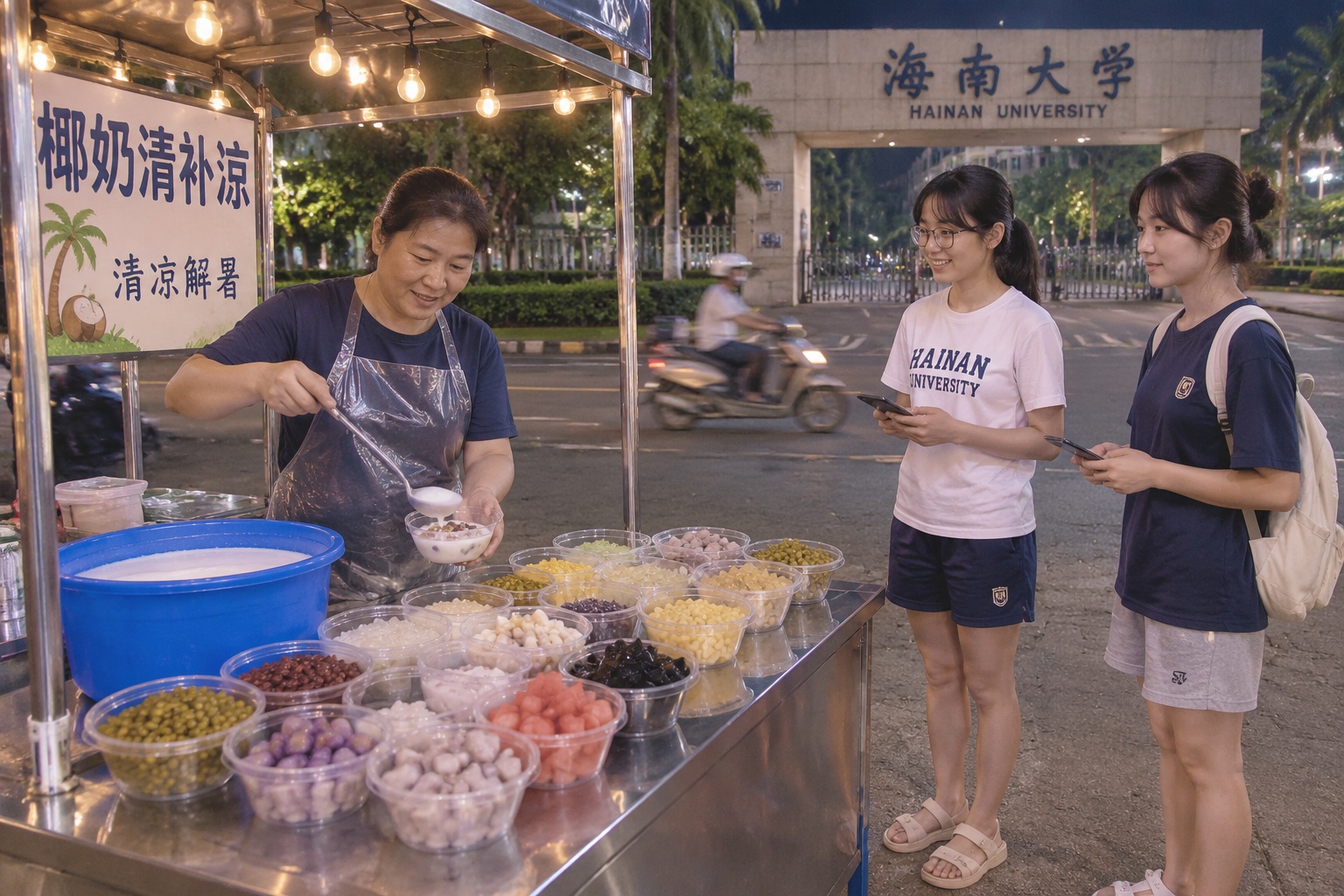

At nine on a Tuesday night, the air outside the south gate of Hainan University is still 29°C and smells of grilled oysters, wet pavement and the exhaust of passing scooters. Chen Lifen stands behind a stainless-steel counter, dragging a ladle through a blue plastic tub of coconut milk. Twenty small bowls are lined up in front of her, each holding a different topping: mung beans, red beans, pearl barley, cubes of taro, sliced watermelon, dark translucent grass jelly — and small elbow macaroni, the one that makes first-time visitors stop and point.
“Less ice?” she asks the man in front of her, then asks again more slowly, holding up a cup of ice and raising her eyebrows. He nods. She scoops, pours, presses on a lid and swivels the payment QR code toward him. The whole exchange takes forty seconds. He pays 12 yuan, about $1.70, and carries the bowl away with both hands.
What qingbuliang actually is
The name is misleading in translation. Qingbuliang — literally “clear, replenish, cool” — started in Guangdong as a simmered herbal tonic, the kind of thing a grandmother makes when someone feels run-down. In Hainan it turned into something else entirely: a cold, coconut-based dessert eaten for pleasure rather than health, and sold everywhere from street corners to the freezer section of convenience stores.
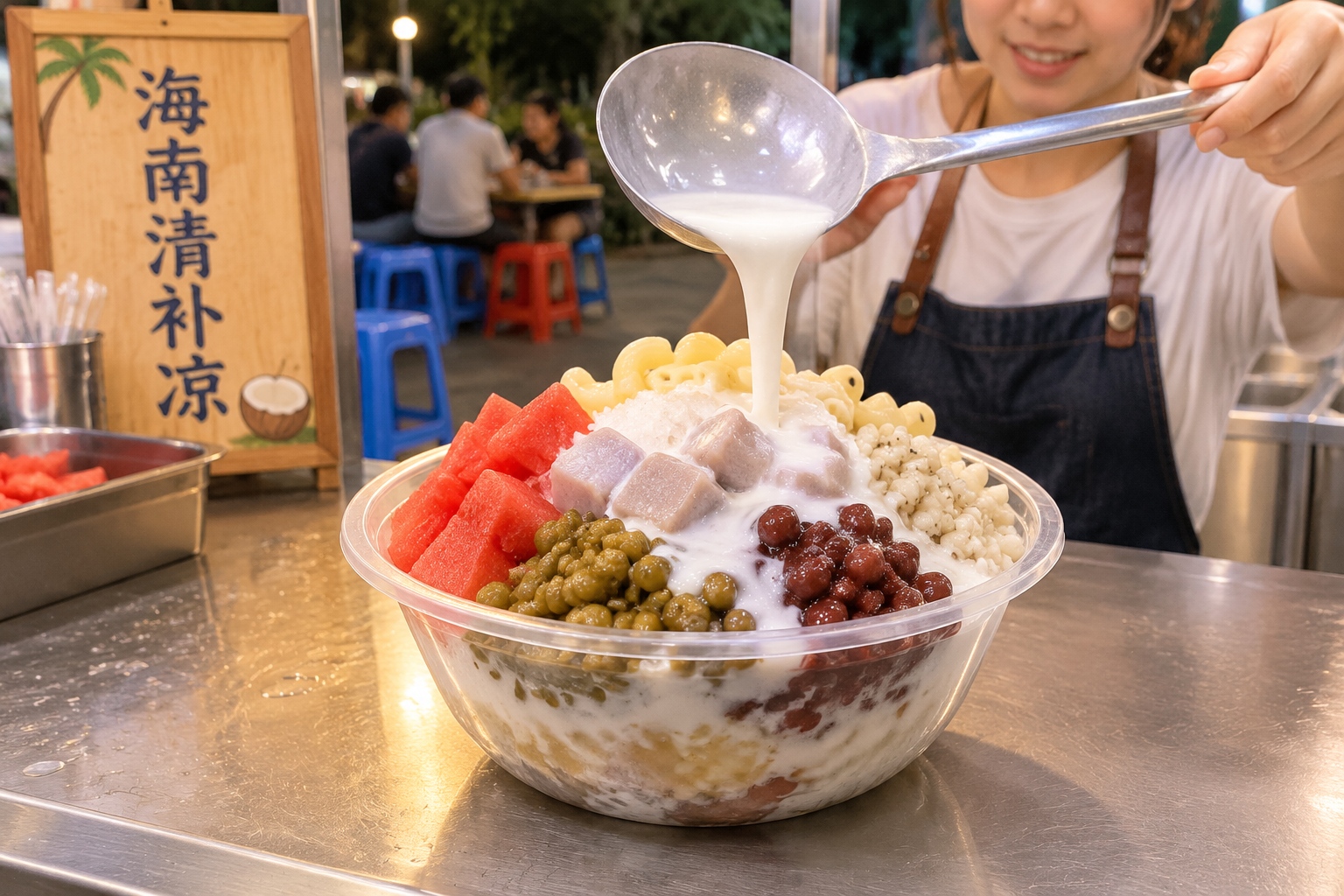
A standard bowl has three parts. First the base: coconut milk, coconut water, brown sugar water, or a scoop of shaved ice that vendors stir on a cold plate until it firms up, which locals call chao bing. Then the toppings, which can run to a dozen or more — beans, barley, taro, sweet potato, tapioca pearls, aiyu jelly, fresh coconut strips, sometimes quail eggs. Then the ice and sugar level, which is where regulars reveal themselves. “Less sugar, less ice” is the order of someone who eats this three times a week. “Everything, extra ice” is usually a visitor in a linen shirt, filming the counter before the bowl is even full.
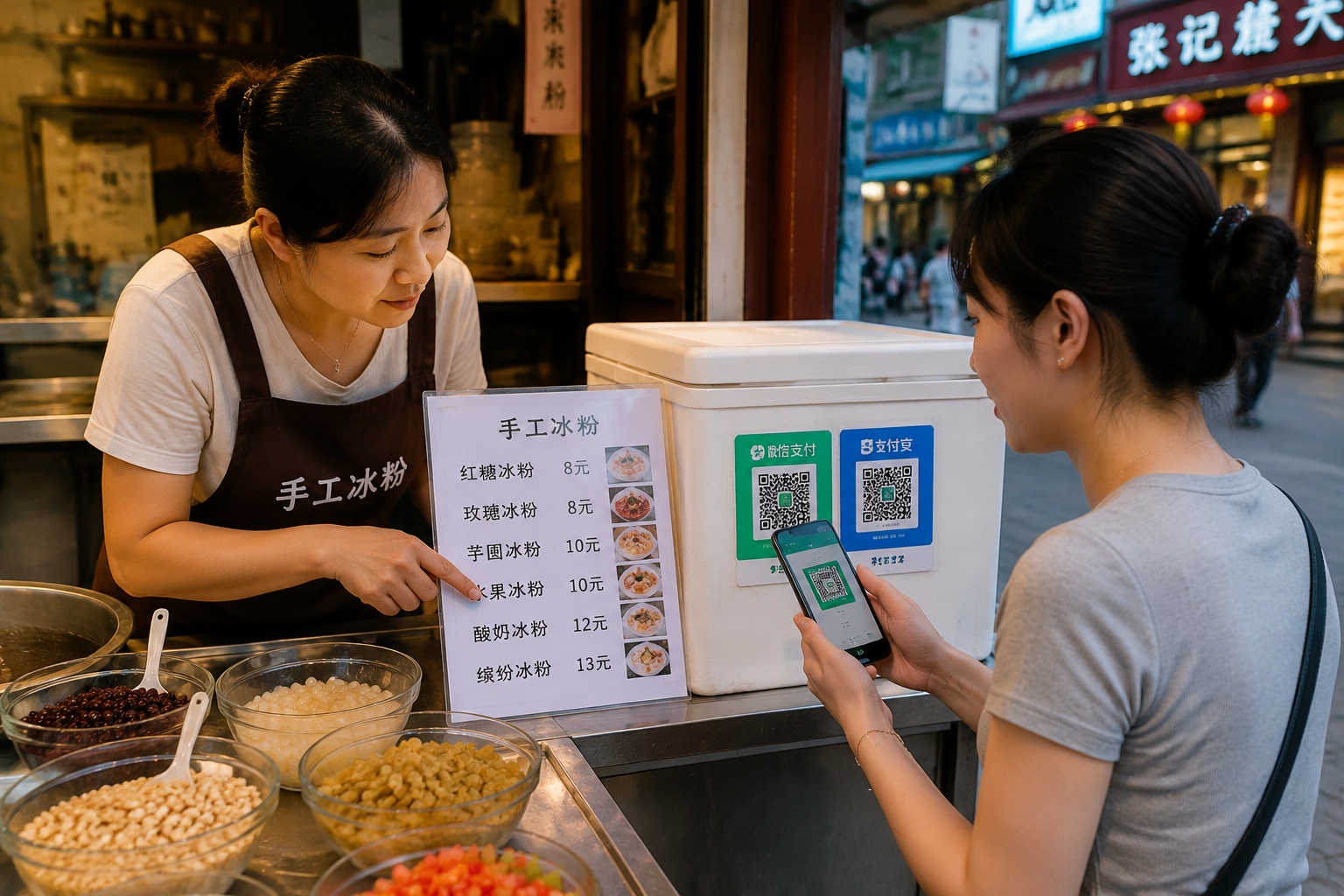
Prices are not hidden. In Haikou, most bowls cost 10 to 15 yuan ($1.40 to $2.10). Walk into a tourist strip in Sanya or a street next to a resort hotel and the same bowl can be 25. The menu board is usually a laminated sheet with photographs and numbers, which means you can order without saying a word.
A bowl that does two jobs at once
Chen has worked this corner for six years. She does not need a loyalty card system; she remembers faces. A woman in a hotel housekeeping uniform comes by most nights around ten, and Chen starts assembling before she sits down. “The usual?” The usual is coconut milk, no watermelon, extra barley.
Then there are the people she will never see again. A family from Shandong, here for four days, asks what the macaroni is doing in a dessert. Chen laughs, spoons a little into a plastic cup for them to taste, and says something about how it makes the bowl chewier. They order two. The grandmother takes a photo of the bowl from above, then a photo of Chen, who poses with the ladle held up like a trophy.
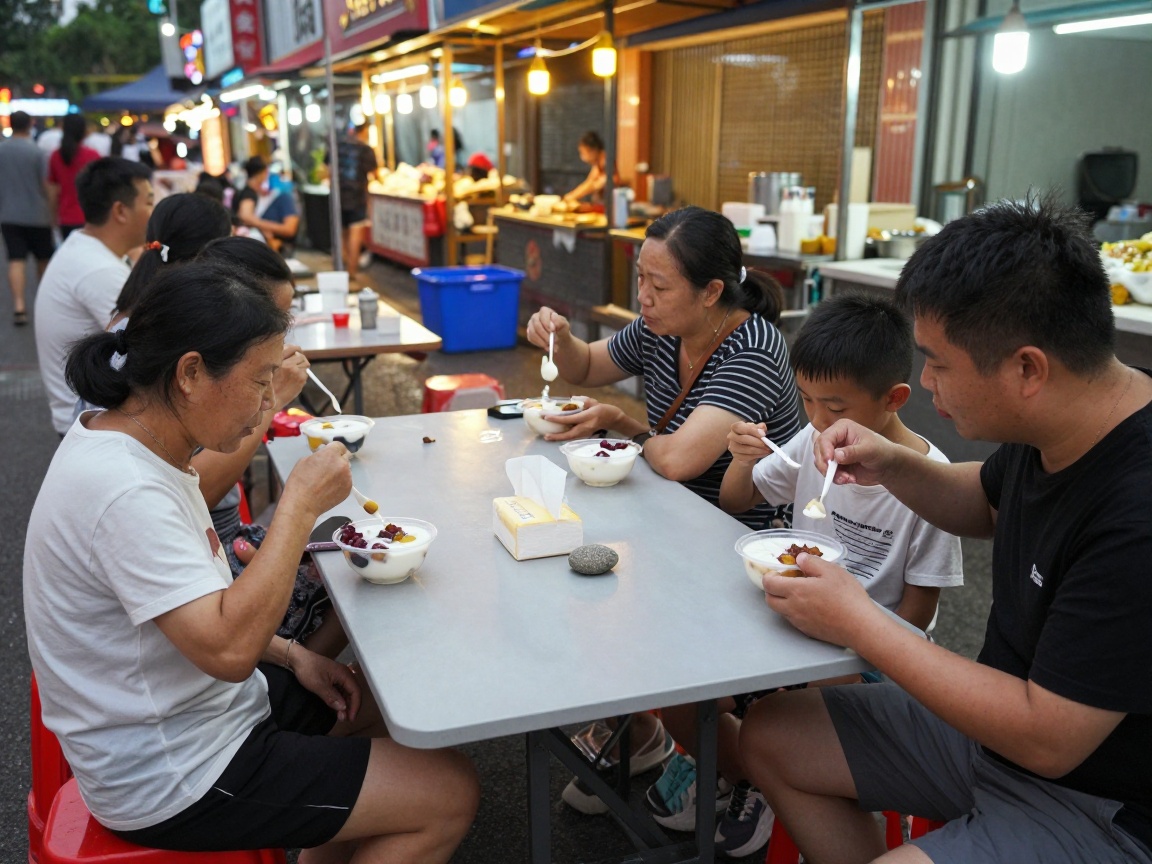
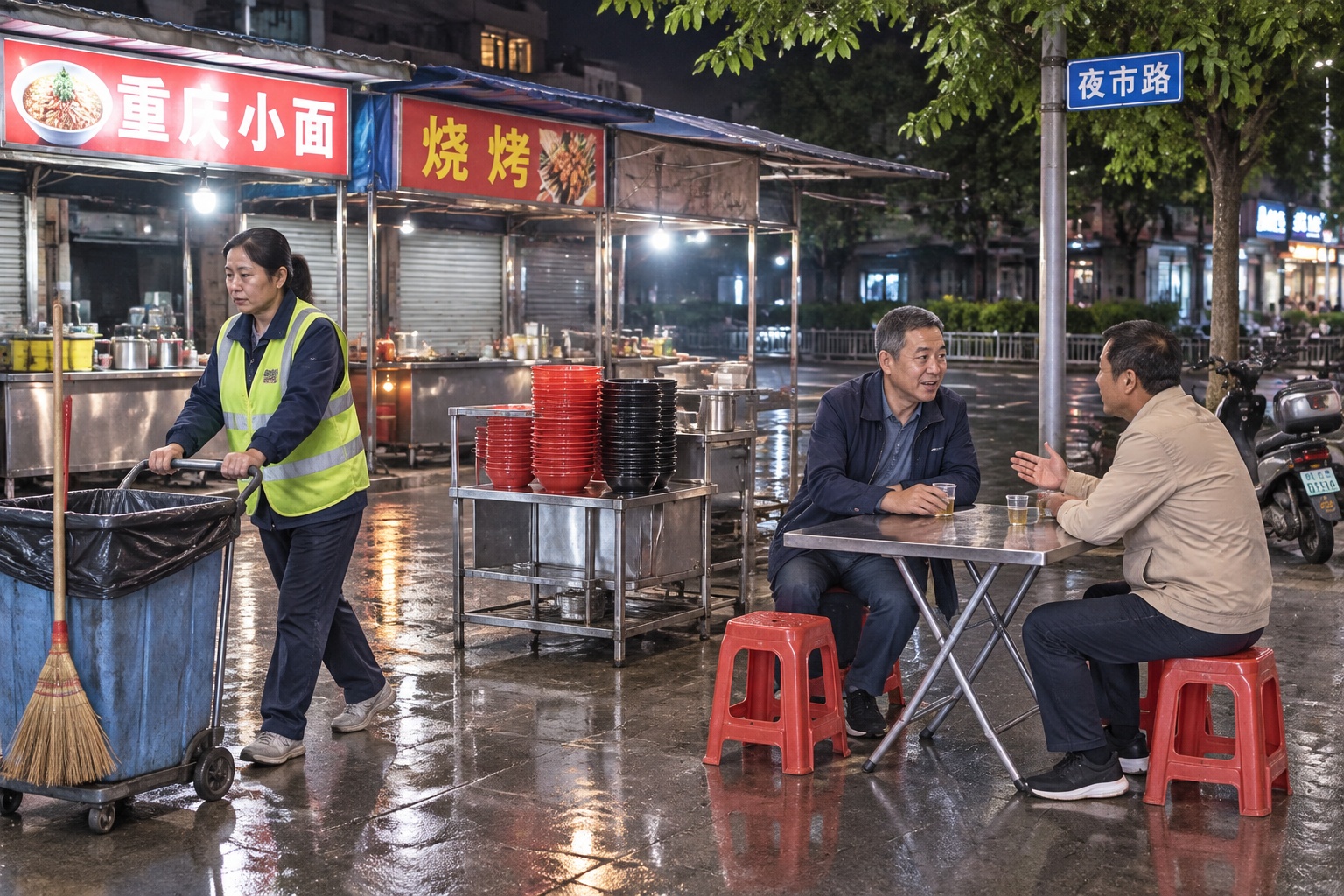
The table is where the two groups actually meet. Seating is shared and scarce: long folding tables, red plastic stools, a stack of tissues weighed down by a stone. On a busy night a local woman will slide her bag off a stool so a tourist family can sit, and the tourists will say thank you in English, and she will nod and go back to her phone. Nobody becomes friends. But for ten minutes they are eating the same thing at the same table, which is more contact than most tourist cities manage.
Payment is its own small negotiation. Nearly every stall shows two QR codes, for WeChat Pay and Alipay, printed on a sheet of A4 and taped to a cooler. Most Chinese customers scan without looking up. Foreign visitors often can’t — linking a foreign card to Alipay works in more places than it used to, but it is far from universal at a stall with a plastic tarp roof. Cash still works. Vendors keep a stack of notes under the till and may have to hunt for change.
The night market as a shared living room
The south gate market is not a picturesque old street. It is a working strip that runs for maybe two hundred metres along a campus wall, and it is managed more tightly than it looks. Stalls are numbered. Vendors pay a nightly or monthly fee and are expected to keep the ground in front of them clear. Price boards are the norm, partly because the local market authority checks them. At the end of each row there are rubbish bins, and from around eleven a cleaner moves through with a cart, collecting the bowls people have stacked themselves.
The rhythm changes with the calendar. Between December and February, when much of northern China is below freezing, the crowd is heavier and louder — families in light jackets, tour groups, couples pulling small suitcases. On a Tuesday in July it is mostly students, delivery riders coming off shift, a few nurses from a nearby clinic. The queue at Chen’s stall is short on those nights, and she has time to talk.
Hygiene is the thing visitors worry about most, and it is worth being honest: standards vary. Some stalls wear gloves and keep toppings covered; some don’t. Ice is the ingredient most likely to cause a bad night, and it is also the hardest for a customer to judge. What has changed in recent years is that the visible infrastructure has improved — tiled ground instead of mud, running water in the shared wash area, bins that get emptied during the night rather than the next morning. That matters more to the people who eat here weekly than to the people who eat here once.
What one bowl says about Hainan’s night economy
Hainan has spent the past few years pushing night-time consumption as part of its tourism and free-trade-port plans. Some of that shows up as big projects: night cruises, light shows, duty-free malls open late. But the part that touches ordinary life is smaller and cheaper. Twelve yuan is less than a milk tea. For a student, a bowl of qingbuliang is an affordable way to end an evening out; for a vendor, the arithmetic only works at volume.
Chen says a good weekend night can move 300 bowls. At an average of 12 yuan, that’s 3,600 yuan in takings — before ingredients, the stall fee, and the two helpers she calls in on holidays. Weeknights in summer she might sell 80. The gap between those numbers is the gap between tourist season and local life, and it is why the same stall feels like two different businesses depending on the month.
Not everyone is winning. Stall fees have risen as the neighbourhood has become better known, and some older vendors have moved further from the gate. Young people open dessert stalls with better lighting and an Instagram-ready sign, then close within a year. The picture is not a success story with a soundtrack; it is a crowd of small operators reading the same street and guessing what it wants.
Last bowl
By half past eleven the crowd has thinned to the die-hards. A tourist couple, leaving tomorrow, comes back for one more bowl to take to the hotel. Chen packs it with the ice separate, warns them not to wait too long, and turns back to the counter. Two men in their fifties are still on their stools at the end of the table, bowls empty, talking about a cousin’s wedding.
Nothing here is a metaphor for anything large. It is just a street where a woman sells a cold dessert from a plastic tub, and where, night after night, a few hundred people who would otherwise never share a table end up sharing one. The connection is not abstract. It is 12 yuan, a scoop of coconut milk, and a stool someone slides over.