
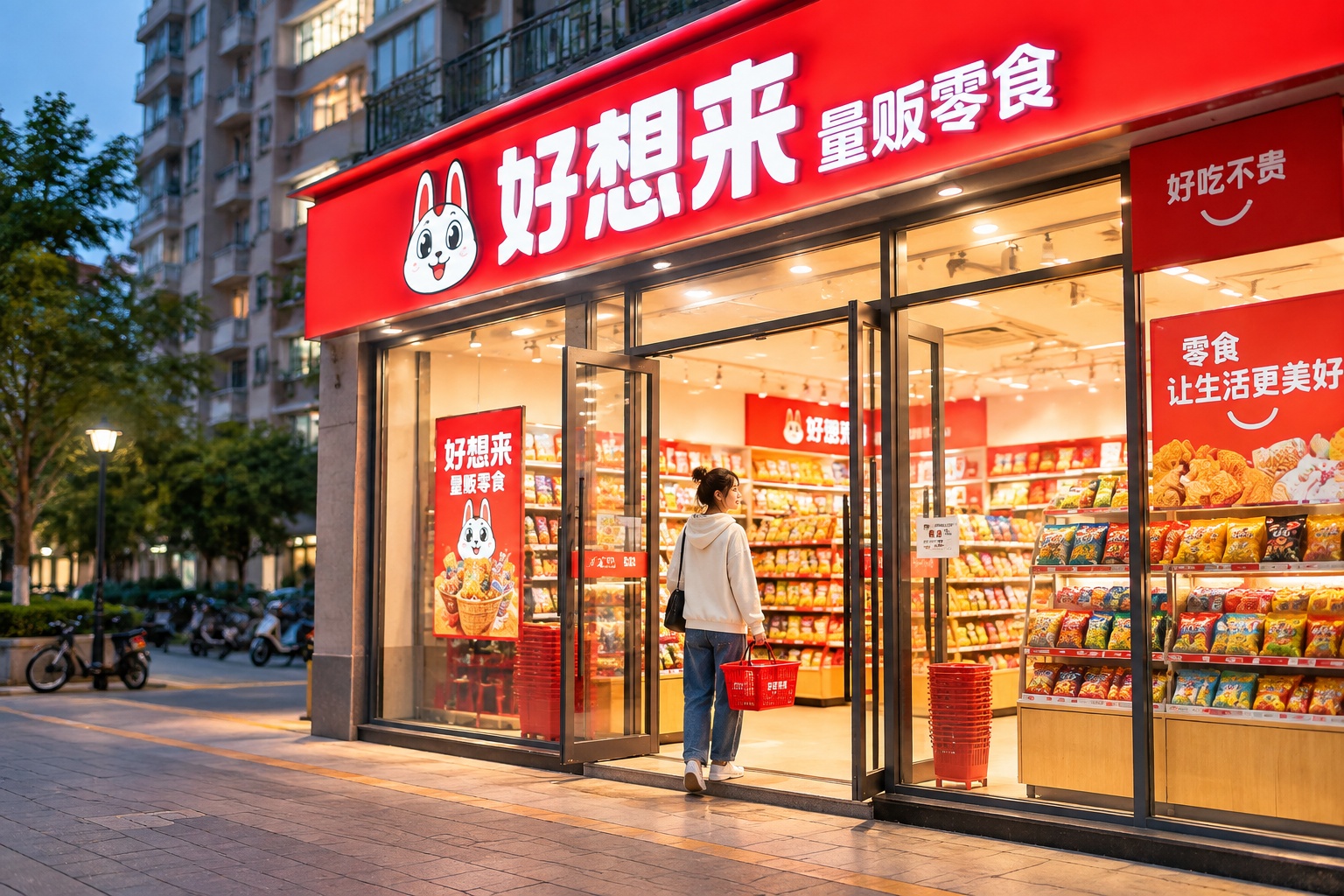

A snack run after work
At 7:20 p.m. on a warm Monday, the sliding glass door of the Haoxianglai snack store on a residential street in Zhengzhou kept opening and closing like a metronome. The shop was not big — about the size of a two-car garage — but the fluorescent lights were so bright that the rows of red, yellow, and green packages looked almost like a festival banner. From outside, you could see shelves running from floor to nearly the ceiling, each one packed with plastic pouches of every size and color.
A woman in her mid-thirties, wearing a beige linen apron over a T-shirt, stepped in, grabbed a blue plastic basket, and headed straight to the dried-fruit section. Her name is Wang Chunxia, a dental assistant who lives in a nearby compound. She told me she came here twice a week and usually spent no more than 70 yuan on each visit.
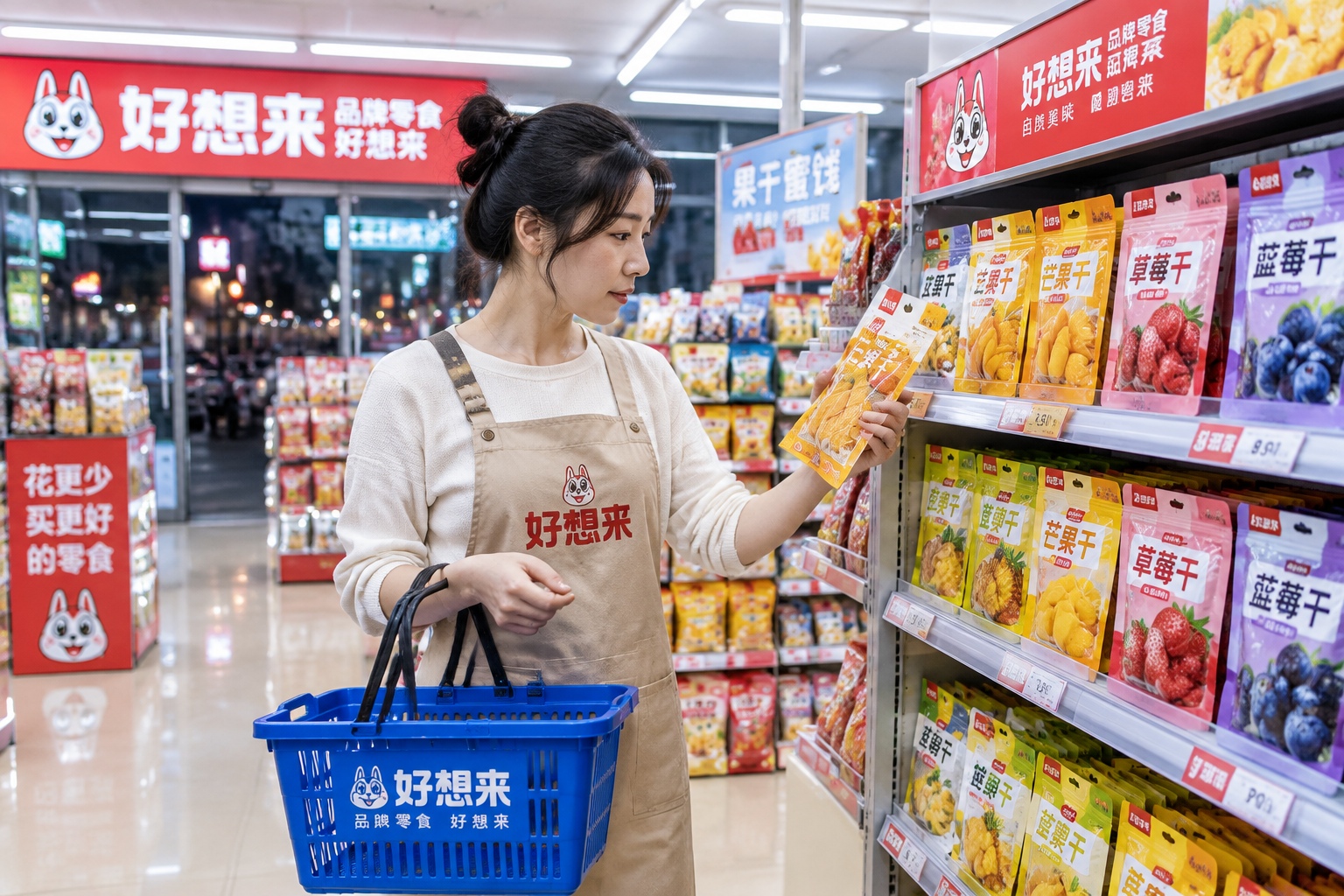
Wang picked up a packet of white peach slices, turned it over to read the production date, and then placed it carefully into her basket. “My daughter likes these,” she said, without looking up. “The same brand costs more in the big supermarket. Here they sell it wholesale, directly from the factory, I think.” She paused and added, “It’s packed on the same day, see? I checked.”
She was not entirely wrong. Haoxianglai belongs to a fast-growing category in China called “mass-discount snack” stores. Unlike a traditional convenience store, these outlets are bigger on snacks and drinks, often with more than 1,200 SKUs, and they position themselves as something between a supermarket and a warehouse market. Instead of paying rent for a premium location inside a mall, many branches occupy street-level shops in middle-class residential areas, where rents are lower and the footfall is predictable.
Scales, labels, and a calculus of pleasure
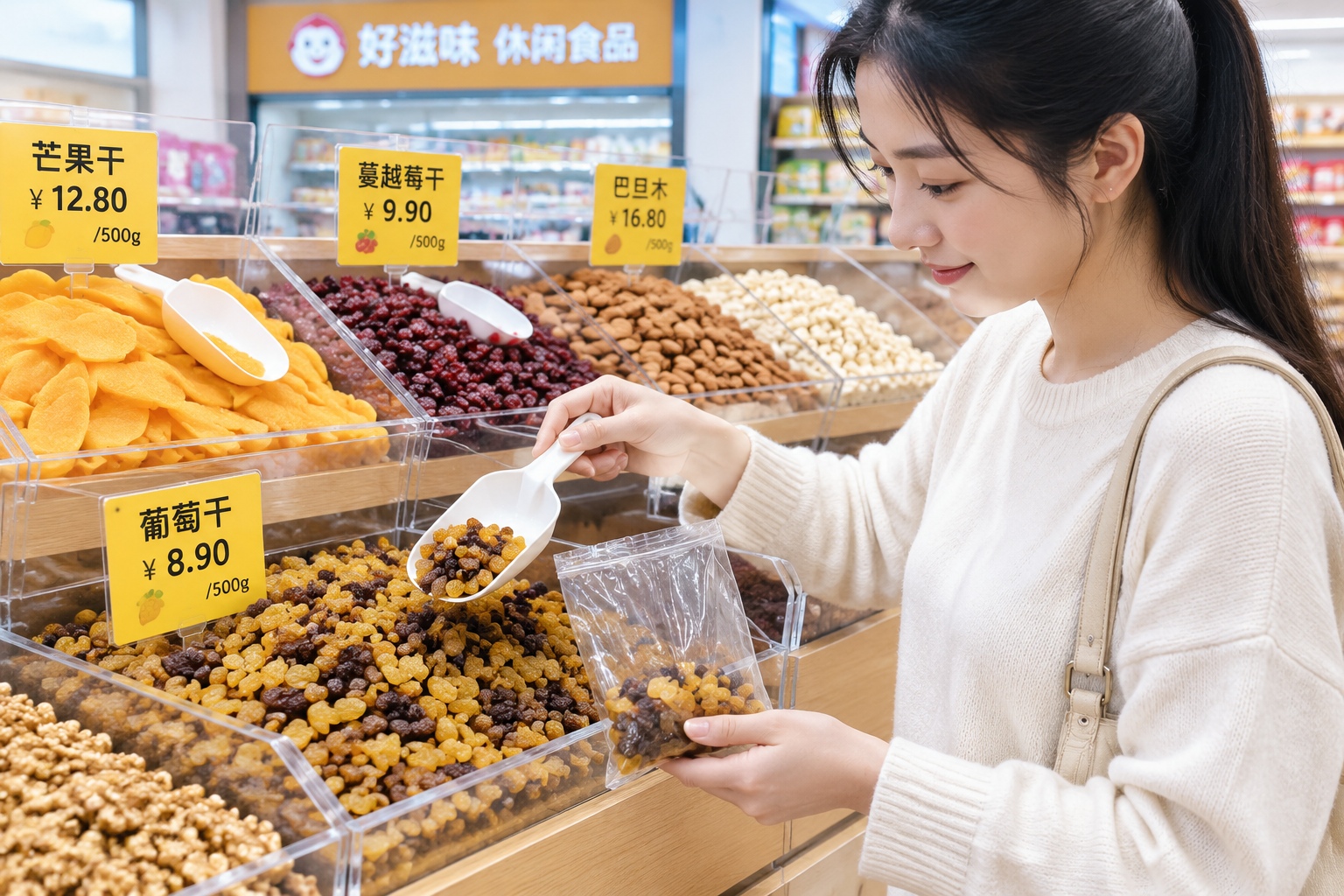
The side wall of the store was a self-service bulk area. There were dozens of transparent bins filled with cranberries, pistachios, salted dried peas, spicy gluten sticks, and even freeze-dried okra. Each bin had a small yellow label showing the price per 500 grams. A plastic shovel lay on each lid, and nearby were thinner transparent bags.
Wang took one small bag, opened it, and filled it with about a handful of mango raisins. She then moved to the next bin, hesitated, and added a few pieces of salted egg yolk crisp. “When it’s weighed, if it turns out too expensive, I can just pour a few back,” she said with a laugh. She wasn’t rich, but she was not looking for the cheapest either — she wanted to try new things without the commitment of a full-size package.
Standing in front of the wall of bins, it’s easy to understand why this kind of store has spread quickly. The prices are transparent, the quantities are self-defined, and the act of scooping snacks into a small bag feels a little like a lottery. Wang filled her bag until it was about half full and tied it to a knot loosely before placing it in her basket.
“My husband thinks these are all processed factory foods. But I think the same of any supermarket,” she said. “At least here I can read the label before buying.”
This behavior is exactly what the so-called “mass-discount snack” model relies on. Haoxianglai is a chain owned by the listed company Wanchen Group. Instead of selling through distributors, the chain claims to buy goods from manufacturers by the container and mark up only by a small percentage. A typical store carries over 1,000 SKUs, and many items are priced between 1 yuan and 15 yuan. That is often 15% to 20% cheaper than the same snacks in convenience stores or supermarkets in the same neighborhood.
The customer’s logic is not what you’d expect
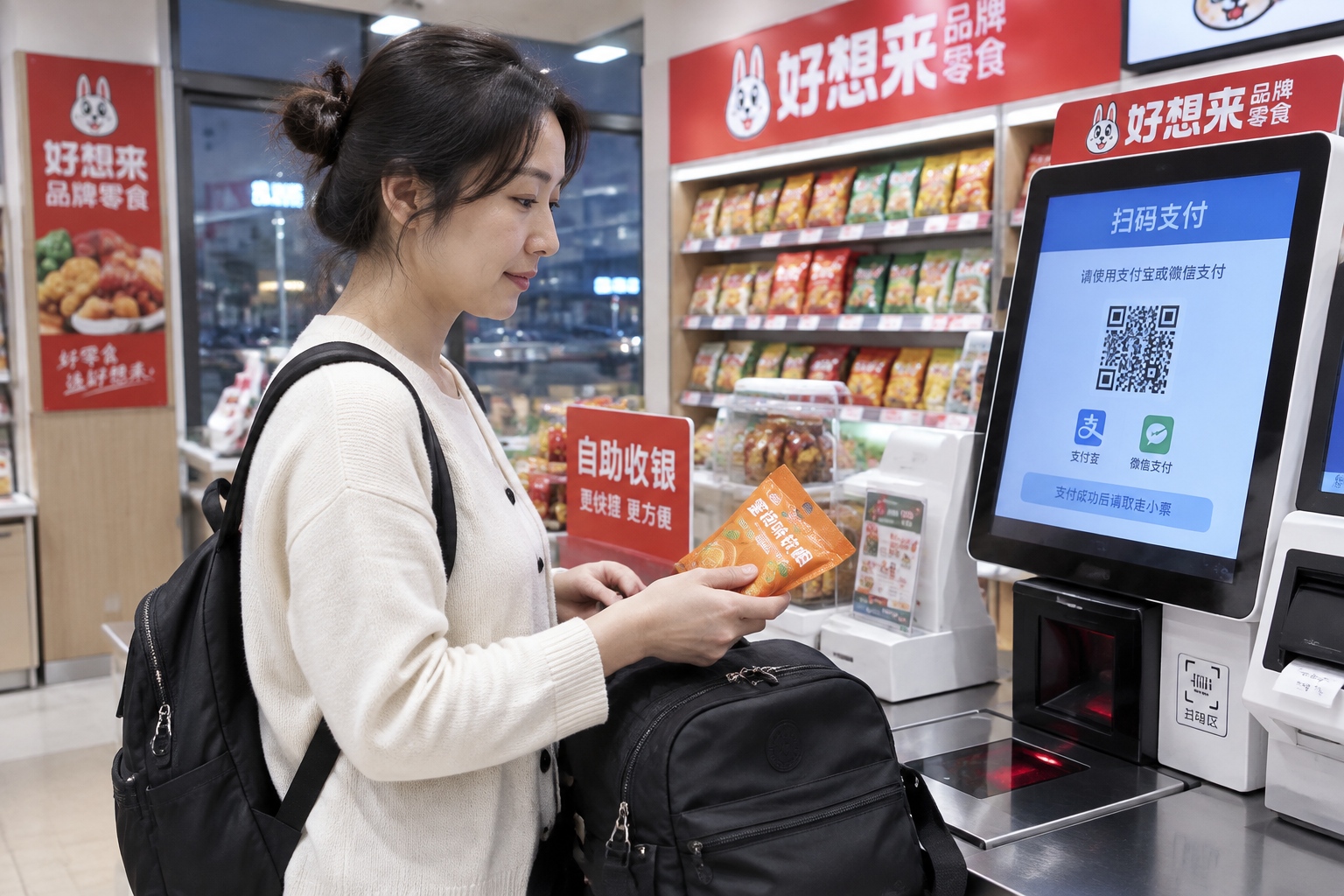
At the checkout, Wang’s basket held 11 items: two packs of shrimp crackers, a box of chocolate milk, a bag of mixed nuts, four packets of small dried tofu, and an orange-flavored candy. The total came to 64.10 yuan. She paid with a QR code on her phone.
I asked her to compare that with what she would have bought at a supermarket. She thought for a moment. “Maybe I would have bought the same things, but spent at least five or six yuan more. And I would have had to stand in line with a big cart. Here, the whole errand takes five minutes.”
“In the end, it’s about not having to open your phone and wait two days for delivery to eat a snack,” she said as we walked out. “When my mother watched the news, she thinks most people are ordering everything online. But for me, the fun of picking the bag and pressing it to see how fresh it is, is something the courier can’t bring.”
I walked with her through the dark street for half a block. She swung the plastic bag gently. Many Chinese consumers, especially younger ones, have moved away from the old habit of buying one big bag of Lay’s and then being tired of it. The new snack stores allow them to buy a small handful of each flavor, to control calories, to keep the kids happy, and to limit waste.
It’s not just the price. The arrangement of the shop is a psychological delight: rows of colorful packages, almost no empty aisles, no harsh shouts from sales staff. You are left alone with your own wants.
The quiet economics of hyper-local retail
Later in the evening, the shop saw a rush between 8 and 9 p.m. A resident in his sixties bought two bags of salted broad beans and a small box of soybean milk; a teenage girl spent exactly 5.2 yuan on four small packages of spicy snacks; a delivery rider walked in and used a vending robot to buy an energy drink. The cashier — a twenty-year-old with a ponytail who studies accounting — told me that the store’s bestseller is the five-spice dried tofu, popular among older residents who used to buy loose snacks from dusty old shops.
Most of these shoppers likely did not know or care that Haoxianglai’s parent company reported more than 4 billion yuan in revenue in 2023, or that other similar chains, such as “Snack Run” and “Zhao Yiming,” have also grown rapidly. What they see is a newly opened store that brightens up a street corner, employs three local students as part-time cashiers, and makes it possible to try nine kinds of potato chips without spending a small fortune.
For China’s post-90s and Gen Z consumers, this model answers a question that older generations didn’t even ask: why should I buy a huge bag of a snack I’ve never tried?
Of course, the boom is not entirely problem-free. Industry analysts have noted that identical products sold at different distance prices can cause channel conflict, and some smaller independent snack shops have seen their customers go to the discount chain nearby. But the popularity of these stores is a proof that, in the world’s largest online shopping market, physical stores can still win over consumers if they offer the right mix of affordability, selection, and instant gratification.
A cart that holds more than snacks
At 9:15, Wang left the shop and strolled toward the small plaza in front of her apartment complex. A few older women were doing square dance at the far end. The snack bag in her hand made a slight rustling sound with each step.
She said: “My husband always says these little packets are overpriced. But honestly, if you take the money spent on one cup of bubble tea and split it into three bags of snacks, it covers more of the evening.”
Her perspective is not a grand theory. It is a practical negotiation with desire, carried out in the bright aisles of a neighborhood store. What she buys, and what millions like her buy, tells you more about China’s consumers than any economic report: they want a tiny pleasure, they want no risk, and they want it now.
Start the discussion at forum.chinacomes.com