


Sophie, a French industrial designer, had been happy at her job at a Shanghai electronics company for three years. When she moved to a local competitor, the joy didn’t last. Her old employer sent a warning letter citing a non-compete clause she had signed in her first week: she could not work for any similar product company in China for 18 months.
Sophie’s first reaction — “I’m not Chinese, this can’t be enforced” — is a common miscalculation. Foreign employees in mainland China are not exempt from restrictions that apply to Chinese workers. However, the enforceability of a non-compete agreement is never automatic. Chinese courts expect the employer to meet strict conditions before they will stop you from taking a new job. This article explains how those conditions work in practice, and what you can do to protect your own career.

Where non-compete agreements get their legal force in China
Non-compete provisions in China are a labor-law topic, not ordinary contract law. The core rules are found in Articles 23 and 24 of the Labor Contract Law, which has applied nationally since 2008. The law applies to any worker who establishes an employment relationship with a company registered in mainland China. That includes an expatriate employee holding a valid China work permit and a signed labor contract.
Article 23 states that an employer may include a non-compete clause in an employment contract or a separate agreement to protect trade secrets or confidential commercial information. It also requires the employer to pay the worker monthly compensation throughout the entire non-compete period after the employment ends.
Article 24 limits which employees may be covered. The law covers:
- senior managers;
- senior technical staff; and
- other staff who genuinely have access to confidential business information.
If you belong to one of these groups, the employer can lawfully ask you to sign a non-compete. If you are a junior engineer who worked only on routine tasks and never saw a customer list or product roadmap, the restriction will be hard for an employer to defend in court.
What the law requires for an enforceable non-compete
Three elements almost always define whether a court will enforce a restrictive covenant against a former employee:
1. A genuine trade secret
Your former employer must point to concrete confidential information that you possessed—for example, proprietary source code, manufacturing methods, pricing strategy, or client contacts. General industry skill, market knowledge, or the poor performance of an old project do not justify a restriction.
2. A reasonable scope, subject matter and territory
Article 24 says that the scope and area of a non-compete clause should be agreed by the parties, but the agreement should not violate laws. Courts read this as a “reasonableness” requirement. A clause that prevents you from joining one identified competitor in the same Chinese region has a good chance of surviving. A clause banning you from working for “any enterprise that might compete with the company, anywhere in the world, in any field connected to electronics,” will usually be reduced or struck down.
3. A monthly financial settlement
The law requires compensation, paid on a monthly basis, while you are restricted. There is no uniform national standard for the amount. Some cities have developed local guidance. In Shenzhen, for example, the local regulations refer to at least 50% of the employee’s average monthly wage over the previous year. Courts in Beijing and Shanghai tend to respect the amount stated in the contract, provided it is not extremely low. A tiny symbolic payment, such as 100 yuan per month, may lead a judge to find the clause unfair and invalid.
What counts as low depends on your salary level and local practice. This is one reason why two factually similar cases may be decided differently in different provinces.
What happens when the employer never pays compensation?
The most frequent point of confusion for departing employees is this: “They said I cannot go to my new job. But they haven’t paid me anything. Does that make the clause pointless?”
The short answer: not in most Chinese courts. A failure to specify compensation does not automatically nullify the clause, and neither does a failure to start paying on time, at least for the first three months.
The Supreme People’s Court’s Judicial Interpretation I on Labor Disputes, effective January 1, 2021, sets out the following rules:
- If the contract says “non-compete” but does not put a price on it, the employee who actually obeys the restriction can sue for compensation. A court will set the amount at 30% of the employee’s average monthly wage for the twelve months before departure, unless higher local standards apply.
- If the employer is responsible for missing more than three months of compensation payments, the employee may ask a court to remove the non-compete obligation.
- If the employer decides it no longer needs the restriction, it can terminate the clause early but must pay the employee an additional three months of compensation as a statutory “exit fee.”
For an employee, the critical takeaway is this: never rely on oral messages such as “We won’t enforce it.” If you do not comply because you assumed the clause had died, but the employer later proves the clause was still active, you risk paying contractual damages. If you choose to comply because you want the restriction to end quickly, you must follow the formal procedures—sending the employer a written notice of the arrears and then, if unpaid for three months, filing a court request to terminate the clause.
Please note that these are national guidelines. Local case practice in Beijing, Shanghai, Shenzhen, Chengdu and other regions can vary in detail.
What a Chinese court examines if you are sued
If your former employer files a lawsuit, the judge will go through a fairly standard checklist:
- Were you truly in a position that required protection of trade secrets?
- Did the employer have a valid trade secret, and did you have access to it?
- Is the restriction narrow enough to protect an actual business interest and allow you to earn a living?
- Did the employer promise and actually pay monthly compensation?
- Was the total period longer than two years? If yes, the court may shorten it.
Many employers try to use non-compete clauses as a scarecrow. They send letters or threaten litigation simply to stop a former employee from moving to a rival, without being ready to prove the above elements. A foreign employee should understand that a letter from a law firm is not a court order. Do not ignore it, but do not assume it automatically reflects what a judge will decide.
Practical steps to protect yourself
The time to reduce your exposure starts long before you hand in your resignation.
Before you sign: Ask for a legally binding English translation of the contract or add a clause that both versions are equal. Compare the list of restricted companies: if it is ridiculously long, request a narrower list. Also negotiate the compensation level. A monthly payment that equals 50–60% of your previous salary makes a non-compete easier to enforce than one at 10%.
At the moment of leaving: Request a written statement from HR stating whether the employer plans to activate the non-compete and the amount of monthly compensation to be paid. If the company says it will not activate it, obtain that in writing as well. A verbal release may not protect you later if a senior leader changes their mind.
If you are complying: Keep document trails proving that you did not engage in restricted work. Avoid using your old employer’s email or phone after your last day. If the new employer is on the restricted list, do not quietly accept a role hoping nobody will notice; that is a high-risk strategy.
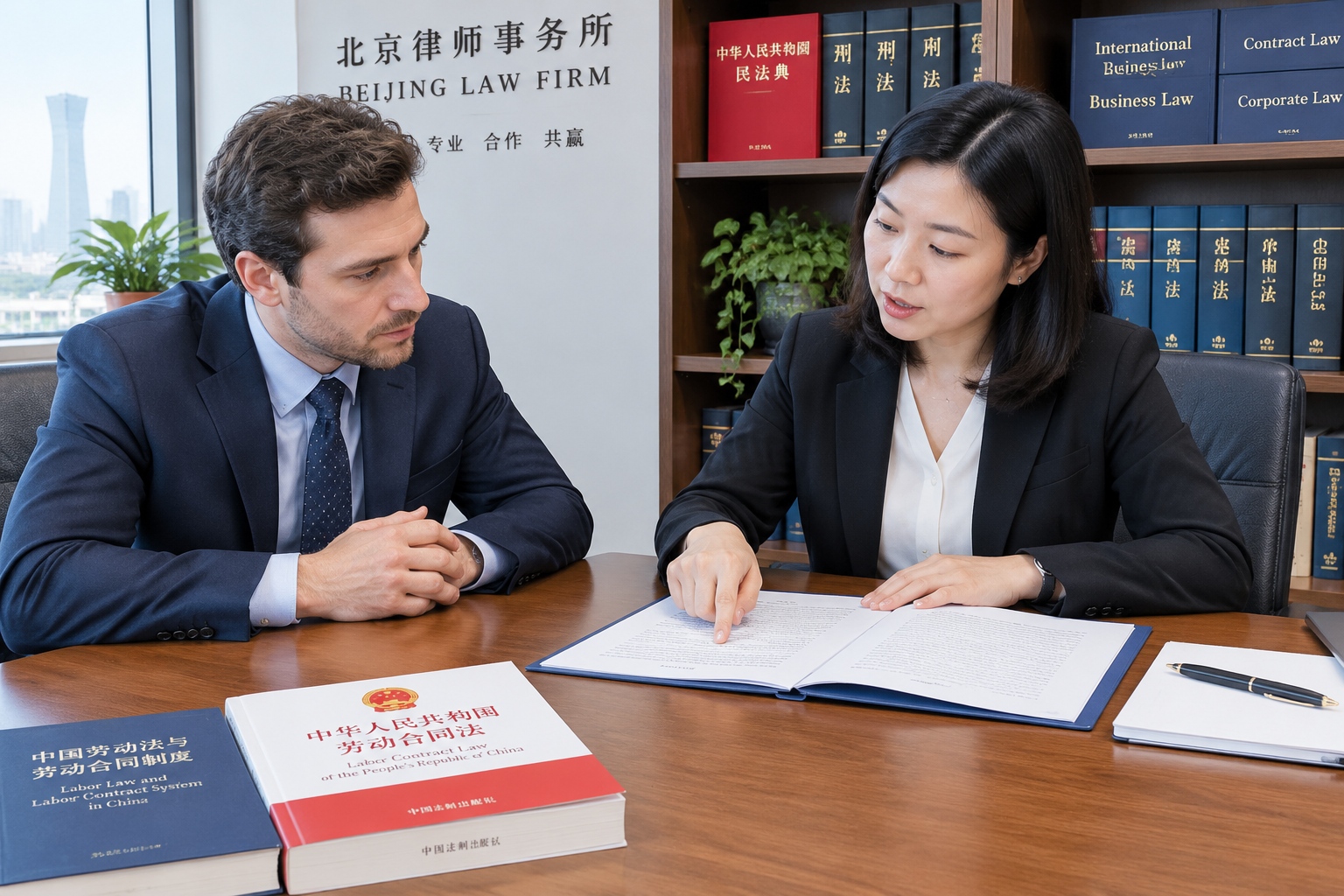
If you are threatened or sued: You should never try to defend the case on your own. Look for a labor lawyer in the city where you worked, preferably one who handles expatriate disputes and is comfortable with both Chinese and English. Most courts in large cities require a Chinese lawyer to represent a party in labor litigation; foreign lawyers cannot appear in mainland Chinese courts. The lawyer can help you argue that the clause is too broad, the compensation is inadequate, or that the employer forfeited the right by failing to pay.
Cross-border complications: can your old employer chase you abroad?
If you leave China and go back home, the legal landscape changes. A company in Shanghai can still file a lawsuit against you in a Chinese court, particularly if your labor contract includes a jurisdiction clause selecting a Chinese court. If you have left China, the court will still accept the case and may send legal documents to your overseas address. If the employer obtains a default judgment, it can attempt to enforce that judgment in the country where you live. Whether that enforcement succeeds depends on the local legal system and whether China has a mutual enforcement treaty with that jurisdiction. For most Western countries, there is no such judicial assistance treaty.
In practice, Chinese employers seldom invest large legal fees to chase a foreign employee across borders, unless the damage is very serious. A larger threat for expatriates who plan to work in China again is that an unresolved Chinese labor dispute could surface in background checks or create trouble for re-entry visa applications.
Final note
China’s non-compete rules are stricter than many people assume, but that does not mean an employer can write anything it likes and expect a court to follow. The two-year cap, the monthly compensation requirement, and the reasonableness analysis give a departing expatriate real room to defend the case where the employer has not acted fairly.
As with most areas of Chinese law, however, the details vary with geography and with the judge’s understanding of your particular role. Treat the information above as a starting point, not as a substitute for advice from a licensed Chinese lawyer. If you are facing a restriction that threatens your next job, take the time to have your specific contract and job history reviewed before you make a move.
Start the discussion at forum.chinacomes.com