

Seven Minutes Into the Clouds
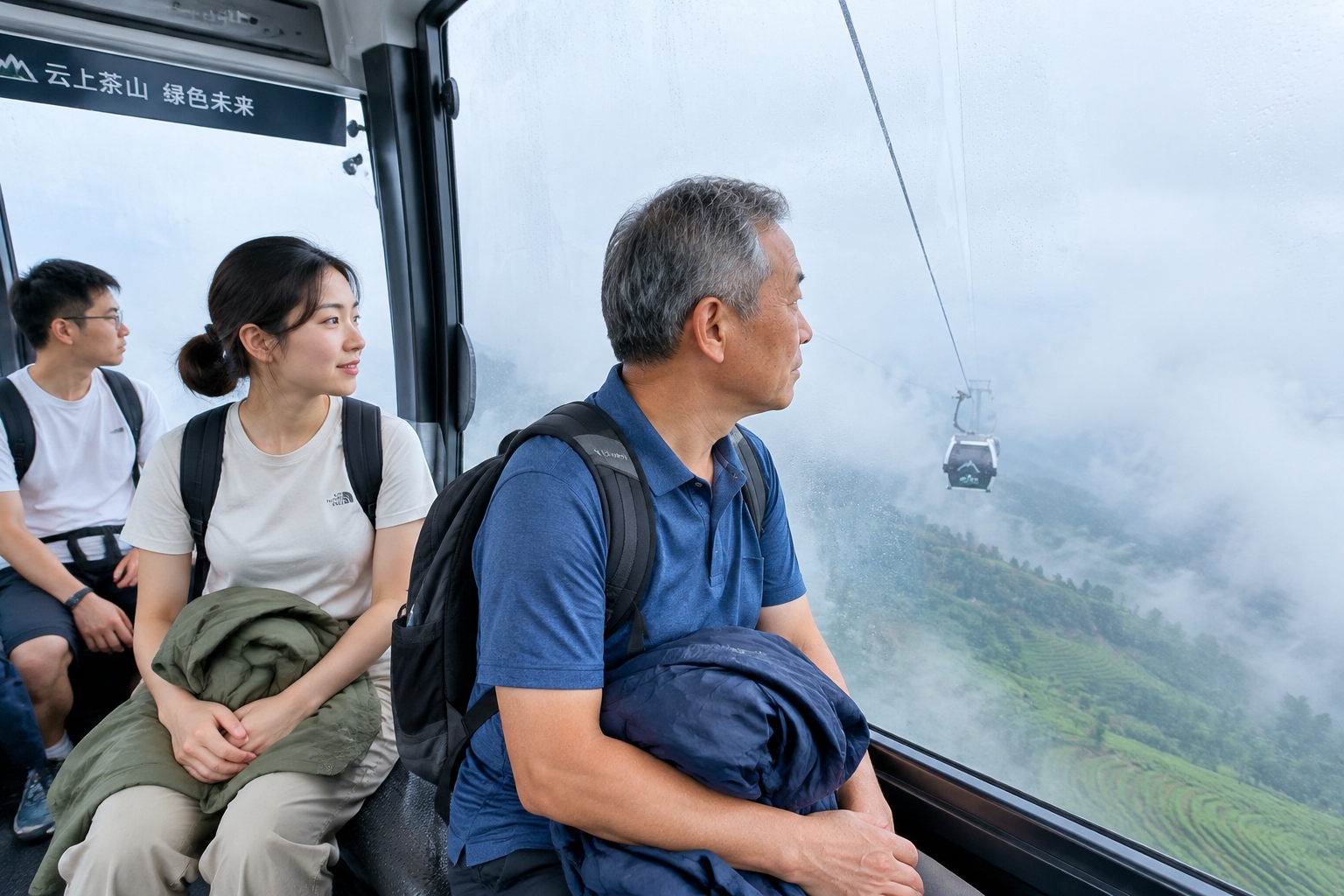
The cable car leaves the valley floor with a jerk that makes everyone grab the rail. For the first two minutes you can still see tea terraces and the roofs of farmhouses below. Then the car slides into cloud, the glass fogs over, and all that is left is the smell of wet pine coming through the vents and the sound of someone in the corner quietly peeling a hard-boiled egg.
When the doors open, the air surprises almost every first-time visitor to Mount Lu: it is cold. In July, the city of Jiujiang, forty minutes below, is a 36°C furnace. Up here, at 1,164 meters, it is 22°C and dripping. People who boarded the cable car in shorts start pulling fleece jackets out of their bags.
A Town That Should Not Be Here
Guling, the little town on top of Mount Lu, was not planned by any government. It was started by a British missionary named Edward Selby Little, who leased a patch of this mountain from local officials in 1895 and began selling plots to foreigners who wanted somewhere cool to survive the Yangtze Valley summer. Within thirty years there were hundreds of houses up here — stone cottages with fireplaces, chimneys and gabled roofs, built by English, American, German, Swedish, Russian and French families, in styles that look as if a slice of the Cotswolds or Bavaria had been lifted onto a Chinese ridge.
Around 600 of those villas survive. They are the reason Mount Lu joined the UNESCO World Heritage list in 1996, and the reason this mountain feels unlike any other in China. You walk down a lane of moss-covered grey stone walls, pass a church, and two minutes later you are standing in front of a Chinese temple with incense smoke drifting out of the door.
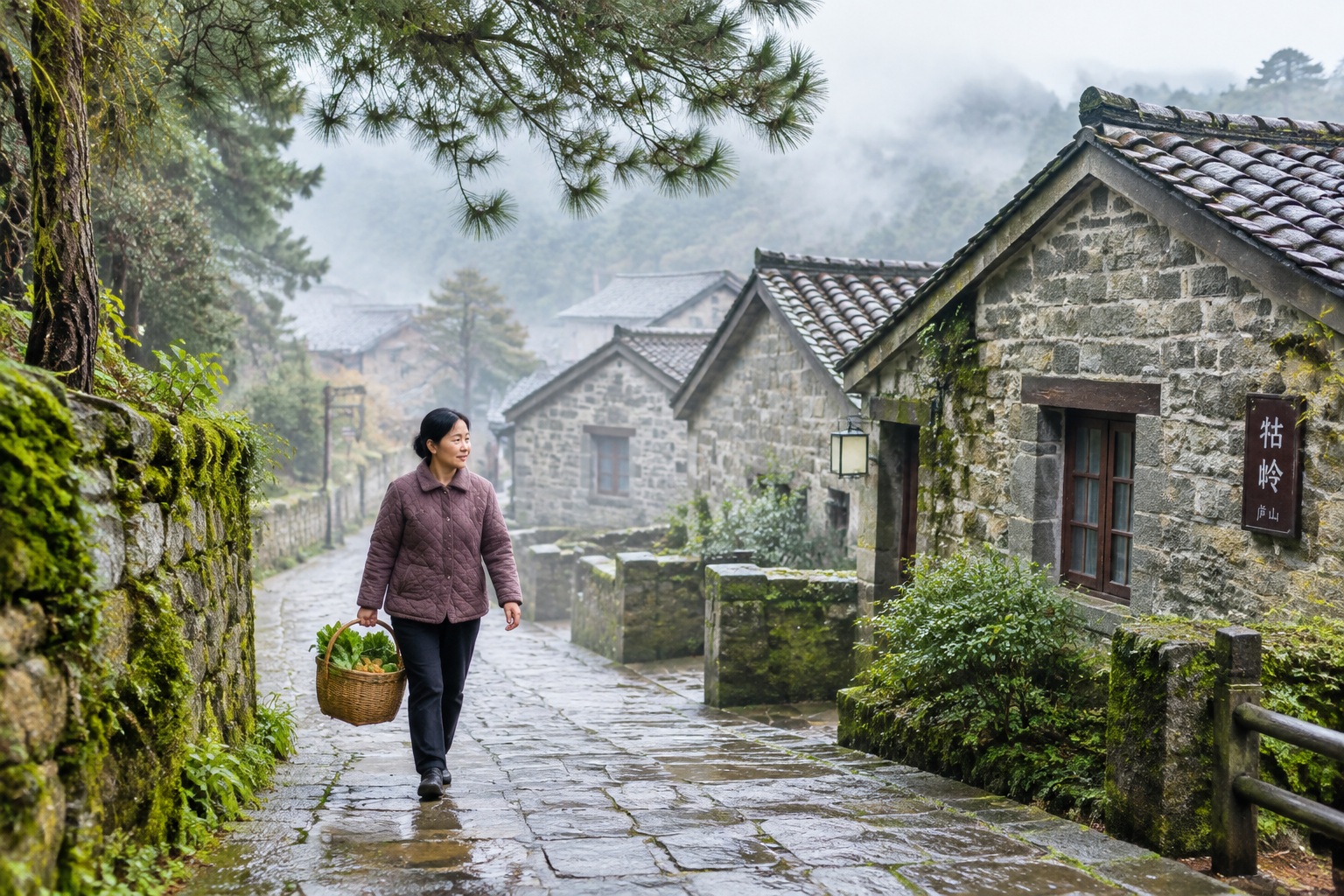
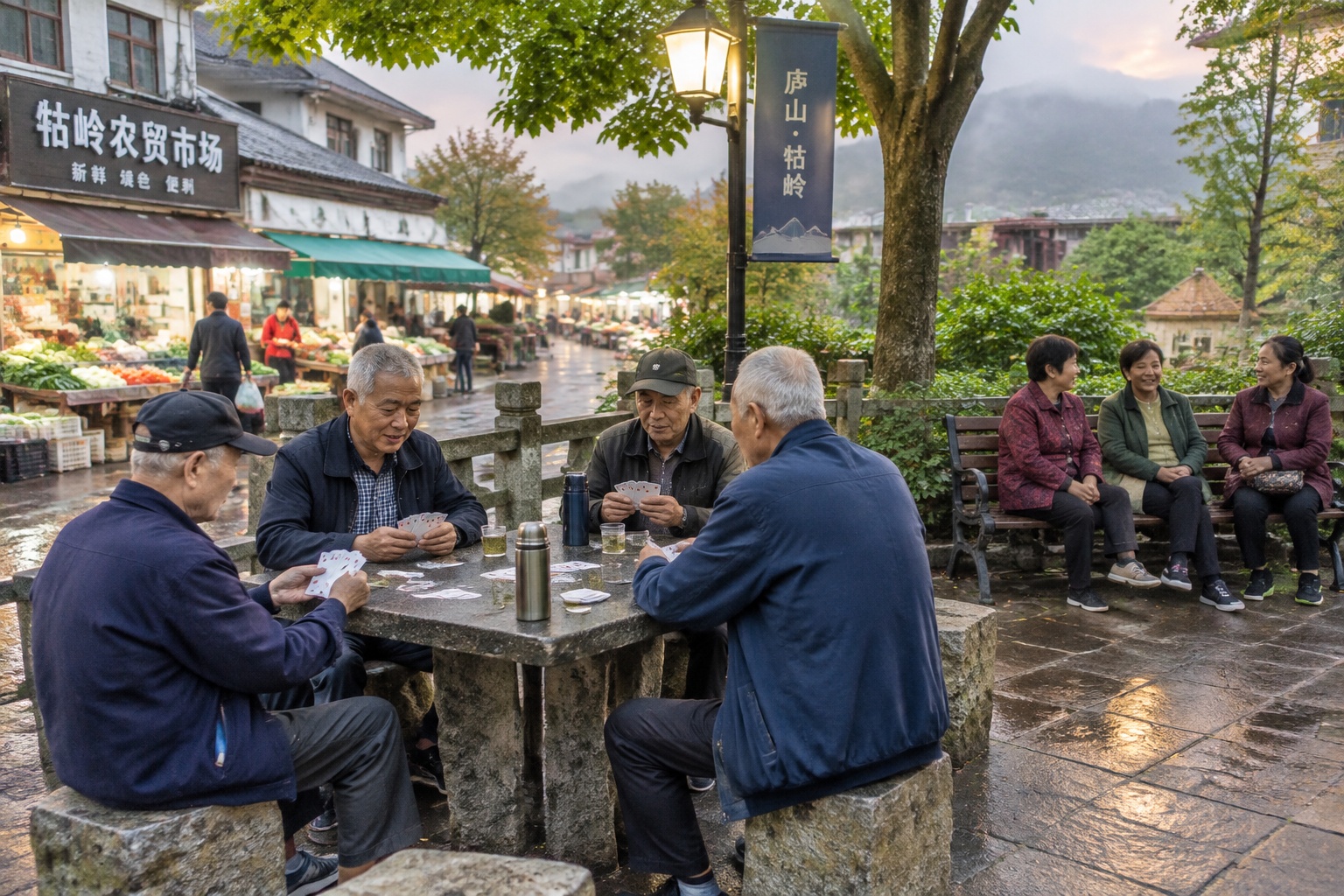
What most visitors do not expect is that Guling is a real town, not a resort. Roughly ten to twenty thousand people live up here year-round. There is a primary school, a hospital, a post office, and a market where the vegetable seller hands you cucumbers and then asks where you are from. Children here grow up above the clouds and, on foggy mornings, walk to class without being able to see the building next door.
The Waterfall That Lives in a Poem
Ask any Chinese person over the age of six what they know about Mount Lu, and they will recite this without pausing:
Sunlight on Incense Burner Peak gives birth to purple smoke; from far away, the waterfall hangs like a river before the mountain. Flying down three thousand feet, it seems the Milky Way has fallen from the ninth heaven.
Li Bai wrote that in the eighth century, and it may be the most memorized piece of nature writing in the Chinese language. Schoolchildren learn it before they can properly read it. It is the reason Mount Lu is on the domestic tourist map at all.
Here is what surprises people: Li Bai was almost certainly not writing about the most spectacular waterfall on the mountain. His poem describes the cascade at Xiufeng, on the southern slope. Sandiequan — Three-Step Spring — a 155-meter drop in three tiers, is a different fall entirely, and it was not famous until centuries later. Local accounts say a woodcutter found it during the Song dynasty, and that the philosopher Zhu Xi, who badly wanted to see it, never managed the trip and regretted it for the rest of his life.
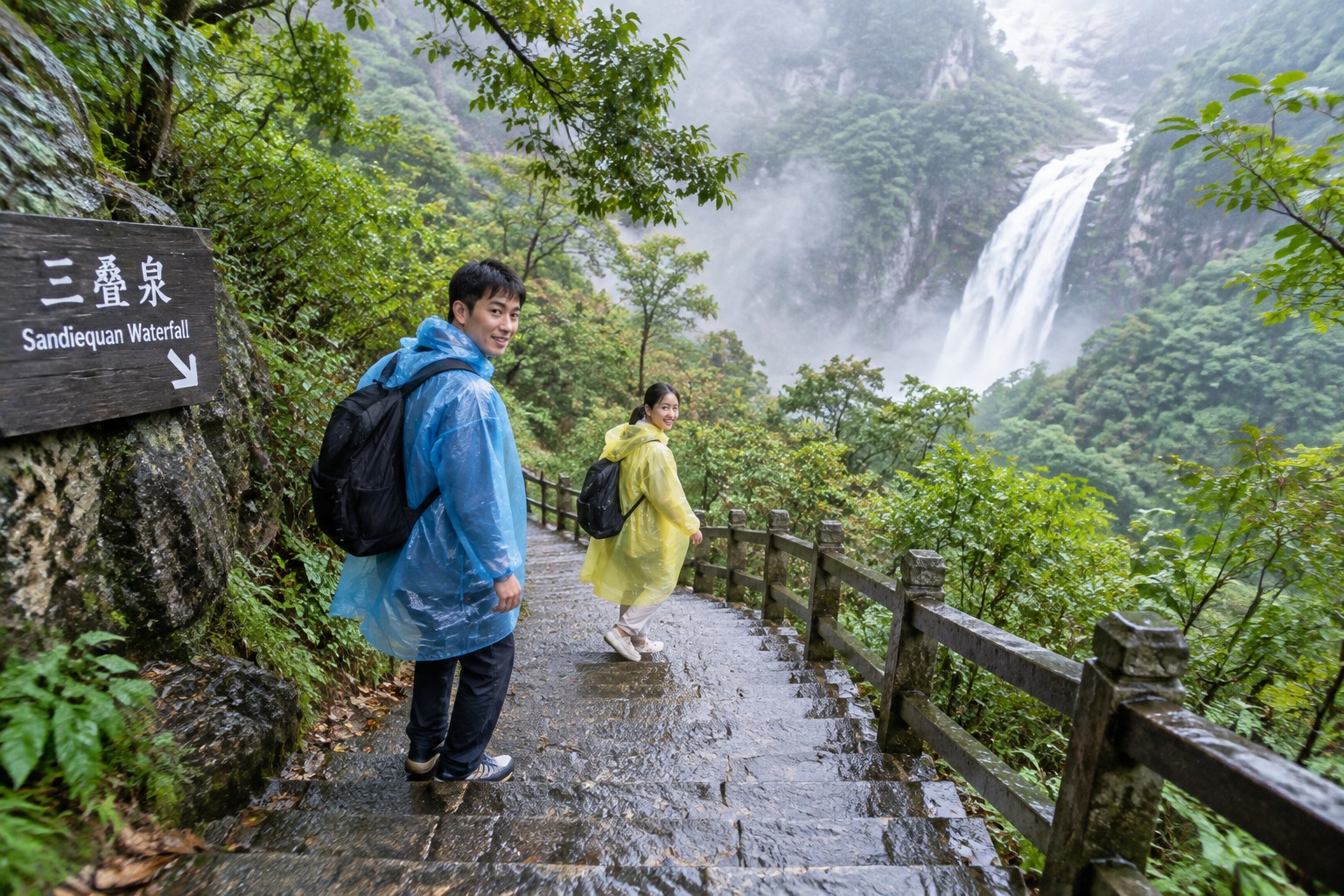
Visiting Sandiequan is a commitment. From the nearest shuttle stop you descend somewhere between 1,300 and 1,500 stone steps, steep and often slick with mist. It takes about an hour down. Old women sell tea eggs and bottled water at the halfway point. Porters with bamboo sedan chairs will offer to carry you back up for a few hundred yuan, and on a wet afternoon that offer starts to sound reasonable.
At the bottom, the water lands in three distinct stages, each with its own thunder. Depending on the season it is either a roaring white curtain or a thin silver thread down black rock. Both are worth the stairs. Neither is worth underestimating the stairs.
The Villas Have Seen Politics
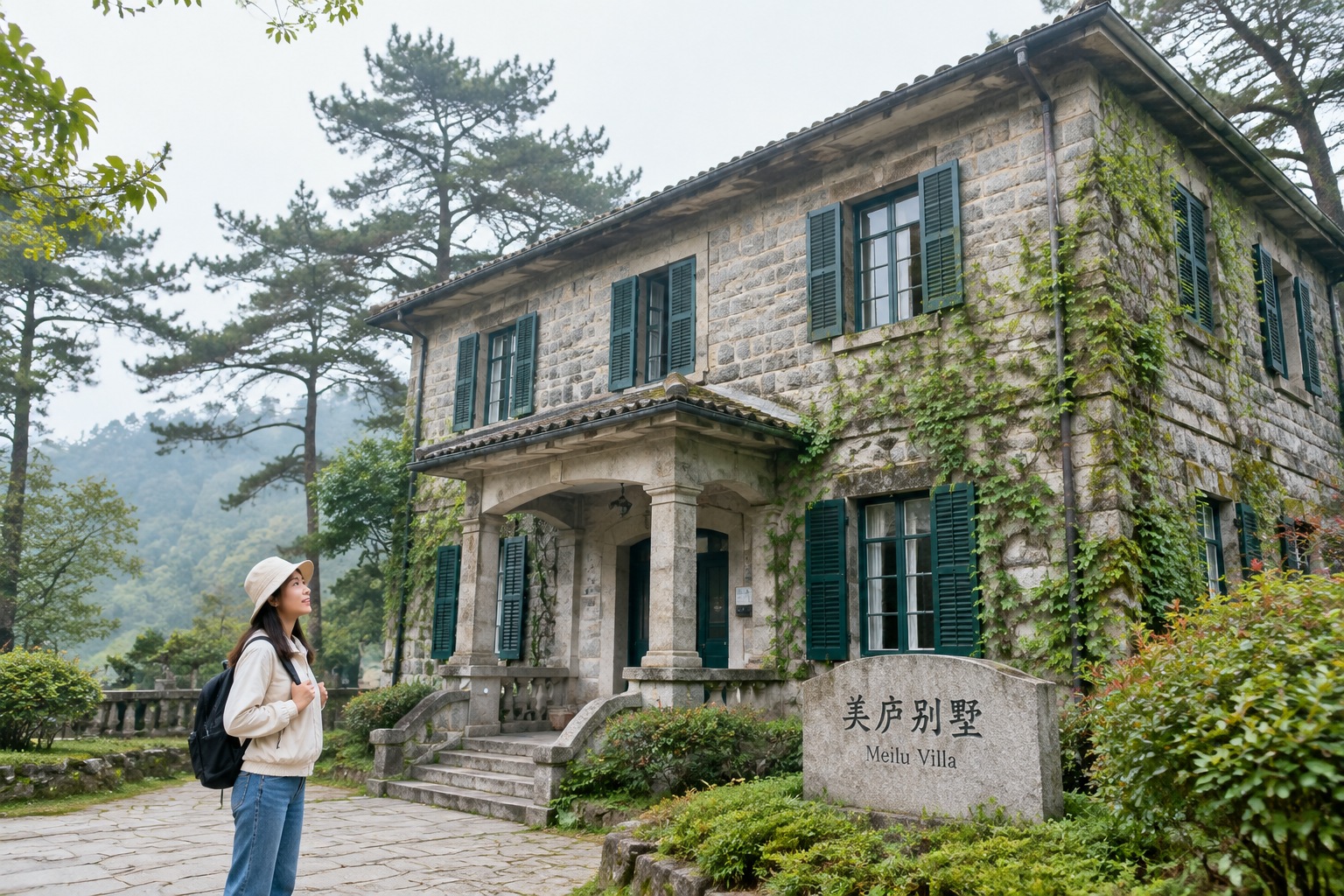
For about fifty years, from the 1920s into the 1970s, Mount Lu’s villas were where modern Chinese politics went for the summer. Chiang Kai-shek and his wife Soong Mei-ling kept a house here, Meilu Villa, a two-storey stone building with a garden and a small chapel. In July 1937, Chiang stood on this mountain and announced China’s resistance to the Japanese invasion, in a speech broadcast nationwide.
After 1949, the same villas filled with a different set of officials. In 1959, Mao Zedong convened a meeting at Mount Lu that began as an economic review and ended with the fall of Marshal Peng Dehuai, who had criticized the Great Leap Forward. The building where it happened is still standing.
You can visit Meilu Villa today. The furniture, the photographs and the bathtub are preserved, and the ticket costs a few dozen yuan. What makes it interesting is not the objects but how small and ordinary the rooms are. It is a summer house, not a palace. People who were arguing about the future of hundreds of millions of lives were doing it in rooms with creaking wooden floors and windows that look straight into the fog.
What People Actually Do Up Here
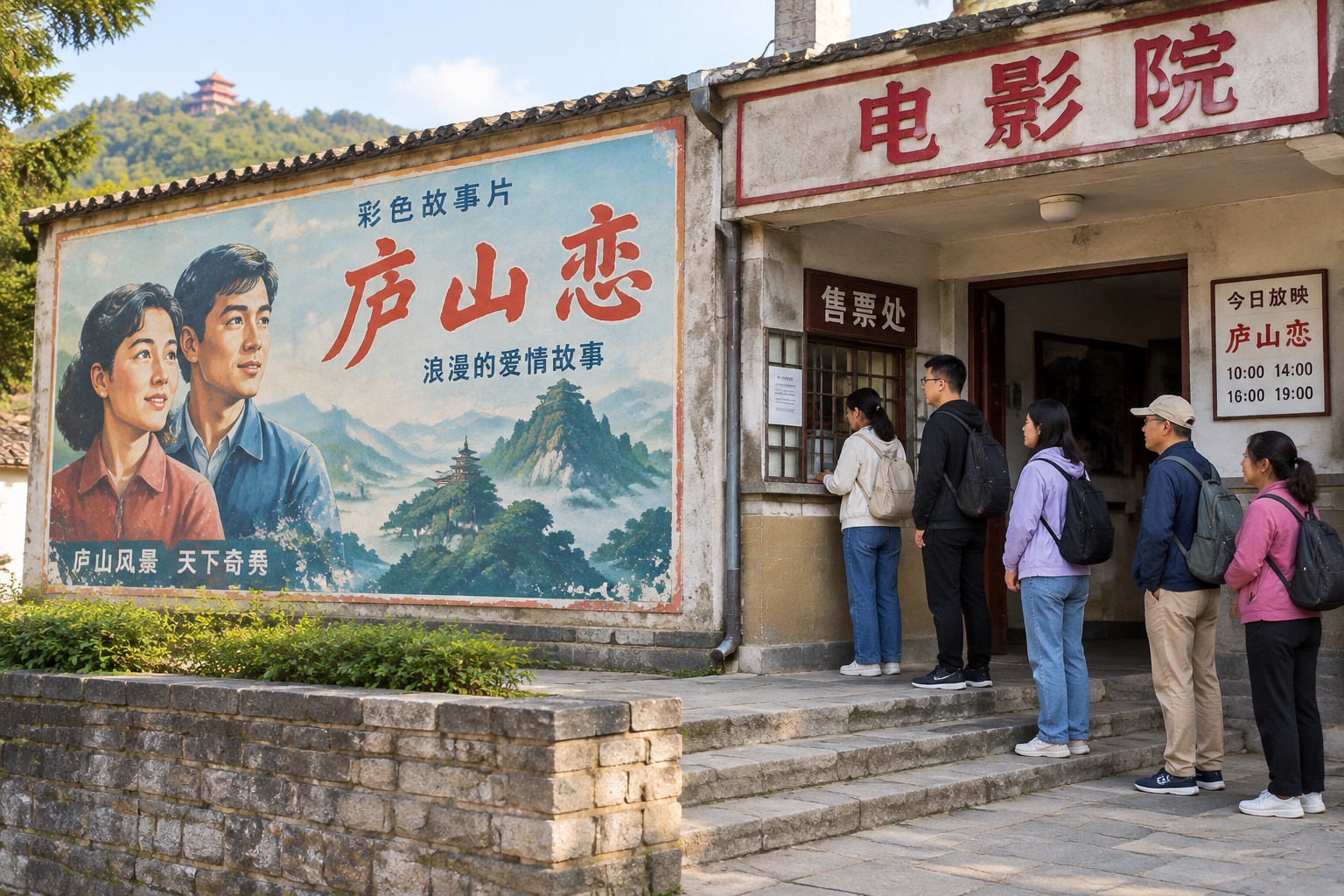
There is a cinema in Guling that has screened the same film, Romance on Lushan Mountain, almost every day since 1980. The movie, a love story between a visiting Chinese-American girl and a local boy, contained one of the first on-screen kisses in post-1949 Chinese cinema and turned the mountain into a honeymoon destination. The cinema claims a Guinness record for the longest-running continuous screening of a single film. Tickets are cheap. Tourists still go, mostly for the joke, and end up watching the whole thing.
Others come for the tea. Lushan Yunwu — cloud and mist tea — grows on these slopes and is sold all over town: some of it excellent, some of it repackaged from the lowlands. Buy from a shop where you can taste before you pay.
At five in the morning, people gather at Hanpokou, a viewpoint on the eastern edge of the mountain, to watch the sun rise over Poyang Lake, China’s largest freshwater lake. When the weather cooperates, the lake looks like a second sky. When it does not, you stand in grey nothing for an hour with two hundred other people and then go get breakfast.
And there is the everyday stuff: retirees playing cards on stone tables in the park, school groups in matching hats, a woman drying chilies on a wall outside a villa where a German consul once slept. Mount Lu’s odd charm is exactly this mix. It is a nature reserve, a colonial hill station, a revolutionary site and somebody’s actual hometown, all stacked on one ridge.
If You Go
Getting there: Take a high-speed train to Jiujiang or Lushan Station. From there, buses climb the mountain on a road with 396 bends; it takes about 50 minutes and the last twenty are unpleasant if you get carsick. The cable car from the base is faster, around seven to ten minutes, and far more comfortable.
Costs: Expect roughly 160 yuan for the mountain entrance in peak season, plus about 90 yuan for the shuttle bus that links the sights inside the scenic area. The cable car is separate. Prices change, so check before you travel.
Best time: Late September to early November usually gives the clearest views. May and June are the mist months — beautiful, but you may see nothing at all. July and August are cool and crowded. Avoid the first week of October, when the whole country is on the move.
Stay overnight: Do not do Mount Lu as a day trip from Jiujiang. The mountain is at its best early in the morning and around dusk, after the tour buses leave. Guling has guesthouses and hotels at every price point.
Practical notes: Fog can erase the entire view for a full day, so build in two. Wear shoes with grip; the stone steps get slippery. Alipay and WeChat Pay linked to a foreign bank card work almost everywhere, but keep a little cash for small vendors. Bring your passport — you need it to check in — and confirm in advance that your hotel accepts foreign guests, since not every small guesthouse is registered to.
What You Remember
Not the poem, and not the villas. It is the sound of water at night, when Sandiequan keeps going and you are lying in a bed in a stone house built by someone who sailed here from Liverpool in 1901, and the fog presses against the window, and somewhere below, a town of ten thousand people is living its ordinary life 1,164 meters above the rest of China.
Start the discussion at forum.chinacomes.com