


A crowd of red figures, thirty metres above the river
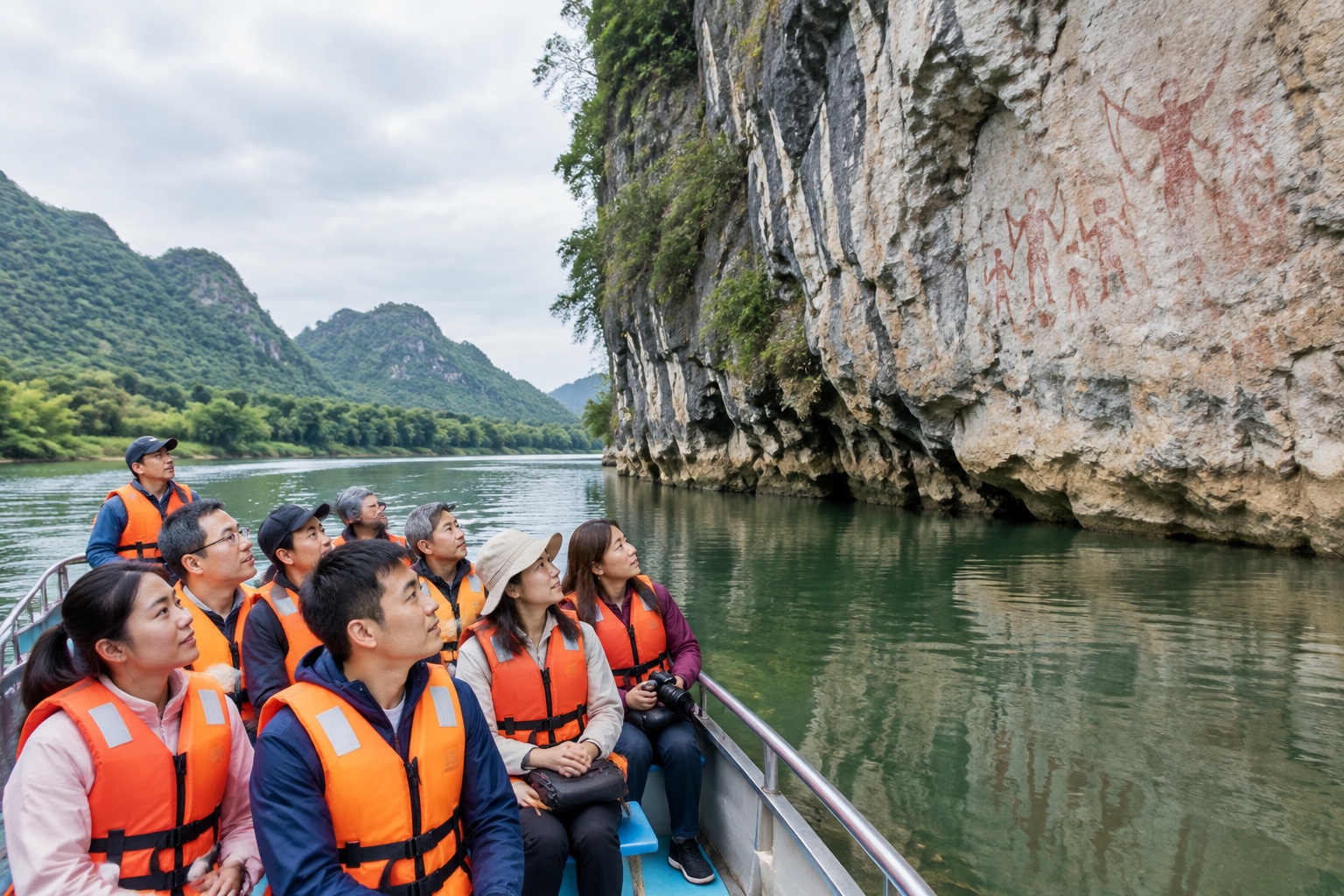
The boat engine cuts out before you see anything. The Zuo River swings around a wall of grey-green limestone — the soft, rounded karst scenery that fills Chinese landscape paintings — and then, about thirty metres above the waterline, there is a crowd. Not people. Figures, painted in a red so saturated it looks recent: squatting bodies with knees splayed outward, arms raised and bent at the elbow, standing in clusters of ten, twenty, sometimes forty across a cliff face roughly the length of a football pitch.
They are about 2,000 years old. Nobody repainted them. The red is still red.
Most visitors to China have never heard of the place. Huashan — “flower mountain,” though the name really describes the speckled look of the rock — sits on the Zuo River in Ningming County, Chongzuo, in the far southwest of Guangxi, close to the Vietnamese border. It was inscribed as a UNESCO World Heritage Site in 2016 under the name Zuojiang Huashan Rock Art Cultural Landscape. That same year, the Great Wall received visitors in the tens of millions. Huashan received a fraction of a fraction.
That gap is exactly why it is worth the detour. The site also poses a question archaeology still cannot close: why did people 2,000 years ago climb onto ledges above a river and paint hundreds of bright red humans onto the stone?
What is actually on the cliff
The main Huashan cliff runs about 220 metres along the river and rises more than 40 metres. On it, researchers have counted close to 1,900 individual figures. The Zuojiang basin as a whole holds 38 known rock art sites, with thousands more figures between them; Huashan is simply the largest and densest.
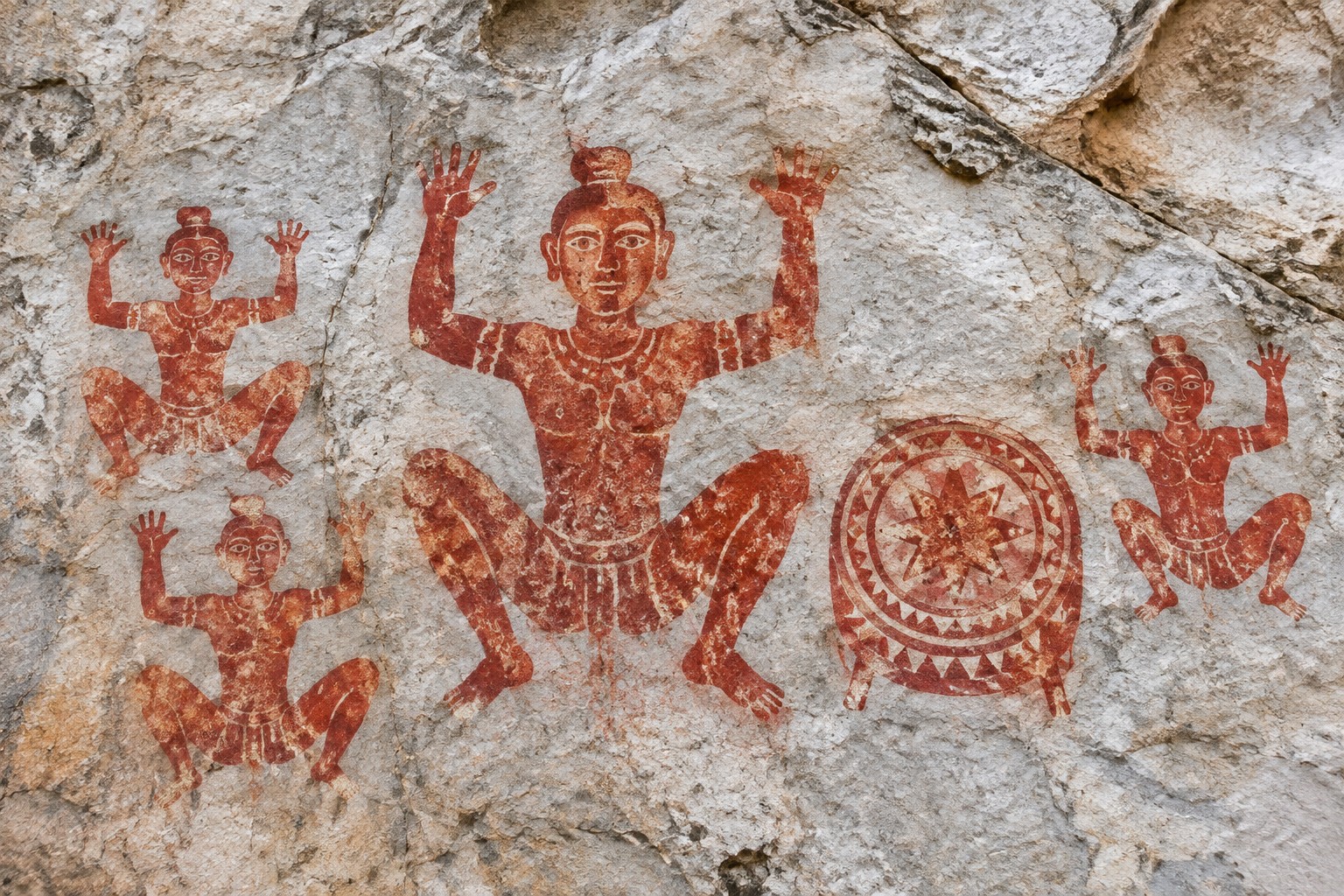
Size varies wildly. Most figures are between 60 centimetres and 1.5 metres tall, but the biggest reach nearly three metres. The dominant posture is what Chinese scholars call the squatting, or frog, pose: legs bent and pushed out to the sides, arms lifted, elbows bent, hands up. Some hold what look like swords or short knives. Others have clearly drawn genitalia or rounded bellies and are usually read as female.
Mixed in with the humans are animals — dogs, mostly, sometimes on leads — and objects: bronze drums drawn as circles with a star or sun pattern in the centre, boats full of rowers, and what appear to be feathered headdresses or ritual masks. Many of the figures seem to be arranged in scenes rather than scattered at random. In several clusters a large central figure is surrounded by smaller ones, as though a leader is being ringed by a crowd.
These were not Han Chinese painters
Dating the paintings is difficult, because you cannot radiocarbon-date a mineral pigment directly. The current consensus, based on the style of the bronze drums depicted, artefacts found in the region, and the geological setting, puts the main painting period between roughly the 5th century BC and the 2nd century AD — from the Warring States period through the Eastern Han dynasty.
The people who made them are identified as the Luo Yue, a group that lived across what is now Guangxi and northern Vietnam. They were not Han Chinese. They cast bronze drums, farmed rice in river valleys, and were eventually absorbed into the expanding Han empire and the wider ethnic mix of the region.
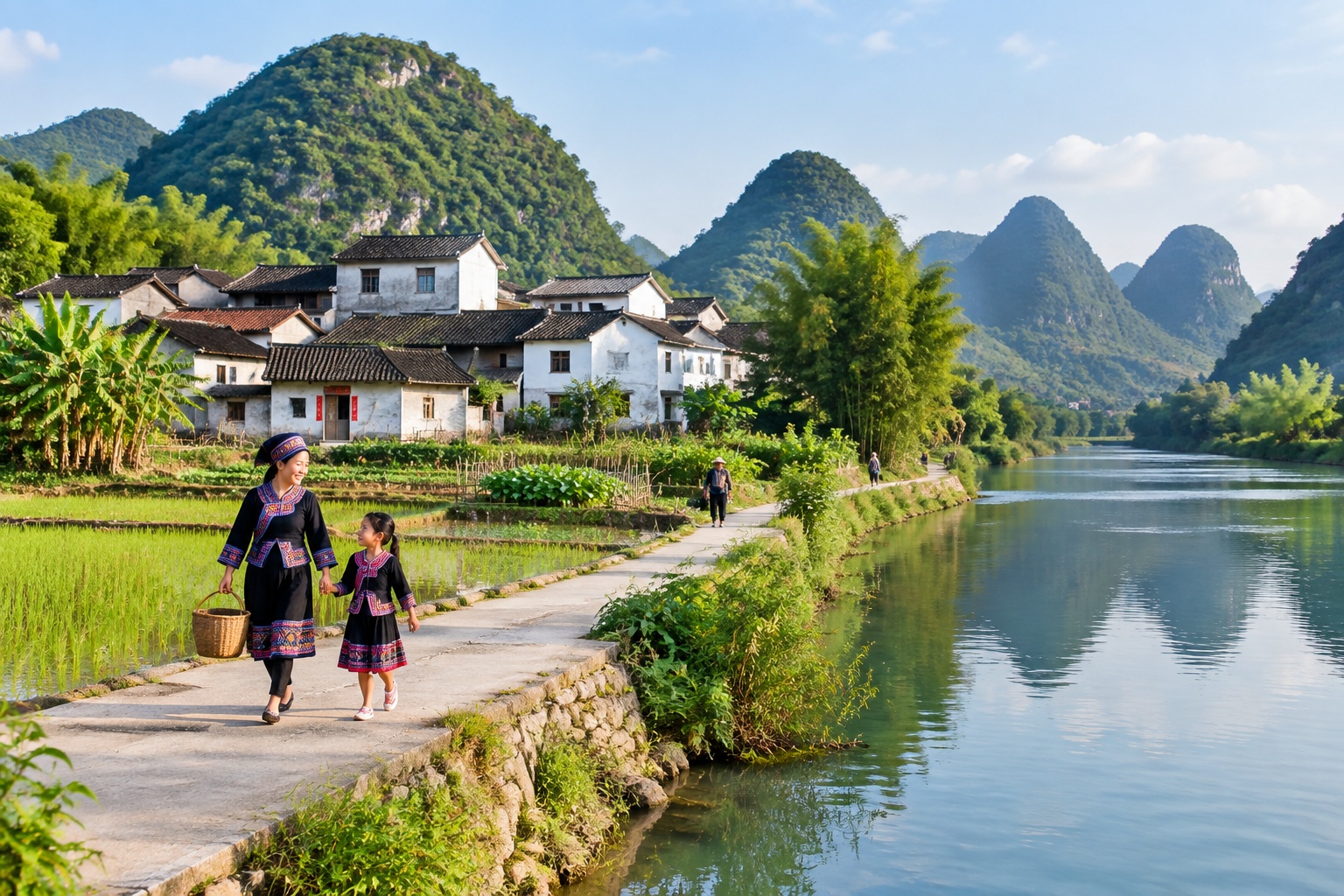
Their most direct descendants today are the Zhuang, China’s largest ethnic minority, roughly 18 million people and the dominant population in this part of Guangxi. Here the archaeology stops being abstract. In Zhuang villages elsewhere in Guangxi, a festival still exists called the Frog Festival, held in the first lunar month. Villagers find a frog, seat it in a small sedan chair, parade it through the fields with drumming, and bury it with ceremony to ask for rain. In the Zhuang imagination the frog calls the rain and is a friend of thunder.
Look again at the figures on the cliff — knees out, arms up — and the frog reading is hard to ignore.
Why red, why the cliff, why so high up
The colour is not decoration. The pigment is iron oxide — hematite, essentially rust — mixed with an organic binder that analyses have suggested was animal glue, plant sap, or possibly blood. It belongs to the same family of pigment used in cave art on every continent, and red carries the same associations nearly everywhere: blood, life, heat, danger, the sacred.
As for location, the cliffs chosen are almost always directly above water, often at bends or confluences where the river shifts direction. Several painted surfaces are clearly visible from a boat; others require you to stand almost directly beneath them. The likeliest explanation is that the river itself was the stage. Boats, drums, chanting, a painted cliff as backdrop — the images may be less like pictures and more like one permanent piece of a performance that happened on the water.
Height is more practical than mystical. Anything painted at eye level in a monsoon climate would have washed away within decades. The panels that survived are the ones tucked under overhangs, angled away from direct rain.
The paint that will not fade
Two thousand years of subtropical rain, sun and humidity should have erased these images. They did not. Part of it is the rock itself: many panels sit under a limestone overhang that sheds the heaviest rain. Part of it is chemistry — iron oxide is extremely stable and does not break down in light the way organic dyes do.
There is a third factor that makes conservators slightly nervous. In places, a thin translucent layer of calcium carbonate has grown over the paintings, like ice forming in slow motion. Elsewhere, mineral crusts have flaked away and taken pigment with them. Water seeping through the limestone is the main long-term threat, which is why access is tightly controlled and why you are not allowed to touch anything, or to bring a boat close enough to try.
What it is like to visit
Ningming is roughly a two-and-a-half-hour drive from Nanning, the capital of Guangxi. There is also a high-speed rail line to Chongzuo, about an hour and a half further by road. From the scenic area dock, small tour boats run upriver to the main cliff, and a viewing platform on the opposite bank gives you the full width of the panel at once.
Go in the morning if you can. The cliff faces roughly east, and low sun picks out the red instead of flattening it. In the dry season, roughly November to April, the Zuo River runs clear and green; in the wet months it turns brown and rises, and the boat route sometimes changes. Life jackets are compulsory, and the boats keep a respectful distance.
Practical notes for foreign visitors: bring your passport, since it is needed for ticketing. The site museum near Ningming has some English signage, but the boats and the cliff itself are mostly explained in Chinese, so a translation app or a local guide helps. Weekdays outside Chinese public holidays are quiet. You may find yourself on a boat with a dozen people, looking at paintings that several hundred million Chinese have never seen either.
What has changed since 2016
World Heritage listing tends to bring pavement, and it did here. Roads into the scenic area were improved, a visitor centre and museum were built, and villagers from the surrounding Zhuang communities took jobs as boat operators, ticket staff, cleaners and guesthouse owners. Rice farming along the river did not stop; it simply stopped being the only income.
The crowds, so far, have not arrived the way they have in Guilin, three hours east, where tour boats queue nose to tail. On a normal weekday the Zuo River is still quiet enough that you can hear your own boat’s wake against the bank.
The questions that remain
Nobody knows exactly what the ceremonies were. The Luo Yue left no writing that anyone has deciphered, and the paintings carry no captions. Along the same river there are many limestone cliffs with similar surfaces, but only some were painted — and no one can say why those and not the others.
Then there is the ending. Roughly 2,000 years ago, the painting stops. Not gradually, as far as anyone can tell. It simply ends, around the time Han authority pushed into the region. Whatever ritual kept people climbing onto ledges with brushes and pigment for centuries lost its reason to continue.
Which leaves you with the scene as it is: a green river, a grey cliff, and a few hundred red people who have been standing in the same posture, waiting, since before the Roman Empire reached its height.
Start the discussion at forum.chinacomes.com