
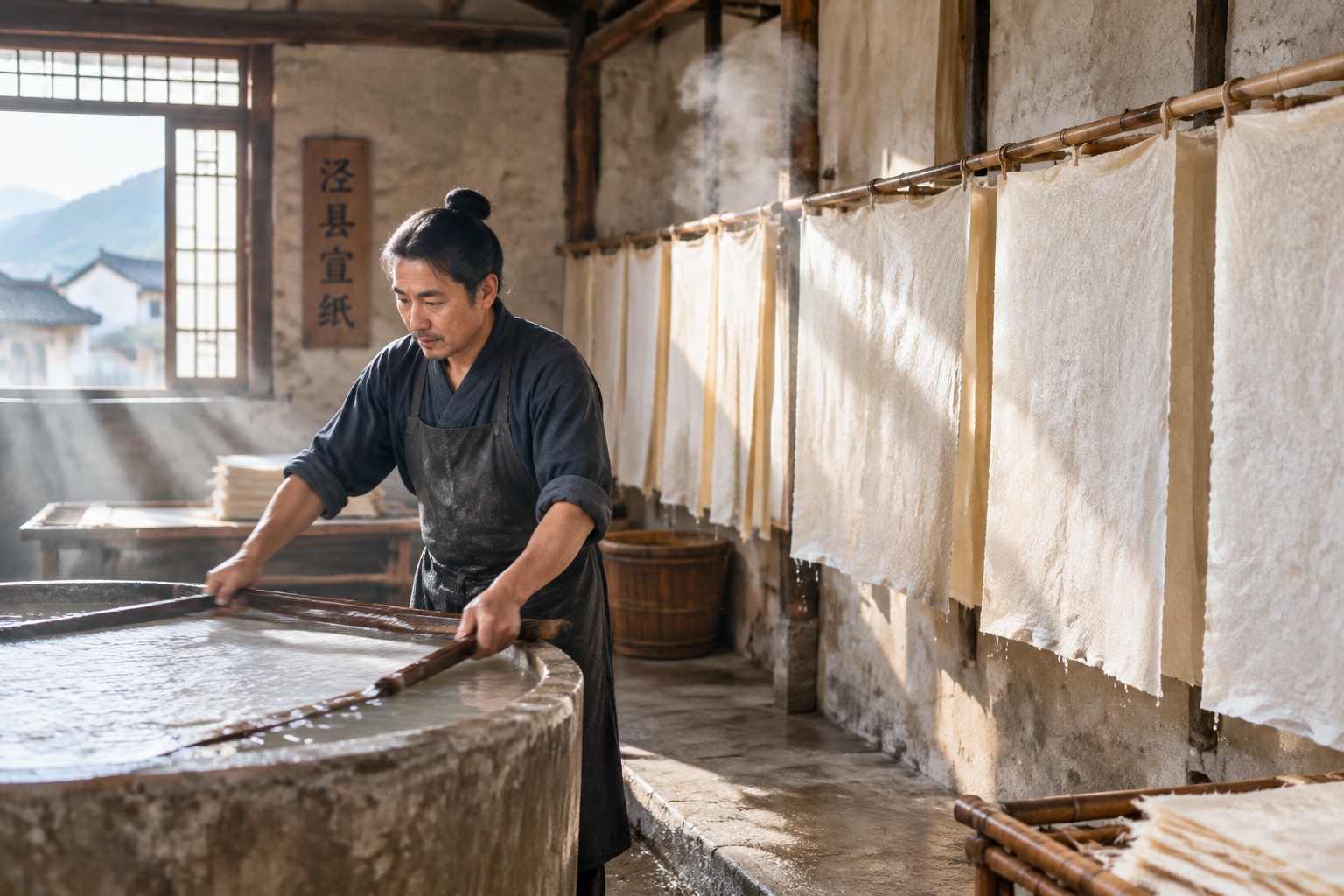

At 5:30 in the morning, the paper village of Shuanglu in Jing County, Anhui, is still half-asleep. Inside a low workshop lit by a bare bulb, 54-year-old Cao Ming rolls up his sleeves and plunges his arms into a water tank full of strips of bark. The water is bitingly cold. He grabs a handful of wet bark, rubs it between his palms, and peels away the dark outer layer, leaving pale, fibrous ribbons. This is the first of dozens of steps that will, nine months later, turn this rough plant material into a single sheet of xuan paper—the legendary surface that Chinese calligraphers and painters have trusted since the Tang dynasty.
Xuan paper was inscribed on UNESCO’s Intangible Cultural Heritage of Humanity list in 2009. Its nickname, “paper that lasts a thousand years,” is earned: the fine fiber structure and alkaline-free processing allow ink to sit on the surface without bleeding, and the paper resists decay far longer than ordinary paper. Museums in China and Japan still use xuan paper to repair ancient books. But behind those lofty credentials lies a more humble, physical reality: hundreds of repetitive, exacting tasks performed by hand in steamy workshops, oxen-level labor dressed up as art.
The Long Season of Bark and Straw
Cao’s day starts twelve hours earlier than the paper itself. The bark comes from the wings of the blue sandalwood tree (Pteroceltis tatarinowii), which grows wild in the rocky slopes around Jing County. Harvested in winter, when the sap retreats, the branches are steamed, peeled, and then left to soak and rot in lime water for weeks. After that, the fibers are washed in mountain streams and bleached by sunlight on flat stones. This “sun worship” is not a metaphor; the pulp must be laid out for days under strong UV to turn white. Only then is it mixed with rice straw—another slow-demanded material—and manually beaten with wooden mallets into a creamy pulp.
One of Cao’s brothers, Xu Wenbin, 46, tends the beating shed. He uses a heavy hammer that raises and drops by a water wheel, a mechanism unchanged for centuries. “The beating has to be fast enough to soften the fiber, but slow enough not to tear it,” he says, feeling the pulp between his calloused fingers. “You get a sense only after many years of practice.”
The Rhythm of the Vat: Wet Sheets and Muscle Memory
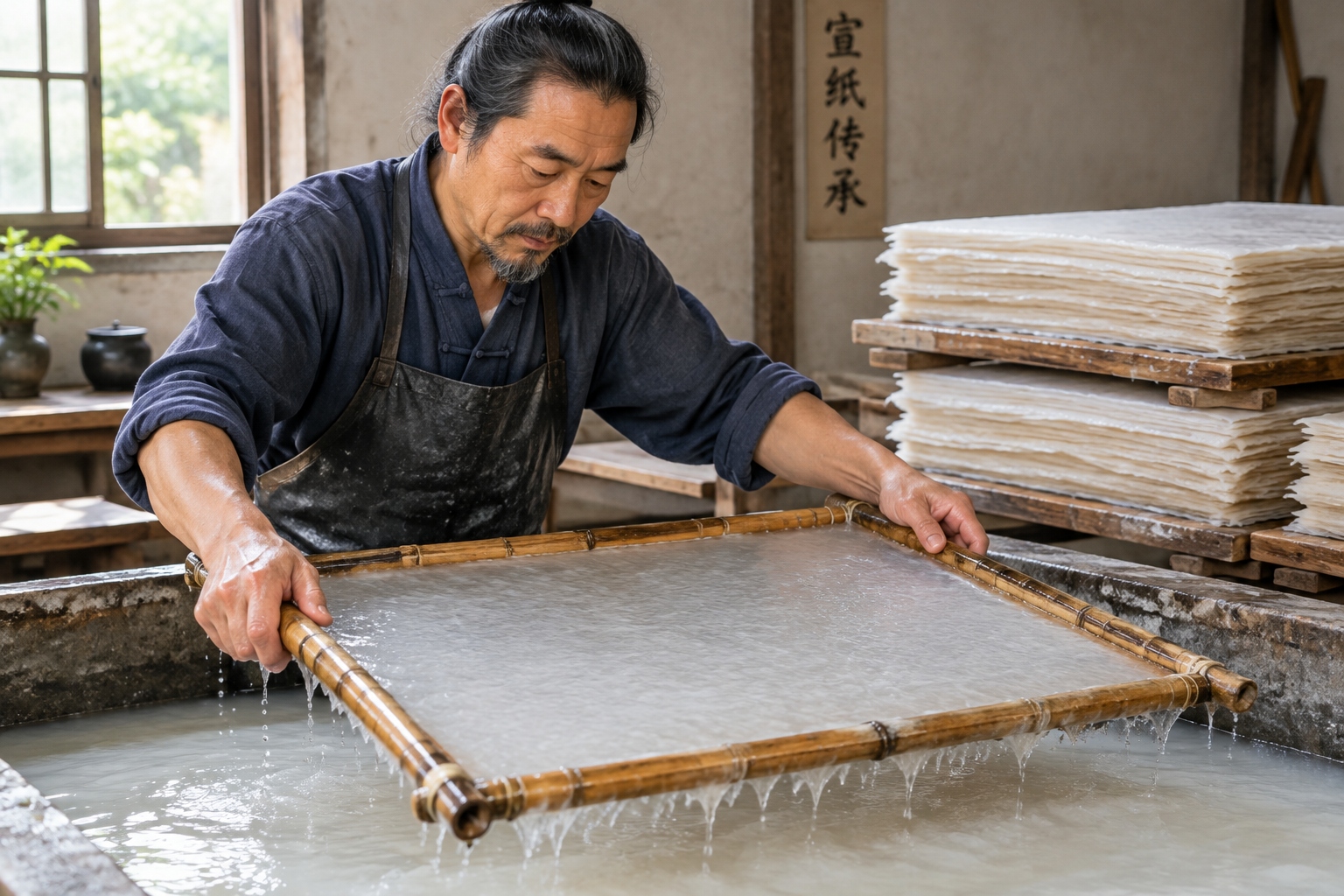
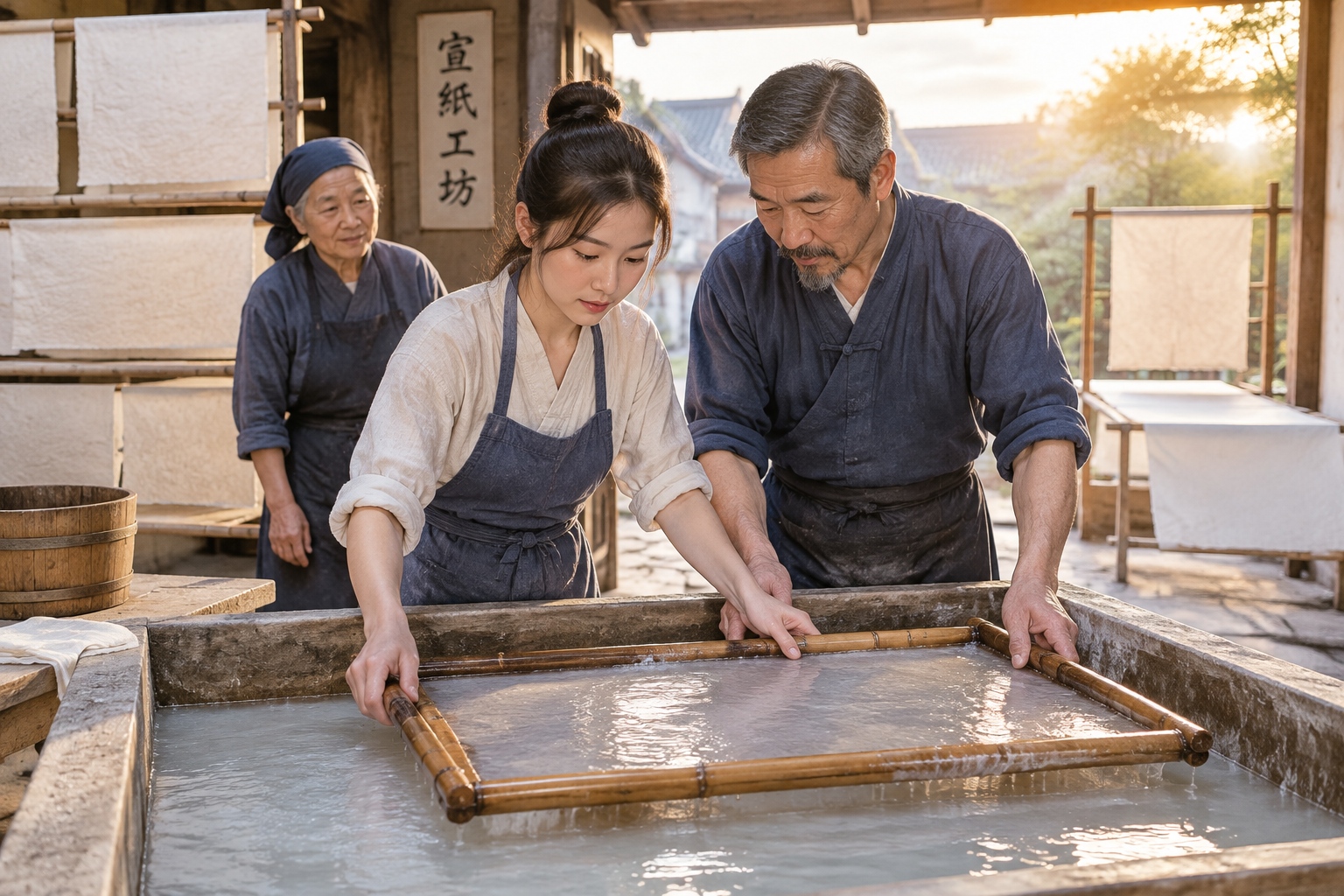
The most famous step is *cǎozhǐ* — sheet-forming at a vat. In the main hall of the workshop, a long trough of watery pulp sits in front of a wooden frame. The vatman, Chen Guoping, 39, stands with his knees slightly bent. He holds a bamboo-screen mold—a rectangular mesh stretched over a frame. With one smooth motion, he dips the mold into the pulp, shakes it repeatedly, lifts it out, and drains the water. A thin film of fiber clings to the screen. He then flips the screen upside down to deposit the wet sheet onto a pile. The whole process takes less than ten seconds, yet it demands nearly five years of training to get the sheet uniformly thin and flawless.
“Every movement is a memory of the body,” Chen says. “The angle of the dip, the frequency of the shake, the force of the drain drop—all must be exactly right, or you get a paper that is too thick on one side and too thin on the other.” He makes about 500 sheets a day, but each one is unique, a silent autobiography of his hands.
Walls of Fire and Paper
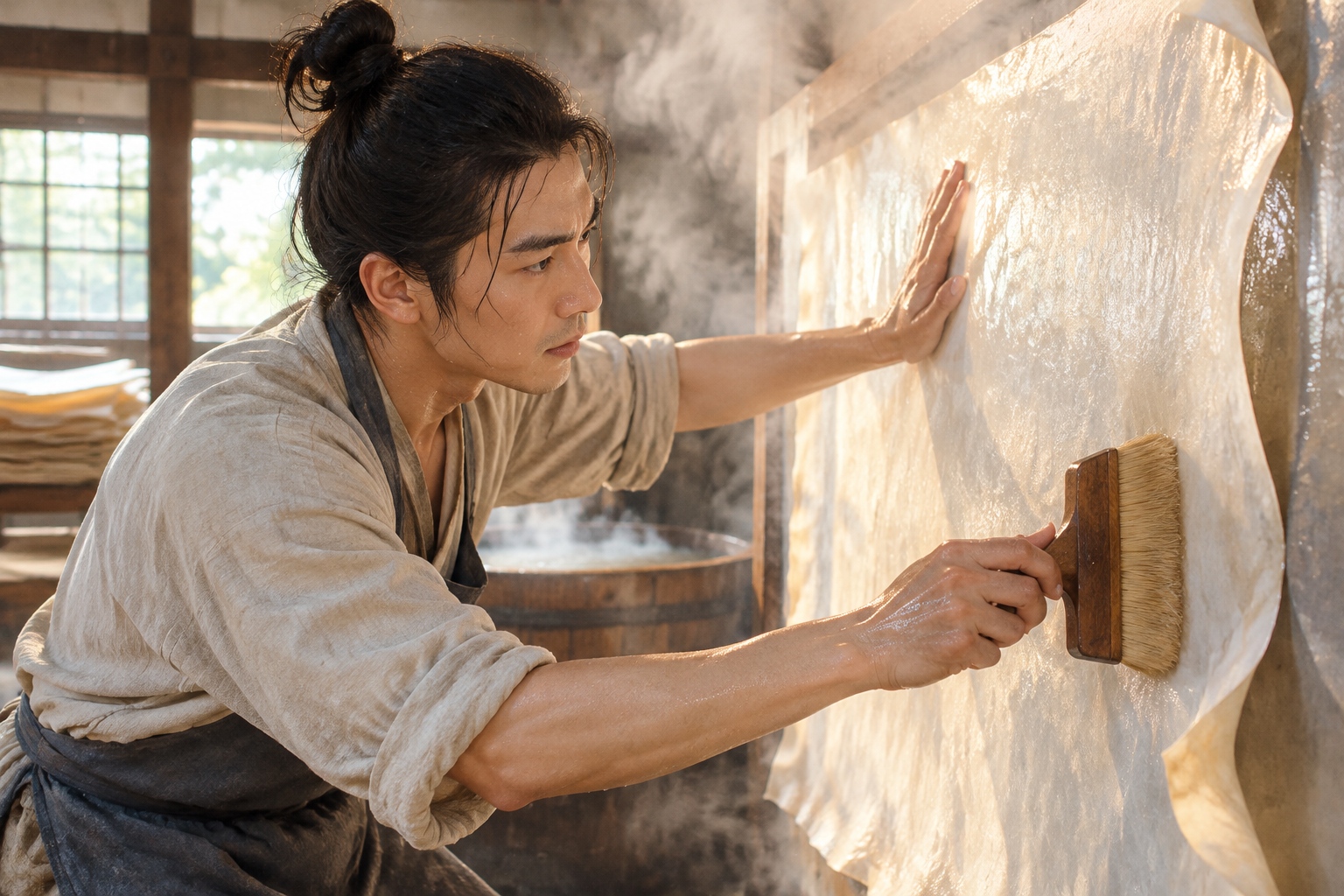
Once the wet sheets are stacked in a neat pile, a second worker moves them to the drying wall. This is a heated plaster wall that looks like a traditional kang bed in northern China. The paper press worker uses a soft broom made from pine needles to pick up a single sheet from the stack—wettened and softened—and carefully pastes it onto the wall. A blast of heat dries it instantly. With a dry fingertip, he gently pulls a corner, and the paper comes off, now flat, crisp, and as flexible as silk.
The temperature of the wall is usually around 80–90°C. Too cold, the paper wrinkles; too hot, it cracks. “We adjust the heat by feel,” says the worker, Zhou Jinhua, 51, touching the plaster with the back of his hand before each sheet. “It’s not written in a manual. You feel it in your skin.”
The Paper That Remembers
After a final quality check—flipping each sheet to catch specks of dust or uneven spots—the paper is cut to size with a long steel knife, counted in bundles of 100, and packed with a special wrapping paper that protects it from moisture. The finished sheets are so fine that you can see your hand through one. They call the best quality *jubi*, a grade used by contemporary artists like Liu Dawei, who says the paper “listens to the brush.”
In fact, the paper has an almost photographic memory. Smoother surfaces produce a sharp line; rougher ones create a dry, textured stroke. Chinese painting relies heavily on this variable absorbency, which is why a painter will deliberately choose a certain xuan paper the way a violinist chooses a bow.
Will the Craft Outlive the Craftsmen?
Despite its UNESCO status, xuan papermaking is struggling to pass on its skills. In Shuanglu, the average age of the 70-odd workers is over 50. Many young people from the county have left for cities. Wages are modest—a skilled vatman earns about 8,000 yuan a month, less than half the salary of a new college graduate in Shanghai. And the market for handmade xuan paper is niche: only a few high-end artists and conservators pay premium prices.
To adapt, some workshops are opening their doors to tourists. A 20-minute “try-to-make-your-first-sheet” experience costs about 80 yuan. It takes an hour, and most visitors end up with a lumpy piece they hang on a wall as a souvenir. But the revenue helps keep the fire burning under the drying wall.
There is also a new wave of young apprentices. The local government has set up a training school, and under a joint program with the Xinjiang Arts University, a handful of postgraduates spend eight months in Jing County every year to learn the hundred-plus techniques. One of them, 25-year-old Li Tong, says, “I used to think paper was just a flat white thing. Now I know it’s a creature that has gone through birth, growth, and memory.”
A Last Look
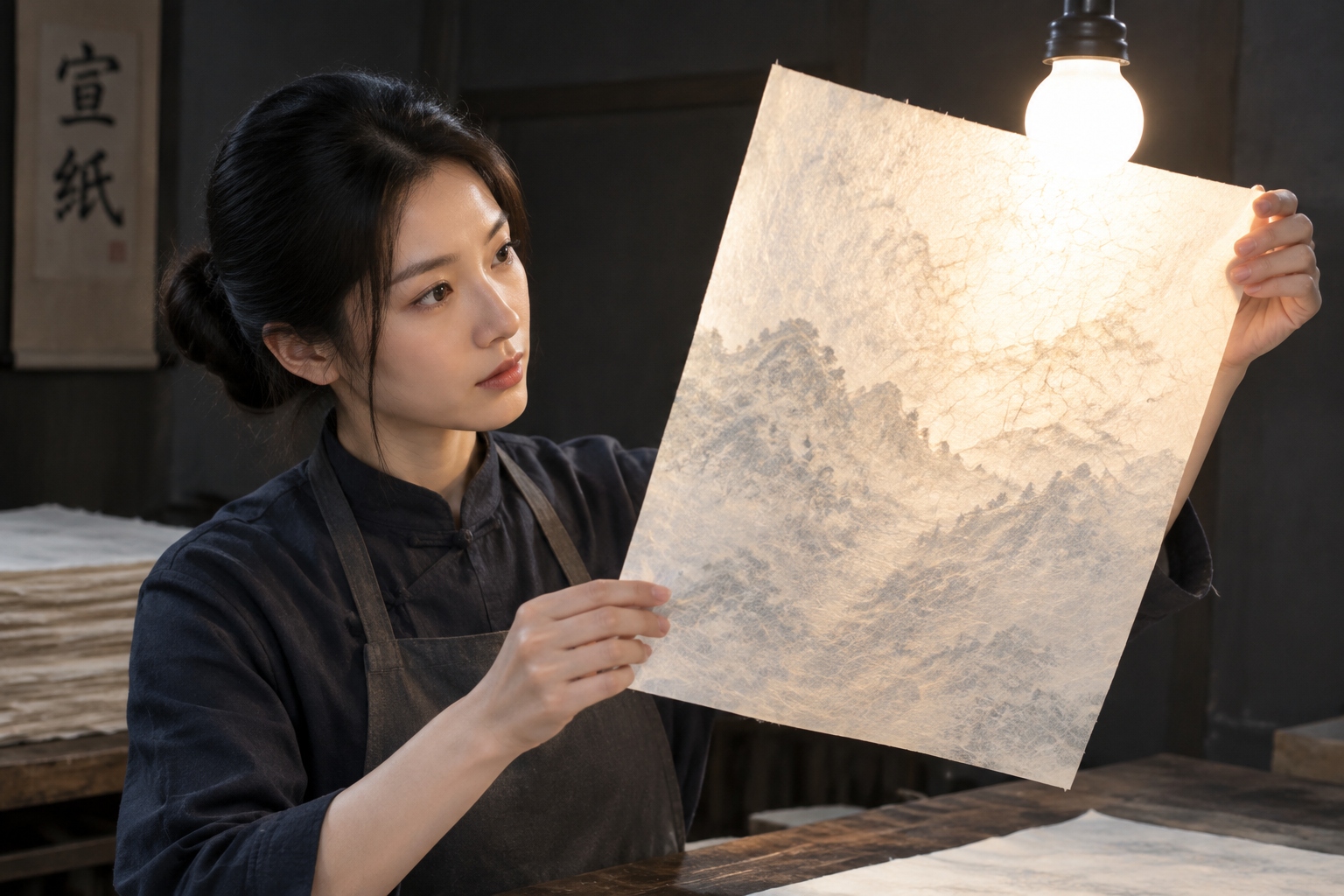
At dusk, Cao Ming leaves the workshop and walks to the drying wall. He picks up a freshly dried sheet of paper and holds it to the light. The fiber network glows like a miniature landscape, with hills and valleys of pulp. “Paper has its own life,” he says. “If you treat it gently, it will treat you gently. That is the whole secret.”
He puts the sheet back on the pile, turns off the lamp, and closes the workshop door. Behind him, the bamboo mountain is darkening. Tomorrow, the vat will be refilled, the fire restoked, and another thousand sheets will be born, one by one, the same way they have been for over a millennium.
Start the discussion at forum.chinacomes.com