
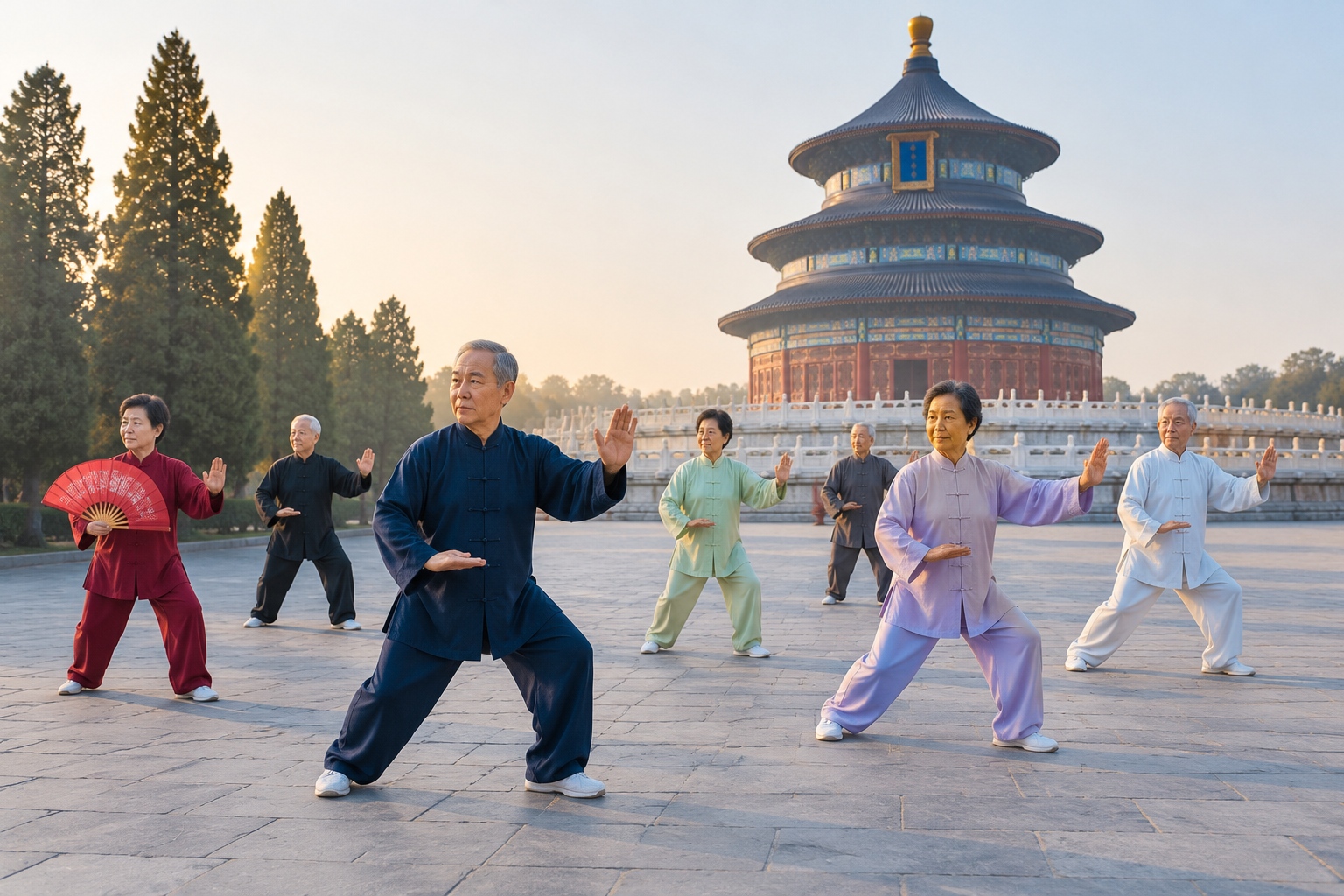

By 6:20 on a Tuesday morning, the east gate of the Temple of Heaven has already had its rush hour. It is not a queue of tourists. It is a queue of retired people with cloth bags, thermos flasks and monthly passes, and it moves fast.
One of them, a 71-year-old in a red fleece jacket, has walked through this gate almost every morning for eleven years. His pass costs 15 yuan a month — about two dollars — for unlimited entry to a 273-hectare park in the middle of Beijing. He ignores the ticket windows, ignores the tour buses that will arrive in three hours, and joins six men kicking a weighted shuttlecock in a circle under the cypress trees.
Two hundred metres away stands the Hall of Prayer for Good Harvests, the round, blue-tiled building that appears on every postcard of China. At this hour, it is almost empty.
An emperor’s altar that turned into a neighborhood gym
The Temple of Heaven was built in 1420, the same year the Forbidden City was completed, and for almost five centuries it belonged to one family. Ming and Qing emperors came here to speak to heaven on behalf of everyone else. Ordinary people were not allowed in.
The grounds cover 273 hectares. The Forbidden City covers about 72. You could drop nearly four palaces into this park, which is one reason the morning crowd never feels like a crowd. UNESCO listed the site as a World Heritage Site in 1998.
Entry is cheap by almost any standard. A park-only ticket costs 15 yuan in high season (about two dollars) and 10 in winter. A through ticket, which includes the Hall of Prayer for Good Harvests, the Echo Wall and the Circular Mound Altar, costs 34 yuan (28 in winter). Beijing residents can buy a monthly pass for the price of a coffee. That one policy explains most of what you see at 7 a.m.
Who is actually here at seven in the morning
About 22 percent of Beijing’s permanent residents are 60 or older. Retirement in China usually arrives at 60 for men and at 50 or 55 for women, depending on the job. Many retirees live in apartments far smaller than the parks they use, and close enough to walk. If a pension arrives every month and the flat has one bedroom, a park with a 15-yuan monthly pass becomes a second living room.
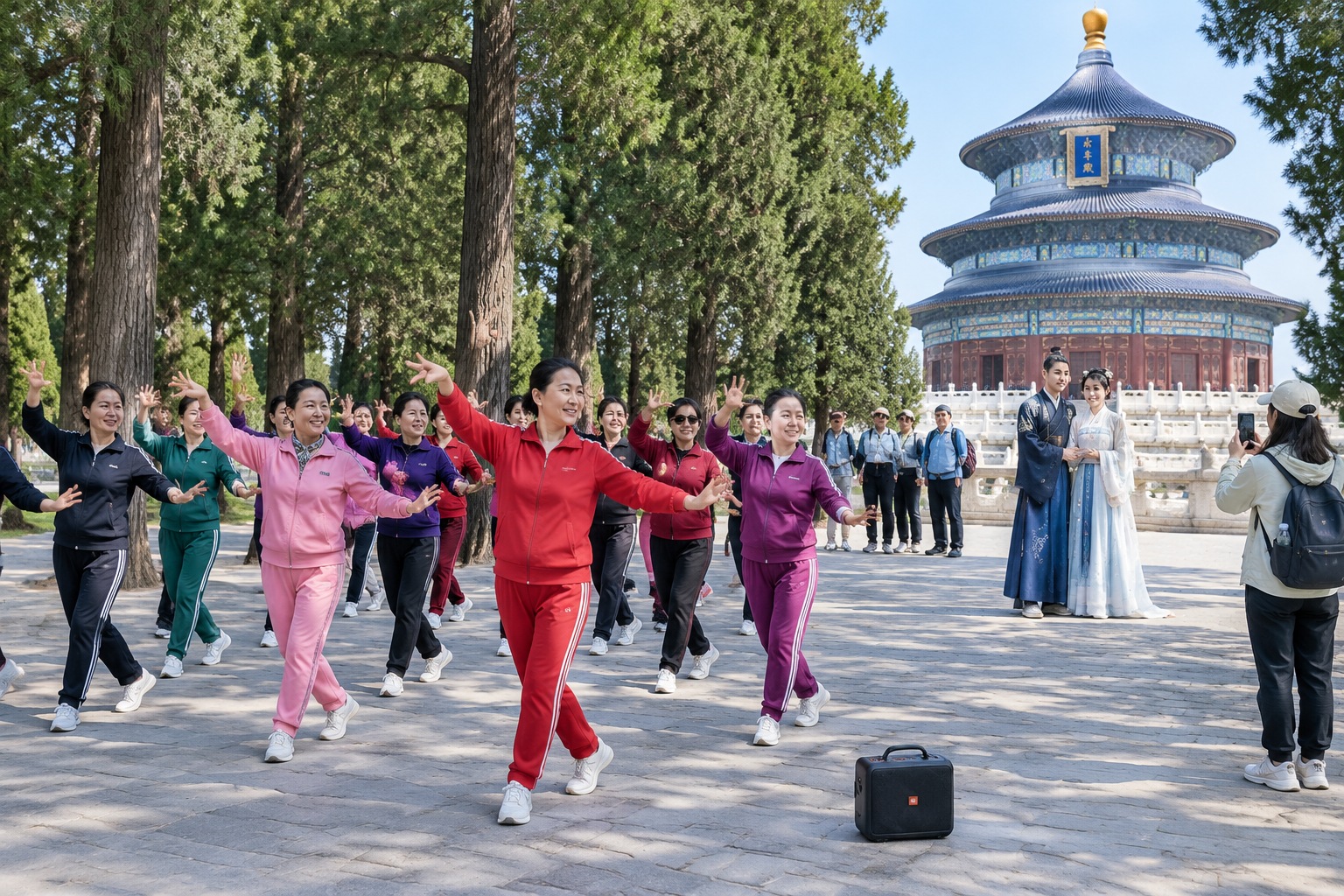
The activities change corner by corner. Near the west gate, a dozen people move through tai chi forms in near silence. On the paving north of the Circular Mound Altar, women in matching tracksuits run through the line dances known here as “square dancing”, a small speaker at their feet. Someone is always writing large Chinese characters on the stone with a long sponge brush dipped in water; the characters dry and vanish, and the writer starts again.
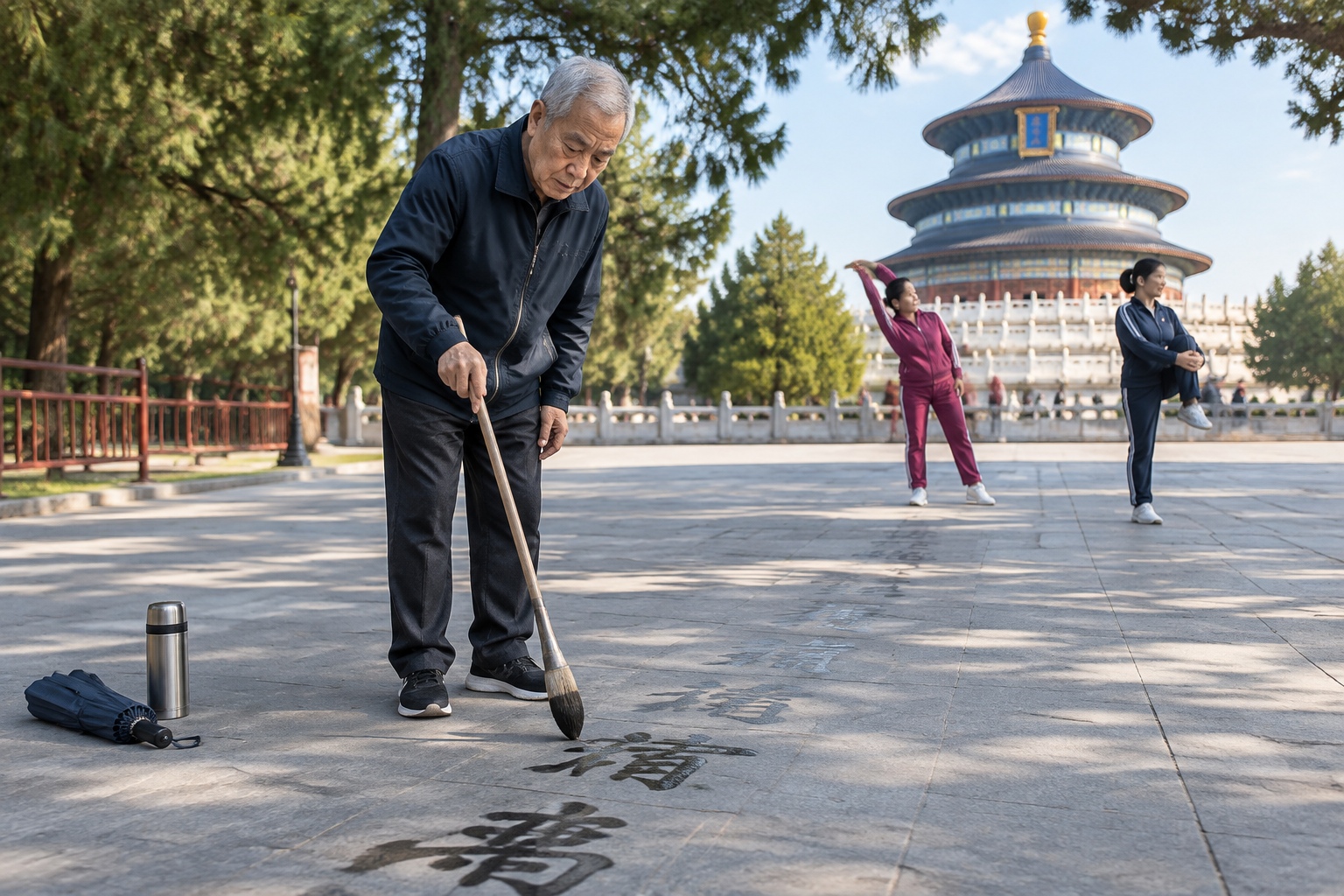
What surprises first-time visitors is not the exercising. It is that none of it is a performance. Nobody is being paid, nobody is following a coach’s schedule, and almost nobody is under 60.
Where the emperors actually stood
Walk south and the noise falls away. The Circular Mound Altar is three tiers of white marble open to the sky, with a round stone at the center known as the Heavenly Heart Stone. The emperor stood on that stone at the winter solstice, before dawn, and offered sacrifices for a good harvest. Numbers mattered here: the paving, the balustrades and the rings of stones around the center all run in nines, because nine was the number of heaven.
The last imperial-style sacrifice at the Temple of Heaven was not performed by an emperor. In December 1914, Yuan Shikai — the general who took power after the Qing dynasty collapsed — dressed in ancient robes and made the offering himself. It was political theater, staged shortly before his failed attempt to crown himself emperor. In 1918 the Temple of Heaven opened to the public as a park. The man with the shuttlecock inherited the plaza.
The Long Corridor never gets quiet
The Long Corridor is 72 connected bays running east of the Hall of Prayer, built as a waiting area for officials preparing for the sacrifices. These days it is the loudest place in the park: cards slapped down on stone tables, Chinese chess clocks ticking, a dozen conversations at once, and a choir of forty or so singing songs from the 1960s and 70s through a portable amplifier.
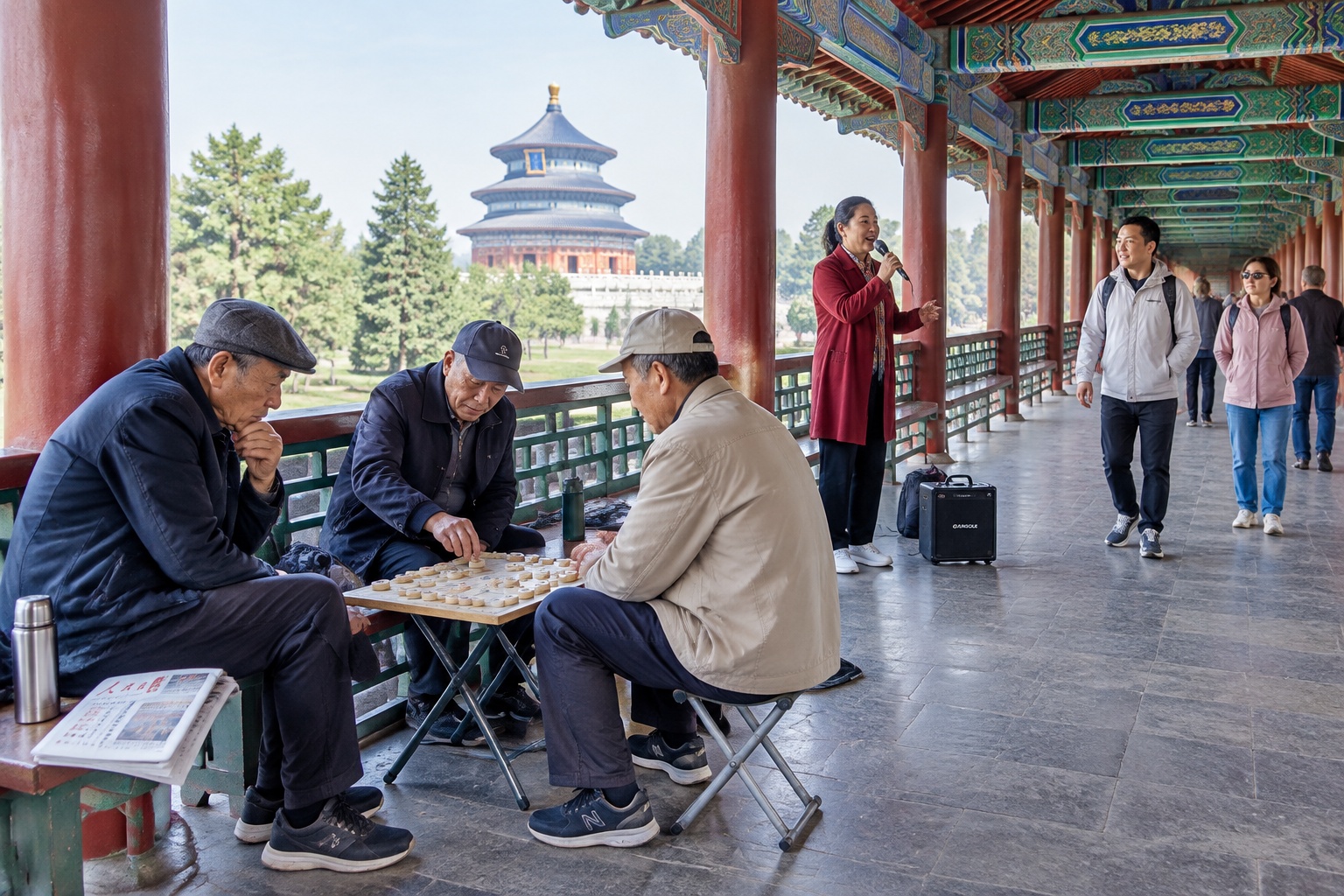
Some regulars will tell you they have sat in the same spot on the railing for twenty years. It is the closest thing Beijing has to a village square.
The part that doesn’t make the posters
By nine, the tour buses pull up at the south gate. The same plaza where a woman was dancing an hour earlier fills with selfie sticks and guides holding up little flags. The Temple of Heaven has also become a photo studio: young women rent hanfu dresses and pose in front of the Hall of Prayer, and gift shops sell fridge magnets and ice cream shaped like the building.
There is friction, too. Beijing’s parks have rules about amplified sound, and staff regularly ask groups to turn the volume down. Dancers want their corner, chess players want theirs, and a visitor who came for the quiet of a 600-year-old cypress grove wants something else again. The park has tried assigning areas and hours. It is still a negotiation, and it is the least photographed part of the place.
Why an old altar makes a better park than a museum
In many cities, a park is something you cross on the way somewhere else. In Beijing, a park that costs a few dollars a month gets used like a living room: five or six mornings a week, the same corner, the same people, for decades. The temple’s design helps — the buildings are quiet and the grounds are enormous — but the real reason is social. This is where retirement is spent, where neighbors are known, and where someone who no longer has a job still has a place to be at seven in the morning.
That is the thing worth noticing. The man kicking a shuttlecock is standing on ground that was once forbidden to him, and he treats it like his own back garden. Both halves of that sentence are true at once.
If you go
Take subway Line 5 to Tiantan Dongmen (East Gate) — the exit drops you at the gate the morning crowd uses. Line 8 to Tianqiao is closer to the west gate. Tickets: 15 yuan for the park in high season, 10 in winter; 34 yuan for the through ticket, 28 in winter.
Come between 6:30 and 8:30 if you want the exercise scene. The halls open at 8:00, so walk the grounds first and do the sightseeing after. Go south to north: the Circular Mound Altar at the southern end, the Hall of Prayer at the northern end. Weekends are busy with domestic tour groups, and the gates close in the early evening, with seasonal times that shift through the year.
You will not find a sign explaining that a place built for one man’s conversation with heaven is now a gym for a few thousand retired people. You just have to be there before eight.
Start the discussion at forum.chinacomes.com