
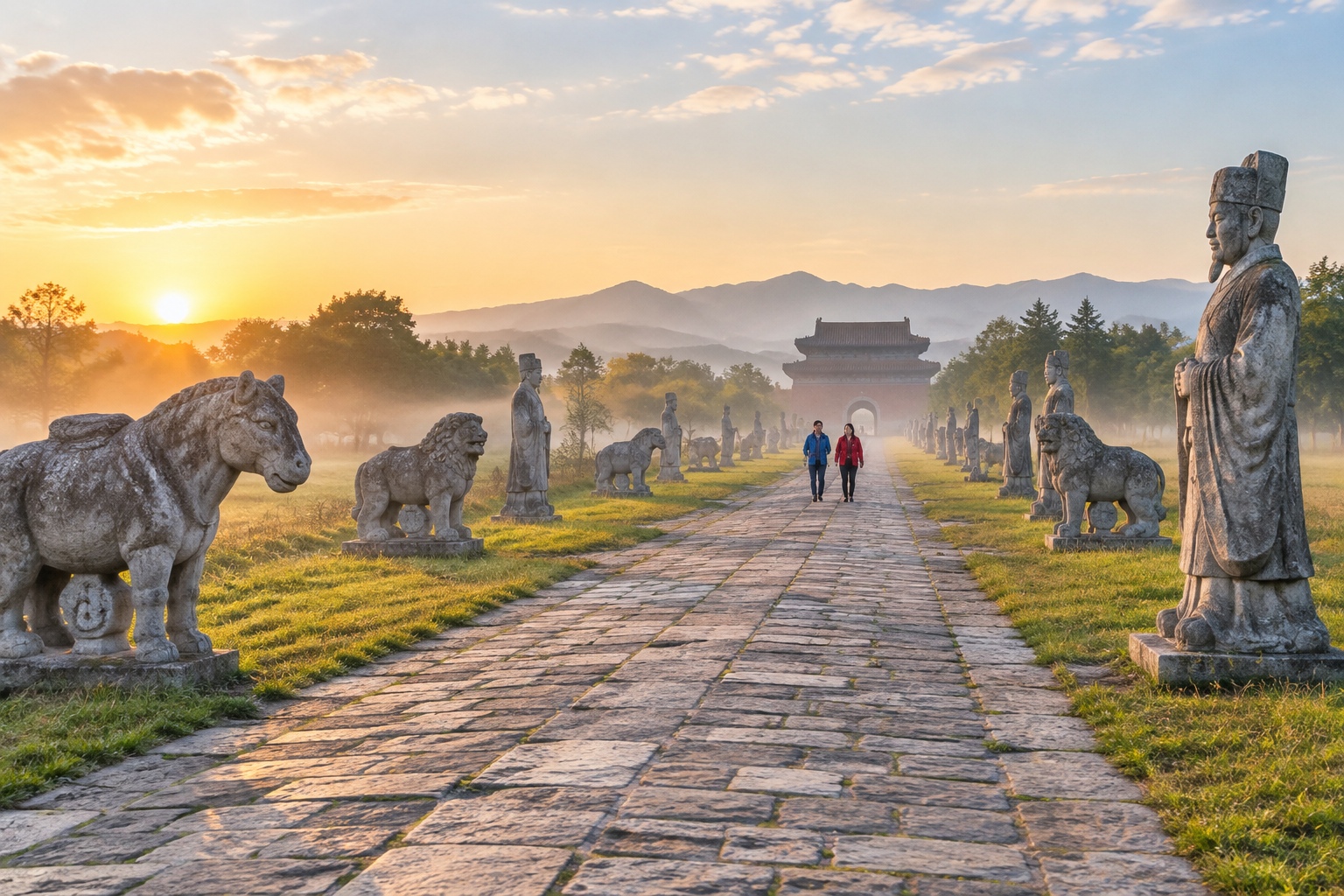

A village named after a dead emperor
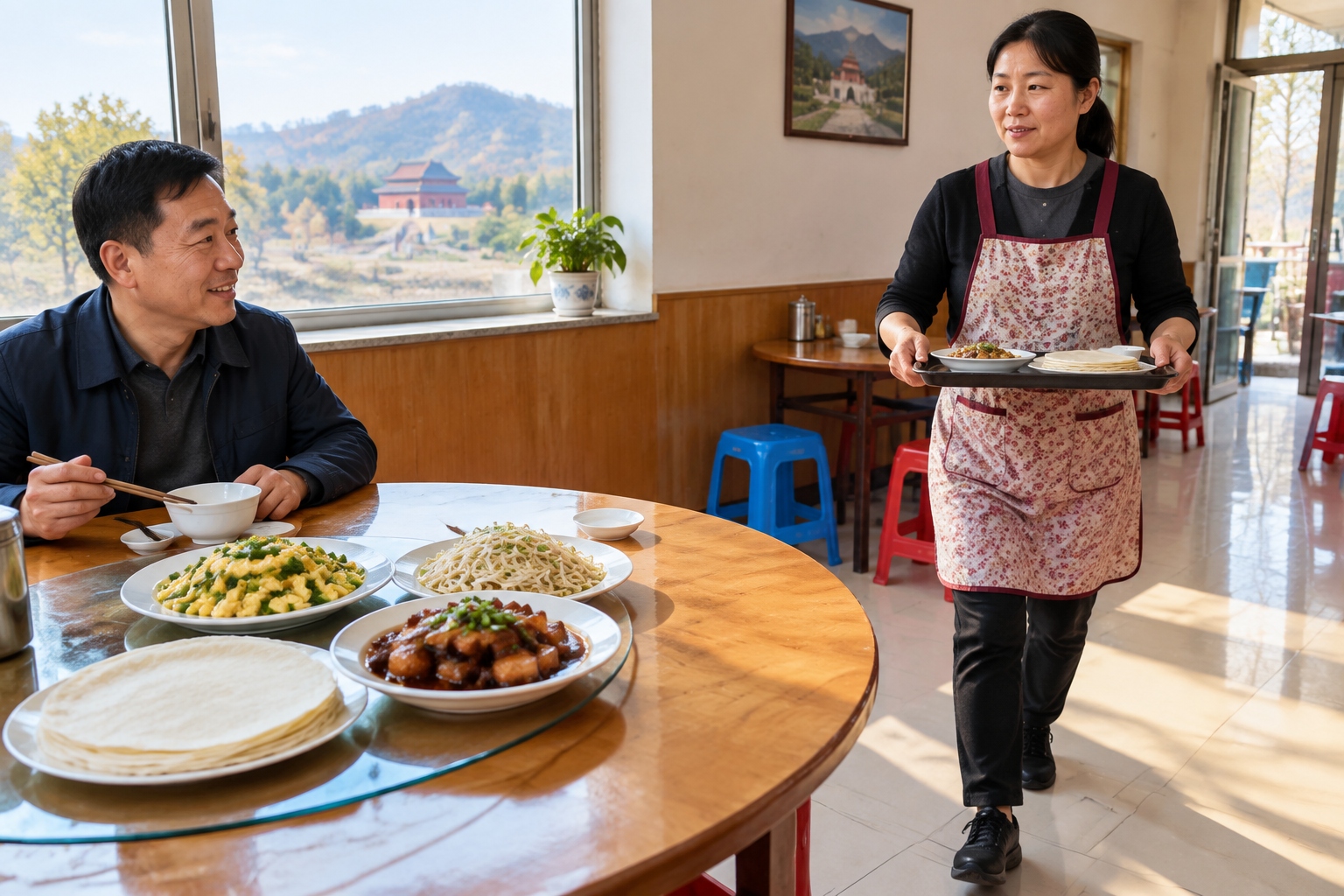
At about seven in the evening in Kangling village, an hour’s drive north of Beijing, a woman sets a stack of paper-thin pancakes on a lazy Susan and starts carrying out plates of braised pork, scrambled eggs, bean sprouts and sweet bean sauce. About forty households in this village run small restaurants, and almost all of them serve the same thing: spring pancakes. The village’s other distinguishing feature is its name. Kangling is the tomb of Zhu Houzhao, the Ming emperor who died in 1521 at the age of 29, leaving no heir.
That combination — dinner service at a table set beside an imperial mausoleum — is what the Ming Tombs look like once you step off the postcard. Most visitors come for the Sacred Way and the excavated underground palace at Dingling, ride a shuttle between two ticket gates, and leave. The roughly 40 square kilometres of valley around them are farmland, orchards and thirteen villages whose names are a list of the dead.
The Sacred Way: 36 statues and one 30-tonne elephant
The Sacred Way, or Shendao, begins at a five-arch stone memorial archway — the largest of its kind in China — and runs about 7.3 kilometres northeast to Changling, the tomb of the Yongle Emperor, who moved the Ming capital to Beijing in 1421 and died on campaign in 1424.
The stretch everyone photographs is roughly 800 metres in the middle, lined with 18 pairs of stone figures carved from single blocks of stone in the 15th century. Twelve pairs are animals: lions, xiezhi, camels, elephants, qilin and horses, each kind appearing four times, twice standing and twice seated. Six pairs are men — military officials, civil officials and meritorious officials — standing in faded court robes with their hands folded.
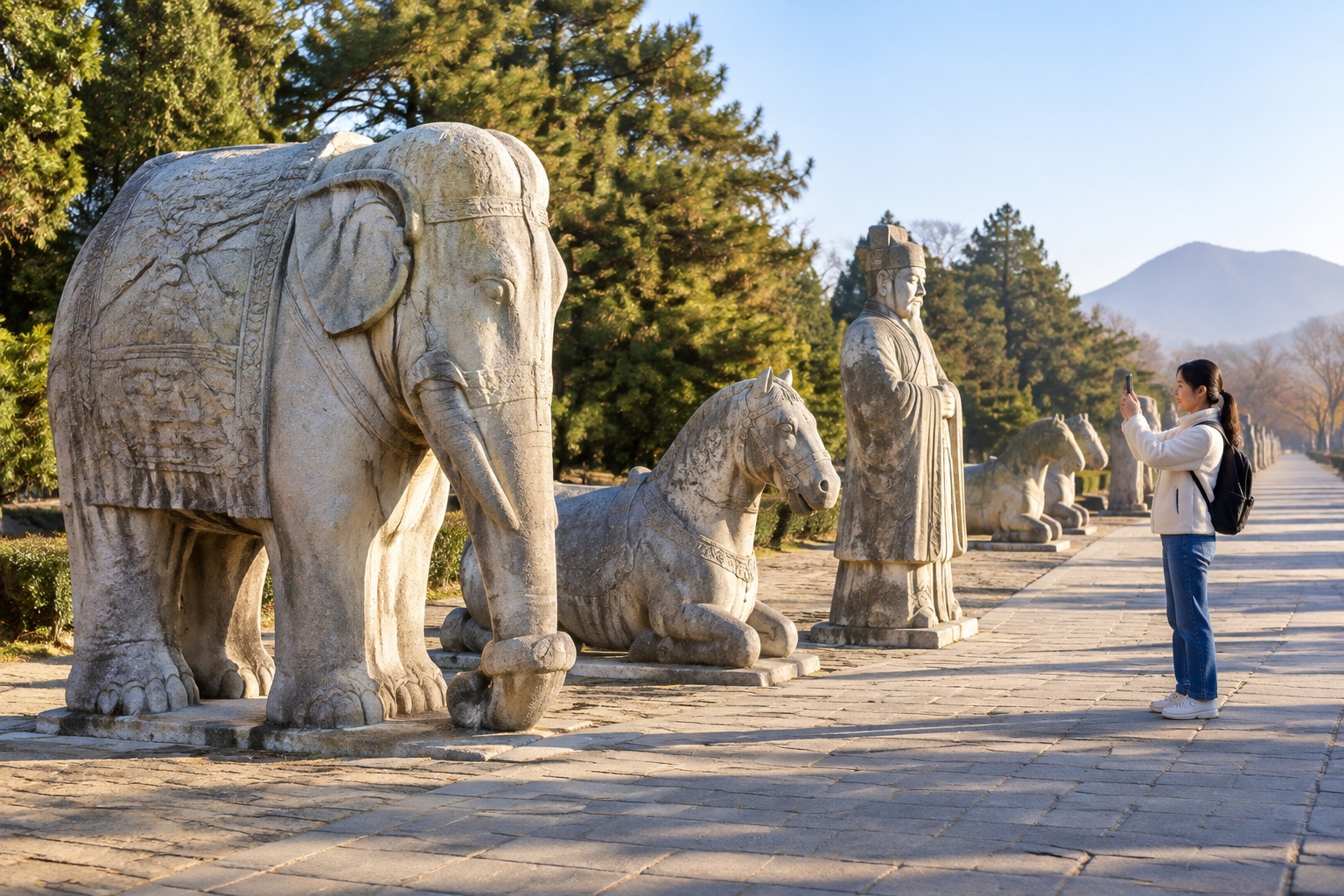
Foreign visitors usually ask about the xiezhi, a one-horned beast from Chinese mythology said to lower its head at honest men and butt the guilty. The elephants are easier to read: the largest weighs more than 30 tonnes, and local people will tell you it was dragged here in winter over ice laid on the road, a technique documented in Ming construction records. The statues were never decoration. They were a queue of symbols marking the approach to an emperor, meant to be walked past slowly.
They have taken damage, too. Chipped edges and cracked faces on several figures date from the twentieth century; the site was placed on China’s first national heritage protection list in 1961, before the worst of the Cultural Revolution reached this valley. Today the same statues are the backdrop for tour groups, wedding photos and, before eight in the morning, joggers from nearby towns.
Thirteen villages, thirteen tombs
What most visitors never learn is who lives here. When a Ming emperor was buried, an entire apparatus moved into the valley: a eunuch office to manage rituals, a garrison, and hereditary households called linghu — tomb households — assigned to farm the sacrificial fields, sweep the courtyards and keep the incense burning. The system outlived the dynasty it served. After 1644, the Qing emperors kept paying for the upkeep of the Ming tombs for a while, partly as a gesture toward their Han Chinese subjects. Then the money stopped. The families stayed.
Thirteen villages in Changping District still carry the names of the tombs they grew around: Changling, Xianling, Jingling, Yuling, Maoling, Tailing, Kangling, Yongling, Zhaoling, Dingling, Qingling, Deling and Siling. Sit long enough in any of them and you will hear two versions of local history. One is a claim of twenty generations: ‘Our family has guarded this tomb since the Ming.’ The other is far more recent: ‘My grandfather came in 1958 to build the reservoir.’ Both are true. The Ming Tombs Reservoir, built that year with mass labour, brought thousands of people into the same valley, and the two groups of families have been neighbours for three generations now.
What grows where an emperor is buried
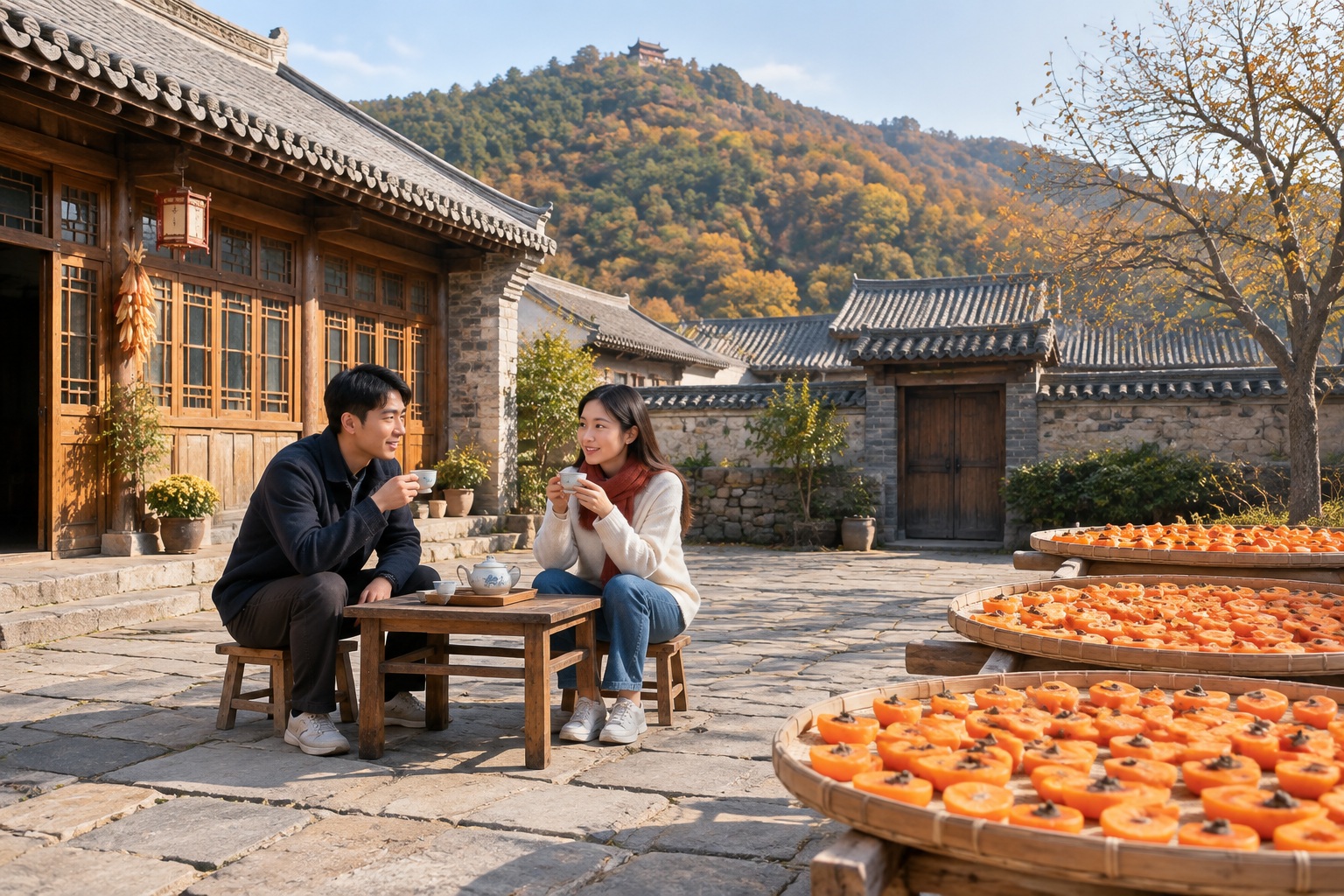
The valley produces apples, chestnuts, walnuts and the flat, dark persimmons known as mopan shi. In autumn, the roadsides fill with cardboard boxes and handwritten price signs. Land here sits inside a heritage protection zone, which comes with limits: no quarrying, restrictions on building height, rules about what can be sprayed near the ancient cypress groves. Farmers describe it as a fair trade only some of the time. The trees are protected, the view is protected, but a family that wants to add a second floor to a farmhouse, or open a small workshop, may wait years for approval.
Tourism money arrives unevenly. Tickets for Changling, Dingling, Zhaoling and the Sacred Way go to the heritage administration that maintains them. The tomb villages get the spillover — restaurants, guesthouses, fruit sales. Kangling turned spring pancakes into an economy. Locals say the recipe survived because the emperor buried here loved them; food historians are more likely to point at a northern Chinese custom of eating spring pancakes at the start of spring, kept alive by families who had no particular reason to leave.
The people who still walk the tombs
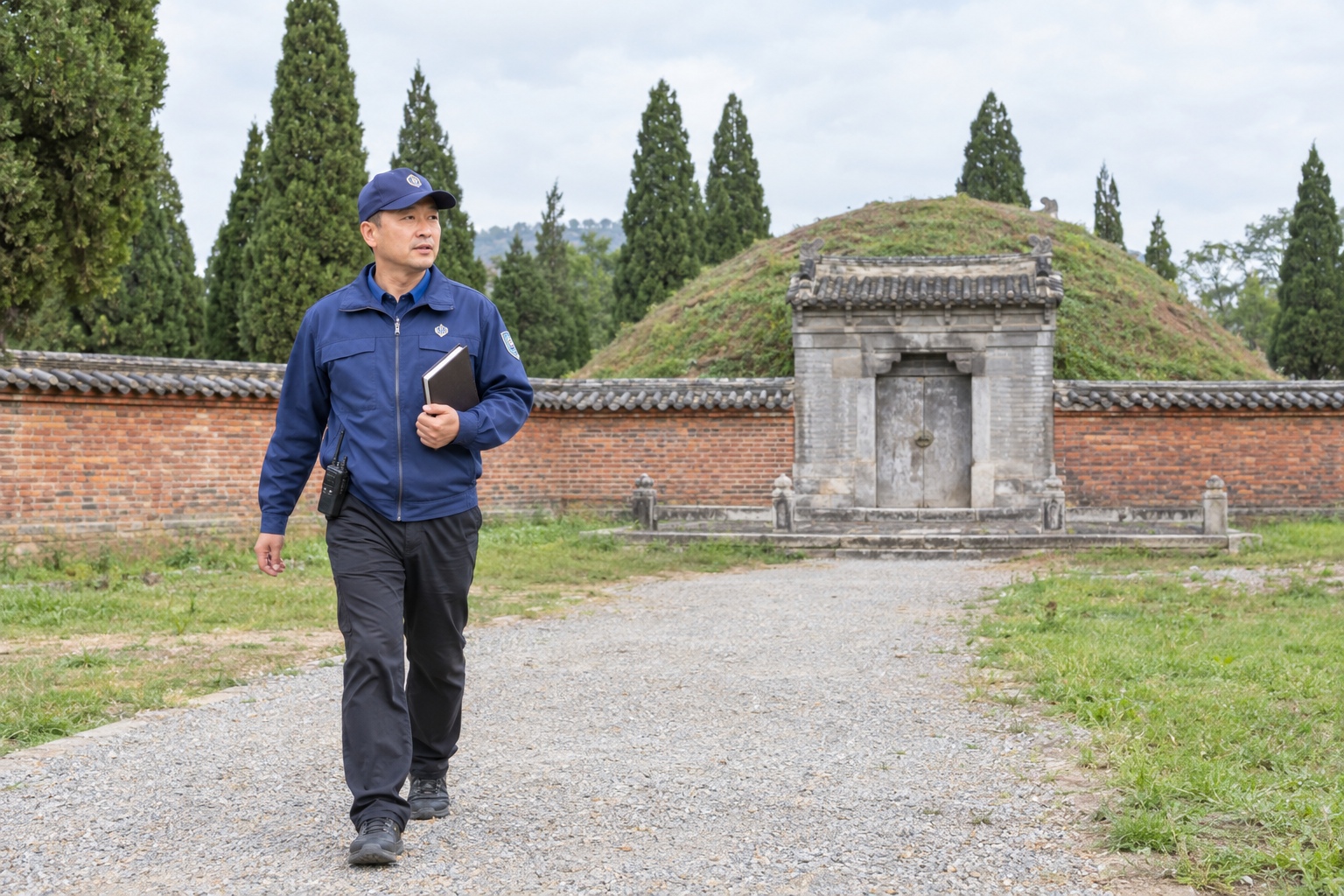
The Ming Tombs heritage office employs wardens, many of them from the villages, to walk the unopened sites daily and log what they find: fire risk, wall damage, signs of illegal digging. On a weekday morning you might meet one on a gravel path behind an unopened tomb, radio clipped to his belt, stopping to look at a crack in a brick wall built before Columbus sailed.
The job is less romantic than it sounds and more important than it looks. Seven concubine tombs and one eunuch tomb lie scattered across the valley, along with the grave of the last Ming emperor, Chongzhen, who hanged himself in 1644 and was buried in what had been a concubine’s tomb. Most of these sites have no ticket booth, no signboard, no tour group. They sit behind low walls or under trees, watched by wardens and, in practice, by the farmers whose fields touch them.
The tombs nobody visits
Siling, Chongzhen’s tomb, is the smallest and the saddest. Its main hall is gone; what remains is a modest walled compound inside a village, with a stele and a mound. There is a small ticket fee, an empty car park, and often nobody else there at all. Walk twenty minutes into the hills and you can find the unopened tombs of emperors who ruled for a decade or two and left behind a mound of earth, a stone wall and a grove of old trees.
Since 2003, when the Ming Tombs were inscribed on the UNESCO World Heritage list as part of the Imperial Tombs of the Ming and Qing dynasties, the district has tried to reframe the area. A Ming culture forum has been held in Changping every year since 2022, with scholars, hanfu dress-up events and carefully staged performances. In several villages, old courtyards have been converted into small guesthouses, and young people who left for Beijing sometimes come back to run them. Whether that revives the villages or simply adds another layer of scenery is an open question here.
If you go
Public buses run from Deshengmen in northern Beijing to Changling and Dingling; the Changping metro line plus a local bus is slower but cheaper. Tickets to the main sites cost roughly 20 to 60 yuan depending on season. The Sacred Way is best before 8 a.m., when mist is still in the grass and there is nobody standing in front of the statues. From Dingling you can walk, or take a short taxi, to Kangling village for lunch, then keep going on foot past orchards to a tomb with no gate at all. Nobody will stop you. That is the part of the Ming Tombs that never made it onto a postcard — and at dusk, with a farmer walking his dog past a stone general, it is the part that stays with you.
Start the discussion at forum.chinacomes.com