
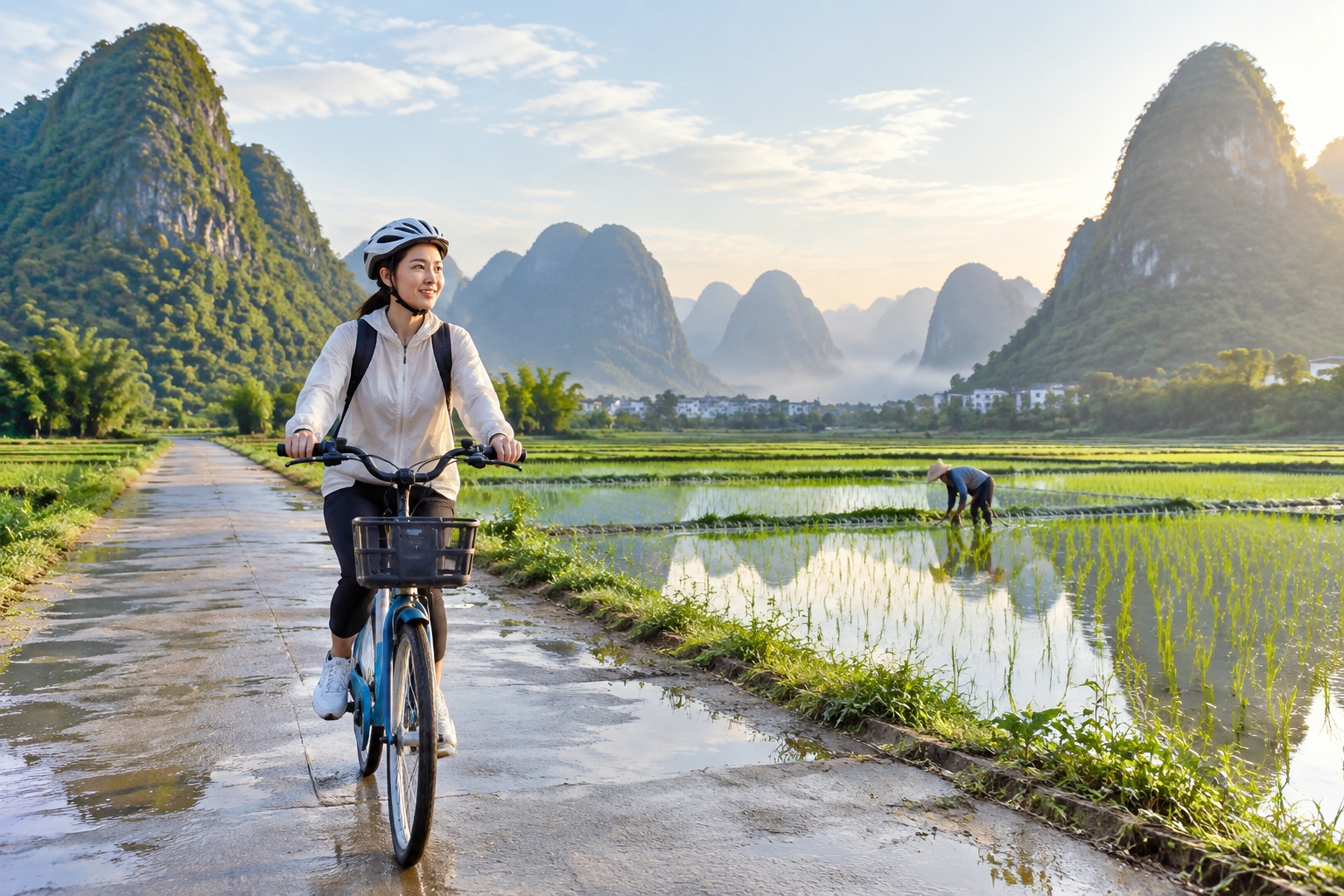

A Bike Shop Opens Before the Tour Buses Move
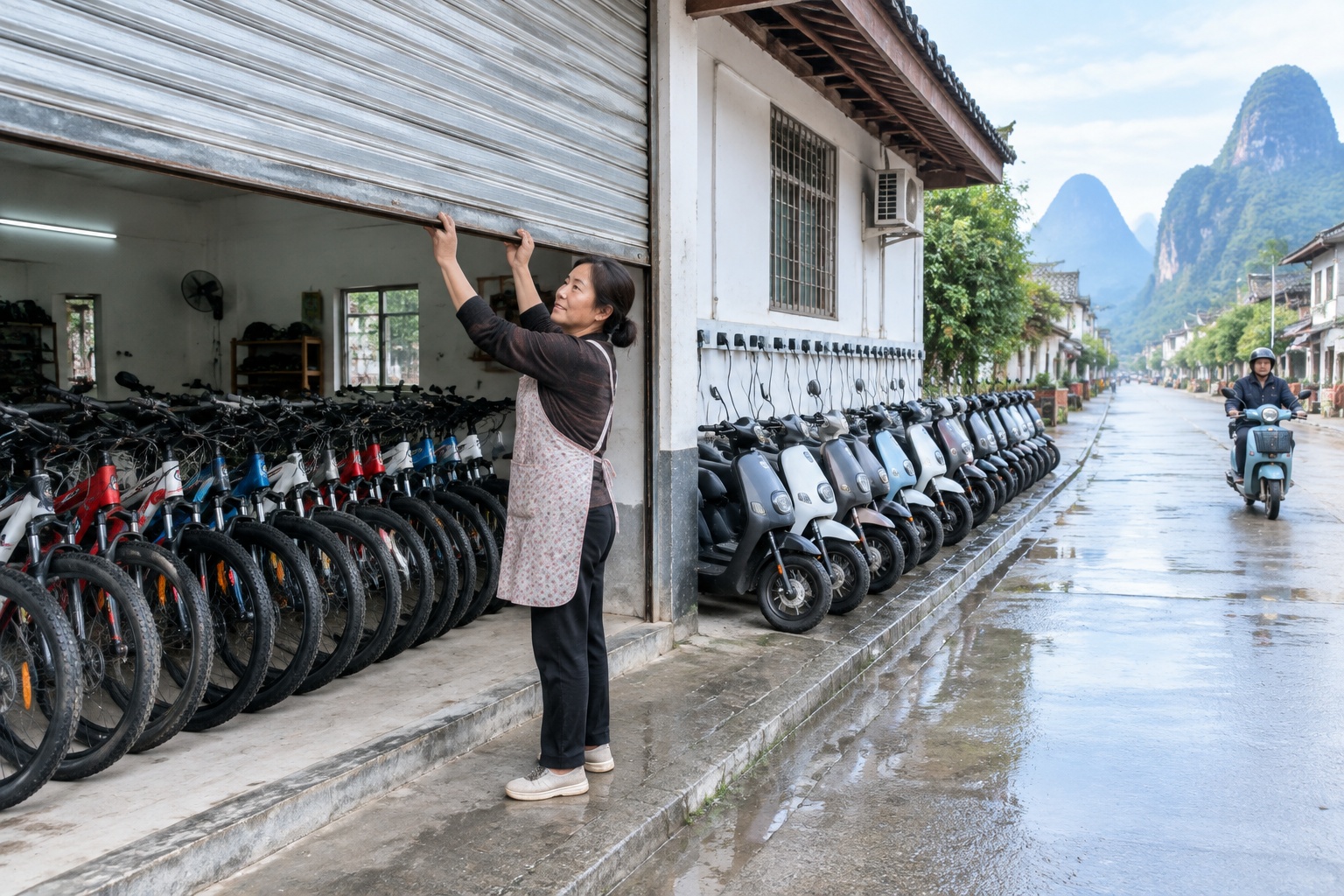
At 7:30 on a Tuesday morning in Yangshuo — the karst county in Guangxi that most Chinese people first meet on the back of a 20-yuan banknote — the metal shutter of a bike shop on Diecui Road rattles up. Chen Guiqin, 52, is already outside, wiping dew off a row of handlebars with a rag. Behind her stand about forty bicycles. Along the wall, plugged into a power strip that hums faintly, sit twenty-five electric scooters.
Ten years ago the ratio was reversed. “Foreigners used to take the mountain bikes and disappear for eight hours,” she says. “Now it’s Chinese families, and the first question is always the same — how far will it go on one charge?”
I rented a bike for 60 yuan (about $8) and a helmet for 10 more. My plan was loose: follow the Yulong River out of town, cut through the villages, and reach Xingping before dark. The plan survived about four kilometres, because the road itself turned out to be more interesting than the postcards.
The Peaks Are 300 Million Years Old. This Road Is Ten.
Yangshuo sits inside the South China Karst, a UNESCO World Heritage landscape. The limestone beneath these towers was laid down on a shallow sea floor roughly 300 million years ago, then lifted up and dissolved by rain into the green, blunt-topped peaks that end up on tea tins and airport murals.
What has changed is everything at ground level. The lane I pedalled out on — concrete, two cars wide, with a drainage ditch on one side — was a mud track when Chen started renting bikes. Village roads across the county were mostly paved or widened within the past decade. Streetlights appeared. So did sewage pipes, parking lots, and small blue signs telling drivers that tour buses are not allowed past a certain point.
That last detail matters more than it sounds. It means a village committee, not a bus company, now decides who gets to bring 45 people into a hamlet of 300.
The Yulong River, Bamboo Rafts, and a Farmer on a Scooter
By 8:30 the Yulong River was already busy. Bamboo rafts pushed off from a concrete landing every few minutes, two passengers each, a boatman in a straw hat standing at the back with a long pole. A ticket runs roughly 200 to 300 yuan depending on the section — more than a farmer here earns from a week of vegetable sales.
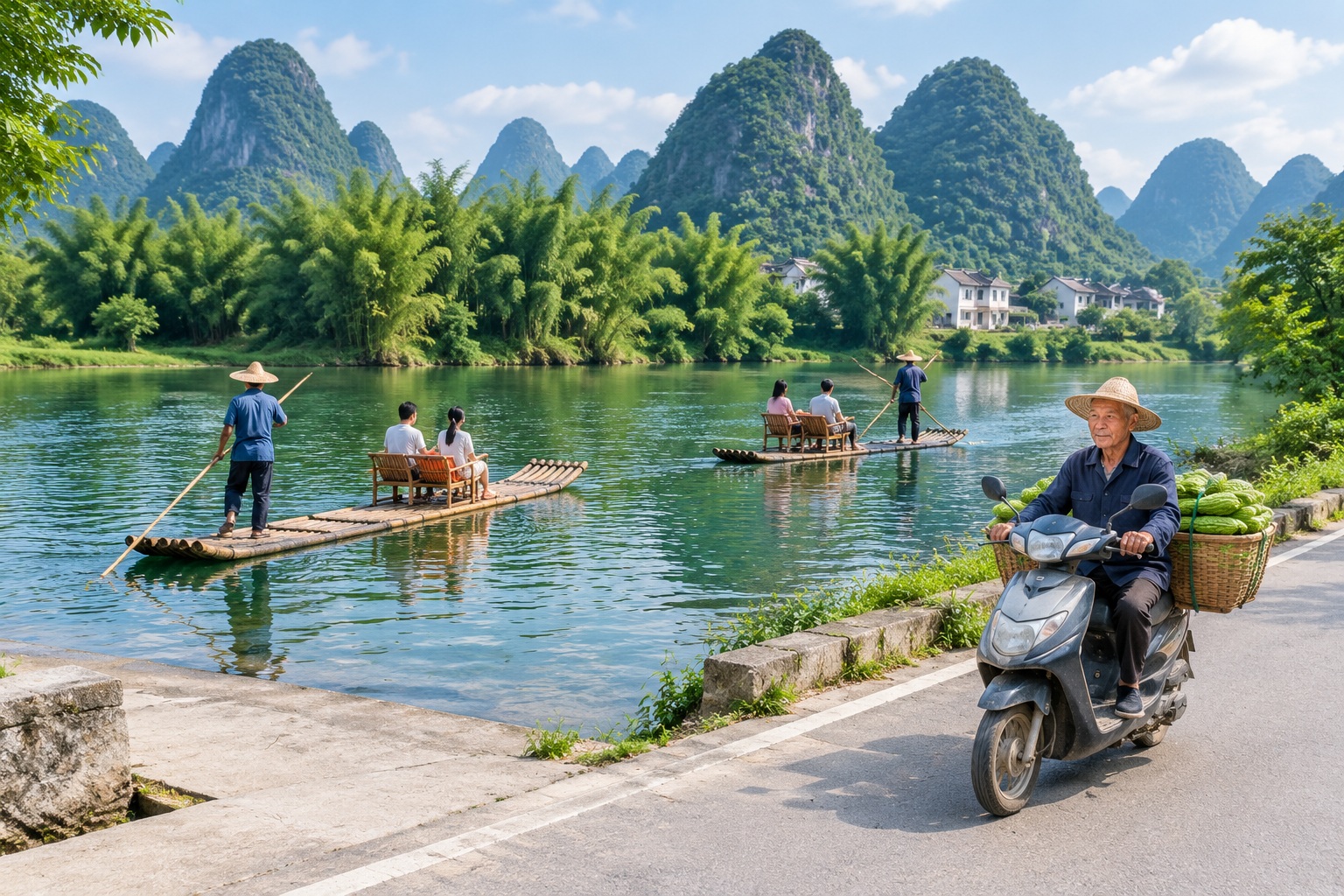
Not everything on the river is performance. On the road running parallel to it, an old man on a scooter overtook me with two baskets of bitter gourd bungeed to the back, heading for the morning market in Yangshuo town. He has made that trip for thirty years. The difference is that the road is smooth enough now to do it in twenty minutes instead of an hour — and that his daughter sells the same vegetables on WeChat before he even arrives.
Farmhouses Become Guesthouses — and the Money Goes Somewhere
Around Jiuxian and Chaolong, the villages most cyclists roll through, the change is visible house by house. A family signs a lease, typically 15 to 20 years, handing a farmhouse and its land-use rights to an operator who is often from Guangzhou or Shenzhen. Rent starts at a few tens of thousands of yuan a year for a back-lane plot and climbs past 100,000 yuan for anything with a river view.
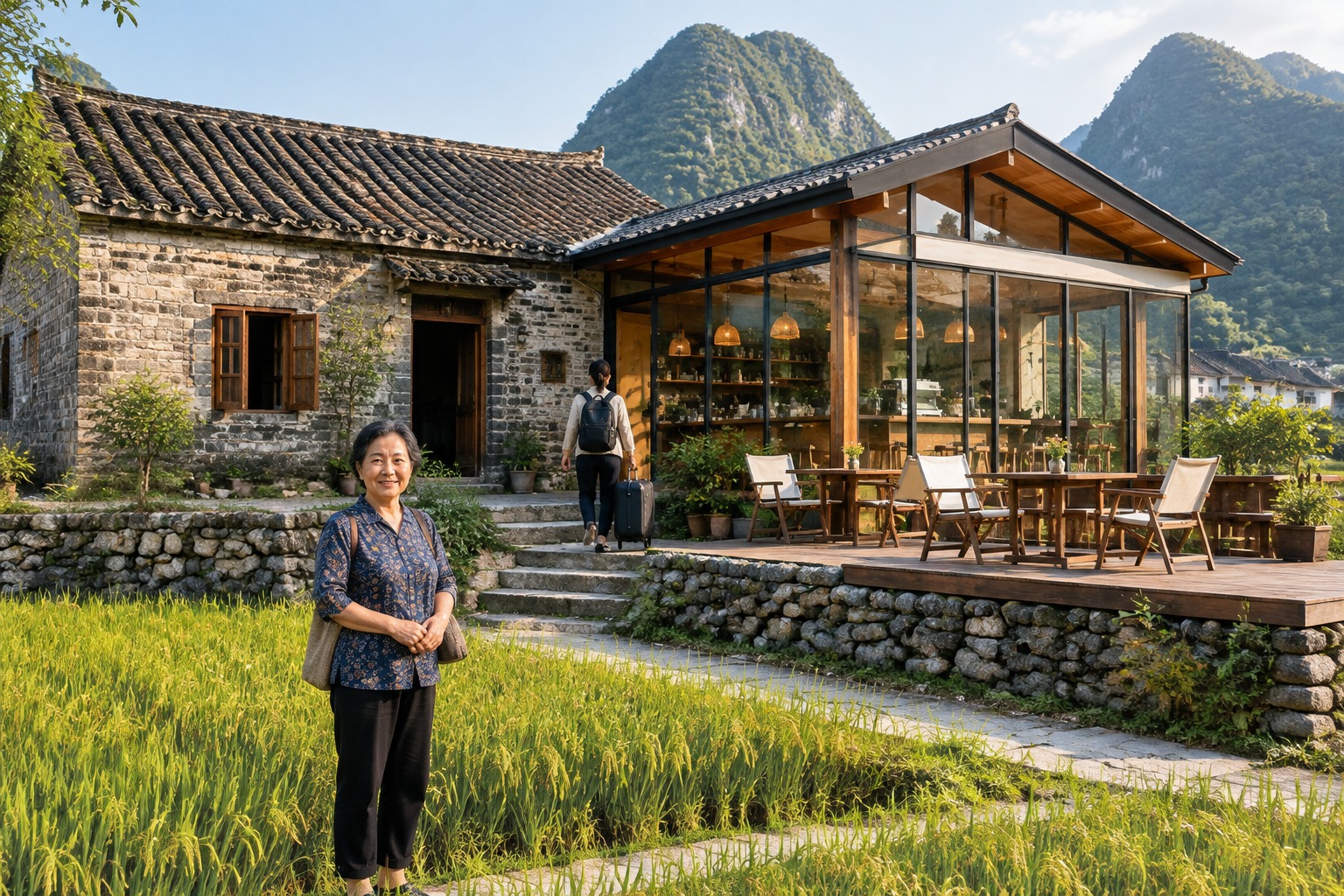
The operator then spends anywhere from one to three million yuan gutting and rebuilding: underfloor heating, floor-to-ceiling glass, a small pool, a coffee bar. In peak season a room can go for 800 to 2,000 yuan a night. The villager who signed the lease gets steady rent and no risk. The operator gets the profit.
It is a good deal for some and an odd one for others. In Chaolong I met a woman in her sixties who rents out the upper floor of her house and still farms two mu of rice — about a third of an acre — in the field below it. She likes the income. She is also mildly puzzled that people pay to sleep where she used to store grain.
The county’s other economy is quieter. Yangshuo is one of China’s largest kumquat-growing areas, and the small orange fruit — sold fresh, dried, or boiled into syrup — now moves through livestreams as often as through wholesale markets. In winter, the hillsides above the cycling routes turn orange, and the pickup trucks parked along the road belong to farmers, not tour companies.
The Kids Who Came Back
The most interesting shift on this ride wasn’t the buildings. It was who stood behind the counters.
A 27-year-old named Liu runs a coffee window in a village with one intersection. He studied in Nanning, spent two years in a Shenzhen office, and came home in 2022 to open a nine-square-metre shop that does most of its business between 10 a.m. and 4 p.m., when cyclists pass. Down the road, a former primary school has been converted into a climbing hostel. Yangshuo has been a global rock-climbing destination since the 1990s — more than a thousand bolted routes are scattered across these peaks — and the cliffs are now shared by European climbers in their fifties and Chinese university students on weekend trips.
High-speed rail made this possible. Yangshuo Station opened in December 2014 on the Guiyang–Guangzhou line. Guangzhou is about two and a half hours away; Shenzhen, under three. A place that once required a flight, a bus and a full day of travel became a Friday-night decision.
What the Postcard Leaves Out
The scenery is genuinely unchanged. The village economy built around it is not, and not everyone is winning.
Peak-season traffic in Xingping and along the Yulong River can lock a two-lane road for an hour. Villagers who don’t rent out their houses argue that the money flows to the people who do, and that the young people coming home mostly want to serve coffee rather than plant rice. Some paddies have been left fallow or converted to lawns that photograph well.
Then there is water. In June 2024, record flooding on the Li River put parts of Guilin and Yangshuo under water. Riverside guesthouses on my route were still showing repair work months later, and several operators told me they had lost an entire season of bookings. Tourism built on a river is tourism built on something that can rise.
Xingping, Sunset, and the Twenty-Yuan View
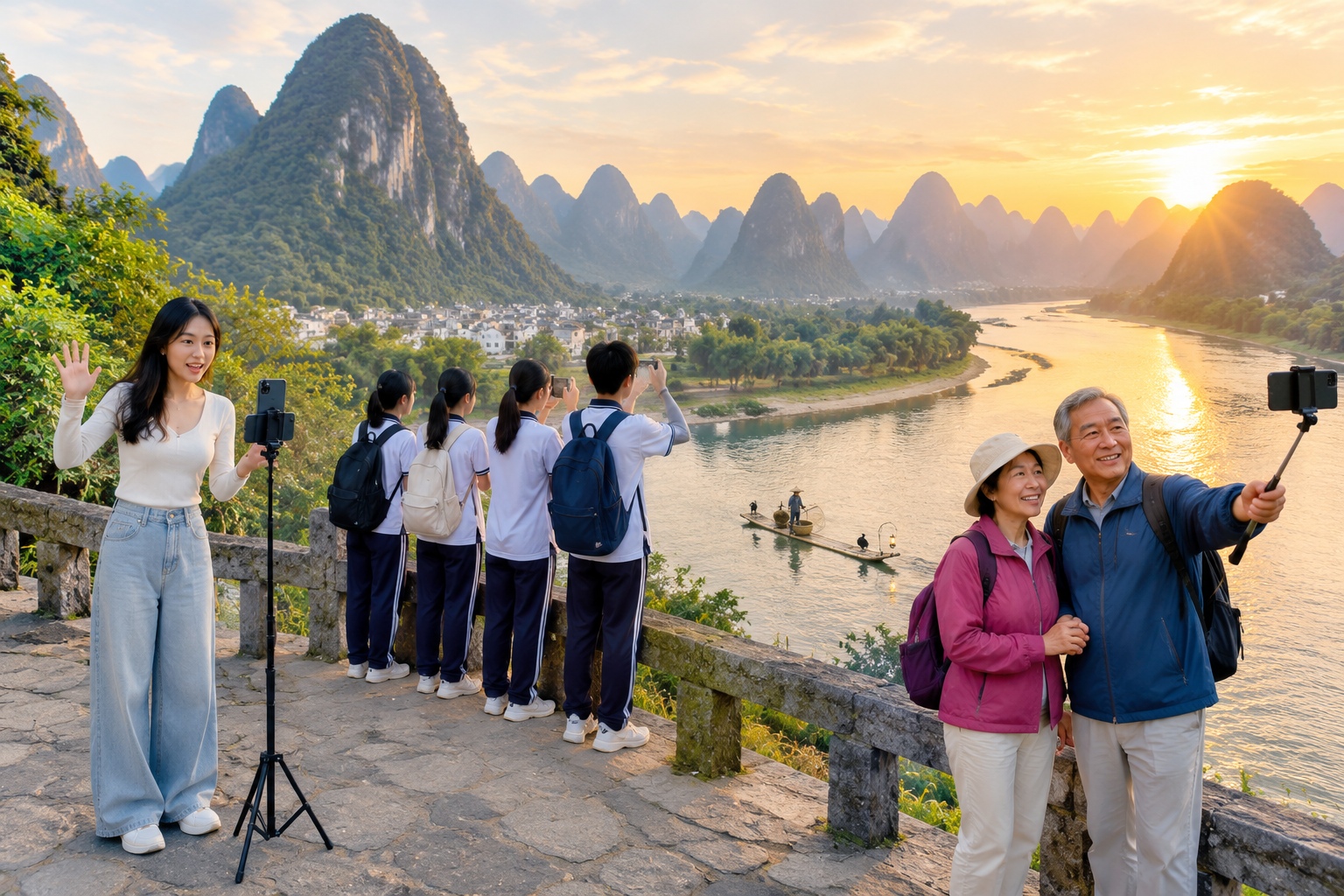
I reached Xingping in the late afternoon, 25 kilometres up the Li River from Yangshuo town. The viewpoint everyone climbs to is the exact composition printed on the back of China’s 20-yuan note: a bend in the river, a cluster of peaks, a few bamboo rafts drifting through.
Twenty years ago the people standing there were mostly foreign backpackers with film cameras. On the evening I visited, the platform held a school group from Hunan, a young woman livestreaming to a few hundred viewers with her phone on a tripod, and two retirees in matching windbreakers taking turns with a selfie stick. The cormorant fishermen posing on the rafts below are paid by the hour; several told me they are in their sixties, and that their sons drive tour minibuses.
The Ride Back
By the time I returned the bike, it was dark and Chen was pulling the scooters inside, unplugging batteries one by one. Her son handles the online bookings now. He sat behind the counter with two phones, answering messages from customers who hadn’t arrived yet.
“Twenty years ago you came here to look at the mountains,” she said, coiling a cable around her elbow. “Now people come to look at the mountains, drink coffee, ride scooters, and take pictures of themselves doing it. Same mountains.”
She shrugged. It was the fairest summary of Yangshuo I could carry home.
Start the discussion at forum.chinacomes.com