

A message from a friend who saw a clip
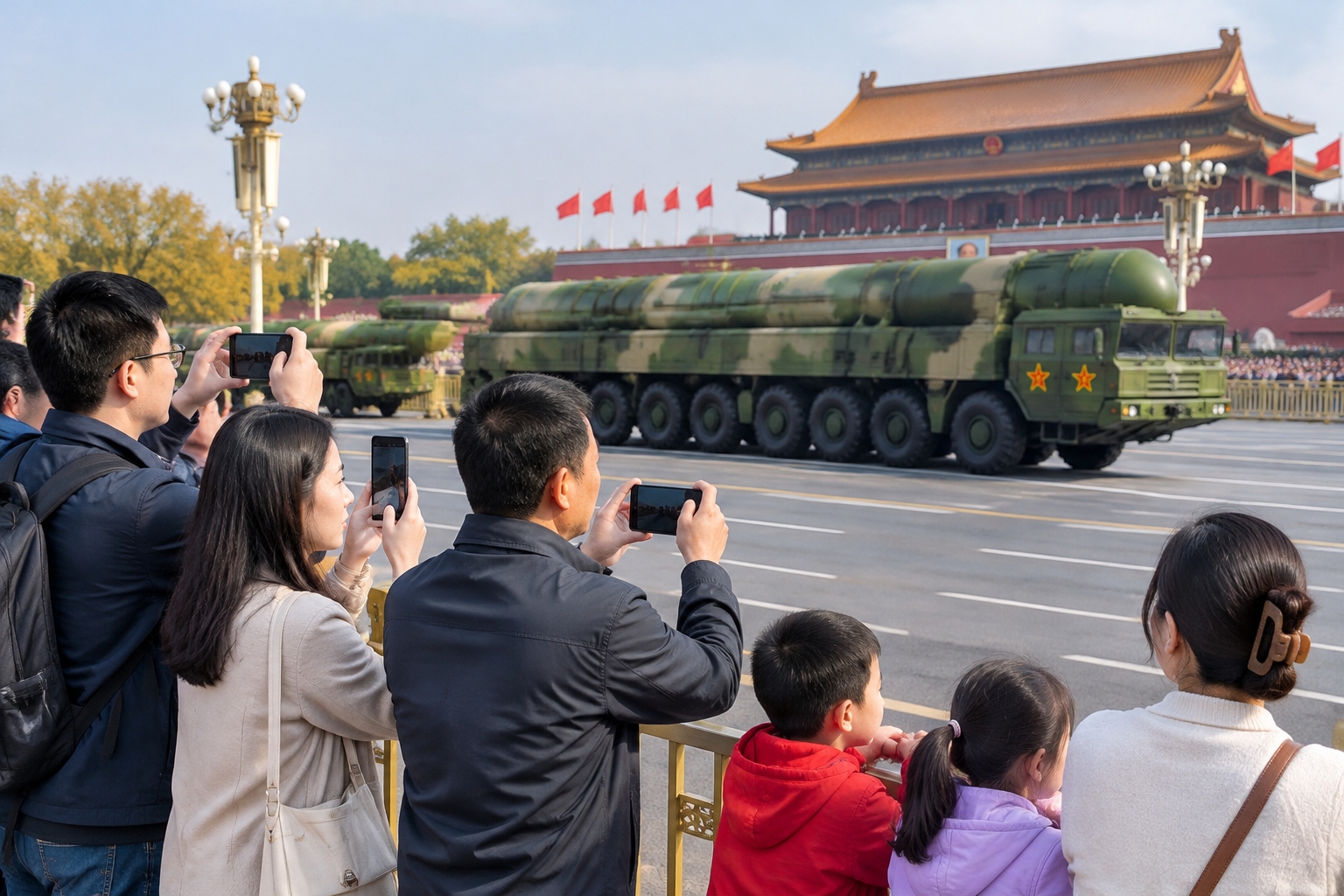
“What is this thing?” A friend in Toronto sent me a 20-second video: a long olive-green cylinder riding on a multi-axle launcher, rolling slowly past crowds on a wide avenue, phones raised. The caption said DF-41. “Should I be worried?”
It is a fair question, and the honest answer is longer than a text message. Most coverage of weapons like this arrives in two flavors — breathless or blank. This piece tries a third: explaining, in ordinary language and using only public information, what the object in the video is, what the phrase “nuclear strategic force” actually means, and what a parade does and does not tell you.
It contains no deployment locations, no performance figures, no operational plans. Those are not public, and repeating guesses dressed up as facts would only add noise to a conversation that already has plenty.
First, what an intercontinental ballistic missile is
Start with the words. A ballistic missile is a rocket that pushes a payload to very high speed and then lets physics do the rest: the payload follows an arc, most of it outside the atmosphere, and comes down under gravity. It is not a cruise missile, which flies powered and steered through the air like a small aircraft.
Ballistic missiles are grouped by range. Short-range systems cover a few hundred kilometers and are battlefield tools. Medium- and intermediate-range systems reach a few thousand. The dividing line that matters here is 5,500 kilometers — a convention that came out of Cold War arms-control negotiations. Beyond it, a missile is called “intercontinental.”
That threshold is bureaucratic in origin, but the consequences are not. An ICBM’s flight time is measured in tens of minutes; its trajectory runs far above weather and air traffic; and, most importantly, a weapon designed to cross oceans is not aimed at a unit, a bridge or a supply depot. It is aimed at the other side’s ability to wage war at all. That is what “strategic” means in this vocabulary, and it is why these systems are discussed in a completely different register from everything else that rolls down a parade route.

So what is a “nuclear strategic force”?
Strategic nuclear forces are the part of a military that exists to make certain decisions unthinkable rather than to win engagements. They are not built to be used in the way a tank or a fighter jet is used. Their function is to sit in the background of every other calculation a government makes.
They usually come in three forms — fixed silos on land, mobile launchers on roads or rails, and submarines at sea — because each survives attack in a different way.
What the public record says about the DF-41 is narrow. It is a Chinese intercontinental ballistic missile. It is road-mobile, meaning it is carried on a vehicle rather than sitting in a fixed silo. It uses solid fuel, which means it does not need to be fuelled shortly before launch. And it first appeared publicly at the 2019 National Day parade in Beijing. That is roughly the extent of what is confirmed.
Those last two characteristics matter for one reason: survivability. A silo is a fixed address. A launcher that moves, carrying a missile that is ready to go, makes the “find it and destroy it before it is used” problem much harder for an adversary. In nuclear planning this is described as surviving a first strike and retaining a second-strike capability — the ability to retaliate after being hit.

Deterrence is a dull word for an uncomfortable idea
Deterrence means getting someone not to do something by changing their estimate of what it will cost them. It is not a physical object. It is a belief inside another person’s head, and it only works if that person believes two things: that retaliation is possible, and that it will actually happen.
During the Cold War this hardened into the phrase “mutual assured destruction” — the grim arithmetic in which two heavily armed states each conclude that striking first is suicidal. Analysts still argue about how much of that stability came from the weapons and how much from the communication between the people holding them.
China’s declared policy is worth knowing because it is unusual. Since its first nuclear test in 1964, Beijing has committed to no first use: Chinese nuclear weapons, in this stated doctrine, would only be used in response to a nuclear attack. China has also described its posture as “minimum deterrence” — a force sized to make retaliation credible rather than to match the largest arsenals weapon for weapon.
Declaratory policy is a statement of intent, not a description of hardware, and outside analysts debate the gap between the two. Outside estimates, such as those published by the Stockholm International Peace Research Institute, put China’s stockpile at roughly 600 warheads as of early 2025, against several thousand each for the United States and Russia. For a reader outside China, that comparison may be the most useful single fact in this article: the current conversation about Chinese nuclear modernization is not about parity. It is about a much smaller arsenal changing shape.
Why put it in a parade at all?
Parades are communication, and every nuclear-armed state does this. France rolls missiles down the Champs-Élysées on Bastille Day. Russia displays its strategic systems on Victory Day. India does it on Republic Day. The vehicles are not there because the military needs to move them from one place to another; they are there to be photographed.
There are two audiences. Domestically, a parade is about confidence, legitimacy and the visible competence of an institution. Externally, it is a signal — but a narrow one. Showing a canister on a launcher tells you that the system exists, roughly what class it belongs to, and that the state is willing to be seen with it. It tells you nothing about how many exist, where they are kept, or whether they are ready.
There is also a texture that foreign coverage tends to miss. For the people who line the avenue, a parade is a day off, a crowd, road closures, and something to photograph for the family group chat. That ordinariness coexists with the strategic meaning; it does not cancel it out.
Where transparency stops, and why
China publishes a defense white paper every few years, is a party to the Nuclear Non-Proliferation Treaty, notifies other governments before long-range missile tests, and takes part in the P5 process among the permanent members of the UN Security Council. None of that discloses operational detail, and no nuclear-armed state discloses operational detail. The United States does not publish the alert status of its silos. Britain does not publish patrol routes for its submarines. The category of information is withheld by everyone, for the same reason.
This is what confuses people. A government will confirm a missile exists and put it on television, then decline to say how many are deployed. That is not a contradiction. Existence is the deterrent signal; numbers and locations are exactly what an adversary would need. Ambiguity about the second category is part of the strategy, not a failure of openness.

Three ways this coverage usually goes wrong
Reading a parade as an announcement
A display is a statement about capability, not about intent or timing. Treating every appearance in a parade as a warning sign is like treating a fire station’s open doors as evidence of a fire.
Treating warhead counts as a scoreboard
Numbers matter, but they are estimates, they carry error bars, and they say little about doctrine — whether a country plans to use them first, how it communicates, what it would consider a red line. Counting is the easy part of analysis and often the least informative.
Assuming transparency means full disclosure
Transparency in nuclear affairs is selective by design, everywhere. The useful skill for a reader is learning which category a given fact belongs to: existence, class, quantity, location, readiness. Most public statements only cover the first two.
What this piece is, and what it isn’t
This is an explanation of vocabulary, based on publicly available material — parades, white papers, treaty membership, and published outside estimates. It is not a technical briefing, and reading it will not make anyone an analyst. It is meant to do one thing: let you read a headline about the DF-41, or a clip forwarded by a friend, and know roughly what is being described and what is being left out.
Back to the text message
“Should I be worried” deserves better than yes or no. The object in the video is the visible part of a system that is mostly invisible: budgets, laboratories, treaties, bureaucratic routines, and an assumption shared by every nuclear-armed government that these weapons exist in order never to be used. Whether that assumption holds is a question about people and institutions, not about a cylinder on a truck.
For most people in China, the missile is background noise, no more present in daily life than it is in Toronto. On the avenue, the parade passes, the road reopens, and the city goes back to its afternoon.
Start the discussion at forum.chinacomes.com