

The valley that has to stay quiet
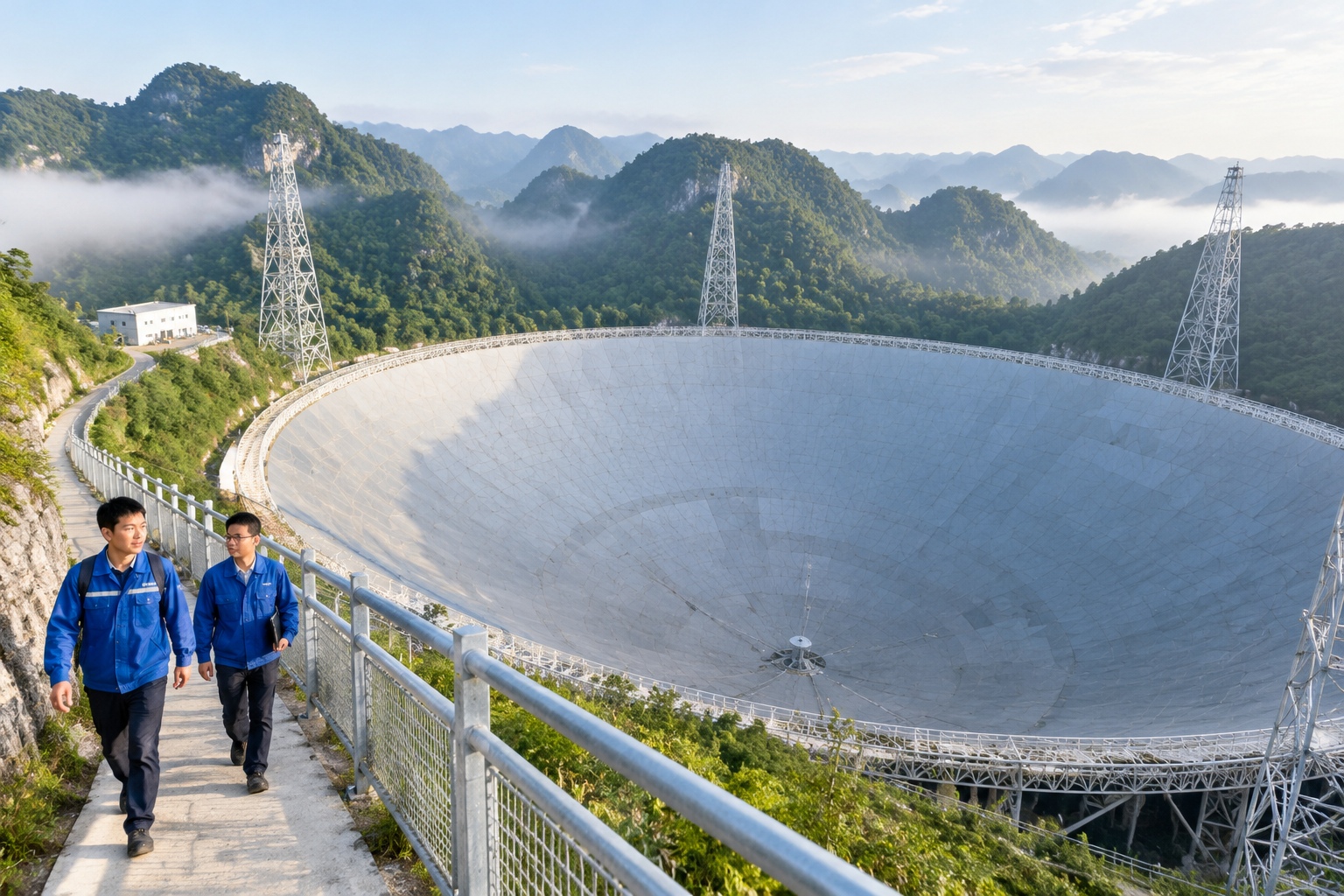
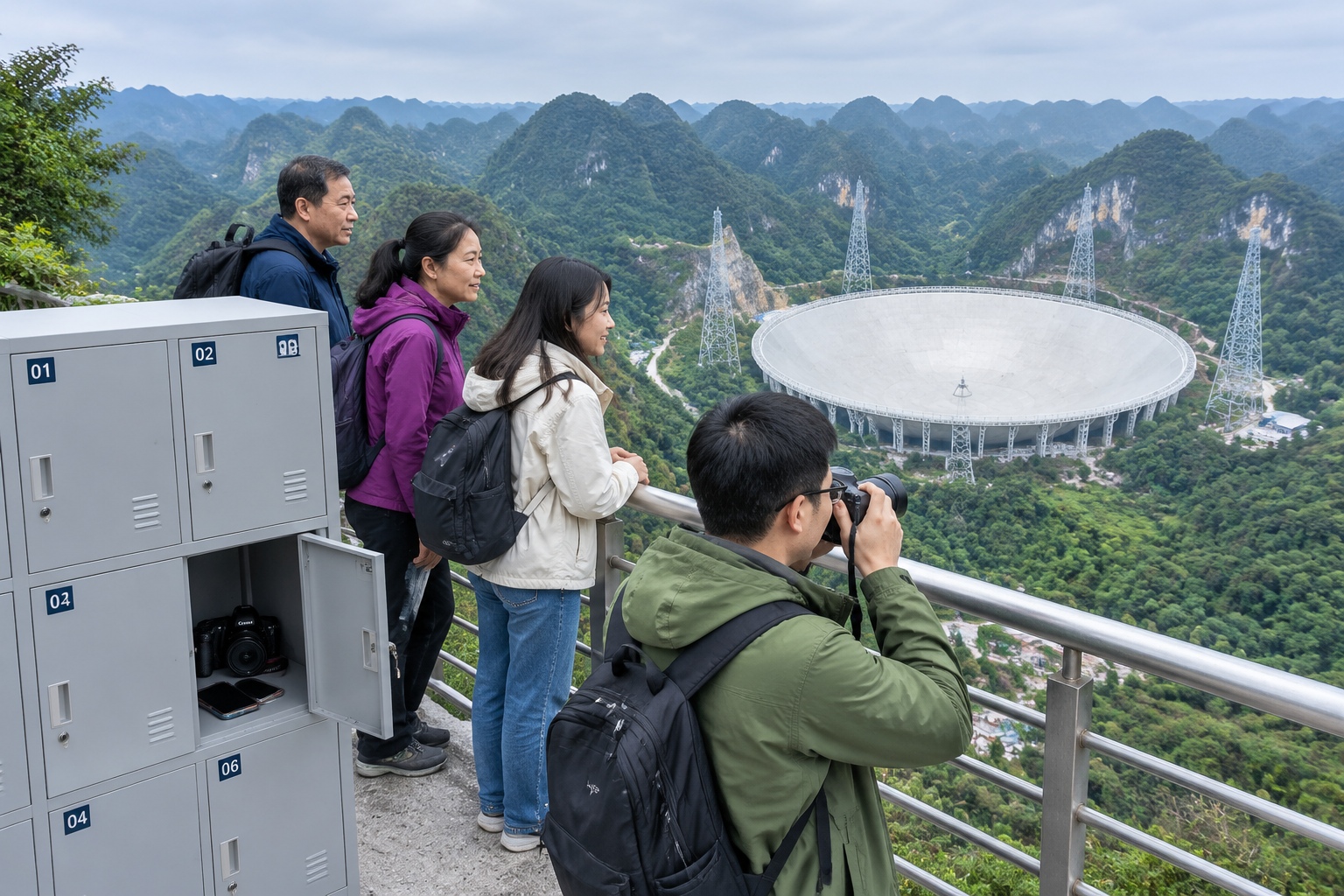
From Pingtang county in Guizhou, a road climbs through terraced hills and ends at a viewing platform. Below it, filling a natural karst hollow called Dawodang, is a white dish 500 metres across — roughly the area of 30 football pitches. A few kilometres back, at the visitor centre, there is a bank of metal lockers. Phones, cameras, smartwatches and car keys stay inside them. A digital camera left switched on near the site can put more radio noise into the air than the signals the dish is trying to catch.
That single rule explains more about FAST — the Five-hundred-metre Aperture Spherical radio Telescope — than any statistic. It is not a telescope that takes photographs. It listens.
What the instrument physically is
The dish is made of 4,450 triangular aluminium panels hung on a cable net, and that net is pulled into shape by 2,225 motorised winches. As the telescope tracks a source, the surface flexes so that a 300-metre-wide patch of the 500-metre dish always forms part of the correct parabola. A feed cabin suspended on cables above the dish collects the signal. Construction ran from 2011 to 2016; the telescope passed national acceptance in January 2020 and has been in scheduled operation since.
Two constraints are worth knowing up front. It works between roughly 70 MHz and 3 GHz, so it sees a particular slice of the radio spectrum rather than everything. And because of how the feed cabin is suspended, it can only track sources within about 40 degrees of the zenith — the band of sky that passes overhead. FAST cannot be pointed anywhere at will. It is a transit instrument with a generous but finite field of view.
Radio quiet matters because of the physics. By the time a signal from a distant object reaches Guizhou it is extraordinarily faint, and a mobile phone, a microwave oven or a car ignition can bury it. Hence the quiet zone: a core area of about five kilometres around the site, with wider buffer rings beyond, where radio-emitting equipment is restricted.
A pulsar is a lighthouse, not a ‘new star’
Chinese coverage of FAST often runs the words 新星 and 脉冲星 close together, and the English rendering can be confusing. They are different objects.
A nova is a thermonuclear flash on the surface of a white dwarf, usually spotted by optical telescopes as a star that suddenly becomes bright. FAST does not go looking for those. What it finds in bulk is pulsars.
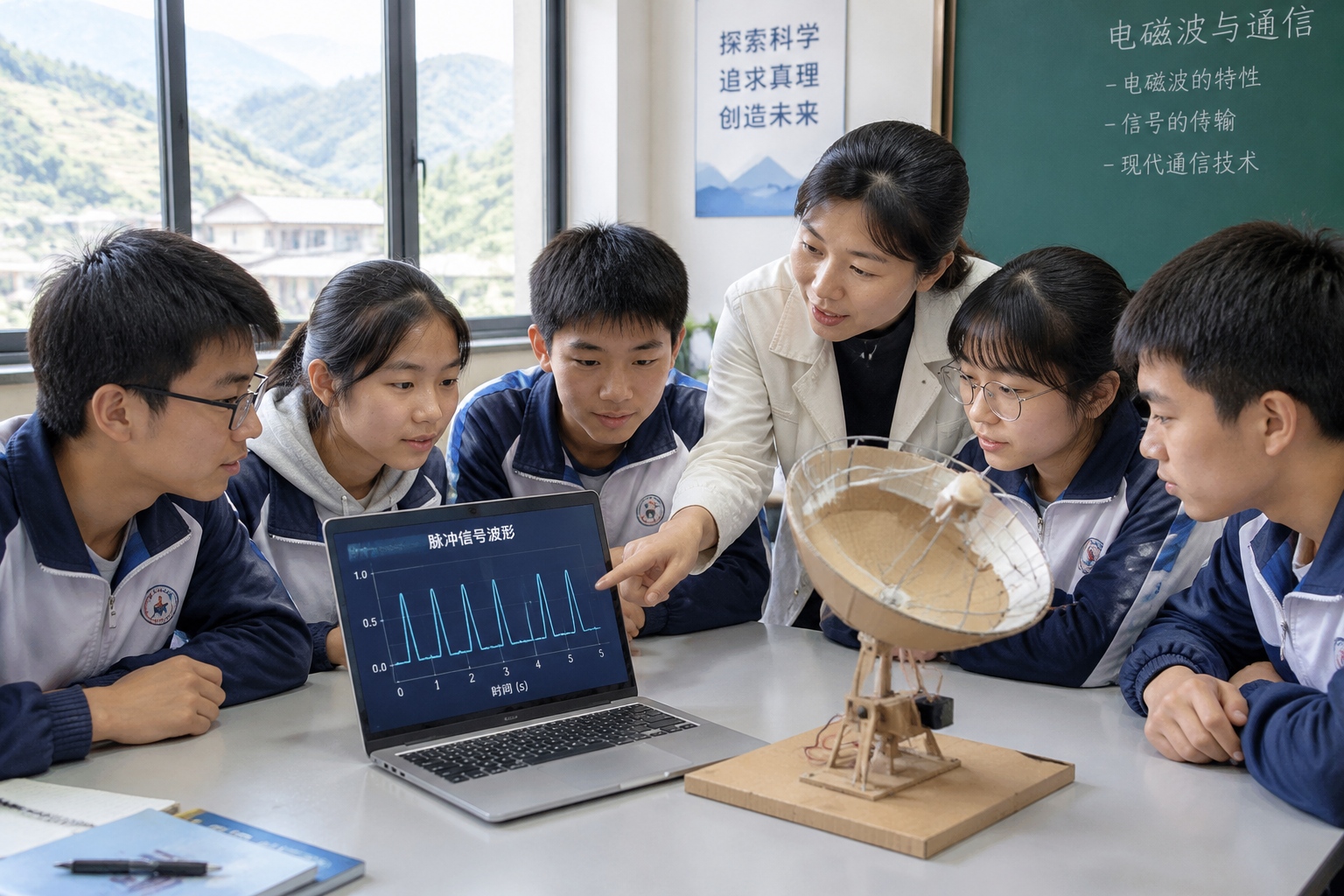
A pulsar is a neutron star: the collapsed core of a massive star, roughly the mass of the Sun squeezed into a sphere about 20 kilometres across. These objects spin — some of them hundreds of times per second — and they beam radio waves along their magnetic axes. Each time a beam sweeps past Earth, radio telescopes record a pulse. The result is a clock more regular than almost anything built by humans, which is exactly why astronomers care.
Pulsars were found in 1967 by Jocelyn Bell Burnell and Antony Hewish, and were briefly nicknamed LGM for ‘little green men’ before a natural explanation took hold. Over the next five decades the global catalogue grew slowly, to roughly 3,000 objects. FAST’s own tally passed 900 by 2024 and keeps climbing.
Why a steady stream matters more than a lucky strike
One pulsar can be luck. Nine hundred is a production line, and production lines say more about a country’s science than any single headline.
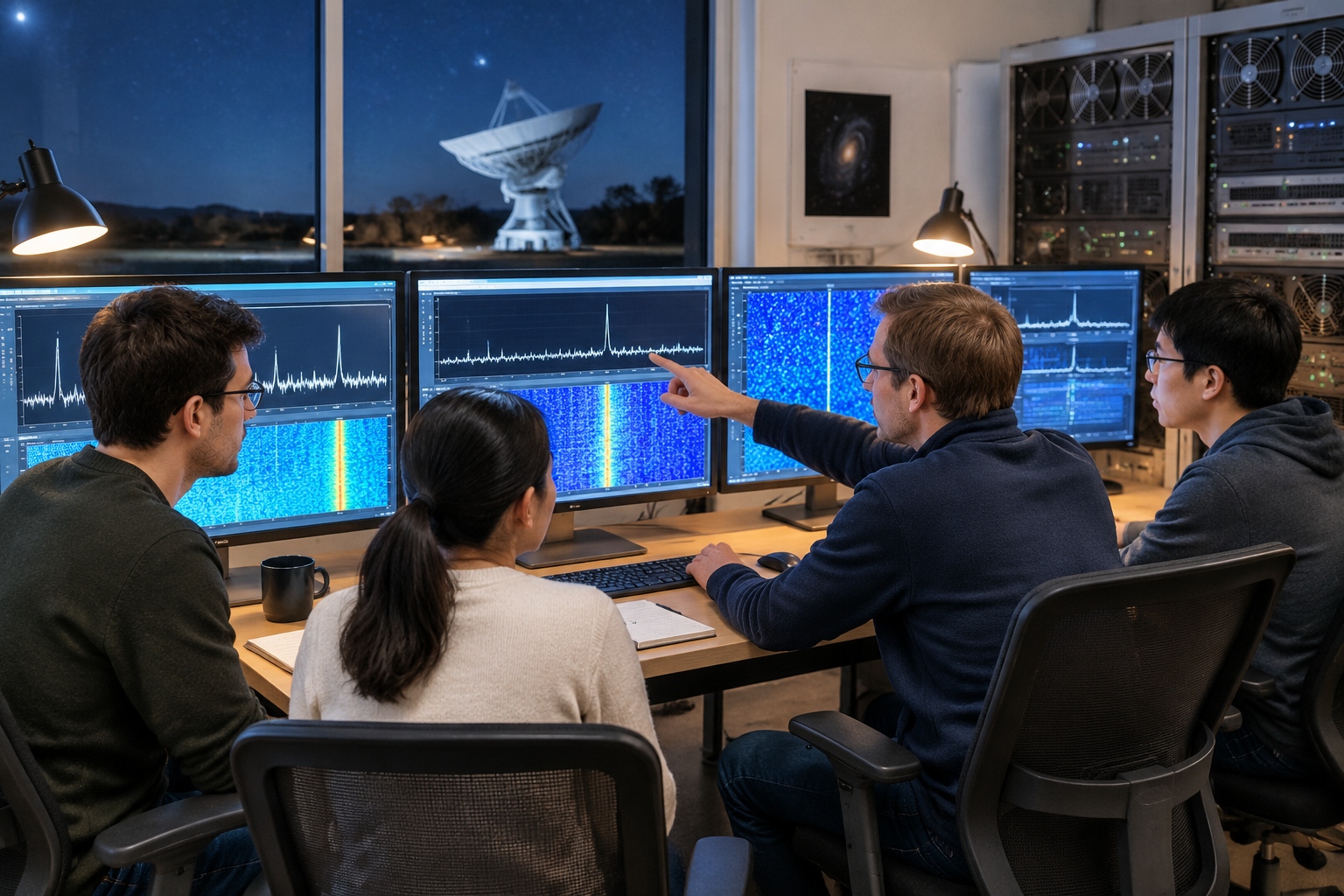
Several things have to work at once. The dish has to be sensitive — collecting area is the main reason FAST finds faint pulsars that older telescopes missed, especially inside crowded globular clusters where signals are smeared and weak. The receiver has to be good: FAST’s 19-beam L-band receiver scans 19 patches of sky simultaneously, and the CRAFTS survey uses it to hunt for pulsars and fast radio bursts alongside other science. The software has to filter: a survey throws up millions of candidate signals, most of them interference from Earth or ordinary objects. And people have to re-observe candidates, with FAST or with other telescopes, to pin down period and position before anything is published.
None of that is glamorous. It is shifts, pipelines, checking, and a queue of proposals competing for observing time. It is also the part that repeats, and repetition is the thing that separates an instrument from an event.
What pulsars are actually used for
Astronomers rarely study pulsars for their own sake. The objects are tools.
Testing gravity
Some pulsars orbit another star, sometimes another neutron star. Timing those pulses over years reveals the orbital decay predicted by general relativity and constrains alternatives to it. The 1993 Nobel Prize in Physics went to Russell Hulse and Joseph Taylor for exactly this kind of measurement.
Listening for gravitational waves
Across the galaxy, dozens of millisecond pulsars are timed at once. A passing gravitational wave would stretch and squeeze the space between them and Earth, showing up as a correlated wobble in arrival times. In 2023 the Chinese Pulsar Timing Array, built substantially on FAST data, reported evidence for a background hum of nanohertz gravitational waves — alongside similar results from North American, European, Indian and Australian teams. The agreement between independent arrays is the interesting part. It turns a claim into a measurement.
Mapping what lies between the stars
Radio pulses slow down as they cross ionised gas, and the delay depends on frequency. Measuring that delay probes the tenuous plasma filling the Milky Way — its density, its turbulence, its magnetic field. FAST’s sensitivity extends those measurements to fainter, more distant pulsars than before.
Understanding extreme matter
Neutron stars are the densest objects that can be observed directly. Their mass and radius tell physicists how matter behaves at densities no laboratory can reproduce.
What this has to do with people who will never use a radio telescope
Honestly: not much directly, and it is worth saying so. Basic astronomy does not produce a consumer product. The spin-offs are real but modest — cryogenics, low-noise amplifiers, data pipelines that cope with a firehose of samples, and control systems that move 2,225 winches in coordination to millimetre accuracy, which sits at the edge of what mechanical engineering can do. That is not a reason to build a telescope. The reason is the science.
What travels further is the machinery of collaboration. FAST has accepted proposals from foreign researchers since 2021, and observing time is allocated by peer review rather than nationality alone. Pulsar timing is international by nature: a single array needs telescopes spread across longitudes, which is why Chinese, Indian, European, Australian and North American data get compared rather than kept apart.
The quieter effect is local. Pingtang county was, until recently, one of the poorer parts of Guizhou. The telescope brought a road, a visitor centre, hotels and a tourist economy — along with restrictions residents did not previously have: limits on drones, on some radio equipment, on certain kinds of development inside the quiet zone. Both things are true. A facility this sensitive reshapes the place it sits in, and not always comfortably.
The unglamorous parts
Most of what FAST finds is not exciting. Ordinary pulsars, slow ones, objects similar to ones already known. Plenty of candidates turn out to be radio frequency interference from a nearby source. Some observing nights are lost to weather or equipment. Data volumes are large enough that processing, not observing, is often the bottleneck.
The dish also has real limits: the 40-degree zenith constraint, the frequency band, the fact that it cannot see the southern sky well. Chinese institutions are discussing a next-generation instrument, but that is years away and the design questions are unresolved.
Still, by the standard that matters in basic research — can you produce new measurements reliably, year after year, and can other people use them — FAST has crossed a line. It is no longer a new telescope to be written about. It is a working instrument, and papers are its ordinary output.
Start the discussion at forum.chinacomes.com