

A Pause on the Stairs
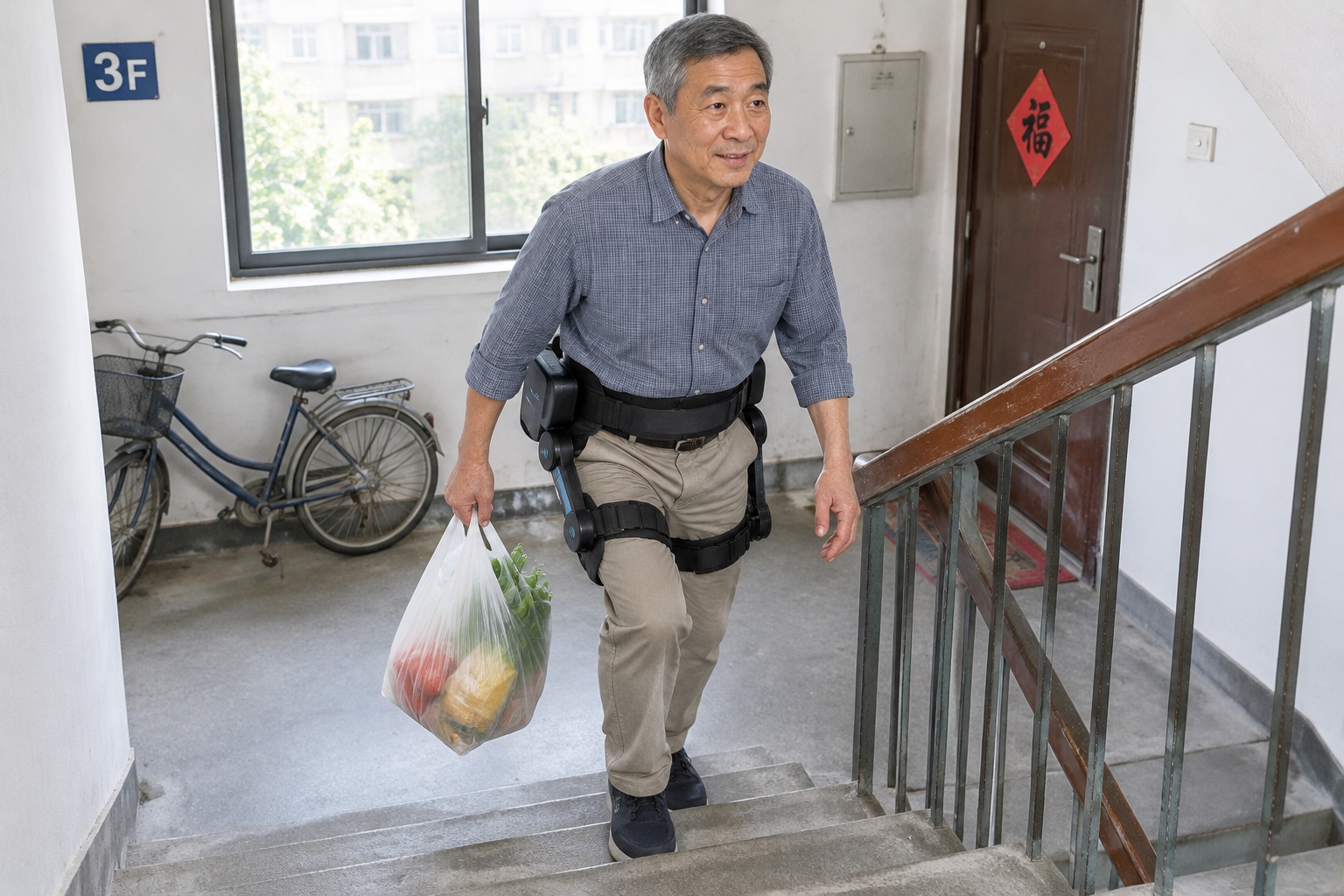
In a residential compound in Hangzhou, 68-year-old Zhou stops halfway up the stairs. He is carrying two bags of groceries. His right knee has been stiff for years, and the fourth floor has started to feel longer than it used to.
This afternoon he is wearing a black belt with two cuffs around his thighs and a small motor pack at his lower back. When he leans forward, the device gives a soft push at his hip. It does not carry him. It makes the next step feel less expensive.
That is the promise of a consumer hip exoskeleton. Not a robot suit, not a sci-fi shell, just a wearable walking aid that uses sensors, motors and control software to help with one of the most ordinary things a person does: taking a step. And it raises a practical question: how much can AI really help you walk?
From Hospital Equipment to a Box at Home
For years, exoskeletons belonged to rehabilitation centers and research labs. They were used after strokes, spinal cord injuries and major surgery, with a therapist standing nearby and a price tag in the tens of thousands of yuan. They were impressive, heavy and rarely something a family bought for daily life.
That is changing. Lighter motors, cheaper sensors, better batteries and China’s deep hardware supply chain have pushed a simpler kind of exoskeleton into the consumer market. Most are hip-only devices. They look like hiking belts with thigh straps. Some are sold online, some in demo stores, some through rental or community rehabilitation programs.
The price is still not pocket money. Consumer hip exoskeletons in China often cost several thousand yuan, while medical or rehabilitation versions can cost much more. But the category has moved from ‘hospital equipment’ to ‘something a family might consider’ — especially in a country with a large older population, dense housing and plenty of stairs.
What the AI Is Actually Doing
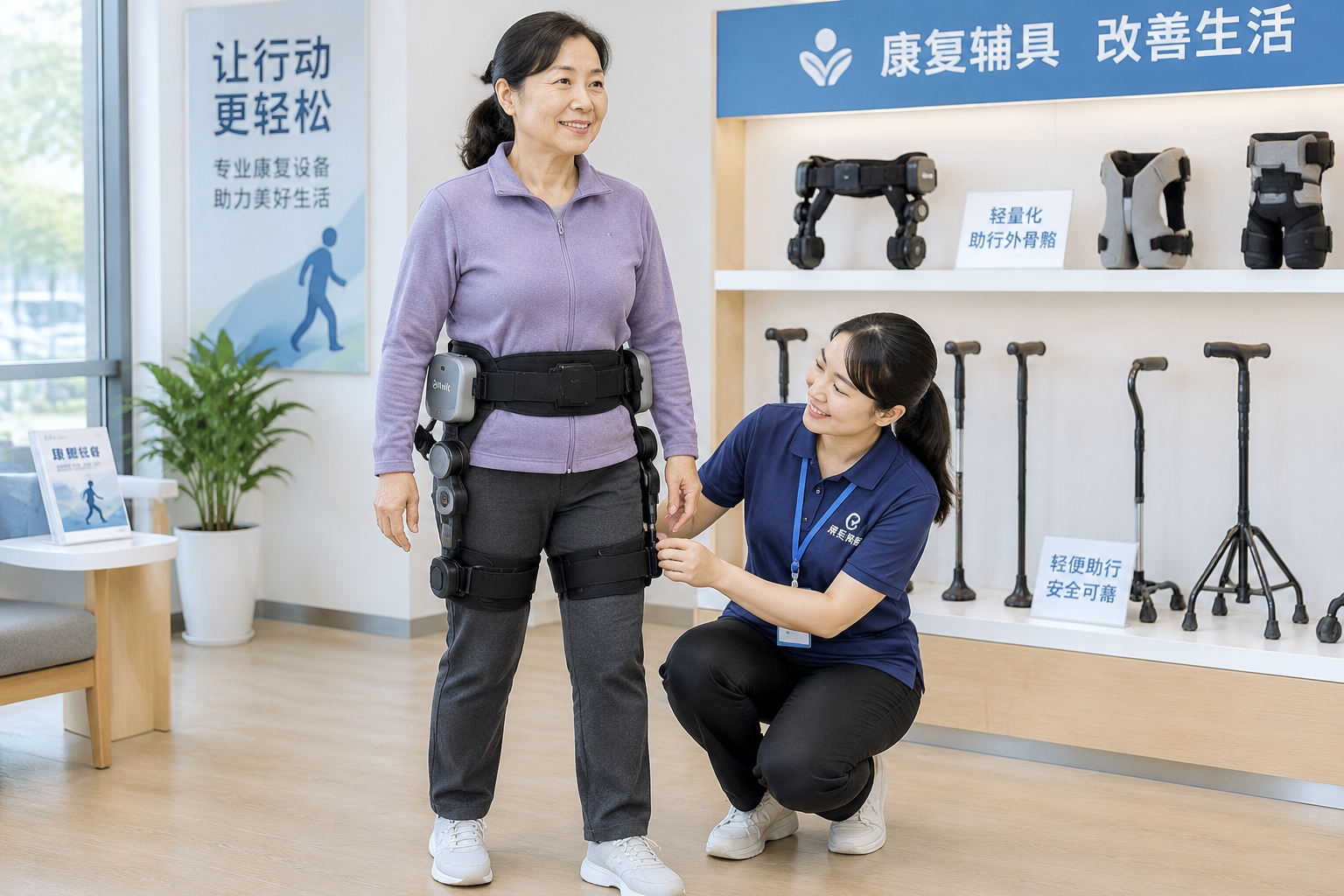
A hip exoskeleton is not thinking about your walk. It runs a narrow control loop. Sensors detect the angle and movement of your thighs, your pace and your rhythm. The software estimates where you are in the gait cycle — stance, push-off, swing — and predicts when the hip needs a little help. Then the motor applies torque at the right moment.
The AI part is adaptation. A simple device might offer one fixed level of assistance. A smarter one adjusts as you speed up, slow down, climb a slope or take a stair. It can learn your walking pattern over a few minutes and stop assisting when the movement becomes uncertain.
This is closer to the pedal assist on an electric bike than to a chatbot. It does not know you are late for lunch. It knows your thigh is moving forward and your hip could use a gentle push.
That difference matters. A cane gives stability. A hip exoskeleton gives power at the hip, helping lift the thigh and swing the leg. It is not a knee brace and not a full-body suit. It is a targeted tool for a specific joint and a specific phase of walking.
It also has limits. Unusual gaits, shuffling steps, severe stiffness and loose straps can confuse the sensors. A good device should fail safe: beep, reduce assistance or return to free mode if it is not sure. Bad design can fight the user instead of helping.
What It Feels Like to Wear
Most consumer hip exoskeletons aim for a weight of two to four kilograms, with a battery life of a few hours depending on the level of assistance. The weight sits at the waist and around the thighs. The first ten minutes often feel strange: a slight tug, a small lag, a motor whine. Then the rhythm settles in.
On flat ground, the help can be subtle. On stairs and slopes, it is easier to notice. Standing up from a chair may be assisted by some hip devices, but not all. Sitting down can press the cuffs into the legs. The belt may dig into the waist if it is not fitted well.
Comfort is the real product. If the strap slides or the belt presses on the hip bone, no algorithm will save the experience. Older users often want one button, a clear battery light and no complicated app. Caregivers want to know how to put it on, take it off and clean it. A device that is hard to wear will stay in the closet.
The real help is modest and concrete: fewer stops on the way to the market, a steadier climb, less fear of a long corridor. It is not a sprint. It is a walking aid, not super legs.
Assistance, Rehabilitation and Enhancement Are Not the Same
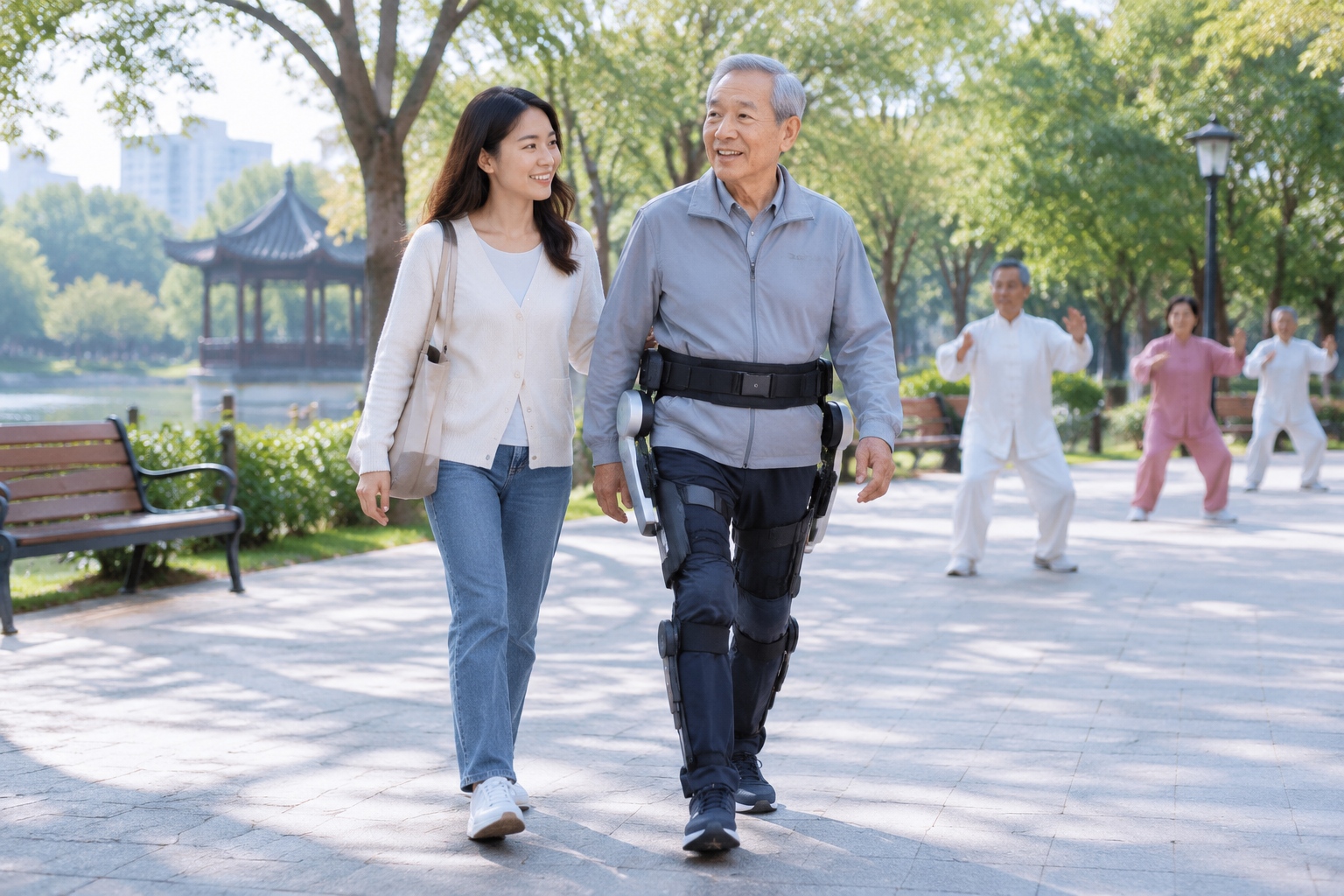
It helps to separate three categories. Assistance means helping daily walking for people with mild weakness, fatigue or age-related decline. Rehabilitation means recovery after stroke, surgery or injury, usually with a clinician and often with medical device registration. Enhancement means helping healthy people carry loads, hike faster or run.
The same hardware can overlap, but the claims and safety rules are different. Most consumer hip exoskeletons are assistance products. They may be used inside a rehabilitation program, but they do not replace physiotherapy. They should not be sold as a cure for knee pain or a way to ‘restore youth.’
For healthy hikers, an extra hip push may be fun, but it is not necessary. It can create pressure, strain or overconfidence. For people with severe balance problems, unexplained falls, acute hip or knee pain, recent surgery, osteoporosis, cognitive impairment or uncontrolled spasticity, a consumer device is not a casual purchase. Professional fitting and medical advice matter.
The Price of a Little Help
In China, a consumer hip device may cost several thousand yuan. Families compare it with an electric scooter, a massage chair or a few months of physiotherapy. Insurance usually does not cover consumer wellness devices, though medical rehabilitation versions may follow different rules.
The cost is not only hardware. It includes fitting, training, repair and battery replacement. In smaller cities, access to demo stores and trained staff may be limited. That is why rental and try-before-you-buy matter. A device bought online and never adjusted is an expensive coat rack.
Safety Is the Feature
Ask the seller a simple list of questions: What is the maximum user weight? How long does the battery last? Is there an emergency stop? What happens if the sensor fails? Can it be used on stairs and wet pavement? What are the contraindications? Who repairs it?
A serious product should pass endurance, thermal, electrical and drop tests. If it makes medical claims, it should have the relevant registration. In China, medical devices are regulated by the NMPA. Consumer products should not promise to treat disease. If a seller says the device cures knee pain, walk away.
The real test is not a smooth stage at a trade fair. It is a wet subway entrance, a narrow market aisle, a bus step and a crowded sidewalk. A walking aid has to work in the untidy places where people actually live.
The Small Thing AI Can Help With
Walking is a small thing until it becomes hard. Then it shapes where you go, whom you visit and how much you ask of other people. A consumer hip exoskeleton does not rebuild a joint. It gives a few milliseconds of timely torque and a little more margin.
That is a modest promise, and a meaningful one. In Zhou’s stairwell, the device did not make him 30 again. It helped him carry the groceries to the fourth floor without stopping twice. For AI in daily life, that may be the right scale: not superhuman, just a small push in the right moment.
Start the discussion at forum.chinacomes.com