
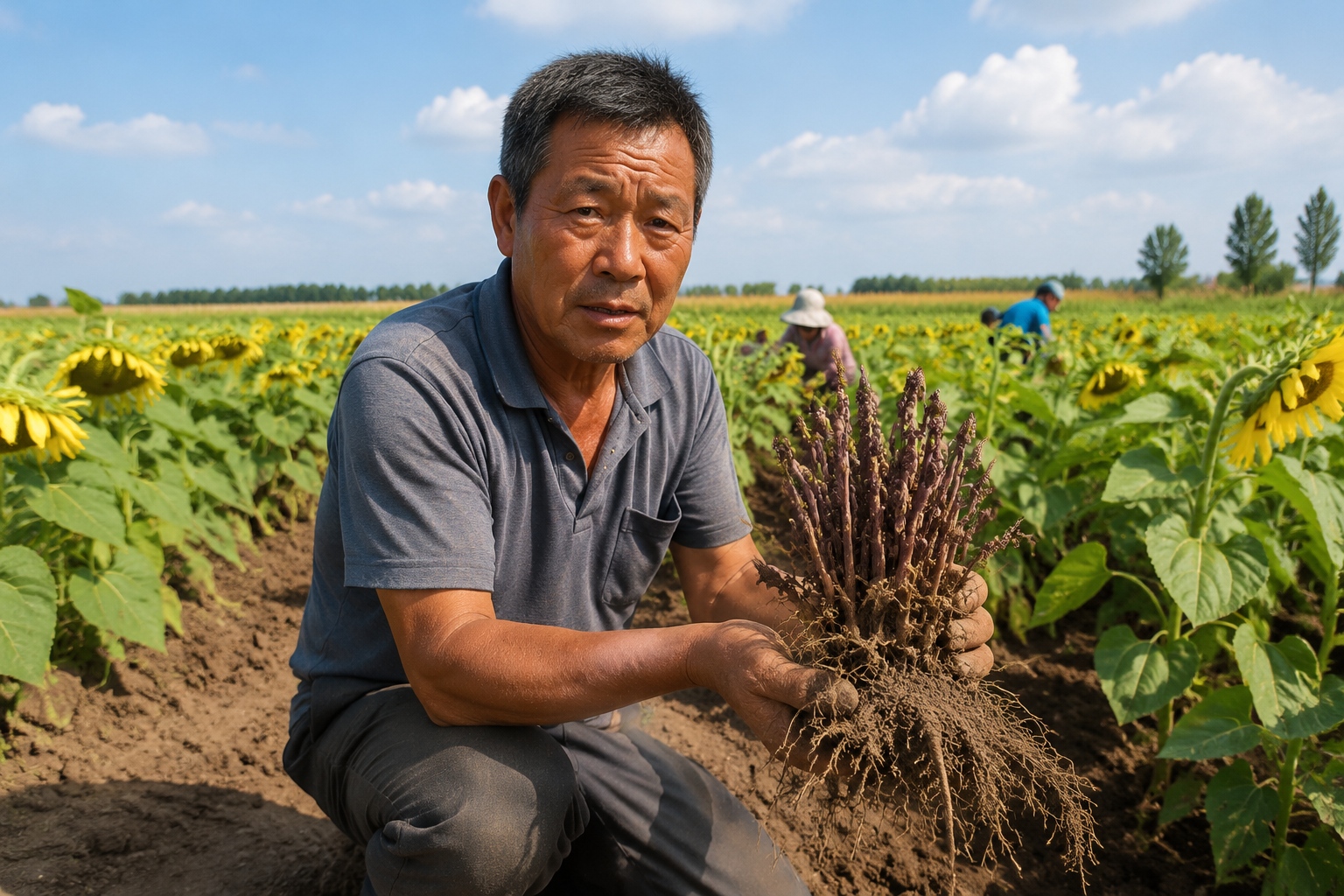

A field that looks healthy until you kneel down
In late July, the sunflowers around Wuchuan County, Inner Mongolia, stand taller than a person. From the road, the fields look good: broad green leaves, yellow heads turning east. Then Li Guizhen kneels between two rows and pulls back the soil. At the base of a sunflower stem, a cluster of purple-brown shoots has pushed out of the ground. Each one is attached to a sunflower root. The plant is broomrape, Orobanche cumana, a parasitic weed that takes water and nutrients from the crop before the sunflower has filled its seed.
Li has farmed here for more than 20 years. She says a clean field can yield around 3 tonnes of sunflower seed per hectare. In a bad year, with broomrape, she may harvest 1.5 tonnes. The difference is not abstract. At local prices of roughly 6,000 yuan per tonne, about $830, that is around 9,000 yuan lost on a single hectare, before she counts the cost of pulling the weeds by hand.
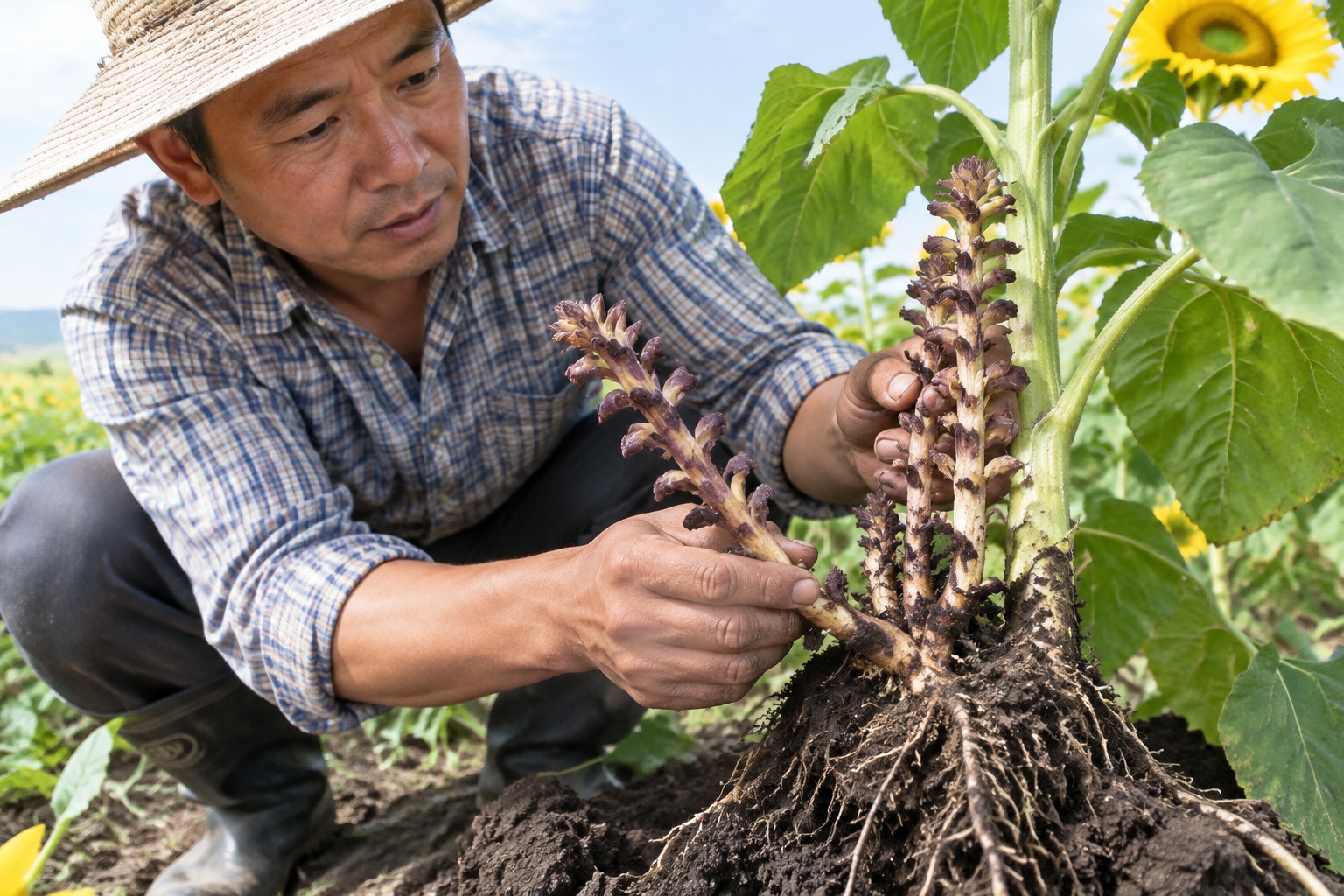
Why broomrape is so hard to control
Broomrape is not a weed that can be sprayed away like a broadleaf intruder in a soybean field. Its seeds are tiny, produced in huge numbers, and can stay viable in soil for more than a decade. They germinate only when they detect strigolactones, chemical signals released by the roots of a potential host. That timing is the problem. By the time the parasite appears above ground, it has already connected to the host’s vascular tissue. It is no longer a separate plant with its own root system. It is a drain installed inside the crop.
Farmers have three traditional options, and each has limits. They can rotate to a non-host crop, but the seed bank lasts for years and rotation may mean giving up a profitable cash crop. They can pull the weeds by hand, but the shoots emerge over several weeks, so the field must be walked repeatedly. In Wuchuan, hired labor costs about 120 to 180 yuan per person-day. A heavily infested hectare can absorb 12 to 20 person-days, or 1,500 to 3,000 yuan, and still lose part of the yield. They can use soil fumigation or selective herbicides, but fumigation is expensive and broad-spectrum, and herbicide-tolerant sunflower systems are not a universal fix.
The same problem appears with Striga, known as witchweed, which attacks sorghum, millet and maize in parts of Africa and Asia. The names and crops differ, but the biology is similar: a tiny seed, a chemical wake-up call, an underground connection, and a yield loss that is often invisible until harvest.
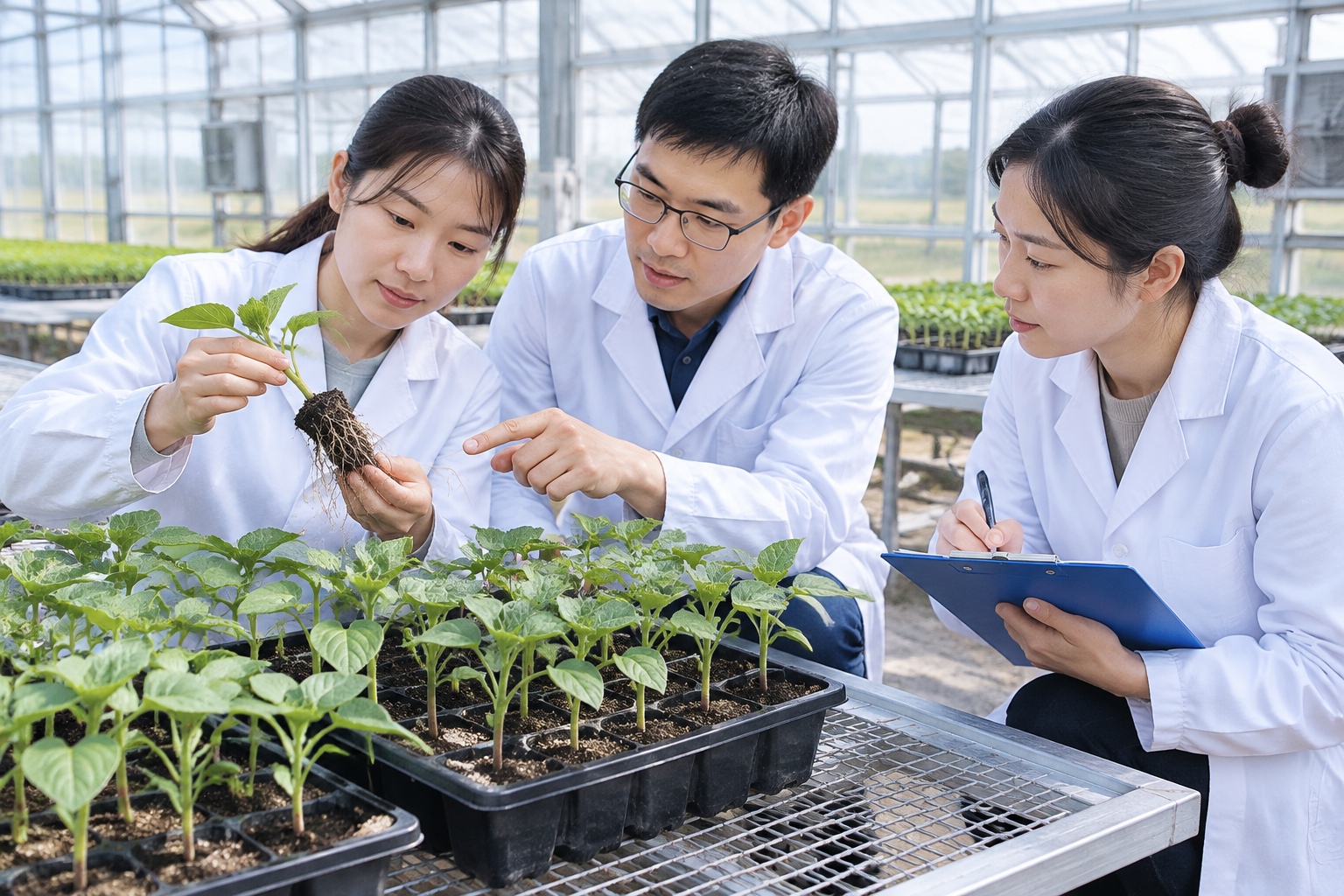
The gene changes the conversation at the root
That is why a gene-based solution matters. A Chinese research consortium working on sunflower broomrape has focused on the earliest stage of the attack: the moment the parasite tries to establish a connection with the host root. The team compared resistant and susceptible sunflower lines in greenhouse tests and in infested soils. The resistant lines did not simply produce fewer parasite shoots above ground. Under the microscope, the invasion points looked different. The host plant had reinforced the cell walls around the parasite’s haustorium with lignin and suberin, the same kinds of materials that make wood hard and waterproof.
The parasite could still germinate. It could still attach. But the connection to the host’s xylem, the pipeline that moves water and minerals, failed to mature. In susceptible plants, the haustorium reached into the vascular tissue and the parasite grew quickly. In resistant plants, the invasion was stopped at the border. The gene variant acts like a lock on a door that is usually left open.
There is a second route in the same body of work. Some resistant lines release lower levels of strigolactones from their roots, so fewer parasite seeds receive the signal to germinate. This is not total immunity. It is a reduction in the number of attacks, combined with a stronger local defense when an attack happens. For a crop like sunflower, that combination can be the difference between a field that is overrun and a field that is harvestable.
From greenhouse to trial plots
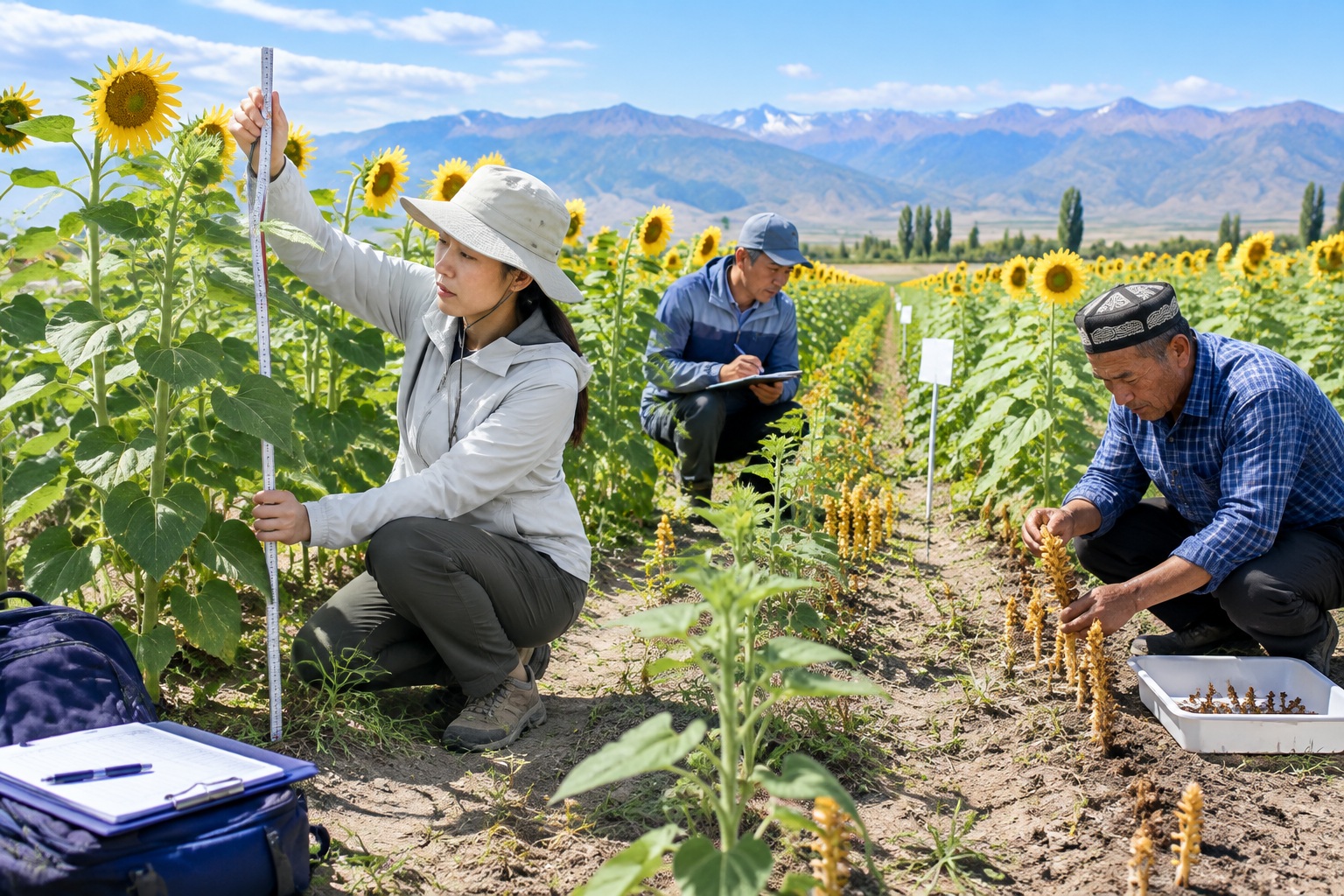
The more important test is not in a petri dish. In 2022, 2023 and 2024, the consortium ran field trials in Wuchuan County, Inner Mongolia, and in Altay, Xinjiang, two regions where sunflower broomrape is a long-standing problem. The trials used local susceptible hybrids as controls and compared them with advanced lines carrying the resistance gene variant. The plots were not small garden beds. They were replicated field plots, planted and managed by local cooperatives, with natural broomrape pressure.
Across the three seasons, the resistant lines showed 70 to 85 percent fewer broomrape shoots per sunflower plant in the most heavily infested sites. Yield told a clearer story. The resistant lines produced 2.6 to 3.1 tonnes per hectare. The susceptible controls produced 1.4 to 1.9 tonnes in the same trials. In one field near Wuchuan, the control plots lost more than half their potential yield. The resistant plots were not untouched. Some parasite shoots still emerged. But the crop kept enough of its root system and water supply to fill seed.
Researchers also measured the cost of control. In the trial fields, the resistant lines needed fewer hand-weeding passes. That matters because labor is the bottleneck. Rural China is aging, and young people are less willing to spend July afternoons bent over a sunflower field. A variety that cuts two or three passes of hand-pulling is not a luxury. It is a practical response to who is actually available to work in the field.
What farmers gain, and what they still risk
For a farmer, the arithmetic is direct. If broomrape cuts a 3-tonne crop to 1.5 tonnes, the lost revenue is roughly 9,000 yuan per hectare at local prices. If hand-weeding adds another 1,500 to 3,000 yuan, the total cost of the problem can approach 12,000 yuan per hectare. A resistant variety does not erase that cost. It reduces the frequency and severity of the loss. In the trial sites, the resistant plots preserved 1.2 to 1.5 tonnes more seed per hectare than the controls. That is real income, not a laboratory number.
The environmental effect is smaller but not trivial. Sunflower broomrape is not controlled by routine broadleaf herbicides. Farmers often rely on hand labor, crop rotation and, in some systems, soil fumigation. Each has a cost. Hand labor is expensive; rotation takes land out of sunflower; fumigation uses energy and chemicals and can affect soil biology. A resistant variety can reduce the need for the most blunt tools. It also fits a wider shift in Chinese agriculture: more emphasis on seed quality, less on simply adding inputs.
Still, resistance is not a permanent shield. Parasite populations vary, and they can adapt. In Spain and Eastern Europe, sunflower broomrape has overcome several resistance genes in the past. That history is a warning. A new variety needs to be deployed with rotation, monitoring and a mix of resistance sources. If farmers plant one resistant hybrid across every field, the parasite will have a large, uniform target.
The scale-up problem
The gap between a trial plot and a farmer’s field is usually seed supply, registration and trust. China’s variety registration system requires multi-site trials, and a new sunflower hybrid must pass those tests before it can be sold widely. Seed companies need parent lines and production capacity. Extension agents need to show farmers that the variety works on their own soil, not just on a research station. The trial data from Wuchuan and Altay are promising, but they are also a beginning. The next step is larger demonstrations, across different soil types and parasite populations.
There is also a market question. A resistant hybrid may cost more than a conventional one. Farmers will pay a premium only if the yield gain is visible. In the trial fields, the gain was large enough to justify a premium in heavily infested areas. In fields with low broomrape pressure, the economics are less clear. That is normal. Agricultural technology rarely spreads in a straight line. It moves field by field, as farmers compare notes and watch their neighbors.
The deeper point is that the solution is not a chemical. It is a seed. For decades, the answer to parasitic weeds has been more labor, more rotation, more soil treatment. The gene discovery changes the starting point. It gives breeders a trait to work with and farmers a way to keep more of what they grow. That is a modest kind of progress, but in a sunflower field in Inner Mongolia, it can be measured in tonnes, in yuan, and in the number of purple shoots a farmer pulls from the soil.
Start the discussion at forum.chinacomes.com