

A 700-metre hole in the ground, and a very old question
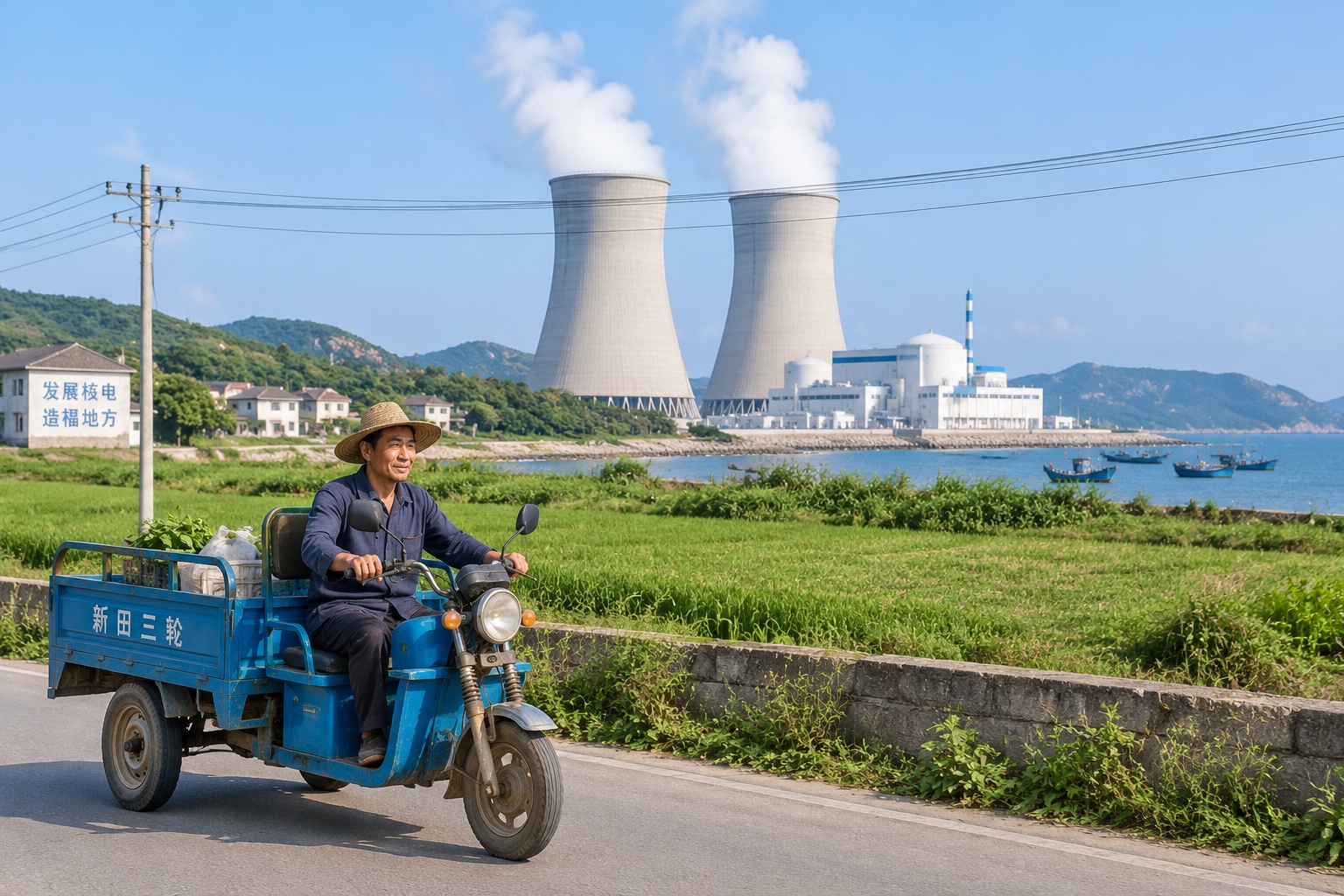
Two hours west of Hong Kong, the highway gives way to rice fields, then to small hardware factories, then to the white domes of the Taishan nuclear station. Past them, a service road turns into a tunnel and begins to descend.
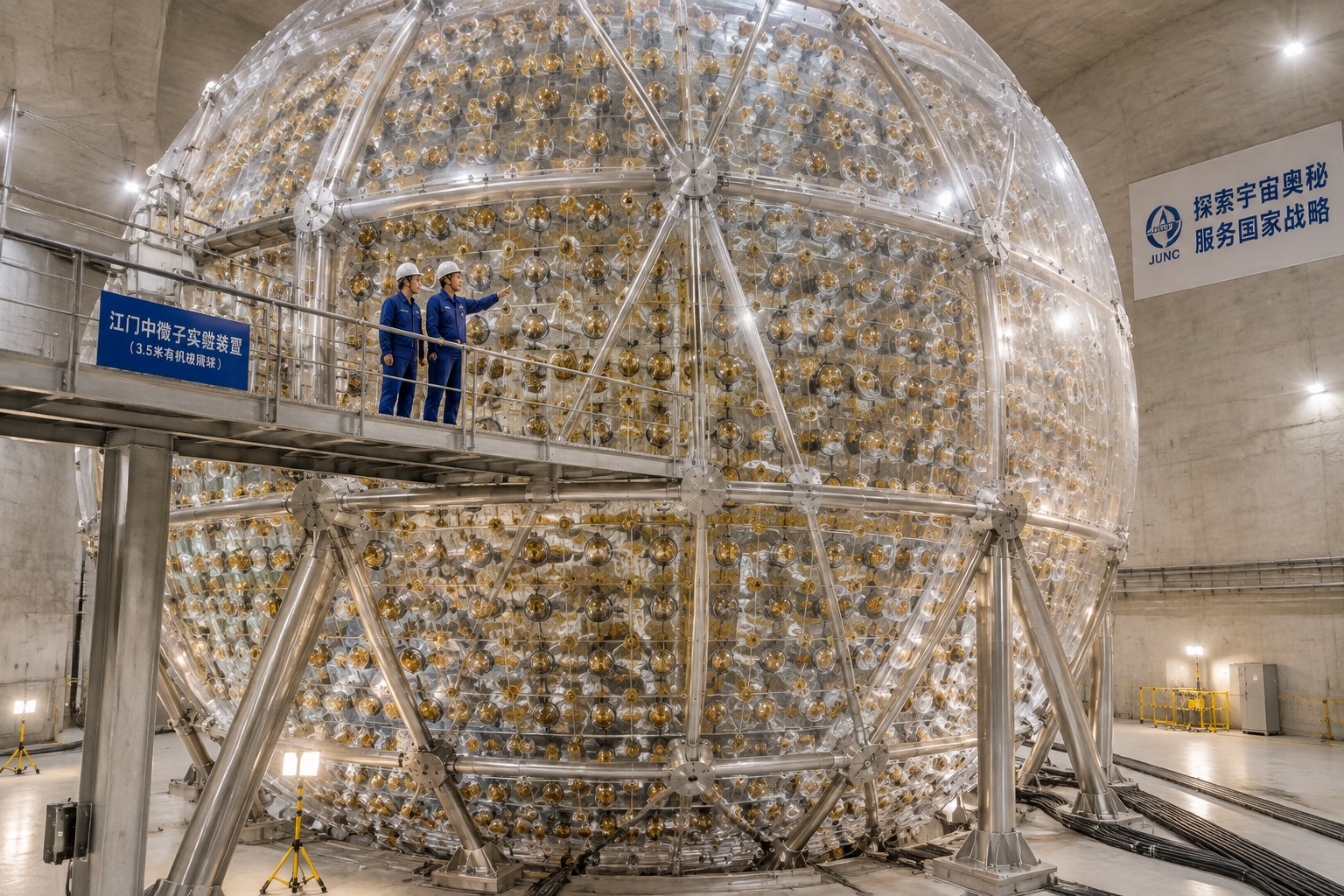
At the bottom, roughly 700 metres below the surface, there is a sphere 35 metres across. It is built from acrylic panels a few centimetres thick and holds 20,000 tonnes of a clear liquid that gives off a faint flash when something almost massless passes through it.
This is the central detector of JUNO, the Jiangmen Underground Neutrino Observatory — a project led from Beijing with about 700 researchers from 17 countries. It is one of the quietest large structures people have ever built: rock overhead, air sealed out, tens of thousands of light sensors waiting in the dark to catch a handful of photons at a time.
The sphere is there to help answer a question that sounds like philosophy and is really bookkeeping. Where did the antimatter go?

The missing half
The standard account of the early universe says energy turned into particles and antiparticles in roughly equal numbers, and that whenever the two met, they annihilated each other into light. If that had been perfectly true, the universe would be a thin soup of photons. No atoms, no stars, no us.
It isn’t. For roughly every billion matter-antiparticle pairs that annihilated, one particle of matter was left over. That leftover is everything we can see — gas, rocks, oceans, people. The antimatter is essentially gone, and nobody has a fully satisfying account of why the ledger tilted.
Something in the laws of physics must treat matter and antimatter slightly differently. Physicists call this CP violation. The Standard Model already contains some of it, measured precisely in particle decays — but the amount is far too small, by many orders of magnitude, to explain the surviving universe. So the search is on for where the rest of the difference hides.
Why a power station makes a good neutrino source
Nuclear reactors are, accidentally, the brightest neutrino sources humans have. Each fission produces fragments that decay and emit electron antineutrinos — a large power reactor releases something like 10²⁰ of them per second. They leave the core, cross the steel and concrete of the containment, cross the countryside, cross you, and almost none of them notice.
That is what makes them useful. A reactor is a well-understood source that runs day and night, and its output can be tracked reactor by reactor.
Catching them takes a trick. Electron antineutrinos occasionally interact with protons in a liquid detector, producing a positron and a neutron. The positron flashes almost immediately; the neutron is captured a few tens of microseconds later by gadolinium nuclei added to the liquid, producing a second, distinctive flash. That two-flash signature is so clean that a detector the size of a small room can pick out a few dozen antineutrinos a day from a background of cosmic rays and natural radioactivity.
Oscillation: the part that sounds like magic
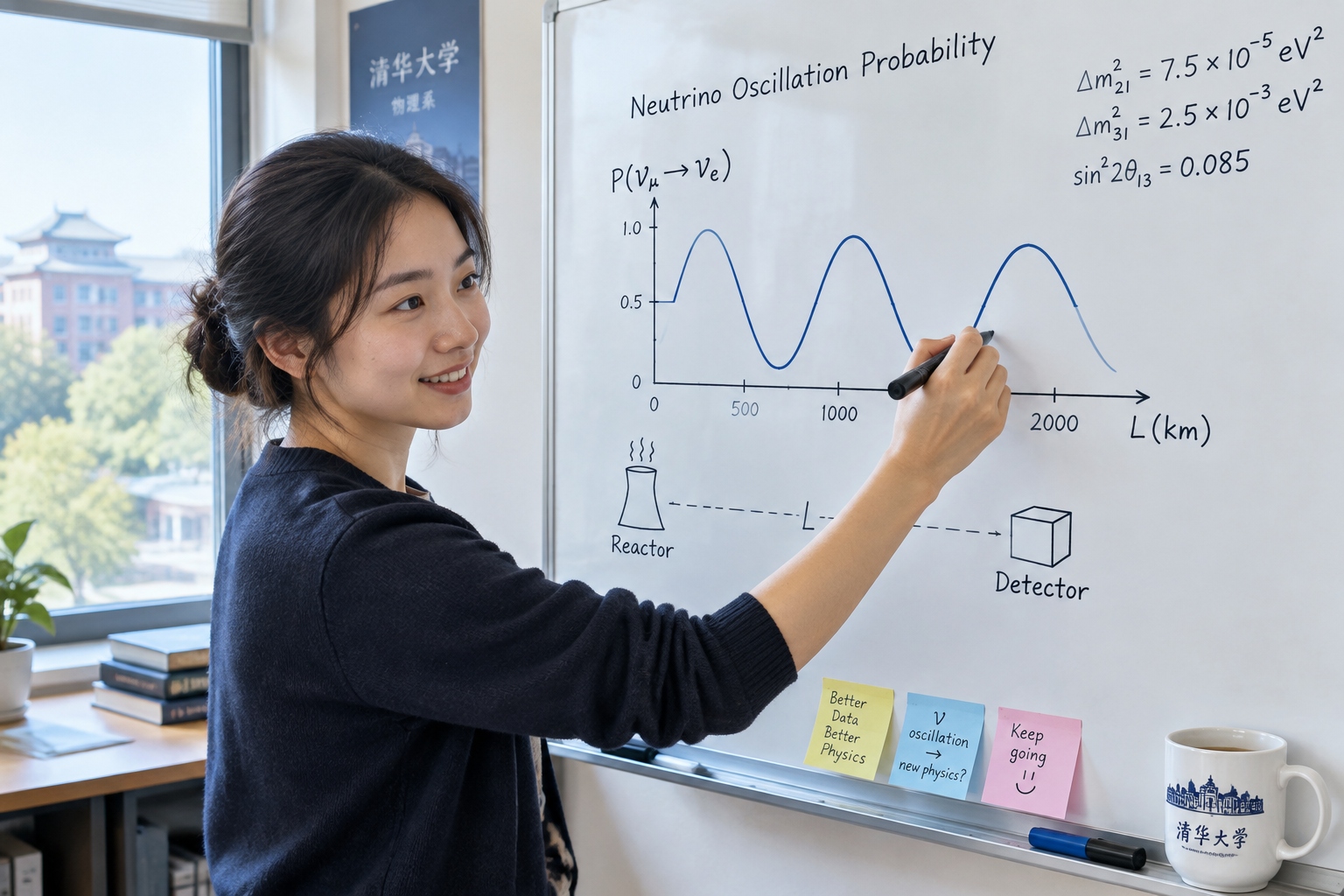
Neutrinos come in three flavours — electron, muon and tau. A reactor makes electron antineutrinos. But by the time they arrive at a detector a kilometre or forty kilometres away, some of them behave like a different flavour entirely.
The picture physicists use is this: a neutrino is not one thing but a mixture of three states with slightly different masses, travelling at slightly different speeds. The mixture drifts as it moves, a bit like three musical notes played together that gradually slide out of phase. How far out of phase they get depends on the energy of the neutrino and the distance it has travelled. That is why the effect is called oscillation, and why the pattern repeats.
Three numbers govern the pattern: two mass differences and a set of mixing angles. Before 2012, one of those angles — written θ13 — was the big unknown. It could have been zero, which would have made a whole class of future experiments pointless.
Daya Bay, and the measurement that unlocked the field
About 50 kilometres northeast of the JUNO site, near the Daya Bay nuclear plant, an earlier experiment was built to settle that question. Eight detectors sat in three underground halls, at distances of roughly 470 metres, 576 metres and 1.6 kilometres from six reactor cores. Comparing the count rates at different distances isolates the oscillation.
In March 2012, the Daya Bay collaboration reported a value of about 0.09 for sin²2θ13 — an angle of roughly 9 degrees — at a confidence level of 5.2 sigma. It was one of the fastest confirmations in the field’s history, and it told everyone that the next generation of experiments was worth building. Daya Bay kept running and publishing until it shut down at the end of 2020.
JUNO is the follow-up. Sitting about 43 kilometres from the Taishan and Yangjiang reactor complexes, it is placed where the oscillation pattern is especially sensitive to something else: which of the three neutrino masses is heaviest. The detector is designed to resolve about 3 percent energy resolution at 1 MeV, which is what it takes to see that pattern clearly. Once the sphere is full and the electronics are settled, the collaboration expects to determine the mass ordering at around three sigma within about six years.
The spectrum, and a bump nobody ordered
The other half of the story is not about counting neutrinos but about their energies.
Reactors emit a continuous spectrum of antineutrino energies, predicted from nuclear data — how much of each fission fragment is produced, and how it decays. Comparing the predicted spectrum with the measured one is a sharp test of both the nuclear physics and the neutrino physics.
When Daya Bay, Double Chooz and RENO did that comparison in the early 2010s, two things showed up. First, the total number of detected antineutrinos was a few percent lower than older models predicted — a gap that shrank considerably once the uranium-235 flux models were revised. Second, and more stubbornly, there was an excess of events around 5 MeV of visible energy that no calculation accounted for. Three independent experiments saw it. It has not gone away.
Explanations have been proposed and mostly ruled out: an unknown fission product, an unmodelled detector effect, a fourth kind of sterile neutrino that would oscillate away over very short distances. None is confirmed. It is a small anomaly, and small anomalies are how physics usually moves.
How this connects to antimatter
The link is not direct, and it is worth being careful here. Neutrino oscillation, as observed so far, does not create a matter-antimatter imbalance by itself. But it offers one of the few places where the laws might contain an extra difference between matter and antimatter that the Standard Model does not have.
One leading idea is called leptogenesis. In the very early universe, heavy neutrinos decay. If their decays slightly favour producing matter over antimatter — that is, if the neutrino mixing matrix contains a CP-violating phase — that imbalance can be transferred to ordinary particles. The parameter that would carry it is called δCP, and it appears in the same mixing matrix that oscillation experiments measure.
Long-baseline experiments, firing neutrino beams through the Earth and comparing neutrino with antineutrino rates, have been hunting δCP for years. T2K in Japan and NOvA in the United States have both seen hints; the hints have shifted as data accumulated and are not yet conclusive.
JUNO cannot measure δCP directly. What it can do is pin down the other oscillation parameters with much better precision, and determine the mass ordering. Both matter: the interpretation of every long-baseline result depends on them. It also matters for a separate question that would change the picture entirely — whether neutrinos are their own antiparticles, which experiments searching for neutrinoless double beta decay are trying to answer.
What has not happened
No one has watched antimatter disappear. No experiment has yet found the missing source of CP violation. And no result from a reactor experiment, including JUNO’s, would by itself prove leptogenesis correct.
What these experiments actually do is narrower and more useful. They measure parameters, shrink error bars, rule out whole classes of models, and force the next generation of questions to be sharper. The honest way to describe the field right now is this: the door is not open, but the keyhole is getting clearer.
Why the tunnel is still worth digging
There is a practical side. Building a 20,000-tonne detector meant developing radiopure materials, large acrylic vessels, and 20-inch photomultiplier tubes at a scale nobody had managed before — technologies that leak into medical imaging, water treatment monitoring and industrial sensing.
There is also a plain-language side. China now operates more than 50 nuclear reactors and is building dozens more, which makes it an unusually good place to point a neutrino detector at power plants. The same reactors that light up cities and run factories are also the source of the particles now being counted underground.
And there is the quiet side. Somewhere in that hall in Kaiping, a graduate student will be on the night shift, watching a screen full of waveforms, waiting for two flashes of light a few microseconds apart. It is not a grand scene. It is just how a very old question gets asked again, with better instruments.
Start the discussion at forum.chinacomes.com