
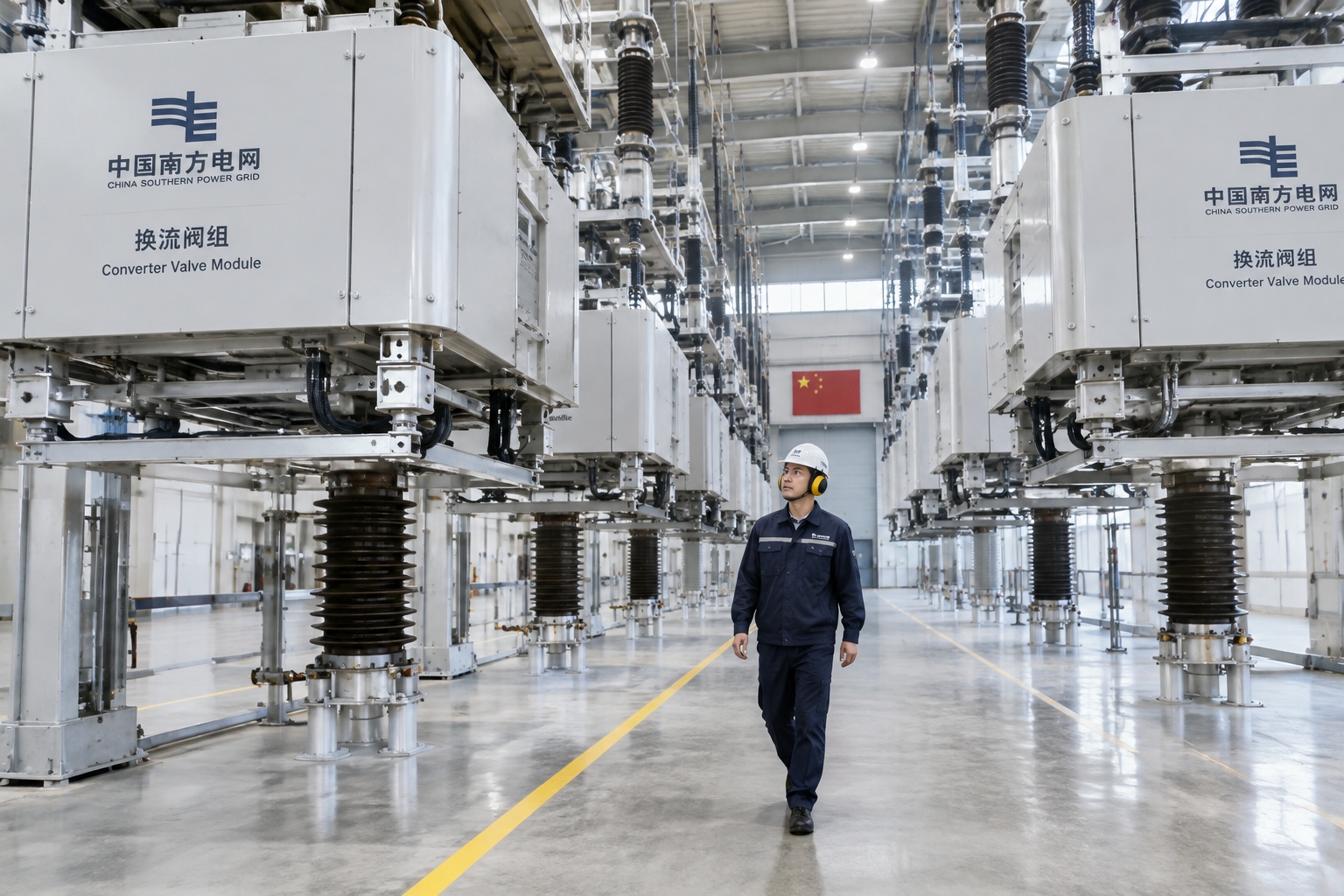

Inside the Valve Hall
At a converter station in southern China, the valve hall is a long, windowless room. Rows of fridge-sized modules hang from the ceiling like a library shelf turned sideways. Each module contains dozens of power semiconductors, and together they perform one of the most consequential tasks in the power system: turning alternating current into direct current, and back again.
When the station is running, the air hums and the floor carries a faint vibration. Engineers in ear protection walk between the rows during maintenance. To a visitor, there is not much to see. That is exactly what makes the device at the center of this story easy to underestimate.

The Relay Race That Keeps Failing
The simplest way to understand commutation failure is to think about a relay race. A baton passes from one runner to the next. If the second runner stumbles, the baton drops. In a high-voltage direct-current (HVDC) system, the baton is electric current, and the runners are the valves inside a converter station. When the grid voltage dips at the exact moment a valve is supposed to switch off, the current fails to transfer. That is commutation failure.
The term sounds like an obscure engineering detail. It isn’t. On a ±800 kV line carrying 8 gigawatts — roughly the capacity of eight large nuclear reactors — a commutation failure can drop hundreds of megawatts in a few milliseconds. The receiving grid feels it as a sudden hole in supply. Protection systems kick in, other lines absorb the shock, and if the grid is weak enough, one failure can ripple into others. For years, engineers have described commutation failure as one of the most stubborn limits on how much clean power a single DC corridor can carry.
China has more reason than most to care. The country operates the world’s largest network of UHVDC lines, most of them carrying hydro, wind, and solar power from the sparsely populated west to cities on the east coast. Those lines pass through regions where the grid can be thin, and they terminate in load centers that depend on them for a significant share of their electricity. A failure on one line is not just a local inconvenience. It is a national grid event.
A Valve That Stops Waiting for the Grid
In a conventional line-commutated converter (LCC), the valve is passive. It waits for the AC voltage to reverse direction on its own, then switches off. The grid is the metronome. If the metronome stutters, the valve misses its cue.
The device at the center of this story — a ±800 kV/8 GW controllable commutation valve — changes that relationship. It uses an active control circuit to force the current to transfer at the right moment, even when the AC voltage is not cooperating. Instead of waiting for the grid to push the current to zero, the valve creates the conditions for commutation itself. “Controllable” means the valve takes over the timing.
Developers describe it as the first device of its kind built at this scale. The unit sits in the same place as a conventional converter valve: at the heart of the converter station. It is not a new kind of power line or a new kind of transformer. It is a replacement for the most critical component inside the valve hall.
What “Controllable” Changes
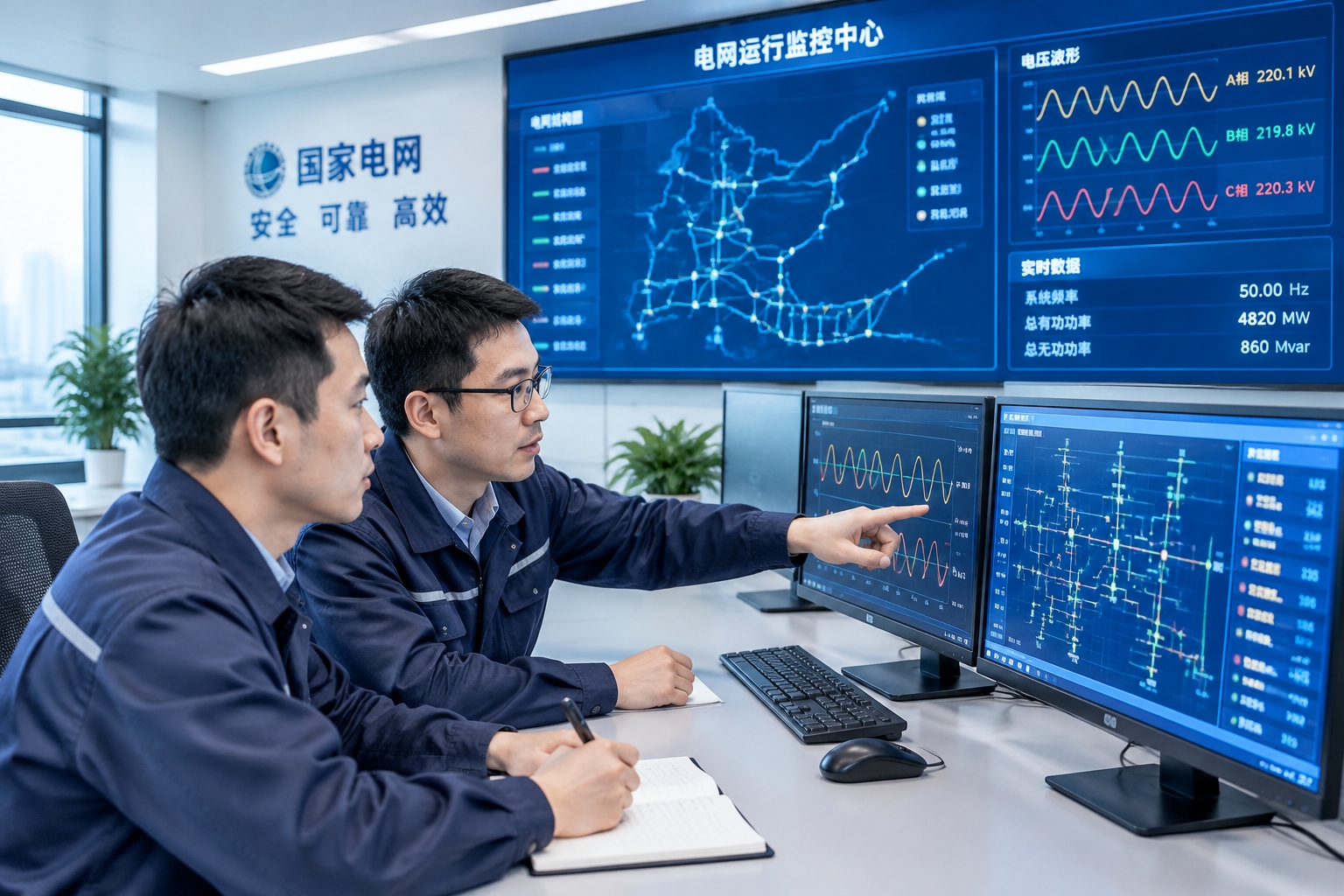
The practical effect is easier to see at the system level than at the component level.
First, the DC line becomes more tolerant of weak AC grids. China’s long-distance lines often terminate in load centers where the local grid is strong. In other parts of the world — and in some parts of China — the receiving grid is thinner. A controllable valve reduces the risk that a minor voltage dip becomes a major power loss.
Second, the line recovers faster. Traditional commutation failure recovery means ramping power back up over seconds or minutes. Active control shortens that window. For a grid relying on a DC line for a large share of its electricity, that difference matters.
Third, it makes it easier to integrate variable renewables. Wind and solar farms send power through DC lines, but they also make the sending-end grid more volatile. A valve that can handle voltage swings without failing removes one constraint on how much renewable capacity can be attached to a single corridor.
A grid operator’s job is to keep supply and demand balanced in real time. Every time a DC line trips, the operator has to replace that power within seconds — usually by firing up gas turbines or pulling from other regions. A valve that reduces the frequency of those events has value that is easy to measure in fuel saved and emissions avoided. Grid operators in China already manage some of the most complex DC-heavy grids in the world. Adding a controllable valve to the toolkit doesn’t replace those systems. It gives them another option for keeping a line in service when the AC side is struggling.
The Gap Between a Prototype and a Power Grid
The first unit is a major engineering milestone. It is not the same as a proven, mass-produced product. In China’s equipment certification system, a “first-of-its-kind” designation signals that the device has passed factory tests and is ready for demonstration. It does not mean it has been running in a commercial line for years.
The next step is a demonstration project — a real converter station, a real DC line, and a few years of operating data. Engineers will watch how the valve behaves through seasonal voltage swings, lightning strikes, equipment aging, and the thousand small anomalies that no factory test can reproduce. That data will determine whether the design is ready for fleet-wide deployment.
This timeline matters for anyone evaluating the technology from outside China. “World’s first” is accurate in the sense that no other country has built a valve with these specifications. It does not tell you whether the device will be standard equipment in five years or remain a specialized solution for difficult grid situations.
Why It Travels

Many countries are trying to move large amounts of renewable power from where it is generated to where it is consumed. The options are long AC lines, long DC lines, or local generation plus storage. DC lines win on distance and efficiency, but they have always come with the commutation failure problem hanging over them.
India, Brazil, and parts of Africa and Central Asia are building or planning UHVDC corridors. In each case, the receiving grid may be weaker than China’s coastal load centers. A valve that reduces dependence on grid strength has obvious appeal.
China’s own experience is the largest test case. The country has built more UHVDC lines than the rest of the world combined — over 30 by 2024, with more under construction. If controllable commutation proves itself under these conditions, it becomes a reference design for other markets. If it doesn’t, the demonstration data will show where the limits are.
The Invisible Machinery
For most people, a converter valve is invisible. It sits inside a building the size of an aircraft hangar, behind fences and warning signs. The electricity it handles reaches homes as a refrigerator hum and a phone charger. The difference between a stable grid and an unstable one is often measured in milliseconds that no one notices.
That is what makes this device interesting beyond its specifications. The energy transition is not only about solar panels and wind turbines. It is also about the machinery that decides whether that power can travel hundreds of kilometers and arrive where it is needed. The headline says “world’s first.” The more useful question is whether it makes the grid a little less fragile.
Start the discussion at forum.chinacomes.com